Data science has touched every aspect of an extensive range of industries globally, and healthcare is no exception. Be it vast volumes of clinical records or the need for real-time insights into treatment status, healthcare data science is crucial for every branch of daily operation. Advanced analytics integrated with AI helps lighten physicians’ workloads by transforming traditional ways of managing medical practices, such as patient care history and current plans, improving treatment decisions, and delivering enhanced clinical services.
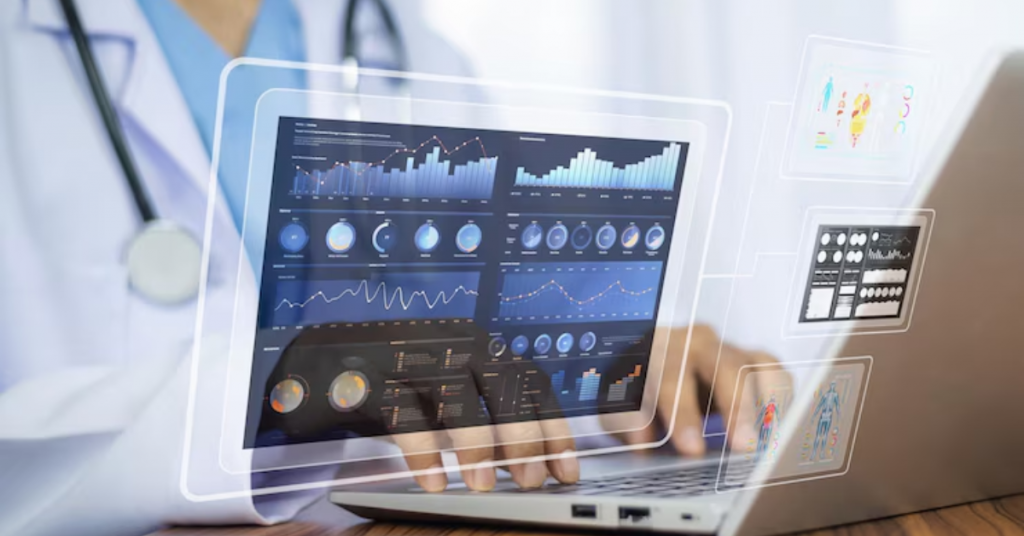
Modern medications are preferred in a more personalized manner, and each patient needs their unique care. Real-time data-driven decisions help in optimizing medical practices and enable the physicians to provide personal nursing to individuals in need of medical care. The expanding application of data science in healthcare is evident from the reports stating that its market size in 2024 was USD 85.91 billion and is estimated to reach USD 182.95 billion by 2032. The scope and benefits of data science in healthcare span from automating diagnostics processes to developing improved disease prevention strategies and reducing medical flaws.
Modern AI algorithms and models are used by clinical professionals to uncover insights from distinct domains, including genomic sequences, EHRs, patient feedback, and sensor data. This article is dedicated to exploring diverse scopes, roles, applications, benefits, and future trends of data science in healthcare.
What Is Data Science in Healthcare?

Healthcare is one of the complex and sensitive content-bearing industries, and the inclusion of scientific methods is crucial to study its diverse aspects. Data science comprises statistical techniques, algorithms, and informatics types of analysis to collect vast amounts of information and derive valuable insights from it. In the context of healthcare, it adds the knowledge of medical science as well to align computational intelligence with clinical operations.
Additionally, advanced analytics utilize machine learning to extract structured and unstructured data generated by hospitals. The major role of a data scientist in healthcare is to employ data analysis techniques and algorithms in medical software and help physicians with their work responsibilities.
Key components of data science in healthcare encompass data collection, analysis, modeling, and predictive analytics.
- Data collection involves assembling structured and unstructured content from diverse clinical sources, including genomics, electronic health records (EHRs), insurance claims, wearable devices, medical instruments, and other relevant sources.
- Statistical tools and ML algorithms are used for data analysis and modeling to explore patterns in past outcomes and uncover correlations between them.
- Prediction analytics provides decision support with forecasted patient outcomes and disease risks. It enhances treatment effectiveness by reducing the severity of health conditions through early diagnosis.
Data-driven decisions empower both healthcare institutions as well as individual clinical professionals, delivering better patient outcomes. Modern technologies include tools like ML and AI, which can interpret millions of patient records in a few minutes, and amplify applications of data science in healthcare. Moreover, EHRs, centralized storage of patient, labs, and treatment records, also offer a base for data inputs used in advanced analytics.
Other techniques like cloud computing and NLP streamline the healthcare digital landscape and provide secure and scalable data storage with analysis. These inventions all together facilitate personalized medications, trace epidemics, allocate hospital resources optimally, and accelerate administrative processes.
The Role of a Data Scientist in Healthcare
The role of a data scientist in healthcare is both collaborative and technical. They conduct ETL processes over medical data gathered from multiple sources, including wearable devices and EHRs. This technologist develops predictive models and algorithms, visualizes extracted data, and applies statistical and computational tools to convert raw content into meaningful information.
Their core responsibility is to transform clinical operations like early detection of diseases, drug discovery, forecasting potential health epidemics, and fulfilling privacy regulations like HIPAA. In this direction, they prepare dashboards and reports to provide a clear view of medical insights to the relevant practitioners and stakeholders and build ML pipelines for seamless information flow between healthcare departments.
Data scientists work with vast piles of medical datasets and perform analytics for healthcare institutions’ internal applications and systems. They need to collaborate with doctors, administrators, and researchers to accumulate the required inputs for developing various models and simulations. This alliance ensures that the original algorithms are as per hospitals’ requirements, and that data reading aligns with clinical best practices.
Analytical experts play a central role in harnessing the full benefits of data science in healthcare by deploying patients’ ideal data and generating actionable insights through their coherent skills.
Data scientists commonly use tools like Python, R, SQL, TensorFlow, and Power BI to navigate their analytical practices through healthcare’s complex data infrastructure. Among these technologies, Python, R, and SQL are used for data analytics and modeling; ML frameworks like TensorFlow are employed for building predictive models. Lastly, Power BI, a data visualization tool, provides an interactive visual representation of identified patterns. In addition to the above responsibilities, data scientists in the healthcare sector are also liable for continuous research and innovation. They tend to be in charge of evolving new data-driven approaches for medical institutions.
Challenges of Data Scientists in the Medical Field
Despite the perks of strategic decisions, applications of data science in healthcare bring numerous challenges for professionals in terms of quality and accuracy. Medical data collected from diverse sources is complex, and a data scientist must be able to stay updated with the latest tools and technologies.
> Data privacy and compliance (HIPAA, GDPR)
Medical information and patient records are generally sensitive and require critical governance. Data scientists are bound to navigate through various privacy regulations in the healthcare industry, such as HIPPA (USA) and GDPR (Europe). They are expected to design information systems in such a way that aligns with the mentioned laws and involve robust security measures.
> Integrating with legacy systems
Data professionals may face difficulties while integrating scientific solutions into the existing infrastructure of a healthcare institution. Many hospitals still follow outdated IT architecture, and modern tools might not fit with them, making it challenging for the scientists. Flexibility and scalability are not incorporated in these traditional systems, and thus often lack supporting AI solutions and advanced analytics.
> Bias in medical algorithms
When algorithms are trained over historical data, they generally capture some biases, and later ML models reflect them in terms of uneven predictions and unfair treatment suggestions. Data scientists must ensure that the training is carried out on diverse groups of datasets to build fair and representative models applicable to all segments of the population.
> Lack of labeled healthcare data
Labeled data is not always available for developing learning models, as most of the patient-related records are handwritten by the physicians and can not be converted digitally accurately. Moreover, inconsistent coding practices, missing entries, costly annotated medical datasets, and data entry errors lead to a lack of labeled data. It results in flawed medical analysis affecting patient outcomes and clinical decision-making.
> Ethical concerns in AI decision-making
The wellness industry consists of the most vulnerable type of information, further complicating the role of a data scientist in healthcare. Data transparency and accountability requirements are growing immensely with the rise of cloud storage and digitalization in the clinical sector. Data science in healthcare utilizes inputs derived from medical histories, diagnostic results, treatment plans, and PII (personally identifiable information). The involvement of such content creates a threat to patient confidentiality, increasing ethical concerns in AI-driven decisions.
Benefits of Data Science in Healthcare
Artificial intelligence serving predictive analytics conveys multiple benefits of data science in healthcare that directly aid the patients, care providers, and medical institutions. Its advantages range from drug discovery to optimized resource allocation and population health management.
1. Reduces treatment failure rates through predictive analytics
The most prominent benefit of data science in healthcare is eliminating misdiagnosis and preventing treatment failure. Predictive analytics helps doctors prepare patients for medical condition-based therapies. Physicians can study their patients’ allergies and resistance to particular medications, recommending them accordingly. Forecasting any potential epidemic in advance reduces the workload of clinical staff by warning people about the symptoms.
2. Facilitates faster drug development with machine learning
Data science boosts drug research and development processes by reducing time and money requirements up to a significant level. It analyzes massive amounts of data to identify the best methods for clinical trials and test the efficacy of new drugs on potential candidates. Another use case of data science in healthcare offers treatment optimization along with minimizing R&D costs.
3. Eliminates manual entry errors via automation
AI-driven data science in healthcare lessens the human intervention in medical information, eliminating the chances of manual entry errors. It enhances data quality and provides accurate insights into the distinct parts of the hospital and clinical areas. Automation increases operational efficiency by reducing human errors in diagnostics, documentation, and billing.
4. Minimizes healthcare costs with operational insights
Datavant CEO Pete McCabe states that with intelligent use of data science in healthcare, 50% to 70% of costs can be saved that go to waste can be saved. For instance, predictive analytics helps in forecasting demand for various medical supplies across different departments, enabling administrators to purchase stock when it is available at low prices.
5. Predicts epidemics using real-time public health data
Big data analytics based on real-time public health data helps in tracking the population’s health conditions and predicting potential outbreaks. Social media inputs also facilitate the building of predictive models that can identify the trends and patterns in health outcomes of the entire community, alerting medical organizations and governments in advance about possible epidemics.
6. Enables personalized medicine based on genetic data
Physicians can analyze genetic and phenotypic data to develop targeted therapies and prepare personalized medication plans for individual patients. It enables the caregiver to tweak the treatment plan as required and enhance their health outcomes. The application of data science in healthcare allows the clinical staff to communicate with each patient and record their response to track their improvements.
Applications and Use Cases of Data Science in the Healthcare Industry
There is a wide range of areas for practical use cases of data science in the healthcare industry, empowering clinical stakeholders to navigate through several complex information processes.
1. Drug Discovery & Development
Data science is used to enhance the drug development process by analyzing large datasets and identifying potential candidates for therapeutic interventions. It also supports researchers in finding targeted drugs for specific diseases, offering more effective treatments and fewer harmful side effects. For instance, Pfizer and Moderna used AI tools to develop vaccines for COVID-19.
2. Virtual Health Assistants
AI-powered chatbots are one of the prominent examples of the application of data science in healthcare. They act as a virtual assistant to communicate with patients, answer their questions, and provide them with basic psychological support. These chatbots also guide the patients about their treatment procedures and educate them about their health conditions.
3. Wearables & Remote Monitoring
Wearables like smartwatches use biosensors to monitor patients’ vital signs, such as their heart rate, glucose level, and activity, and help in diagnosing early signs of any potential health issues. Data science analyses these inputs to remotely monitor patients’ health conditions and formulate their treatment schedules.
4. Disease Surveillance & Tracking
Data science utilizes big data analysis to track social media trends and travel patterns among populations, identifying prospective for the spread of infectious diseases and their impacts. Timely prediction of potential infections enables proactive interventions and helps medical professionals manage public health emergencies.
5. Diagnostics Support
Early diagnosis is a complex task that requires advanced technologies, along with expert knowledge and extensive experience. However, the application of data science simplifies the detection of severe health conditions like cancer or cardiovascular disease accurately and reduces the issues of misdiagnosis.
6. Patient Risk Stratification
Patient risk arises from numerous socioeconomic and physiological factors, and data science helps specialists study those components and their impact on individual lives. This analysis equips the medical industry with accurate measurements of the public’s overall health conditions, predicts the chances of chronic diseases, and offers personalised guidelines.
7. Medical Imaging Analysis (MRI, CT using deep learning)
MRI, CT, and X-ray are the main imaging techniques used every day in hospitals. These images provide a view of a patient’s internal body and help in finding the source of their pain or illness. Advanced tools in data science read the smallest abnormalities in these images and offer an accurate diagnosis.
8. Genomics & Bioinformatics
Genomics studies the hierarchy of genomes carrying humans’ complete genetic information. DNA sequencing is the foundation of future advancements in the medical field, and its analysis is a costly procedure if done traditionally. But integration of data science in healthcare has sped up genomics development and provide valuable insights into the relation between genes and a person’s health status.
9. Predictive Disease Modeling
Major use cases of data science in healthcare are evident from predictive analytics, which analyze the past health records of a patient, study their current vital signs, and forecast the likelihood of diseases in that person. These findings enable the physicians to draw a clear picture of one’s health condition and offer a cure for identified diseases in their development stages.
10. Vaccine Development Optimization
AI empowered tools help the medical professionals to identify antigens and test their immune response. Data science analyzes the historical data, determine certain symptoms, and identify their effect on health. All these insights helps in vaccine discovery and its manufacturing as well. Covid-19 vaccine creation is the prime example of using big data for vaccination optimization.
11. Digital Health Security & Fraud Detection
Data science contains inbuilt safety protocols that save the healthcare data from potential threats, playing significant role in technological advancements. Protection layers in the analytics help in ensuring confidentiality across medical sectors. Security tools within big data examinations detect quirk claim submissions, irregular login activities, and identify involved fraud in the systems.
12. Natural Language Processing for EHRs
Many doctors and physicians still use old-school methods of maintaining patient records due to a lack of resources or ignorance. They handwrite health particulars instead of using EHRs, leading to lost files, requiring them to enter their physical records into system. NLP software helps the healthcare providers to transfer their patients’ unstructured handwritten files into a computarized platform.
13. Biometric Authentication Systems
Biometrics saves the personal information of patients from being exposed to unwanted third parties. These software scans face, fingerprints, or other body parts and saves this information as a security protocol for access authorization. As the confidentiality level is high, biostatistics technology accelerates check-in points by matching users’ physical prints with available data.
Future Trends in Data Science and Healthcare
Data science in healthcare has a promising future with its diverse technologies and their uses in the medical sector. New and innovative tools like wearables, genomics, and images improve patient care services and make the system more productive and cost-effective.
> Integration of AI + IoT in medical ecosystems
Artificial intelligence is empowering healthcare systems in the form of improved diagnosis and better treatment plans. IoT combined with AI in devices like smart watches or medical images, enabling physicians to telemonitor internal body conditions of patients and early disease detection. Other futuristic applications of intelligent analytics include smart beds and connected devices, which automate hospital infrastructure and are becoming new standards.
> Use of generative AI in diagnostics and care planning
Generative AI such as GPT is increasingly used to imitate treatment outlines, produce diagnostic reports, and design clinical trials. These innovative applications are becoming popular among healthcare providers due to their assistance in proactive care planning and preparing personalised medications. It also informs the doctors about the impacts of certain medicines on patient condition and improves health outcomes.
> Real-time health monitoring systems
With the boom of 5G networks and edge computing, data science empowers the medical professional in real-time tracking of public health status from a distance and identifying the likelihood of chronic disease development. It reduces the number of readmissions, improving population health management.
> Blockchain for secure healthcare data sharing
Blockchain technology is emerging as an efficient driver of information flow between various medical departments. It keeps the data secure and safe while sharing it with the stakeholders or different clinical units, including pharmacies, hospitals, and insurance companies.
Data science services are amplifying the medical insight transfer and usage in the real world for delivering better patient outcomes as well as transforming the healthcare industry.
Conclusion
Data science in healthcare is a current reality reshaping all components of the medical landscape. From public health to hospital management, big data analytics accelerates diagnostic and treatment procedures, making clinical services more resilient and effective. AI-driven tools empower physicians and other medical professionals in detecting disease before it becomes severe, and free them from administrative tasks of data handling, providing more time for patient care.
Moreover, increasing innovations in data modeling are widening their scope in medical institutions as well. However, ethical consideration is unavoidable in new emerging data analytical platforms and thus robust regulations need to be regularly updated. For maintaining ethical data science, it must be able to work in collaboration with Pharmaceutical professionals.
However, partnering with an expert like A3Logics can help the healthcare provider business to harness full data science services.