
Smarter and more efficient solutions are now being pursued by manufacturers to stay competitive, and Business Intelligence for Manufacturing is the leader in this matter. Business Intelligence (BI) is making it possible for manufacturers to gather, analyze, and capitalize on data from production floors to the supply chains.
Wasting time depending on guesswork or relying on obsolete reports is gone. Knowledge-driven decision-making is the key ingredient to reach operational excellence now. In addition, with the availability of real-time dashboards, performance tracking, and proactive insights, BI for Manufacturing is the one that gives the power to the business to take necessary actions for cost-effectiveness, high uptime, and the best scenario of every operation.
With the surge in demand for efficient manufacturing, BI for Manufacturing has transitioned from being less critical to being a necessity for those companies who want to improve online visibility on Google, save costs, and make the right decision based on data.
Business Intelligence for Manufacturing is inarguably the most effective method of converting trash data into actionable information that revolutionizes the performance of the entire company, be it in customer service or sales.
Market Size & Growth Projections (2025–2030)
Market shares, i.e. the global business from $7.09 billion in 2025 to $47.88 billion in 2030 with an annual growth of 46.5%. (Source – Grand View Research)
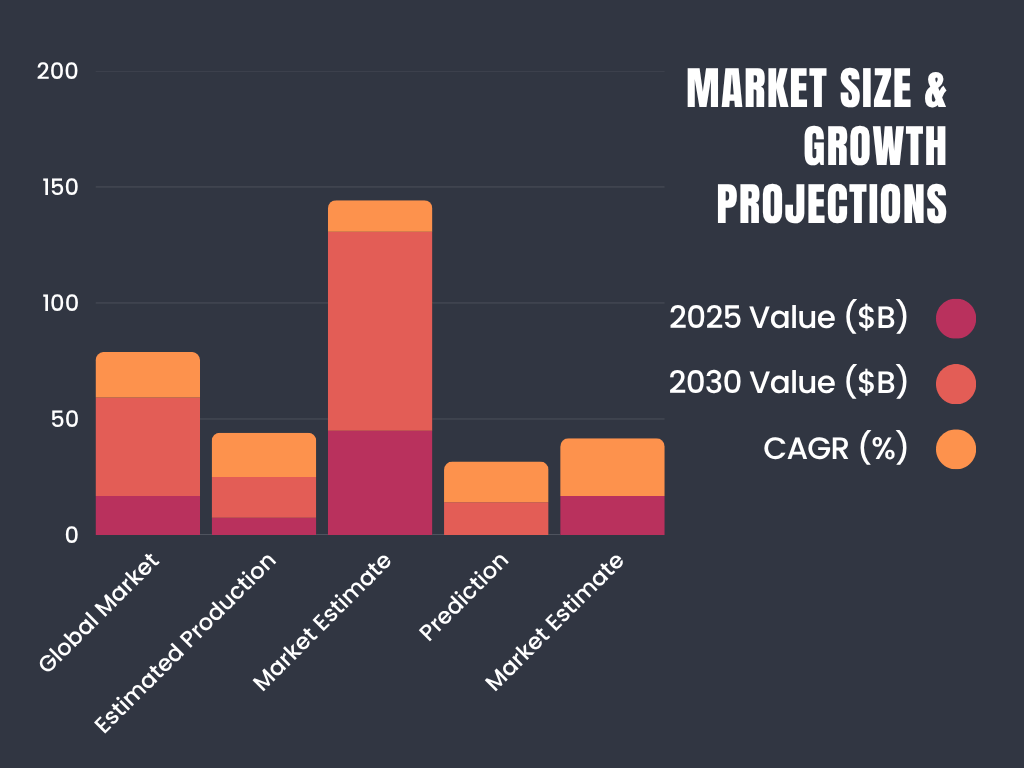
- The global market is very likely to widen from $16.79 billion in 2025 to $42.51 billion in 2030, and this is at a growth rate of 19.58%.
- The estimated production dollars are going up from 7.40 billion in 2025 to 17.63 billion in 2030, making the average annual growth 19.08%.
- It is anticipated to increase from $44.94 billion in 2025 to $85.76 billion in 2030 at a CAGR of 13.6%.
- A figure of $14.1 billion is predicted to be reached by 2030, rising with a CAGR of 17.6% from 2020 to 2030.
- According to the Business Research Company, the figure is expected to be $16.79 billion in 2025, and then it will go further up to $40.9 billion in 2029 at a rate of 24.90% per annum.
These figures show BI’s growing impact on the manufacturing sector. AI, analytics, and real-time data are driving this shift. Companies using BI boost efficiency, enable predictive maintenance, and strengthen their competitiveness.
What is Business Intelligence for Manufacturing?
Business intelligence in manufacturing refers to using data and analytics to improve production efficiency, quality, and decision-making. It combines key components like data collection, integration, analysis, and visualization.
The process starts by collecting data from machines and systems. This data is then integrated across departments. Analytics uncover trends and patterns, and the results are visualized through interactive dashboards and reports.
The flowing of data through these mechanisms one into another and its transformation into meaningful and presentable information give manufacturers all-around insights into their actions. It’s exactly what manufacturing intelligence does, isn’t it? Manufacturing BI allows in-process monitoring, condition maintenance, inventory control, and performance measurement to flow in a simultaneous and empowered way.
BI for manufacturing is a vital resource for streamlining workflows and maximizing productivity. It helps reduce costs while giving teams the tools to make timely, informed decisions.
Key Benefits of Implementing BI for Manufacturing
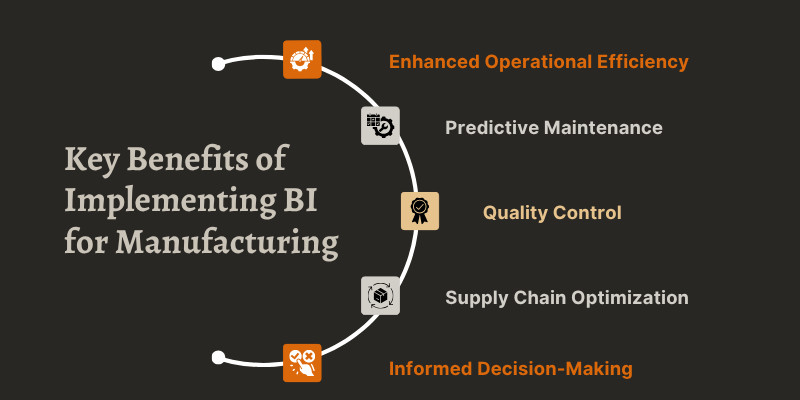
Applying business intelligence in manufacturing offers several key benefits. It brings versatility, saves energy, and supports long-term market sustainability. Here are the main advantages:
1. Enhanced Operational Efficiency
Business intelligence tools for Manufacturing can spot bottlenecks, observe the machine performance, and trace KPIs immediately. This lets the teams simplify the processes, cut downtime, and raise the output on the line of manufacture.
2. Predictive Maintenance
The use of Business Intelligence for Manufacturing sector for prediction On the basis of machine data and usage patterns, BI enables preventive maintenance. It is useful for avoiding unforeseen equipment failures, decreasing maintenance costs, and prolonging the life of essential assets.
3. Improved Quality Control
The development of Business Intelligence has made it possible for manufacturers to follow quality metrics and find defects at the very early stage of the process. These insights allow enterprises to dispose of the problems right away, thus avoiding waste and continuously introducing product standards.
4. Supply Chain Optimization
By having access to information in real-time, companies can accurately forecast demand, keep their inventory levels in check, and make better decisions in the field of logistics. However, manufacturing BI does more than just monitor supply chains.
5. Data-Driven and Informed Decision-Making
Undoubtedly, the most crucial advantage is that Business Intelligence for Manufacturing gives accurate and timely data to the decision-makers.
That is, in turn, contributing to the data they use to source for a vendor or make a projection of demand of the future as well as analyze the insights received, making wiser, quicker, and more confident decisions possible.
Real-World Use Case of Business Intelligence for Manufacturing

Business intelligence for the manufacturing industry is more than a buzzword—it’s a powerful, practical solution used across many areas. Below are real use cases that show how manufacturing BI works in actual scenarios.
1. Production Analytics
For instance, in production analytics, the real-time data from machines and processes will give the actual production rates, cycle times, and equipment efficiency. By analyzing this data, the manufacturers are in a position to recognize the reasons for the delays or bottlenecks in the production process quickly and thus decide on the most suitable corrective action to take.
2. Inventory Control
BI tools keep a close watch on warehouses’ and manufacturing units’ stock levels in real-time. Furthermore, the tools inspect the rate of the flow of raw materials and final products in the supply chain and prevent any excess inventory or stockouts, which can be very expensive. For example, through BI, the manufacturer can set up auto-switch points so that the parts are re-ordered every time the supplies are just about to be finished without turning the machines off.
3. Supply Chain Management and Analytics
BI applies data from suppliers, logistics, and distributors to construct a comprehensive supply chain view. This will enable the companies to calculate the supplier delivery time, determine the transportation cost, and determine the risks of delays and shortages.
With this insight, manufacturers can choose better suppliers. Additionally, they can prepare emergency stock and reroute shipments to cut costs. As a result, they improve reliability and stay ahead of potential disruptions.
4. Financial Management and Forecasting
Manufacturing BI is a tool that automatically refreshes the dashboards with financial data like production costs, sales revenue, and operating expenses. Managers observe these to monitor the company’s growth and identify potential savings. BI is also utilized to make predictions about future earnings.
5. Product Development
BI assists the product teams in gathering customer feedback and analyzing sales data to understand which features or models are the most popular. At the same time, it tracks development costs and timelines, which allows the teams to streamline resources. For instance, if the data show that selling a particular product variant is most effective, development can be centred on the improvement of that line or on the creation of similar products.
6. Maintenance Intelligence
BI evaluates machine sensor data to predict when parts might fail. This approach shifts maintenance from fixed schedules to real-time needs. It enables proactive repairs just before a breakdown occurs.
This is known as predictive maintenance. It helps organizations reduce unplanned downtime and cut repair costs. Moreover, they can perform maintenance during scheduled downtime, without slowing production.
7. Demand Forecasting
BI models study historical sales, changes in seasons, and market trends to estimate the future demand of clients. Precise forecasts allow producers to match their stock levels with demand without any superfluous inventory. To illustrate, a company can make more of some items even before the peak season and therefore guarantee that they do not lose any income.
8. Price Optimization
Business Intelligence allows manufacturers to analyze competitor prices, market demand, and buyer behaviour in order to get an insight into the best prices. The main objective of this approach is to increase the profits of the companies without shedding their clientele.
To illustrate, in the presence of a busy market, BI might propose that prices be lowered to compete, whereas, for products which are in high demand but have limited availability, prices increase.
9. Product Quality Control
BI gives an account of different quality aspects through the production line, including, but not limited to, the degree of defectiveness, variance in material, and conformance to the requirements.
Early quality issue tracking helps companies make quick, informed decisions. This prevents waste and reduces customer complaints. It ensures only high-quality products leave the factory, protecting the company’s reputation.
10. Customer Service and Warranty Management
Manufacturers use BI to identify the reasons behind customer complaints, service issues, and warranty claims. This analysis reveals recurring problems and helps improve after-sales support. With better diagnostics, companies can boost customer satisfaction and build stronger brand loyalty.
11. Vendor Management
BI gets supplier information like delivery history, costs, and quality of supplies, thus evaluating suppliers. A company can also employ these findings when choosing the best suppliers and negotiating with them.
For example, BI can detect suppliers with frequent delays or poor-quality deliveries. The company can then replace them or resolve the issue.
Business intelligence in production drives change across all business sectors. It breaks the traditional front- and back-end divide.

Best Practices for BI Implementation in Manufacturing
For the introduction of the process of Business Intelligence for Manufacturing to be a success and add value over the long term, it is of primary importance to follow the best practices. Below are the necessary steps:
1. Seamless Data Integration Across Systems
To gain a clear view, BI tools must access data from various systems—ERP, CRM, supply chain platforms, and production machines. As a result, efficient data integration ensures all departments work with accurate, up-to-date information. Moreover, it helps avoid issues like discrepancies, data silos, and miscommunication.
2. Comprehensive User Training and Adoption Programs
Even the best manufacturing BI system is useless if no one knows how to use it. It’s essential to create user-friendly training and adoption programs. These programs should help everyone—from shop floor workers to executives—feel confident and open to using BI tools and dashboards.
3. Scalability and Future-Proof Planning
Invest in a BI solution that can go hand in hand with your company’s growth. If there is a need to increase your production capacity or find your way into international markets, Manufacturing BI must be adaptable and elastic to cover future needs and goals.
4. Continuous Monitoring and Optimization of BI Tools
Implementing the technology is just a small part of the work. You should use your Business Intelligence tools on a regular basis, listen to users about the performance and make improvements, and you are even ready for a modernization of your business, if that is the case. This way, your Business Intelligence Services will continue to provide value throughout and yield you the expected ROI.
Adherence to these guidelines will help the manufacturers unleash the potential of BI, which, in turn, will be able to generate better decisions, higher efficiency, and consistent growth.
Challenges in Adopting Business Intelligence for Manufacturing
While Business Intelligence for Manufacturing offers significant benefits, its adoption comes with a few common challenges that organizations must address:
1. Data Silos and Integration Issues
A great number of manufacturers use many systems that are not compatible with each other in the slightest. In this way, these silos become insurmountable barriers to seeing and understanding operations holistically. The delivery of correct insights is impossible without a flawless data integration process, which, in turn, reduces the usefulness of the BI tools.
2. High Initial Implementation Costs
Creating a Manufacturing BI solution normally needs expenses for software, hardware, training, and data migration. The return on investment is good in the long run, but the initial cost can be a big issue for smaller manufacturers up to medium capacity.
3. Resistance to Change and Organizational Alignment
Deploying business intelligence (BI) in the manufacturing sector takes away the power of decisions being made only one way, and that is possible only through changing the data with which the workers are in touch.
The resolution of these impediments necessitates appropriate design, training, and support. It has even been suggested that the participation of the most experienced providers of Business Intelligence Services can partially guarantee a more trouble-free implementation.

How A3Logics can Help in Business Intelligence for Manufacturing?
A3Logics is a leading app and software development company specializing in exploratory data analysis for manufacturing plants. It uses advanced business intelligence tools to simplify complex data, helping manufacturers easily understand and act on insights.
By these means, it is convenient for companies to have the ability to better their performance, cut losses, and be debentures in decision-making. Manufacturers should prioritize developing a custom BI application to avoid issues. A3Logics handles this efficiently by connecting the BI solution to all existing manufacturing systems. This integration enables real-time data updates and centralized reporting.
Additionally, they educate the workers and are ready to support them in the future; thus, manufacturing teams fully embrace the change and can reap the maximum benefit. Partnering with A3Logics means manufacturers get a trustworthy technology partner who understands both IT and manufacturing, delivering BI solutions that drive real, measurable improvements.
Nutshell
Well, the industrial landscape is rapidly changing by adopting many modern technologies. Business Intelligence for Manufacturing is not only a luxury but also an important strategic requirement. It is possible to extract valuable insights from raw data, and thus, BI not only helps in the optimization of operational activities, product quality improvement, supply chain realignment, and decision-making but also increases efficiency.
Business Intelligence for Manufacturing is a trend in the industry that a manufacturer should not miss or ignore. The use cases of Business Intelligence in Manufacturing are numerous, and it is very probable that the impact that they can have is highly positive. Manufacturers embracing Manufacturing BI get a clear competitive edge over their peers and thus are on the right track for wiser growth and long-term success. It’s time to get Industrial BI and express the full potential of your data-driven future now.