Data is the new asset in the current digital era of the business environment, and every industry has to go through a vast range of records available internally as well as externally. Expanding content gives birth to several challenges related to data management across various systems and teams. Tools like Microsoft Fabric are playing a crucial role in addressing these challenges by offering unified data solutions that streamline access, integration, and analysis.
Likewise, the increasing amount of information generation has given rise to the robust demand for analytical tools from past decades. Data analytics is like a compass that shows direction towards business growth by producing actionable insights for long-term success. It converts the raw knowledge into useful information to provide valuable content, which is the core of the strategic decisions.
Mostly, companies are always looking for a way to stay ahead of the competitor, for this they must uncover potential opportunities before anyone else does. Here, data analytics play a major role by exposing critical market information and fostering innovations. It offers data to use as a base for identifying patterns, better customer penetration, and future anticipation for the business, empowering them to make informed choices.
An enterprise can modify its operation accordingly to gain long-lasting profitability, competitive advantage, and sustainable growth. Market trends show that in 2023, 91.9% of organizations investing in data and analytics gained measurable value. Data analytics also serves as the groundwork of further analysis in the future, offering navigation in the ocean of immense data. However, to implement the same, we must understand what Microsoft Fabric data analytics.
Kye Takeaways:
In this article, we will explore details about “what is Microsoft Fabric”, along with all the relevant components, benefits, features, and use cases. This single blog post will equip you with a comprehensive guide to the unified ecosystem and everything you need to know as a data professional, decision maker, or analytics engineer.
Lastly, we will discuss the importance of partnering with an IT expert like A3Logics to harness the full potential of Microsoft Fabric data analytics services.
What is Microsoft Fabric?
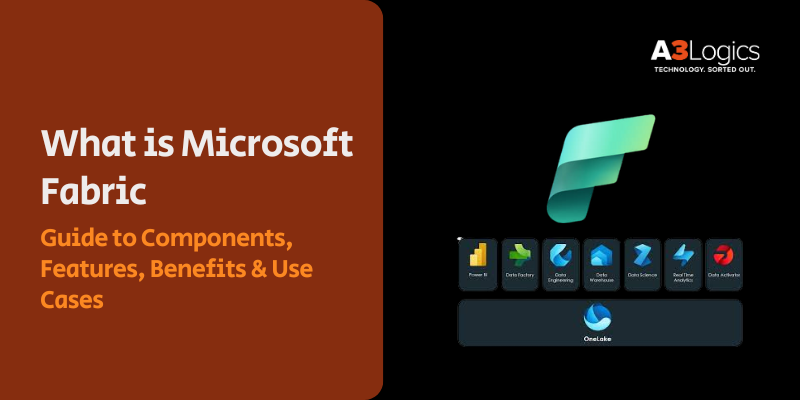
Microsoft Fabric is a unified platform and drives everything from data engineering to storage, analytics, and data relocation. It is a coordinated solution that integrates various tools and technologies to provide a simple information infrastructure. This allows different users to collaborate on the same content without barriers and derive meaningful and measurable values. It was launched on May 23, 2023, at the latest Microsoft build, and made generally available for purchase by businesses on November 15, 2023, at its Ignite conference.
The platform was a major step for Microsoft towards simplifying organizational digital asset management. Before Microsoft Fabric came into existence, HDInsights and SQL Data Warehouse were introduced. They were the first generation of Microsoft’s data platforms, later accompanied by Azure Synapse Analytics as the second generation.
Fabric is on the third number in the formation list, inheriting all the capabilities from its previous technologies. It can not only fit with its family tool like eczema and team, but also with a third-party system, bringing everything under one umbrella.
Moreover, unified data storage, access, and extraction help teams collaborate across pipelines without juggling separate tools at each step. As a result, it reduces processing time and enables real-time analysis of large data volumes. Ultimately, Microsoft Fabric strengthens business intelligence by uniting processes and empowering users throughout the data journey.
Core Components of Microsoft Fabric
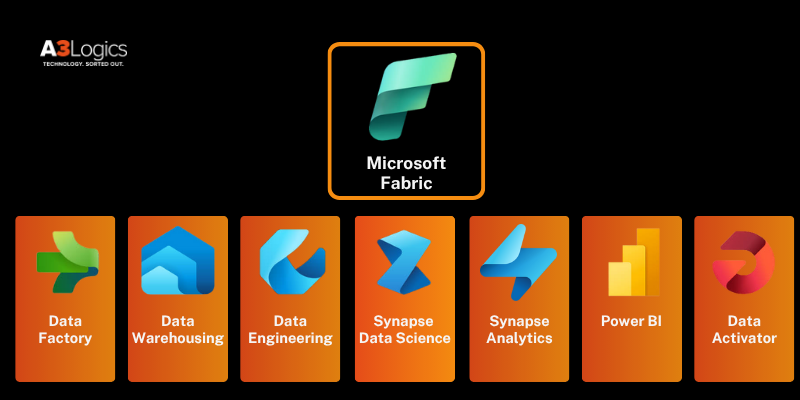
Microsoft Fabric components are the essential workloads that form the foundation of this powerful platform. It consists of several integrated services that support the entire data lifecycle within an enterprise. To better understand what is Microsoft Fabric, let’s explore its core components:
1. Data Factory
Built on Azure Data Factory, this component combines scale and power to manage data pipelines efficiently. As a key ETL tool in Microsoft Fabric, it supports both technical and non-technical users with a low-code interface. Moreover, it offers over 150 connectors to extract data from various on-premises and cloud-based sources.
Here, on-premises suppliers are centralized warehouses, and cloud-based suppliers include data lakes. Its SaaS design helps users to orchestrate data pipelines and set up information flow by automating the process. Additionally, this module provides a drag-and-drop option for transforming the raw content in a simplified way.
2. Synapse Data Warehouse
This brand new module provides a lake-centric warehousing facility at infinite scale and supports independent storage and computing. Data analysts and professionals get industry-leading warehousing experience in association with Lakehouse for large amounts of data.
This cloud-scale analytics service can work with all content based on Parquet and Delta Lake, and can provide faster responses to queries and analysis. Its built-in optimizations make it the best solution for BI workloads by establishing a structured data environment.
3. Synapse Data Engineering
Microsoft Fabric components include Synapse data engineering that offers majestic features like Spark service, instant start with live pools, and great authoring experiences. Its Spark engine works within the Lakehouse in the Microsoft platform and facilitates the design, construction, and maintenance of data assets. It combines the best inputs from data lakes and warehouses and eliminates the resistance during data absorption and transformation.
As the name suggests, it engineers the information infrastructure to build and manage analytical input pipelines. Its ability to collaborate with live pools enhances their productivity, delivering a delightful experience in Microsoft Fabric data analytics.
4. Synapse Data Science
It offers the users a variety of tools needed to create advanced AI models, get together on projects, and train, implement, and handle ML artifacts. Microsoft Fabric use cases include data science workflows, and this specific Synapse element offers support to the entire process of extracting, transforming, analysing, and building a data estate.
This workload is backed by the Azure machine learning and empowers data scientists with a collaborative environment to conduct ML experiments, develop and deploy predictive models, and analyse large datasets within the Fabric. Synapse Data Science offers extensive AI and ML capabilities by combining famous ML frameworks, including PyTorch and TensorFlow.
5. Synapse Real-Time Analytics
This workload of Microsoft Fabric offers a real-time analytics service for the business to analyse and process data. Staff with no coding experience can also operate this tool and perform cloud-based analysis on the content and derive useful insights instantly.
This component is built on the working of Azure Synapse and KQL (Kusto Query Language) is at its core, enabling this tool to perform analytics on large semi-structured data streamed from IoT devices, logs, telemetry, websites, and other sources. Real-time inventory tracking, fraud detection, and active customer engagement are the major use cases of this analytical platform.
6. Power BI
When we talk about “what is Microsoft Fabric”, Power BI always makes it to the discussion. This is an industry-leading data visualization tool that harnesses statistical data from one lake, delivers interactive dashboards and reports, and offers insightful information about the trends and market dynamics.
Power BI is the center attraction of Microsoft Fabric landscape that enables the data scientists and analysts to discover meaningful values by representing the organizational content in a simplified and easily understandable manner. With its deep connection with Microsoft 365, enterprises can directly acquire relevant information from any of the 365 instruments. Its AI-supported abilities accelerate data penetration to the next level, empower business intelligence, and streamline factual decisions.
7. Data Activator
This new no-code addition in the Microsoft Fabric ecosystem regularly monitors data and, upon identifying any predefined condition, gets triggered and instantly notifies to take action. Its in-built digital nervous system enables the business user to react instantly to data changes without the involvement of IT specialists and extensive coding.
Data activator helps to create an event-driven workflow that constantly absorbs the real-time content evolution and comes into action when a set of conditions are met, facilitating proactive response through alerts or initiating business processes.
Key Features of Microsoft Fabric
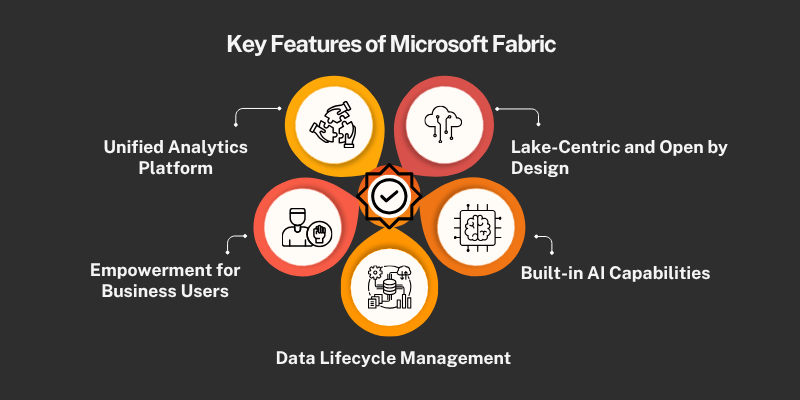
Microsoft Fabric features are in various ranges, facilitating an end-to-end data analytics platform for the organization in a unified tool. The distinct qualities of the comprehensive solution serve throughout the whole data lifecycle, starting from absorption to the final visualization. The brief discussion about features will also help to better understand “what is Microsoft Fabric”.
1. Unified Analytics Platform
Microsoft Fabric acts as a unified platform for complete data analytical needs, discarding the requirement of employing different software for every data activity. The end-to-end system integrates various data subsystems in a single mechanism to cater whole extraction, loading, and transformation processes along with running ML models on the insights to get useful values.
Fabric brings different records, teams, and departments together to work in one lake and remove duplication, by providing the same statistics for analysis to everyone within the organization. This data unification builds the sole source of truth and maintains consistency, simplicity, and high performance.
2. Microsoft OneLake: Lake-Centric and Open by Design
The platform disguises a lake framework where users can simply drag and drop raw as well as semi-structured data and extract it whenever needed. The entire enterprise can deposit every single fact and figure drawn from databases, lakes, files, and other external sources into the consolidated tool.
It works the same as OneDrive does for Microsoft 365. This SaaS model-based software helps to centralize and combine your information infrastructure and empower the data engineer to connect to multiple sources and curate desired tables or sets.
All analytical engines can share a unified storage system, eliminating siloed platforms for data discovery. Its open format and open APIs design enable it to embrace different data layouts and support analytics engines that use a variety of proprietary formats.
3. Empowerment for Business Users
Microsoft Fabric serves a variety of users, including data engineers, analysts, scientists, business analysts, data architects, C-level executives, and many more. It provides them all distinct and role-specific experiences along with a tailored group of tools to perform their data tasks. They can simply generate real-time insights independently and can collaborate easily with other teams, leading to improved productivity.
The extended no-code capabilities of Power BI help in accessing, analyzing, and visualizing complex information in easily understandable reports without any technical assistance. Users can deploy in built templates, natural language query options, and interactive dashboards, obtaining valuable insights for the strategic business decisions.
4. Built-in AI Capabilities
The AI-powered Microsoft Fabric feature is built on Azure OpenAI Service, combines large language models and a chat GPT-like experience, offering quick data interpretation. It allows users to unlock new insights and get valuable information. Artificial intelligence and machine learning attributes within the Fabric platform through Synapse Data Science enable analysts and data engineers to build, train, and deploy ML models straight into the platform.
These attributes accelerate predictive modeling and intelligent automation, uncovering the blurred trends and targeting challenges proactively. AI-driven assistants like Capilot use natural language processing for automating pipeline creation and data workflow, delivering intelligent suggestions and recommendations. Natural language feature allows users to easily generate queries, making conversation two-sided and accessible for a wider audience.
5. End-to-End Data Lifecycle Management
The Unified Fabric platform supports the entire data lifecycle, providing end-to-end management of ingestion, transformation, and analysis of organizational content. For instance, Data Factory balances pipelines, Synapse Engineering prepares data, Synapse Data Warehouse offers a single source of truth, and Data Activator initiates triggers for business actions.
These comprehensive capabilities work seamlessly and are tailored for individual uses, including specific personas such as data integration, data lakes, data movement, real-time analytics, and business intelligence. Microsoft Fabric features allow users to use one software for their complete analytical requirement instead of applying separate tools for each team and task.
Benefits of Microsoft Fabric
Microsoft Fabric data analytics process into a unified system of workloads, accelerating the actionable insights and removing separate tools and mechanisms for each task. The following key Microsoft Fabric benefits amplify the workflow of data-driven businesses:
1. Simplified Data Pipeline and Workflow Management
The platform collapses data silos and integrates various analytical mechanisms into a centralized programme streamlining the data pipeline management. It allows the IT team to compose and apply the organization’s fundamental capabilities and permissions to all the platforms instantly. The elimination of desperate tools and systems reduces content complexity and simplifies data access by locating it in a single repository named as one lake.
2. Integrated Data Processing Across Teams
Unified data storage, access, and extraction help teams collaborate across pipelines without juggling separate tools at each step. This reduces processing time and enables real-time analysis of large data volumes. Microsoft Fabric strengthens business intelligence by uniting processes and empowering users.
3. Lower Total Cost with a Unified Platform
Data-intensive projects demand multiple analytical tools from different vendors, increasing the overall business cost. Before and after use, one system often stays idle, wasting valuable capacity for other programs. Microsoft Fabric enables a unified analytics approach, allowing all tools to work together and preventing unused system resource loss. Business needs to invest in a single SaaS Fabric architecture, contributing to substantial savings.
4. Built-in Data Governance and Security
Separate teams may overlook data security and governance due to their disparate tools and mechanisms at work. Microsoft Fabric, with Purview or One Security, offers built-in protection for an organization’s entire content estate. Users manage insights centrally by applying strong security features across all data analytics tools. Role-based access, robust tracking, and compliance automation are some of the key highlights to govern data operations across industries.
5. Boosted Productivity and Faster Decision-Making
Microsoft Fabric supports all stages of data analysis without switching between multiple platforms or tools.
It offers real-time access to market trends and predictive modeling for deeper, timely insights.
Teams gain clear understanding of customer behavior and purchase patterns with faster data interpretation.
This enables proactive responses to buyer trends and quicker, innovative decision-making.
It also reduces time spent searching for critical information and helps seize new business opportunities efficiently.
Industry Use Cases of Microsoft Fabric
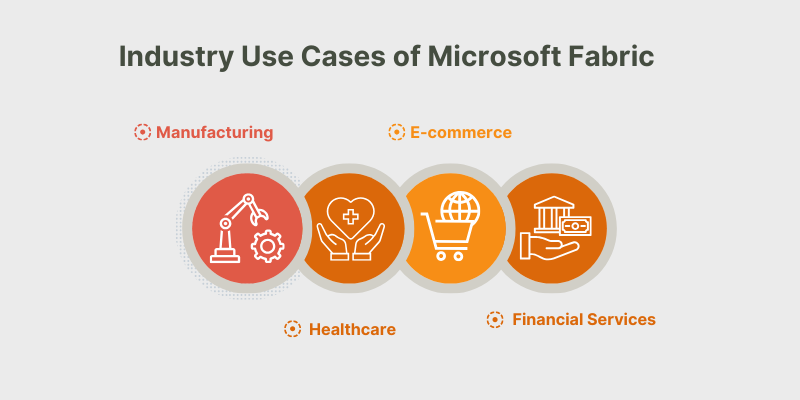
Microsoft Fabric use cases extend across numerous industries to cater to their data analytical needs and turn raw content into competitive advantages. Practical deployment of the platform is discussed below:
1. Manufacturing
Production factories regularly generate large amounts of data in each unit, including manufacturing, packaging, IoT, and machinery sections. This content needs continuous management to optimize the product-making process. Microsoft Fabric data analytics offers real-time visibility into supply chain operations, production line, quality control network, and also observes insights from these dimensions, turning factories into smart outlets.
Fabric alerts supervisors about machine conditions and potential failures to prevent production delays through timely action. It also improves product quality, controls costs, and boosts customer satisfaction in manufacturing.
2. Healthcare
Medical institutions use Microsoft Fabric to gather and store patient data from sources like reception, labs, pharmacies, and EHRs. It integrates information from wearables, insurance providers, and medical histories into one unified platform.
Persona-based experience capability in Fabric allows for versatile research, bringing innovative care solutions to the healthcare industry. Pharmaceutical practitioners can collaborate with distinct wellness programs to deliver better patient outcomes. Overall, Microsoft Fabric use cases support population health management, medical governance, and predictive diagnostics, along with maintaining scalable and safe patient records.
3. E-commerce
Data Factory in Microsoft Fabric unifies data from cloud and on-premises systems for deeper E-commerce consumer behavior analysis. It helps companies design targeted marketing strategies based on accurate, consolidated insights. Balanced inventory management, real-time customer analytics, and personalized recommendation system benefits online retailers.
The Fabric platform supports e-commerce by tracking clicks, conversions, and evaluating marketing campaign performance for improvements. It helps marketers understand campaign effectiveness and make data-driven adjustments to boost results.Power BI helps in visually presenting customer insights, including their demands and preferences, facilitating better marketing strategies.
4. Financial Services
Financial institutions go through extensive monetary data, which is quite sensitive and thus needs to be governed and safeguarded closely. MS Fabric’s unified analytical platform helps economic units like insurance and banking firms to get a holistic view of their content from various sources. It helps them to detect fraud, analyse risk, and prepare reports in compliance with regulatory protocols.
The OneLake system uses market data to guide financial services in setting fair prices with accurate pricing models.
Microsoft Fabric stores historical market trends, helping financial firms prepare optimized investment portfolios for clients.
It enables teams to run machine learning and predictive models for accurate forecasting and better decision-making.
How A3Logics Can Help You Leverage Microsoft Fabric?
A3 Logics has a decade of experience in data analytics services and enterprise software development, allowing us to create customized solutions exclusively according to business needs. Our years of experience allow us to save on cost and time without compromising efficiency and overall project quality.
1. Custom implementation strategy
A3Logics knows every business is unique, so it tailors Microsoft Fabric implementation to specific needs and resources. It ensures smooth deployment without disrupting workflows and trains employees to maximize platform capabilities.
2. Integration with existing systems
Acquisition or shift to a new system often disrupts workflow and creates platform compatibility issues. A3Logics helps to overcome these integration challenges and confirms that various Microsoft Fabric components like data factory, Power BI, and real-time analytics, seamlessly merge with your legacy infrastructure. This effective synchronization results in uninterrupted workflows and establishes a well-coordinated data ecosystem.
3. End-to-end support and consulting services
A3Logics is committed to delivering dedicated support during your whole digital transformation journey, even after the post-deployment of MS Fabric. We offer performance adaptability, AI-driven analytics application, dashboard building, and many more in a cost-effective manner. You can maximize your analytical capabilities by joining A3Logics for Microsoft Fabric data analytics. We hold a successful track record of remitting enterprise-grade data analytics services.
Conclusion
This blog has talked about “what is Microsoft Fabric”, its benefits, features, components, and much more. The technology has shown a significant leap towards enterprise data analytics by consolidating all core data tasks into a single platform.
It breaks down the data silos, increases coordination across distinct teams and facilitates informed decision making throughout the business unit. Organizations can avoid using multiple vendor tools and instead invest in one platform for all analytical and data needs. The entire enterprise accesses unified information, which reduces duplication and improves performance by delivering faster and more actionable insights.
Modern insights-driven enterprises need AI-supported systems to streamline data access and analytics on a single platform. Implementing a unified solution builds flexible infrastructure, ensures governance, and adds advanced capabilities—making it a smart business investment. In addition, partnering with A3Logics to support your Microsoft Fabric components ensures a smooth transition and drives long-term success.