The insurance industry is on the verge of a technological revolution because of how quickly artificial intelligence (AI) and machine learning (ML) are improving. Machine learning in insurance is changing how insurers look at risk, handle claims, find fraud, and talk to customers. Insurance businesses can now make better predictions, automate complicated tasks, and offer personalized services on a large scale by using a lot of organized and unstructured data.
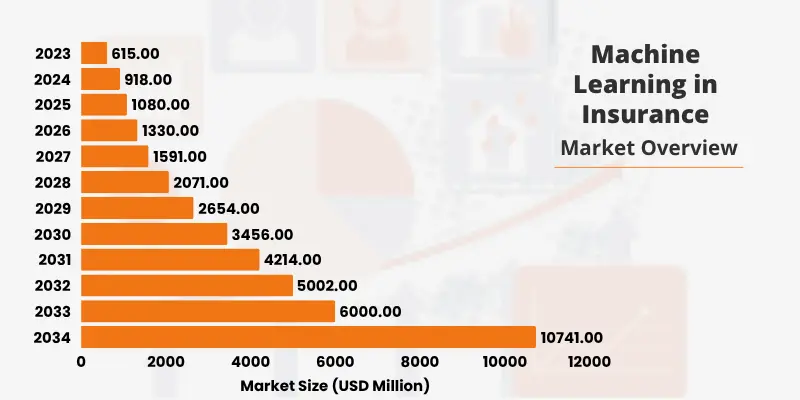
The insurance industry has always been against new ideas, but it is now going through a digital transformation. Underwriters are using advanced machine learning algorithms to bring in more data for improved risk management and to set premium prices that are right for each customer. Artificial Intelligence (AI) is automating the back end of the insurance process so that applicants can get in touch with carriers faster and more easily. By 2034, the global market for AI in insurance is expected to be worth $141.44 billion. This fast move has big effects on both applicants and insurers.
This post looks at the state of machine learning in insurance industry. It talks about the most important use cases, the real benefits it brings, the problems it causes, and the new ideas that are making the future possible.
Machine Learning in Insurance: Market Overview
Machine learning (ML) is a type of AI technology. It is a way to analyze data that lets computers learn from what they have done in the past and make accurate estimates about what will happen in the future. A human programmer only has to do a little bit of work for all of this to happen. The more data they produce – the more their ML solutions can learn and change on their own. The main purpose of ML is to free up human agents from doing mundane tasks so they may focus on more complex requests and analyses.
More and more insurance companies around the world are using Machine Learning for Insurance to be ahead of the competition. The rapid growth of data, the demand for operational efficiency, and customers’ rising expectations for smooth digital experiences are all driving the use of ML technology. Reports from the industry say that insurance companies that are putting money into Machine Learning Applications in Insurance are seeing better fraud detection, claims administration, underwriting, and client engagement.
Some interesting numbers you must know about:
- Using machine learning for underwriting can cut the time it takes to do it by ten times.
- In reinsurance, ML systems can predict market expectations with up to 80% accuracy.
- After using ML-based underwriting tools, the percentage of case acceptance went up by 28%.
- More than half of an actuary’s time is spent on data problems that machine learning can handle.
- As per the studies, 84% of insurance companies have already started using or plan to use machine learning to make the client experience more customized.
The market for ML-driven insurance solutions is predicted to increase at a double-digit CAGR over the next decade. This is because regulations are changing and technology is getting better. Both established carriers and insurtech startups will be at the forefront of this growth.
Top Machine Learning Use Cases in Insurance
In insurance, machine learning can be used in many parts of the value chain, from getting new customers and assessing risks to processing claims and keeping customers. These are the most important apps that are changing the industry:
1. Fraud Detection in Insurance using Machine Learning
The insurance business loses billions of dollars every year because of false claims. Machine learning in insurance industry lets insurers find strange or suspicious trends and claims in real time, marking them for further investigation. ML models can find small signs of fraud that traditional rule-based systems often miss by looking at past claims data, behavioral trends, and data from outside sources.
This not only stops people from losing money, but it also stops them from trying to commit fraud in the future.
2. Machine Learning in Insurance Claims
Both insurers and customers find claims handling to be a major pain point. Machine Learning for Insurance automates the process of sorting, checking, and settling claims by finding the right information in papers and photographs, figuring out how much harm was done, and forecasting how the claim will turn out.
This makes it easier to settle claims faster and more accurately, with less manual work, and makes customers happier.
3. Automated Underwriting Using ML Algorithms
Underwriting specifies the conditions of the policy and figures out the risk profile of applicants. Machine learning applications in insurance look at huge amounts of data, like medical records, credit ratings, and social media activity, to get a better idea of risk. Automated underwriting speeds up the process of issuing policies, makes prices fairer, and cuts down on human bias.
4. Customer Experience and Personalization
Personalization is a big part of what makes insurance companies different these days. In insurance, machine learning can be used to group clients, guess what they need, and make goods and communications more personal. Machine learning-powered chatbots give you immediate help, and recommendation engines suggest coverage options that are relevant to you, which keeps you interested and committed.
5. Customer Churn Prediction and Retention
It costs less to keep consumers than to get new ones. Machine learning in insurance industry looks at behavior, transaction history, and feedback to guess which policyholders are likely to leave. Then, insurers can give incentives or better services to keep clients who are at risk of leaving, which will increase their lifetime value.

6. Document Classification and Data Extraction
Insurance companies have to deal with a lot of paperwork, like applications, claims forms, medical reports, and more. Machine Learning Applications in Insurance simplify the sorting, extraction, and validation of documents, which cuts down on manual work and mistakes. This makes workflows easier and makes sure that data is the same across all systems.
7. Behavior-Based Insurance (Telematics)
Telematics and IoT devices make usage-based insurance models possible, especially for auto and health insurance. Machine Learning for Insurance looks at driving habits, health data, and lifestyle data to come up with individualized premiums and rewards for safe driving. This makes things more clear and makes premiums match the real risk.
8. Reinsurance Optimization
Reinsurance helps insurance companies deal with the risks they take on. Some ways that machine learning is used in insurance are to improve reinsurance strategies by modeling risk correlations, anticipating disasters, and simulating how a portfolio will do. This helps people make better choices and use their money more wisely.
9. Health Risk Prediction
ML models in health insurance use a person’s medical history, genetics, and lifestyle to figure out how likely they are to get chronic diseases, go to the hospital, or make a lot of claims. This lets insurance companies design wellness programs that help people stay healthy, take care of risks before they happen, and set the right prices for their plans.
10. Image Recognition for Damage Assessment
Machine Learning in Insurance uses computer vision to look at pictures or recordings of harm, including vehicle accidents or damage to property. ML algorithms can figure out how much repairs would cost, find fake claims, and speed up the claims process, which makes it more accurate and builds confidence with customers.
Machine Learning for Various Insurance Domains
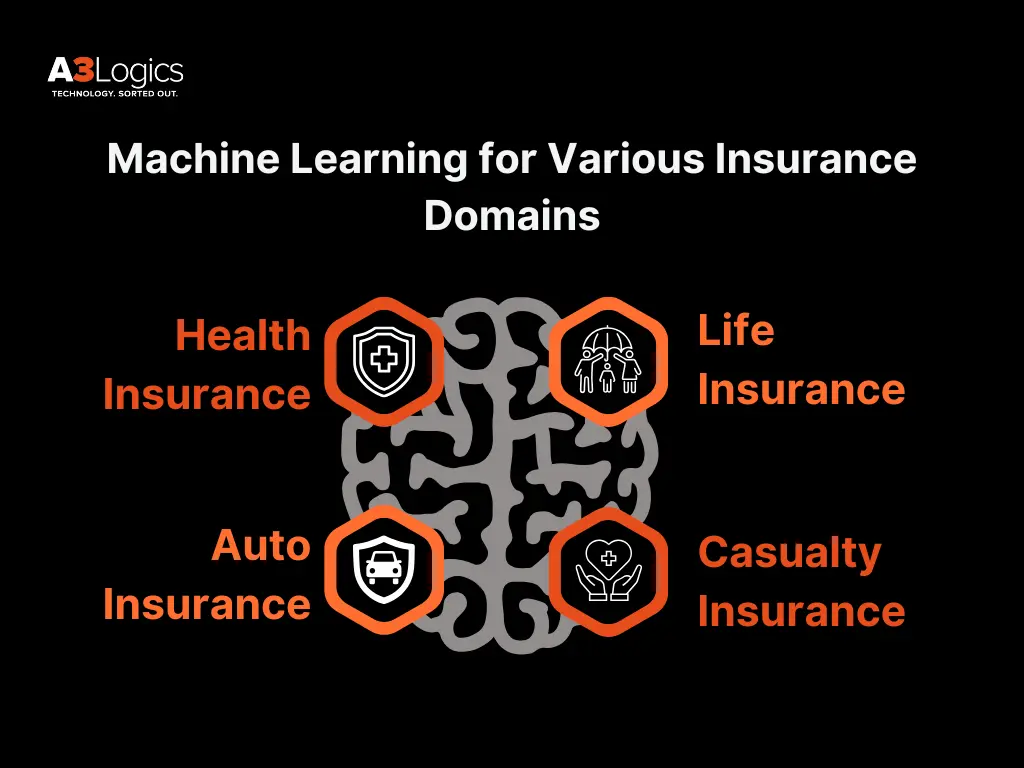
Machine Learning for Insurance isn’t only for one type of business. It affects health, life, auto, and property and casualty insurance, each of which has its own uses and benefits.
1. Machine Learning in Health Insurance
In health insurance, ML models look at patient data to find health concerns, tailor wellness programs, and find false claims. Predictive analytics help insurers construct policies more precisely and deal with the risks of chronic diseases, which is good for both the insurer and the policyholder.
2. Machine Learning in Life Insurance
Life insurance companies utilize machine learning to figure out how likely someone is to die, automate the underwriting process, and find fraud. Machine Learning Applications in Insurance use medical records, lifestyle data, and even data from wearable devices to set prices that change over time and speed up the process of getting a policy. This makes the customer experience better.
3. Machine Learning in Auto Insurance
Telematics and machine learning help auto insurers offer usage-based insurance, find fake claims, and speed up damage assessment. Real-time analysis of driving behavior helps separate risks, and picture recognition speeds up the process of settling claims.
4. Machine Learning for Property and Casualty Insurance
ML models help property and casualty insurers assess natural disaster frequency, evaluate property risk, and optimize reinsurance pricing. The team at Alliance Risk has mentioned that these data-driven pricing models are helping businesses across multiple industries secure more accurately tailored coverage than ever before. Additionally, automated document processing and fraud detection improve operational efficiency and reduce losses.

Benefits of Machine Learning in Insurance Industry
Machine learning in insurance industry has many benefits that lead to growth, efficiency, and happy customers.
1. Enhanced Operational Efficiency
ML takes care of boring, repetitive operations like entering data, processing claims, and checking documents. This cuts down on mistakes made by people, speeds up workflows, and frees up people to do more important tasks.
2. Improved Customer Satisfaction
Better customer experiences come from personalized suggestions, chatbots that offer rapid help, and speedier claims processing. With machine learning in insurance, insurers can figure out what their customers need and give them services that are timely and useful.
3. Data-driven Decision-making for Risk Management
ML models look at huge datasets to find patterns and trends that aren’t obvious, which helps with better risk assessment and pricing. This gives insurers the information they need to make smart choices and lower their risk of unexpected losses.
4. Cost Reduction through Automation
Machine Learning-powered automation for insurance cuts costs by reducing the need for people to do things, speeding up processes, and making the best use of resources. This means more profit and prices that are competitive.
5. Competitive Advantage with Real-time Insights
Insurers can quickly adapt to changes in the market, new risks, and client needs thanks to real-time analytics and predictive modeling. Machine learning applications in insurance give businesses useful information that leads to new ideas and makes them stand out.

Challenges of Machine Learning in Insurance Industry
Machine Learning in the Insurance Industry has the potential to change things, but there are a number of problems that need to be solved before it can be used successfully.
1. Data Quality and Availability
ML models need a lot of good, relevant data. Predictions that aren’t accurate and outcomes that aren’t the best can happen when data is missing, inconsistent, or prejudiced. Insurers often have trouble with data silos and old systems that make it hard to combine data.
2. Legacy Systems Integration
A lot of insurance companies still use old IT systems that don’t work with new ML solutions. It can be hard, time-consuming, and expensive to connect ML models to older systems, which requires a lot of money to modernize.
3. Regulatory and Ethical Concerns
The insurance business is very tightly controlled. People are worried about fairness, accountability, and transparency when it comes to using ML. To make sure that rules are followed and protect consumers’ interests, regulators want models that can be explained and strong governance.
4. Talent Gap and Skill Shortage
There aren’t enough data scientists, ML engineers, and domain specialists to meet the demand. Insurers confront issues in hiring and retaining skilled people capable of creating, deploying, and maintaining ML solutions.
5. Data Security and Privacy
There are big security and privacy risks that come with handling sensitive customer data. To keep client information safe, insurers must follow data protection laws and put strong cybersecurity safeguards in place.
6. Model Maintenance and Monitoring
To stay accurate and useful, ML models need to be watched, retrained, and validated all the time. Ongoing model management and governance are needed when data patterns, rules, or business goals change.
Solutions to Overcome Machine Learning Challenges in Insurance
To fully leverage machine learning in insurance, insurers must adopt strategic solutions that address key challenges like data quality and system integration.
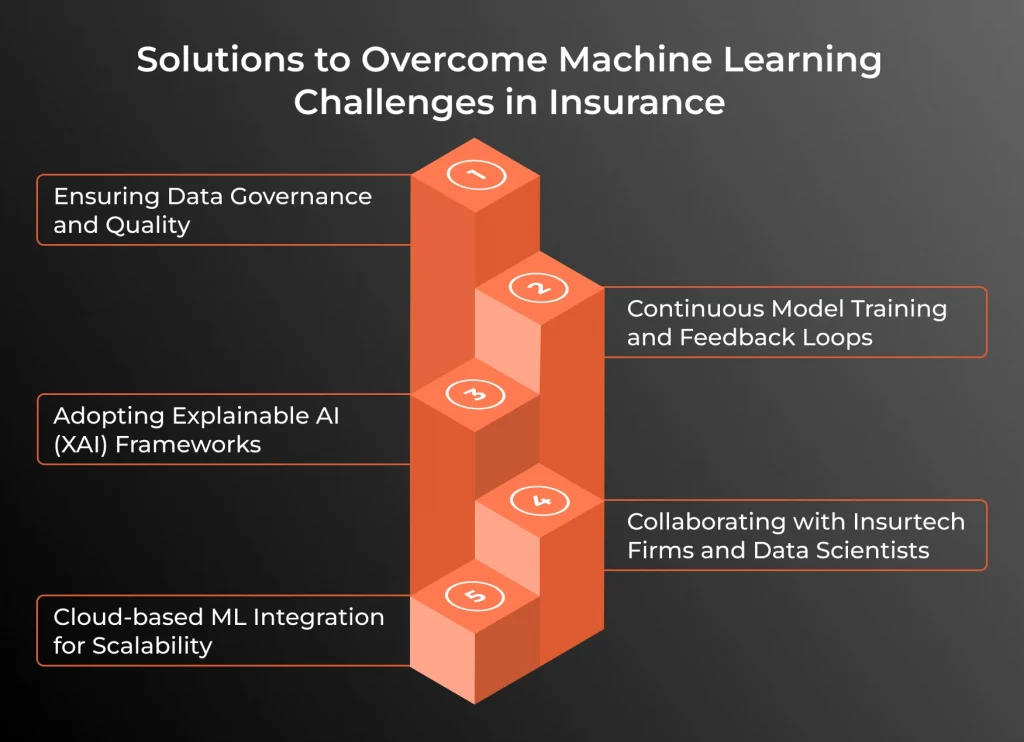
Ensuring Data Governance and Quality
Strong data governance systems ensure that data is accurate, consistent, and easy to find. Regular data audits, cleaning, and integration projects assist make sure that ML projects have a strong base.
Adopting Explainable AI (XAI) Frameworks
Explainable AI frameworks make machine learning models clear and easy to understand, which helps with ethical and regulatory issues. XAI helps stakeholders understand how decisions are made, which builds confidence and compliance.
Cloud-based ML Integration for Scalability
Insurers can quickly scale ML systems, get access to advanced tools, and lower infrastructure costs by using cloud platforms. Cloud-based ML also makes it easy to connect with other systems and work together from afar.
Continuous Model Training and Feedback Loops
Setting up ongoing feedback loops makes sure that ML models may change to meet new data and business needs. Retraining and validating the model on a regular basis keeps its performance and relevance.
Collaborating with Insurtech Firms and Data Scientists
Working with insurtech companies, ML Consulting Services, and data scientists brings in specific knowledge and speeds up new ideas. Working together helps people share what they know and get access to the latest technologies.
Case Studies: Real-World Success Stories of ML in Insurance
A number of top insurance companies have successfully used Machine Learning Use Cases in Insurance to get real business results:
- Allianz used machine learning algorithms to find fraud, which cut down on false positives and saved the company millions of dollars in fake claims.
- Progressive employs telematics and machine learning to deliver individualized vehicle insurance prices, which helps them better separate risks and make customers happier.
- MetLife used machine learning to automate underwriting, which cut the time it took to issue a policy from weeks to minutes.
- Lemonade, an insurtech disruptor, uses chatbots driven by machine learning to handle claims right away, raising the bar for customer service.
Future Trends in Machine Learning for Insurance
Machine Learning for Insurance is going to bring even more new ideas and changes in the future
- Hyper-personalization: Insurers will be able to offer very personalized products and services based on real-time data thanks to advanced ML models.
- AI-powered risk prevention: Predictive analytics will change the focus from reducing risks to preventing them in the first place.
- Combining ML with IoT devices: All this with blockchain technologies will make data more accurate, safe, and clear.
- Processing claims on their own: Automation of claims from FNOL (First Notice of Loss) to settlement will become the standard.
- Ethical AI and fairness: As the focus on ethical AI grows, more people will use ML models that are explainable, fair, and accountable.
How A3Logics is Revolutionizing Insurance with Machine Learning?
A3Logics is a top Machine Learning Development Company that is leading the way in changing the insurance industry with new ML solutions. Our ML consulting solutions help companies find high-impact use cases, build bespoke models, and easily add ML to their current workflows.
A3Logics helps insurance companies simplify claims, enhance fraud detection, and offer personalized experiences. Through end-to-end insurance software development services, we streamline operations and drive smarter decisions. Additionally, we focus on data governance, scalability, and regulatory compliance. As the industry rapidly evolves, we empower insurers to innovate and stay ahead.

Final Take – Machine Learning for Insurance
Machine learning in insurance is no longer a thing of the future; it is a present-day reality that is changing every part of the business. Machine Learning Applications in Insurance are giving measurable benefits, such as finding fraud, automating claims, engaging with customers in a more personalized way, and managing risk.
Even with challenges like data quality, legacy system integration, and compliance, smart solutions and partnerships are simplifying adoption. As technology advances, insurance companies that embrace machine learning in insurance will be better positioned to thrive in an increasingly competitive and customer-centric market.