
Traditionally, real estate was all about process, instinct, and local knowledge. In recent years, the real estate industry in general has been undergoing a vast change. Data Analytics for Real Estate isn’t just a passing trend; it is a metamorphosis that is completely redefining the way real estate businesses function.
Additional global events bestowed even more input for the need for intelligent, data-driven decisions. The COVID-19 pandemic immensely drove residential property demand for a short while, simultaneously triggering a sharp decline in commercial real estate. Now, those gains are considerably lowered with the interest rate hikes through 2022 and 2023.
As 2025 begins, things are starting to look up again. Inflation has begun to ease globally, and interest rates are following suit. The European Central Bank has cut its interest rate multiple times in 2024, reaching 3.25% in October. Meanwhile, the U.S. Federal Open Market Committee also reduced interest rates over the year, with further cuts expected in 2025.
The blog explores how Data Analytics for Real Estate is transforming the industry, presenting its key benefits, challenges to implementation, possible real-life Real Estate Analytics Use Cases, and how Predictive Analytics can influence Real Estate in the future. Whether you are a broker, investor, developer, or property manager, data analytics services are versatile for everyone.
What is Data Analytics for Real Estate?
Data Analytics for Real Estate transforms raw information into actionable insights, making you capable of making the right decisions. At its core, data analytics involves gathering market data, buyer behaviour, property characteristics, and economic indicators and processing this information to seek trends, compute risk, and decide on strategy.
Key data sources include price trends for now and then, transaction volumes, neighbourhood demographics, interest rates, and even buyer search behaviour. Other inputs are asset-specific, including square footage, age, and amenities, plus higher-level economic indicators like employment figures and building permits.
IoT sensors in a property can also relay useful data on occupancy and energy consumption. When combined and analysed properly, these can enable firms to identify key value drivers and pinpoint promising investment opportunities across various markets.
The 4 Types of Data Analytics in today’s real estate industry are as follows:
Descriptive analytics explain what has happened by summarising historical data. This would report on things as average selling prices in a region, rental yield by neighbourhood, or changes in Real Estate Market Trends over time.
Diagnostic analytics that goes deeper as compared to descriptive analytics. While descriptive analytics only talks about what happened, diagnostic analytics also focuses on why it happened.
Predictive analytics in the real estate sector represents future forecasting. Using machine learning, models predict rises in property values, demand in certain locations, or maintenance issues that might arise. For instance, a predictive algorithm might estimate vacancy risks by analysing former tenant patterns and maintenance records.
Prescriptive analytics gives actual recommendations. They direct the decision makers on what to do. This might include whether to renovate before selling, what price would hit the highest returns, or where would be best for future developments based on population growth projections.
Descriptive analytics is supported by software platforms such as Tableau and Power BI through interactive dashboards, while the more advanced software platforms form the predictive and prescriptive models. Commercial software platforms deliver numerous benefits by integrating predictive tools and data visualisations that can serve the needs of a non-technical end-user.
By the combination of descriptive, predictive, and prescriptive analytics, Data Analytics for Real Estate brings clarity to the situation. The approach is very comprehensive. All of these factors augment the value of Real Estate Data Analytics and Predictive Analytics in Real Estate.
- Also Read: 4 Types of Data Analytics
The Role of Data Analytics for Real Estate Decision-Making
Imagine a commercial real estate firm considering an investment in a medium-tier office block in downtown Dallas. On paper, the property seemed to be an opportunity: excellent location, decent infrastructure, and stable occupancy in the past. Using traditional approaches, such as their gut feeling or old reports, would not serve them well. Instead, the firm decides to use data analytics for real estate.
They start by pulling up the lease history for comparable office spaces within a 5 km radius. This is added with market trends revealing a fall in demand for traditional office leases with the increase in hybrid work models. Employing predictive analytics in real estate purposes, the team learns that while the demand is down overall, local tech startups are showing a growing preference for co-working spaces as opposed to regular offices.
The firm continues to layer on real estate data analytics by including demographic shifts, Google search trends for commercial real estate in Dallas, and zoning data flagging an infrastructure overhaul in the area.
Using these data points, they revise the original concept from getting the building leased out as generic office space to an alternative of modular co-working units, pitched toward the tech startup market. Within three months after launching, it has achieved an 85% occupancy rate.
That one decision, made entirely using data analytics for real estate, changed a risky investment into a strategic win. The perfect example of the right insight at the right time not only minimises risk but also transforms the result.
Top 5 Benefits of Data Analytics in Real Estate
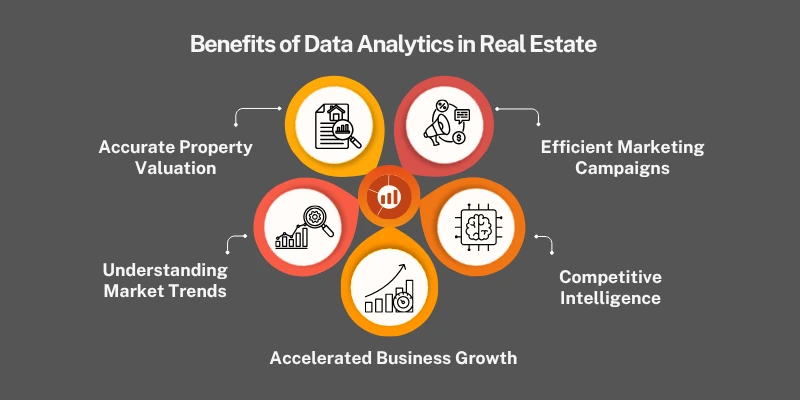
1. Accurate Property Valuation
One of the most critical benefits of data analytics for real estate is the opportunity for greater precision in property valuation. The real estate practitioner uses this live data, including recent sales, local demand, inflation, and properties’ characteristics, instead of outdated list prices or simply “gut” feeling on application. As against overpricing or underpricing of properties, this lets marketing be towards a fair negotiation level based on data for both buyers and sellers.
2. Efficient Marketing Campaigns
Real estate is a competitive field; advertising to the wrong crowd exhausts time and money. With real estate data analytics, an agent can segment potential buyers or renters based on behaviour, geography, past interactions, and property preference. Campaigns should be personalised for the best timing and messaging to increase conversion rates, more ROI, and engagement throughout the sales cycle.
3. Understanding Market Trends
Staying ahead in this dynamic sector means tracking patterns before they become obvious.. The predictive analytics in real estate, emerging hot zones can be identified, and price escalations or decrements in demand can be forecast well before any of the operators get the idea. This helps investors and operators to make smarter buy decisions and put an exit strategy along with the real estate market trends.
4. Competitive Intelligence
Knowing what a competitor is doing is just as valuable as knowing a customer. Real estate data analytics allow firms to monitor competitor listings, pricing strategies, marketing activities, and customer sentiment. This level of competitive intelligence helps to benchmark performance and identify gaps that could be turned into opportunities. Businesses are empowered to respond faster and more effectively to changes in the Real Estate Market Trends.
5. Accelerated Business Growth
Data analytics for real estate can amplify growth. The prime aim is to design the perfect business-oriented operational decisions. Property portfolios optimised, leads qualified automatically: every touchpoint becomes faster and sharper. The result is accelerated and sustained growth because it is fact-based rather than assumed.
6 Key Use Cases of Data Analytics in Real Estate
1. Property Valuation
Accurate property valuation is a cornerstone in Data Analytics for Real Estate. Using both historical sales data and current market indicators, agencies create Automated Valuation Models (AVMs). These models compare properties, take into consideration nuances such as area, quality of renovation, and features, and even local factors such as school ratings or transport accessibility.
Machine-learning-powered AVMs provide near-instant base valuations with a confidence level, capable of creating value far quicker and reliably than traditional appraisals. Hence, property owners gain realistic pricing benchmarks while investors see more clearly about asset performances. Real Estate Data Analytics replaces guesswork with consistent and objective insights, turning valuation into a strategic advantage.
2. Market Analysis
Real Estate Market Trends are no longer vague predictions, thanks to structured data aggregation from listings, census reports, economic conditions, and urban planning updates. Predictive algorithms highlight price growth in developing areas or signal potential slowdowns caused by job market shifts or declining infrastructure.
Geospatial analytics shed light on commute times, retail access, and crime levels, all of which influence location desirability. Investors and developers can compare cities, neighbourhoods, and zones to uncover hidden gems and stay ahead of the competition. Data Analytics for Real Estate empowers firms to act with confidence, reducing risk while maximising returns through insight-driven location planning.
3. Customer Profiling
Analysing the buyer or tenant is as vital as looking into the property. Real Estate Data Analytics uses customer interaction data such as search patterns of the users, listings viewed, income range, past transactions, etc., to build detailed buyer personas.
The advanced scoring systems help sales teams ensure that their time is spent on leads ready for conversion, while predictive engines indicate properties to users based on their stated preferences and past behaviour, thus forging greater levels of personalisation. Therefore, Data Analytics for Real Estate transforms dead-end leads into long-term customers.
4. Property Search Platforms
Online property portals have evolved, turning from simple listings into queries for the Real Estate Analytics Use Cases. Recommendation algorithms use parameters like buyer preferences, price sensitivity, and lifestyle data to present listings best suited to the user’s interests. Visual recognition software examines the images to grade the interior quality and even determine absent items.
Meanwhile, real-time user inputs and preferences related to the search, for example, specified proximity to schools or work, further filter the results. Given Data Analytics for Real Estate, these platforms are matchmaking tools that improve engagement and satisfaction.
5. Risk Assessment
Risk comes with property investment, but Data Analytics for Real Estate reduces the chances of surprise. Data about crime rates in a neighbourhood, histories of vacancies, local economic health, and tenant payment records are fed into a risk model designed to rate the likelihood of an incident happening, whether language, default, depreciation, or legal challenge.
Meanwhile, predictive tools indicate forthcoming issues in operations and sudden drops in revenues, while location-based forecasting indicates weak markets. This helps lenders, investors, and landlords make informed decisions about pricing, insurance, and exit strategies.
6. Property Management
With Data Analytics for Real Estate, a property manager can monitor sensor data to observe equipment performance, energy consumption, and space usage. Maintenance records and activities of a tenant are analysed to anticipate grievances or service requirements.
If the data shows a rise in turnovers or maintenance costs, management can respond before problems become serious. Analytics transforms maintenance to being proactive, thereby avoiding disruptions and saving money. This raises tenant satisfaction, which is beneficial to supporting occupancy growth.

Implementing Data Analytics in Real Estate: Best Practices
1. Data Collection & Integration
Data Analytics for Real Estate begins with gathering a multitude of highly diverse data from reliable sources. These may include zoning laws, lease agreements, tax records, CRM systems, climate data, and online user behaviour. Integration tools then bring all this data into one central platform for unified access. This is done to eliminate inaccuracies in data, and therefore, the departments can work more efficiently.
2. Data Cleaning & Preprocessing
Cleaning is done to ensure data accuracy. It removes duplicated records, corrects address inconsistencies, and deals with missing values by specified methods. Preprocessing might also require conversion from words to numbers, such as in turning “excellent condition” to some numerical value. Real estate data analytics with inaccurate data leads to wrong valuations or investment decisions. A dataset, when properly structured, becomes the foundation on which reliable insights are drawn.
3. Market & Trend Analysis
Keeping track of local and global property trends is another crucial practice. Instead of focusing solely on present-day buyer preferences, real estate teams should also consider the broader shifts or changes in urbanisation patterns, preference for energy-efficient homes, or the birth of hybrid working. These pointers position businesses for the future rather than making them react to the past.
4. Predictive Analytics
Integrating predictive tools helps forecast scenarios such as market growth, rental patterns, or forthcoming maintenance needs. They are capable of running through large data sets comprising lease dates, building age, and historical occupancy trends. The results are more than mere ballpark figures and give risk scores and probability insights to aid in strategic decisions. Within the realm of Data Analytics for Real Estate, predictive analytics allows investors and property managers to take a proactive approach.
5. Risk Mitigation Strategies
Real estate in today’s environment needs risk prevention and risk management facilitated by data. Analytics can identify warnings associated with payment defaults, regulatory issues, or the long-term degradation of an asset. Alerts in real-time and what-if scenario simulations keep enterprises ready for surprises and in better allocation of resources. Analytics assures the credibility of the tenants of the structural risks of the assets. Practices like these provide the benefits of Data Analytics in Real Estate to businesses and maintain the trust of investors and customers.
The Future of Data Analytics for Real Estate
1. AI & Machine Learning
In Real Estate Data Analytics, an integration with AI and Machine Learning is the path to evolution. These technologies use historical as well as real-time data to actually automate decision-making and consumer personalisation. From an AI standpoint, tenant screening and dynamic pricing lead to intelligent forecasting and strategic planning. It also looks at identifying patterns in unstructured data, including textual reviews or images, thereby ensuring that the predictions are much more accurate and sensitive.
2. Blockchain
The Data Analytics in Real Estate has blockchain applications reconsidering the execution of transactions and contracts. Blockchain offers inefficiencies in the form of immutable records, decentralised verification, and secure smart contracts, while these constraints were not offered by traditional systems. Investors and buyers can conduct direct peer-to-peer transactions and maintain tamper-proof records of ownership. The mix-up of Blockchain and Predictive Analytics in Real Estate further enhances trust in sourcing data.
3. Smart Cities
With smart cities emerging, the data generated by them becomes a goldmine for Real Estate Analytics Use Cases. IoT devices making rounds provide insights into foot traffic, air quality, utility usage, and infrastructure resilience. These enriching streams of data Analytics allow more precise modelling of property value, development potential, and environmental risk. These smart cities are a new benefit of Data Analytics in Real Estate.
How A3Logics Can Help in Data Analytics for Real Estate?
A3Logics is a trusted name in building powerful solutions around Data Analytics for Real Estate. We hold years of experience in data engineering, AI, automation, and machine learning, which we put into creating platforms where real estate companies can transform fragmented information into actionable insights.
Our services cover the full data lifecycle from integration and cleaning right through to advanced modelling and dashboarding. Methods include building real-time analytics dashboards, applying predictive analytics in real estate for informed decision-making, and automating data pipelines so that performance is ramped up across portfolios.
Our methodology prioritises data quality, governance, and international standards compliance while focusing on optimising existing infrastructure for enhanced Benefits of Data Analytics in Real Estate. Through A3Logics, real estate companies can fully leverage the power of Data Analytics and maintain competitiveness in the data-driven world. Whether it’s optimising portfolios or identifying hidden opportunities, we make complex property data actually work for your bottom line.

Conclusion: Data Analytics for Real Estate
Guesswork has no place in the real estate landscape. Data Analytics for Real Estate has become an absolute process for competing in the market. From the best possible valuations and risk management to personalised marketing and long-range planning, Real Estate Data Analytics enables companies to arrive at decisions that are intelligent and profitable.
As we discussed, its advantages include customer profiling, market studies, and operational efficiency, with future trends such as AI, blockchain, and smart cities paving more pathways ahead.
To really keep ahead, a culture built around informed, data-driven decisions needs to be set up. Predictive analytics in real estate should be employed not only to forecast demand but to future-proof business models within this fast-changing sector. In embracing analytics tools, real estate professionals can react to market signals early on, cutting down the risks before they develop into real issues and then creating residual value for clients and stakeholders.
There’s a chance to take your business to new heights now. Look at leading real estate analytics solutions with A3Logics and watch insights drive revenue. Reduce vacancy rates, predict market shifts, optimise pricing, and turn every property decision into a calculated competitive advantage.