Cloud migration has been very popular around the world in the last few years. However, because more people are now working from home, firms are using cloud services and apps more than before. A thorough grasp of the costs of legacy systems versus Cloud-Based Benefits Administration Solutions can help you figure out the return on investment and what needs to be done first. A defined and well-resourced plan helps keep your cloud migration on track and on budget. Choosing the appropriate cloud partners may make or break your business.
More and more businesses are using Cloud-Based Benefits Administration Solutions instead of old, hard-to-use, or on-premises systems. This big change is happening because companies need to cut costs, increase compliance, make the employee experience better, and keep up with quickly changing expectations from workers. With new cloud platforms, companies can quickly scale up, easily integrate, and create value that changes the way HR teams and employees work.
Key Statistics
Moving applications and other IT tasks to a cloud computing environment is called cloud migration.
When small businesses move to the cloud, they usually move their apps and data from old, on-premises infrastructure (such servers) to centralized cloud services that are hosted by a vendor or cloud provider.
- More than 60% of organizations now use cloud-based solutions or hire outside help to handle benefits administration. This is a 40% increase from three years ago.
- Cloud-based platforms are said to have lowered the amount of work that needs to be done on benefits chores by 20–35% and the number of mistakes by up to 80%.
- A global study from 2025 says that the core benefits administration category will make up 39.6% of the entire benefits administration market, thanks to the huge growth of cloud computing.
- More than 71% of workers in companies that use cloud-based benefits technology prefer digital self-service, saying it makes them more engaged and happy.
What Are Cloud-Based Benefits Administration Solutions?
There are hazards involved with moving to the cloud, and many small business owners may want to take their time with their cloud projects. But these delays can put their businesses at a big disadvantage when it comes to competition:
- They are paying too much. The price of maintaining and using legacy programs could be taking money away from other important projects.
- Spending money on things that don’t work. Companies can be buying new gear and software to keep an old legacy platform running, which is a strategy that almost never works.
- Not being able to grow. A lot of organizations need to swiftly roll out and grow new apps. With old infrastructure, this is often hard or even impossible.
- Weaknesses in security. Hackers and other cybercriminals like to go after old software and systems that aren’t supported anymore.
McKinsey says that by 2024, most businesses will spend 80 cents of every dollar they spend on IT hosting on the cloud. This investment comprises PaaS, IaaS, SaaS, and private cloud.
Cloud-Based Benefits Administration Solutions are new, web-based tools that make it easier to manage, enroll, and run employee benefit programs all in one place. These solutions are housed on secure, remote servers that may be accessed from any device or location.
Cloud-Based Benefits Administration Solutions usually work on a subscription or pay-per-use basis. Cloud platforms let HR departments manage open enrollment, eligibility tracking, reporting, compliance responsibilities, and employee assistance all from one digital hub, which is different from traditional on-premises software.
Why Are Companies Shifting to Benefits Administration Cloud Based Solution?
When you use a benefits administration cloud based solution, the cloud provider takes care of all the gear (servers, storage devices, firewalls, switches, and routers) that you would normally have to buy and manage yourself. Moving to the cloud can help you get rid of these regular capital costs.
It’s much easier to scale up and down when you move to the cloud. You only pay for what you need right now, so you don’t have to worry about modifications in the future. You don’t have to plan for capacity for the next five years anymore. If your demands change, you can quickly and easily scale up.
Benefits
1. Less money spent on capital. With cloud computing, the cloud provider gives you all the hardware (servers, storage devices, firewalls, switches, routers) that you would normally have to buy and take care of yourself. Moving to the cloud can help you get rid of these regular capital costs.
2. Lowered costs of doing business. Cloud computing cuts down on the costs of traditional IT infrastructure. Cloud computing services at pay-as-you-go pricing mean that businesses no longer have to pay for pricey gear and maintenance. Businesses can better plan their budgets and cut down on unnecessary costs by using pay-as-you-go services.
3. Lower opportunity expenses. When you spend a lot of money on anything, you miss out on other opportunities. If you spend $50,000 on a new on-premises server implementation, you won’t be able to use that money for anything else. Moving to the cloud means that instead of spending a lot of money up front, you pay a small amount per month.
4. More flexibility. It’s much easier to scale up and down when you move to the cloud. You only pay for what you need right now, so you don’t have to worry about modifications in the future. You don’t have to plan for capacity for the next five years anymore because you can quickly and simply add more if your needs alter.
5. Better availability and dependability. Moving data to the cloud cuts down on downtime and data loss. Most cloud managed benefits services providers have service level agreements that say their services will be up 99% of the time or more. It’s much easier to keep your infrastructure available and reliable when a cloud provider takes care of it and gives you backup and fast connections.
Also Read:- What is Employee Benefits Administration Outsourcing? A Complete Guide
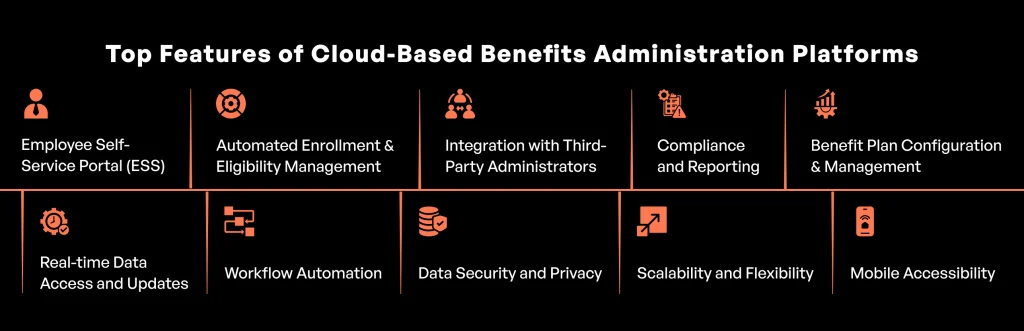
Top Features of Cloud-Based Benefits Administration Platforms
Using the best benefits administration cloud based solution from the industry that are embedded into cloud apps can help businesses run more smoothly and get more work done by their employees. You can access cloud apps and infrastructure from anywhere, which can make things run more smoothly and make it easier for people to work from home.
This can make employees happier and more likely to stay with the company. Plus, being able to quickly increase (or remove) computing power or new features can help a business take advantage of chances or deal with downturns.
1. Employee Self-Service Portal (ESS)
By means of web or mobile platforms that are simple to operate, employees have the ability to self-register, self-service, and self-change their benefit plans, etc. Self-service options give you prompt access to the required data regarding plan coverage, prices, eligibility, and status. Besides feeling more confident, people also save HR’s time.
2. Automated Enrollment and Eligibility Management
The Cloud-Based Benefits Administration Solutions technologies are highly efficient in all the difficult tasks as registration, eligibility tracking, and life events processing. The engines that are based on rules automatically verify the eligibility, execute the elections, produce reminders, and highlight the differences that help to ensure the correctness, and the compliance is done so no one has to wait for a task to be done.
3. Benefit Plan Configuration and Management
HR teams can create, alter, and manage not only the employee’s benefit – health, dental, vision, voluntary benefits, or any other – but the entire package of wellness benefits with just one location and plan configuration tools that are flexible. The company can communicate its plans more easily to employees which leads to annual renewals and adjustments made in the middle of the year being completed in less time
4. Integration with Carriers and Third-Party Administrators (TPAs)
(TPAs)The solid relationships with insurance companies, payroll, TPAs, and other HR systems give the data flow a smooth and easy way to be shared. The real-time EDI feeds allow for the plans to be updated automatically without any double entry, and the organizations can react quickly when there are changes in employees or carriers.
5. Compliance and Reporting
Compliance management modules take care of rules like ACA, COBRA, HIPAA, and others. Automated reporting, document storage, and digital audit trails help make sure that filings are correct, decrease the risk of an audit, and give regulators or advisors immediate access.
6. Real-time Data Access and Updates
Both employers and employees benefit greatly from being up to date with information on benefits, pending enrollments, claims, and usage history. Immediate updates clarify things, allow people to make decisions quickly, and keep costs at a lower level.
7. Workflow Automation
Automation of routine HR and benefits tasks, for example, approvals of enrollments, verification of dependents, and sending of reminders for open enrollment, leads to increased performance, accuracy, and completion on time.
8. Data Security and Privacy
Any and all benefits data can be guarded by top-notch security measures such as encryption, access controls, security logs, and compliance certifications. Cloud-Based Benefits Administration Solutions ensure that the data remain private and at a lower risk of breaches or violations.
9. Scalability and Flexibility
The most amazing feature of cloud computing is that it can always expand or contract as per your needs. The amount of computing resources that a business needs can change based on the requirements of the business. The businesses that are either affected by seasonal changes or grow rapidly would be the ones to take advantage of the flexibility offered by cloud service providers.
10. Mobile Accessibility
The mobile applications or adaptable platforms are available for employees as well as HR professionals, provided they are on the move and have to handle the benefits. Consequently, they can enroll and claim on the go in a timely manner irrespective of their locations.
Challenges of Traditional Employee Benefits Administration Solutions
Almost half of all cloud migrations don’t work. But your business doesn’t have to be one of those.
1. Complexity of Regulations and Compliance
It’s challenging to keep up with healthcare regulations and rules that change quickly when you use manual or old methods. This raises the chance of missing deadlines, making mistakes, or getting fined.
2. Administrative Burden and Manual Processes
The usage of paper forms, spreadsheets, and manual data entry is not only inefficient but it also causes delays and the number of errors increases.
3. High Costs (Direct and Indirect)
On-premises deployments are incredibly expensive for hardware, software licenses, IT workers, and the process of ongoing maintenance that in the end will take money away from corporate growth.
4. Poor Employee Experience and Communication Gaps
Old systems have the potential to make it difficult for employees to get to the needed information, make plan alternatives vague, and annoy users, which in turn lowers the level of satisfaction and HR’s reputation.
5. Limited Scalability and Flexibility
The process of changing benefit programs or adding more capacity to traditional systems as the organizations grow is a time-consuming, very expensive, and mostly disruptive one.
6. Data Security Risks (for manual/on-prem)
The combination of obsolete technology and low-security standards renders manual and on-prem systems as the easiest targets for breaches, data loss, and compliance issues.
7. Integration with Legacy Systems
It is challenging to link together older systems with carriers or external partners that result in doing the same task twice and data silos.
8. Data Migration Concerns
The process of transitioning from legacy systems to cloud computing platforms is a one-time obstacle that requires thorough planning, however, qualified vendors handle it securely using protocols and providing transparent workflows.
Top Industries Adopting Cloud Based Benefits Administration Technology
Benefits administration cloud based solution is when you use computers, data, and apps that run on servers in a data center that a cloud vendor takes care of and that you can get to via the internet.
1. Healthcare
Hospitals and medical networks use cloud-based benefits systems to keep up with staff turnover, complicated compliance, and different shifts. Mobile access and strong compliance tools have changed how people sign up and manage their accounts.
2. Insurance
Insurance firms need integrated technology to offer flexible, multi-plan options and to stay in line with strict rules. Cloud solutions let you scale up quickly and have strong, carrier-level integrations.
3. Finance
Banks and investment organizations have to follow stringent rules and handle a lot of benefits transactions. Cloud systems make it easier to report and handle data safely.
4. Retail
Retail businesses with large, often seasonal, workforces need systems that can grow and are easy to use for quick onboarding and offboarding. Cloud-based technologies have cut administrative costs for big retail firms byTV extra money.
5. Technology
Tech firms use cloud-based platforms to help them develop quickly, expand throughout the world, and give their employees digital-first experiences. They do this by using advanced analytics and AI-driven technologies to make sure benefits are delivered in the best way possible.
6. Manufacturing
Manufacturers work in shifts and at different locations. Cloud solutions make sure that all employees can access the system and that benefits are managed correctly for each shift.
Examples of Companies Benefiting from Cloud Based Benefits Administration Technology
Business leaders from all around the world have shown that moving to the cloud may help a business grow, encourage new ideas, or give businesses insights through big data analytics. All of this can happen while organizations save money, work more efficiently, and get more content.
Here are companies that have moved to the cloud and how Cloud-Based Benefits Administration Solutions has helped them.
- Procare HR: By switching from manual benefits management to an employee benefits administration cloud based management, they saved a lot of time and money, got thousands of employees more involved in their benefits, and made fewer mistakes.
- Rippling: Medium and big organizations that use Rippling say that it makes their workflows easier, helps them stay compliant, and makes onboarding easier because the system uses cloud-based benefits administration technology to automate enrollment and eligibility.
- Benefitfocus and WageWorks: They are both big players in North America. They both support a lot of clients with strong cloud-based solutions that include integrated carrier connections, mobile access, and automated compliance. This leads to high retention and good employee experiences.
Why Choose A3Logics for Cloud Integration
We at A3Logics have the required expertise to take complete responsibility of cloud integration. Being the industry-leading Cloud-Based Benefits Administration Solutions provider, we help:
- Businesses make their benefits systems more efficient,
- We make it easier to move from old systems by providing seamless integration
- We follow top security standards, easy-to-use mobile or web portals, and compliance automation.
- We also help you get real-time insights about your workforce.
- Our Employee Benefits Administration Services automate, scale, and save money on processes.
So, this shows how we at A3Logics keeps coming up with new ideas, knows all the rules, and gives great support to make sure that businesses get the most value, spend the least on administration, and give their employees great digital experiences.
Final Thought
So, this shows how cloud-based technology is taken into consideration for managing employee benefits. In fact, it is changing how businesses handle, improve, and distribute benefits to their workers. It is important that you understand all the aspects related to benefits administration cloud-based solutions as it is much more flexible, cost-effective, compliant, and engaging than legacy or manual methods. If you are thinking about connecting with the experts, then A3Logics can assist you with all it. Connect now!