In 2025, the intersection of AI and creativity is reshaping the digital art landscape. AI creativity tools are revolutionizing various fields, including fashion, gaming, advertising, interior design, and more. AI Art Generator Apps are providing users with the opportunity to create high-quality images by simple prompts.
With advanced generative AI, smart model designs, and image-making techniques, AI art apps are now helping both professionals and hobbyists by offering creative tools and highly personalized results. For example, Canva’s Firefly suite and Midjourney’s unique styles are some of these apps. In the end, they are changing the way people imagine and create visual content.
The blog emphasizes strategies, insights into technical features, and cost estimations for decision-makers entering the AI-driven art revolution. Let’s get started!
Understanding the AI Art Generator App Market in 2025 & Beyond
The global generative AI market is projected to exceed $1 trillion by 2034, with AI-generated image tools constituting one of the fastest-growing segments. According to recent Artificial Intelligence Statistics from Statista and McKinsey, over 65% of creative professionals in the U.S. use some form of AI in their workflows as of Q1 2025.
Popular platforms like Midjourney, DALL·E 3, and Leonardo.AI have collectively crossed over 80 million registered users, and moreover, their growth shows no sign of slowing down. In fact, the increasing accessibility of AI models via APIs, combined with improved latency and quality, has significantly made it easier than ever to develop AI Art Generator Apps that rival enterprise-grade tools.
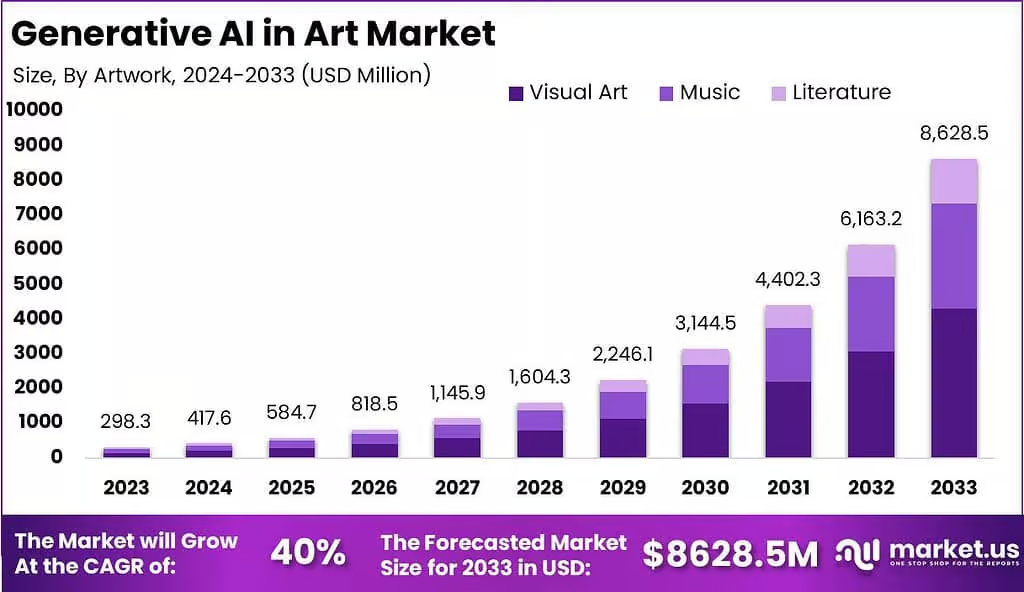
This momentum is further supported by innovations in open-source diffusion models like Stable Diffusion XL, new entrants like Runway Gen-3, and multimodal platforms combining voice, video, and image generation in real time. As enterprises adopt creative automation, AI Art Generator App use cases have moved beyond casual creativity into mainstream SaaS and enterprise content operations.
Why Now Is the Right Time to Build an AI Art Generator App
1. Demand Is Skyrocketing
AI-powered design tools are becoming essential across both B2C and B2B domains. For example, Adobe’s Firefly 3 logged over 2 billion image generations in its first three months of release. Similarly, platforms like Canva’s AI suite are now integrated across 300,000+ teams, which clearly indicates a massive shift in how businesses generate marketing assets, product mockups, and visuals at scale.
The rise of personalized content, faster creative cycles, and remote collaboration tools has positioned AI Art Generator Apps as core productivity tools.
2. API Access Is More Affordable
In 2025, pricing for high-quality generative APIs has become more transparent and cost-efficient. OpenAI’s API for DALL·E 3 now supports prompt-based image generation for under $0.04 per image, while Stability AI’s hosted models allow for commercial licensing of Stable Diffusion XL with affordable compute tiers.
With third-party APIs offering tiered pricing based on volume, startups and indie developers therefore can build AI Art Generator Apps without requiring heavy initial capital and instead focus on development rather than training models from scratch.
3. Availability of Low-Code Tools
Platforms like Replicate, Hugging Face Spaces, and RunPod enable developers to deploy production-grade AI app art generator models with minimal infrastructure setup. These low-code/no-code frameworks support containerized AI models and allow rapid MVP launches using pre-trained backends.
Additionally, integration-ready SDKs (e.g., for Flutter, React Native) make it easier to add AI generation features directly into mobile and web apps without needing to build GPU environments from scratch.
4. Monetization Opportunities Are Richer
The rise of subscription SaaS models, credit-based monetization, and commercial licensing rights has unlocked robust monetization channels. According to a report, top-performing AI Generated Art Apps generate between $30,000 and $250,000/month, depending on user volume, features, and B2B licensing options.
NFT marketplaces, digital downloads, creator tipping, as well as API reselling (white-labeled endpoints) now collectively provide creators and founders with multiple paths to revenue.
Key Features of an AI Art Generator App
Designing a successful AI Art Generator App requires a feature set that addresses not only creative power but also user experience, monetization, and developer extensibility. Here’s a categorized breakdown.
Core Features
1. Text-to-Image Generation
This is the backbone of any AI art app, as it converts user prompts into coherent, stylized visuals. Typically, most use diffusion-based models trained on curated datasets in order to handle semantic understanding and output diversity.
2. Image-to-Image Generation
Users upload a base image and apply styles, transformations, or enhancements. This is widely used for concept art refinement, character design, and brand mockups.
3. Art Style Selection
It also includes predefined styles like anime, oil painting, cyberpunk, pixel art, and more. In addition, models like DALL·E 3 and Midjourney V6 now support prompt-weighted style injection.
4. Image Resolution Selector
Offers multiple resolution tiers (e.g., 512×512, 1024×1024, 4K). Upscaling may rely on separate pipelines (see 4.3.2) or pre-rendered high-res models.
5. Prompt Library
Helps users discover high-quality prompts and variations. This often includes community-generated content and tagging systems.
6. Live Preview & Image History
Live preview displays intermediate diffusion steps; image history helps users revisit, download, or remix past creations.
User Experience Features
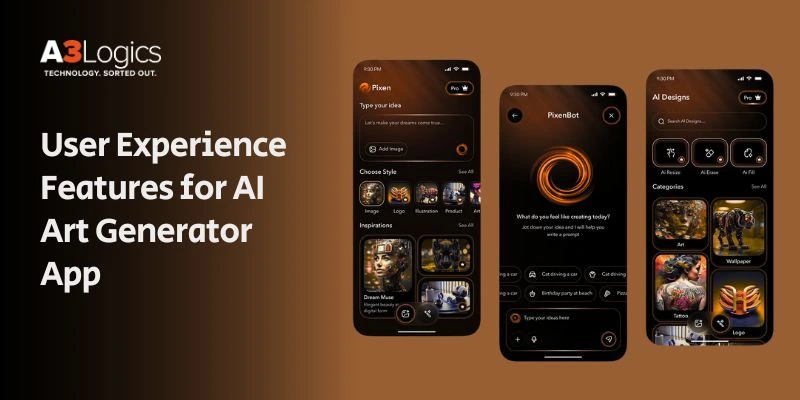
1. Intuitive UI/UX Design
Modern AI Art Generator Apps use minimalist interfaces with rich tooltips, example prompts, and guided navigation to reduce friction.
2. Social Sharing Options
Instant sharing to Instagram, Behance, Pinterest, and Discord. Integration with X (Twitter) or Reddit boosts community interaction.
3. Download With/Without Watermark
Premium plans often offer watermark-free downloads. Free users are encouraged to share branded content, aiding organic growth.
4. In-App Tutorial
Interactive onboarding helps non-technical users quickly grasp prompt structures and creative tools.
5. Variation & Remix Tools
Users can apply minor tweaks (e.g., change facial expression, background, or style) without rewriting entire prompts.
Advanced & Trending Features
1. 3D Model Generation
Tools like Luma AI or Gaussian Splatting integration allow prompt-to-3D generation, valuable in game design and animation workflows.
2. AI Upscaling and Enhancement
Pixel enhancement through models like Real-ESRGAN or Topaz Gigapixel. These increase resolution without sacrificing detail.
3. Real-Time Collaboration Tools
Shared canvases, prompt comments, and version history allow teams to co-create in real-time, which is critical for B2B use cases.
4. NFT Integration and Blockchain Support
Mint art directly to Ethereum, Polygon, or Solana chains. Built-in wallets and metadata editing are supported by some enterprise tools.
5. Custom Model Training
Premium users or enterprise clients can fine-tune models on proprietary datasets, such as branding, character design, or niche styles.
6. Inpainting & Outpainting
Used to extend or modify parts of an image (e.g., fill missing elements or expand canvas). Runway Gen-3 and DALL·E 3 offer this natively.
7. Face Swapping / Avatar Creation
Integrates Stable Diffusion ControlNet or face alignment libraries to convert selfies into stylized avatars or characters.
8. Voice-to-Image Generation
Converts spoken prompts into visuals, using Whisper + TTS + generative model pipelines. Accessibility booster for visually impaired users.
9. AI Collaboration Tools
AI can now auto-suggest prompt improvements, remix combinations, or batch-create assets for social posts or ad campaigns.
10. API Access for Developers
Expose image generation, remix, and enhancement capabilities via RESTful APIs. Many vendors offer rate-limited free tiers.
Monetization & Business Features (for Paid Apps)
1. Freemium Model
The freemium model offers limited access to core features for free, encouraging user acquisition and viral sharing. Paid tiers unlock premium styles, high-resolution outputs, or faster generation queues. This model is effective for scaling initial adoption while identifying power users.
2. Subscription Plans
Monthly or annual subscription plans are now the dominant model across leading AI Generated Art Apps like Adobe Firefly and NightCafe. Tiers may include unlimited credits, exclusive models (e.g., photorealistic or anime-trained), or commercial license rights.
Example: A $9.99/month tier may include 500 generations, watermark-free downloads, and priority access to upcoming features.
3. Credit System
A microtransaction-based credit system lets users purchase image generations à la carte. This suits occasional users or those unwilling to commit to subscriptions. It also enables cost control over API calls and GPU inference time.
4. Commercial Rights
Users increasingly demand clarity on content usage. Providing clear licensing for commercial usage, either baked into a subscription or sold as an add-on, is a key differentiator. This can include rights for print, resale, marketing, or digital products.
Text-to-Image Models: Which AI Engines to Integrate
Choosing the right foundation model is critical when you develop AI Art Generator App solutions for scalability, style diversity, and commercial flexibility. Below are the most reliable and widely adopted AI models powering today’s leading AI Art Generator Apps.
1. DALL·E 3 (OpenAI)
DALL·E 3 is currently the most semantically aligned and linguistically accurate model available in 2025. In addition, it offers superior coherence for long or complex prompts and is also seamlessly integrated with ChatGPT. Moreover, with prompt assistance, built-in safety filters, and watermarking by default, it’s therefore ideal for compliant and user-friendly implementations.
- Strengths: Best-in-class language-to-image fidelity, available via OpenAI’s API.
- Use Case: Enterprise-grade content generation, commercial licenses, educational apps.
2. Stable Diffusion XL (Open-source)
Developed by Stability AI, this model offers full control, low inference costs, and an active open-source ecosystem. Moreover, it supports custom fine-tuning and ControlNet for pose or composition guidance. Additionally, it runs well on both local and cloud GPUs.
- Strengths: Open-source, customizable, lower operational cost.
- Use Case: Creative control, enterprise fine-tuning, hobbyist developer access.
3. Midjourney (via Discord or API)
Known for its stylized, cinematic imagery, Midjourney’s V6 engine focuses on aesthetic brilliance over photorealism. While it still primarily operates via Discord, beta API access is now available to select partners.
- Strengths: High visual appeal, stylized artistry, engaged community.
- Use Case: Social-based apps, community-driven creative platforms.
4. Runway Gen-3
Positioned as a multimodal platform, Runway’s Gen-3 supports both image and video generation. Moreover, it’s particularly relevant for teams that are integrating AI-generated art into short-form content as well as dynamic campaigns.
- Strengths: Integrated with video workflows, supports inpainting/outpainting.
- Use Case: Video-first apps, multimedia content studios.
5. Google Imagen 2
Imagen 2 boasts powerful photorealistic rendering, especially for fine details and face generation. As of mid-2025, it’s available under Google Cloud Vertex AI with enterprise SLAs.
- Strengths: Clean, high-fidelity images, strong for advertising or product imagery.
- Use Case: B2B SaaS, eCommerce content generation.
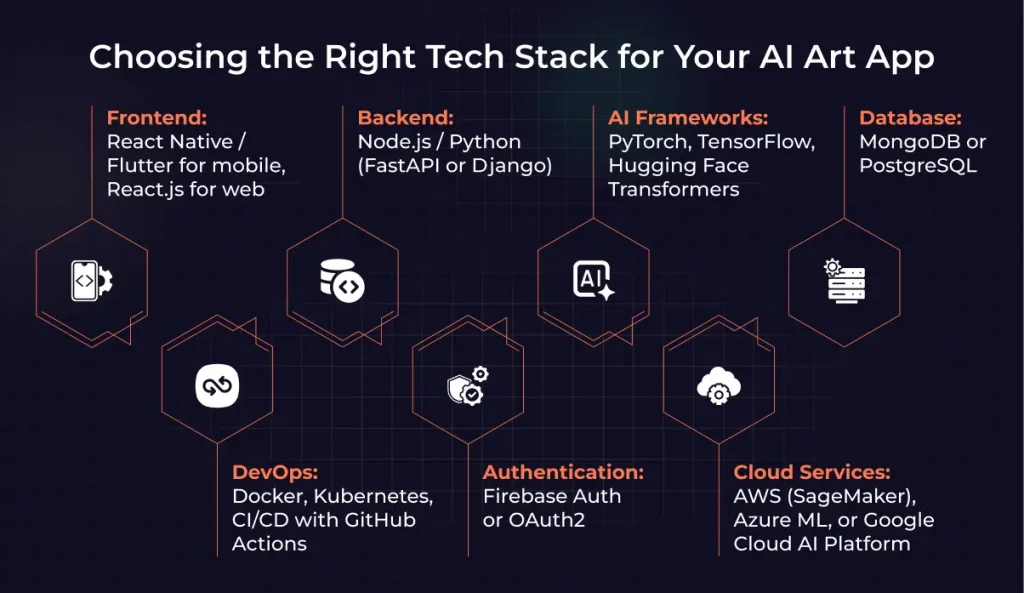
Cost Breakdown to Build an AI Art Generator App in 2025
Building a competitive AI Art Generator App requires careful budgeting across multiple dimensions. Here’s a detailed breakdown:
1. Development Costs
i. AI Model Training and Fine-tuning
If you choose to build and fine-tune your own model (e.g., a custom version of Stable Diffusion), expect costs related to dataset curation, compute (GPU clusters), model validation, and integration.
- Estimated Cost:
- Pretrained model fine-tuning: $15,000–$40,000
- Training from scratch: $100,000+
If you opt to integrate third-party APIs like DALL·E 3 or Runway, these costs drop significantly in favor of usage-based billing.
ii. Frontend and Backend Development
Creating robust UI/UX for mobile (iOS/Android), desktop, or web platforms involves designing generation interfaces, image history modules, tutorial flows, payment gateways, and admin dashboards.
- Estimated Cost:
- Basic App (Single platform): $25,000–$45,000
- Advanced App (Multi-platform, rich UI, analytics): $60,000–$90,000
Hiring an AI Development Company with expertise in GPU-accelerated backends and prompt processing pipelines can reduce time-to-market and ensure architecture scalability.
2. Operational Costs
i. Cloud Computing and Storage
For real-time inference and fast generation, GPU-based cloud instances (e.g., AWS EC2 P4, Azure NDv5, GCP A100s) are necessary. On average, generating a 1024×1024 image can consume 3–6 seconds of GPU time, depending on the model.
- Estimated Monthly Cost:
- Light user base (under 100K images/month): $2,500–$5,000
- Heavy usage (500K+ generations): $10,000–$20,000
Storage for user-generated content, especially high-res versions, also adds ongoing cost (~$0.02–$0.05 per GB/month on S3 or GCS).
ii. API Usage Fees
APIs such as OpenAI (DALL·E 3), Stability AI, and Runway charge per image or per token. For example:
- OpenAI DALL·E 3: ~$0.04–$0.08 per image
- Stability AI DreamStudio Pro: $10–$100/month based on generation limits
- Runway: ~$0.05–$0.10/image or bundled via credits
API costs scale linearly with user engagement. Having a hybrid setup like self-hosted open-source models for baseline users and APIs for premium generation is increasingly common.
3. Maintenance & Updates
i. Ongoing AI Model Improvements
Frequent updates are necessary to incorporate model checkpoints, reduce bias, improve prompt comprehension, or integrate new modalities (e.g., 3D or voice input).
- Estimated Annual Cost: $10,000–$25,000 (depending on whether in-house or through managed services)
ii. Server and Security Maintenance
Includes securing inference APIs, protecting user data, watermarking outputs, and complying with copyright-related API mandates.
- Estimated Monthly Cost: $500–$2,000, depending on scale and compliance needs
4. Estimated Total Cost Range
i. Basic App
A single-platform AI Art Generator App using a third-party API like DALL·E 3, minimal UI, and basic prompt-to-image generation.
- Estimated Cost: $30,000–$60,000
- Time to Market: ~10–14 weeks
ii. Advanced App
Multi-platform with live previews, inpainting, subscriptions, social sharing, and hybrid inference architecture (API + fine-tuned model).
- Estimated Cost: $100,000–$180,000
- Time to Market: ~4–6 months
Working with a provider offering AI Consulting Services can help reduce R&D costs and accelerate deployment through prebuilt ML pipelines and DevOps-ready model hosting solutions.
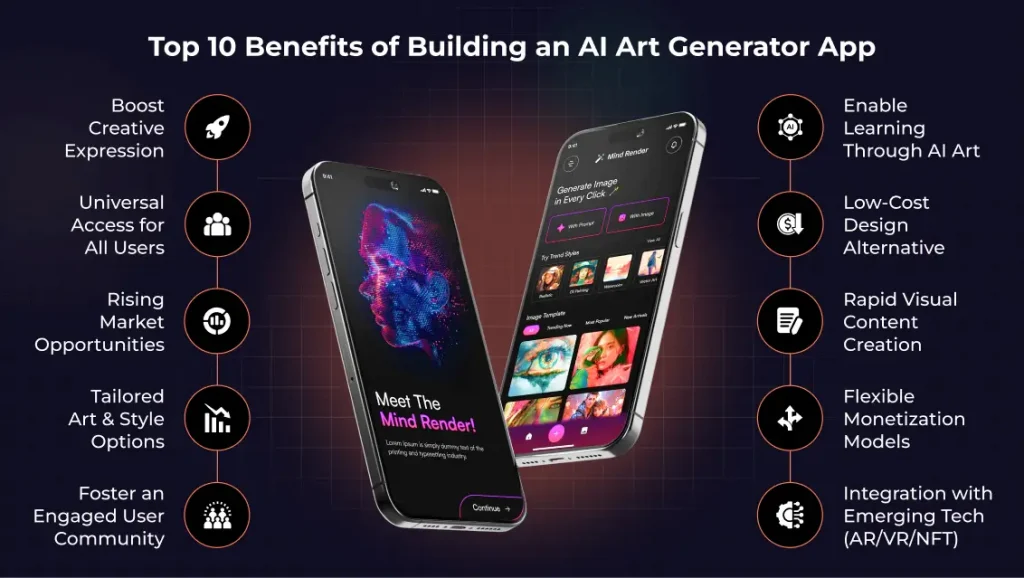
Key Challenges in Building an AI Art Generator App
1. High Computational Costs & Infrastructure
Inference requires GPU clusters with fast memory and throughput. These costs can spike quickly under high user loads, especially during image upscaling or 3D rendering. Scaling must be architected to avoid latency and GPU queuing issues.
2. Copyright & Legal Risks
As the legal status of AI-generated art evolves, developers therefore must track ongoing regulation in the U.S., EU, and Asia. In particular, using copyrighted training data without clear provenance can potentially expose your app to takedown notices or liability. To avoid such risks, opt-in data training and proper disclosure mechanisms are equally critical.
3. Ethical Concerns & Bias
AI models can reflect harmful stereotypes, generate biased imagery, or create NSFW content. Apps must include prompt filtering, safety nets (like OpenAI’s moderation API), and user reporting systems to remain responsible and compliant.
4. Technical Complexities
Integrating advanced features like inpainting, style blending, or custom model training requires expertise in tokenization, CLIP embeddings, GPU container orchestration, and versioning. Choosing the wrong framework (e.g., Hugging Face vs. TensorRT vs. Triton Inference Server) can impact performance or scalability.
5. Future-Proofing Challenges
With the rise of Edge AI, voice-to-image generation, and 3D avatars, ensuring your architecture is modular enough to incorporate upcoming features without reengineering the entire stack is essential. Enterprise clients especially demand longevity in roadmaps.
Best AI Art Generator App in 2025
1. Adobe Firefly 3
Firefly 3 offers advanced text-to-image, generative fill, and vector transformations, all of which are directly integrated into the Adobe Creative Cloud. Furthermore, its licensing model ensures safe-for-commercial-use content, making it especially appealing to enterprise users.
- Key Edge: Commercially licensed content generation with deep integration across Photoshop, Illustrator, and Express.
- Ideal For: Agencies, publishers, and professional designers.
2. Leonardo.AI Pro
Leonardo’s strength lies in its intuitive UX and powerful fine-tuning capabilities. Moreover, it supports model training, prompt management, and AI-generated variations, all while placing a strong emphasis on speed and creative flexibility.
- Key Edge: Custom model training, AI upscaling, and high-res rendering.
- Ideal For: Indie creators and mobile-focused AI app art generator startups.
3. NightCafe Studio
NightCafe democratizes AI art generation by offering both credit-based and subscription models. It supports Stable Diffusion, DALL·E 2, and CLIP-guided diffusion, with a community-driven remix and prompt library.
- Key Edge: Multi-model support and vibrant community challenges.
- Ideal For: Artists, hobbyists, and education use cases.
4. Deep Dream Generator
Though older, Deep Dream remains popular for its psychedelic aesthetic and neural style transfers. It’s often used for stylized content and artistic experimentation.
- Key Edge: Unique neural processing aesthetic and style presets.
- Ideal For: Experimental digital artists.
5. Canva AI Art Suite
In 2025, Canva expanded its AI Generated Art Apps suite, incorporating text-to-image, Magic Eraser, and visual reimagination. The platform’s drag-and-drop simplicity and web-first UI bring AI art to non-designers.
- Key Edge: No learning curve; seamless integration in visual templates.
- Ideal For: Marketing teams, social media creators, business users.
Future Trends in AI Art Generation (2025 and Beyond)
1. Hyper-Realistic & 3D AI Art Generation
Models like Runway Gen-3 and Stability AI’s 3D diffusion pipelines are enabling photorealistic avatars, spatial textures, and asset-ready 3D renders for games and AR.
2. AI-Powered Animation & Dynamic Art
Text-to-video models (e.g., Sora by OpenAI, Gen-3 Alpha) are allowing AI art to move. Storyboarding, animatics, and dynamic layers are becoming part of the generative stack.
3. Personalized AI Artists & Style Cloning
Users can now train “style bots” based on their preferences or existing work, creating digital artist personas with persistent voice, tone, and brushstroke fidelity.
4. Decentralized & Blockchain-Powered AI Art
With NFT demand stabilizing, decentralized rights management and provenance tracking are gaining relevance again, especially in tokenized image marketplaces.
5. AI + AR/VR/XR Integration
Apple Vision Pro and Meta Quest are driving new immersive art canvases where real-time generation can occur inside spatial interfaces.
6. Edge AI: Art Generation on Devices
Thanks to on-device GPUs (e.g., Apple M4, Qualcomm Snapdragon X Elite), AI app art generator capabilities are moving to phones and tablets, reducing latency and enhancing user privacy.
Why Choose A3Logics To Develop an AI Art Generator App?
A3Logics brings over two decades of experience and a portfolio of 500+ successful AI and software projects. As an established AI Development Company, we help startups and enterprises develop AI Art Generator App solutions with:
- Expertise in AI Model Integration: From DALL·E 3 and SDXL to custom LoRA and fine-tuned ControlNet workflows.
- Full-stack Delivery: Web, mobile, and cloud-native app development with security-first architecture.
- MLOps and DevOps: Seamless deployment, scaling, and continuous improvement of inference pipelines.
- Enterprise AI Chatbot Development: Extend your art platform with conversational UI or prompt-based assistants to guide users through creativity.
Our teams combine model fluency with world-class UX, helping clients move from idea to monetized platform with speed and precision. For businesses looking to capitalize on the growing wave of AI Generated Art Apps, A3Logics delivers AI Consulting Services that ensure both vision and execution align perfectly.
Conclusion
The convergence of generative AI, edge computing, and immersive design interfaces is reshaping digital creativity in 2025. Whether you are a startup founder, design-tech innovator, or enterprise leader, building an AI Art Generator App now offers not only technical excitement but also business advantage.
With a rapidly expanding user base, diverse monetization channels, and mature open-source and API ecosystems, the barriers to entry are lower than ever. Yet success hinges on strategic choices, the right features, models, infrastructure, and partners.
Powered by scalable cloud and GPU infrastructure, today’s art apps can serve millions and empower them to create like never before.