The emergence of the AI Music Generator App is a testament to a digital revolution, that is providing both musicians, producers, and music fans new creative opportunities. Applying advanced generative technologies to create original compositions, responsive adaptations to user indications, and automating much of the workflow that exists to produce music, the AI Music Generator App is a cutting-edge example of what is possible in today’s digital age.
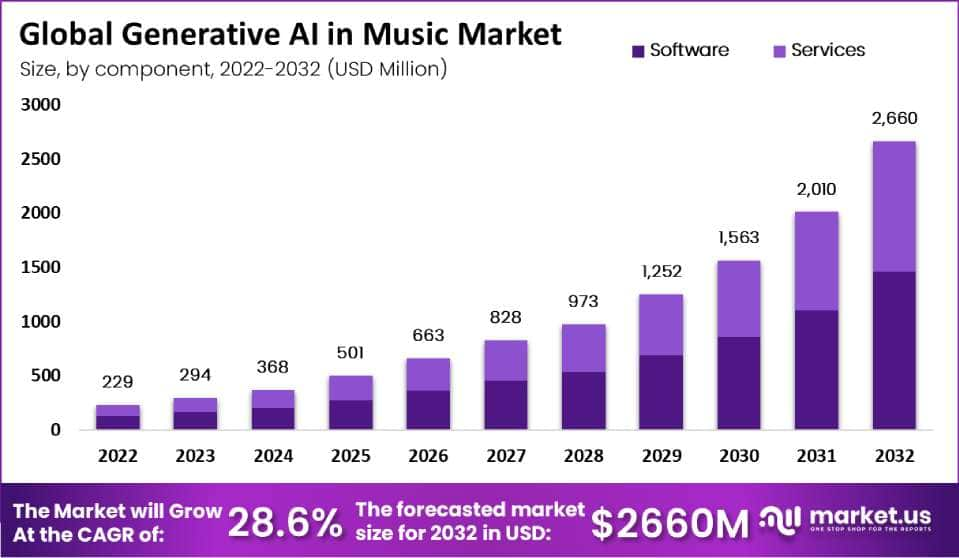
Recent projections of market growth suggest that the AI music market will add up to 2.6 billion dollars in 2032, based mostly on the development of AI Music Generator Apps, and the growth of generative music platforms like AI Music Video Generator App.
Businesses and creators are using developments like AI Music Generator Apps to produce royalty-free tracks, create original soundscapes, or produce actual AI music videos. AI is making creativity accessible, and it is important to understand how to maximize the use of tools like an AI Music Generator App Online, for anyone with an interest in this rapidly evolving industry.
Here in this post we are going to discuss the process of creating an AI Music Generator App and what the primary features it must have in detail. Not only this, we will also understand the cost of AI music generator app development to help you proceed ahead with complete clarity.
Understanding AI Music Generation
AI music generation combines interdisciplinary approaches through deep learning, neural networks, natural language processing, and digital audio processing to generate new music. The use of generative AI for music generation is done by training algorithms with various genres, instruments, and actions to build auto-generated music arrangements, melodies, and units of lyrics compositions. Computers analyze datasets to offer more composers tools to imitate the sound of their favorite artist, develop a new genre of music, or just create music using sophisticated applications.
Potential users of an AI Music Generator App technology include:
- Artists trying to find new inspiration
- Members of the DIY community looking for easy to create ‘custom’ tracks
- Businesses looking to create a distinct unique sound
- Teachers and students learning about digital music
- Entertainment and Media companies looking for background music or scoring
Why Invest in AI Music Generator App Development in 2025?
The AI Music Generator App Development sector has substantial potential for technology companies, entrepreneurs, and creative agencies. The market as a whole is anticipated to grow at a rate of 30% year-on-year up until 2030 due to the increased adoption of music in streaming, gaming and content production. Some of the many advantages include:
Scalability & Cost Savings: AI Music Generation Apps cut back on manual production time and costs exponentially which fast tracks the mass production of original tracks.
Personalization: The algorithm produces monthly music lists based on user selections which keep listeners engaged and returning.
Expanded Creative Frontiers: Artists can try new sounds, genres, and styles at will as the potential for limitless AI-generated new ideas allows artists to explore creative boundaries.
Monetization: There are different paths to monetization from selling tracks to subscription service, all the while becoming increasingly aware that unique content is going to be more sellable or a source of value.
Whether you are a company that wishes to support clients internationally, or an AI Consulting Company that aims to support enterprise innovation, the AI music technology arena offers many opportunities for growth in the entertainment, advertising, wellness, and education sectors.
Must-Have Features of an AI Music Generator App
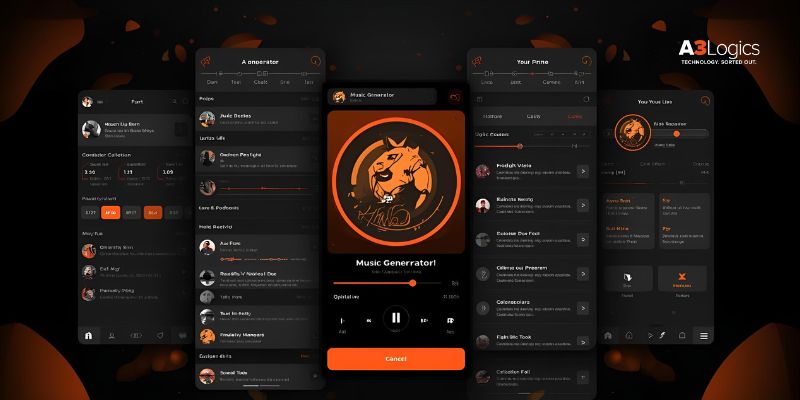
Whether your Generative AI Music App is powerful or not, every similar app will include a combination of key, plus, and differentiating features.
Core Features
1. AI-powered Melody & Rhythm Generation
These abilities are what any AI Music Generator online App does. By taking user inputs, style, tempo, mood, AI models can output unique melodies and rhythms, allowing the user to have a composition that can give them professional quality music in seconds. The technology behind the app fulfills this task using frameworks like TensorFlow or PyTorch, and makes sure the AI output is coherent and has musicality so it feels like the output comes from a musician, not a computer, whether they are someone with a musical background or someone without.
2. Customizable Genres, Moods and Styles
Users can choose from a wide range of genres , moods, and styles, thereby allowing the AI engine to directionally adjust its generative process. Customization is a major factor in user satisfaction and ultimately user retention, and it is a must-have feature of modern AI Music Generation Apps.
3. Real-Time Collaboration and Editing
Collaboration features allow multiple users to co-edit tracks, share drafts, and brainstorm creative ideas in real time. This will enable the building of community engagement which is important for viral growth and organic marketing.
4. Vocal Synthesis (Text-to-Singing AI)
Some of the more advanced AI Music Generator Apps include singing synthesis capabilities , whereby the AI can generate vocals from input lyrics. This allows the user to generate a full song completely from scratch, and even simulates celebrity and custom voices.
5. Text-to-Music / Text-to-Song
Another core feature of AI Celebrity Voice Generator App includes the ability to prompt text (ideas, emotions, lyrics) to a full musical arrangement. By integrating Natural Language Processing (NLP), the app will examine the user-written text and provide tracks that are melody-appropriate and fit the sentiment and story.
Advanced Features
1. Multi-Track Arrangement
Advanced apps like AI Music Video Generator make it easy to layer tracks (vocals, instruments, beats, etc.) with complex song building capabilities, and mimic the finetuning of song production in a digital audio production studio.
2. Lyric Generation using NLP
AI Music Generator Apps use large NLP models like GPT-4, to auto-generate lyrics that correspond to the musical tone, genre, and mood they requested for their specific song – making song writing available for everyone regardless of songwriting experience.
3. Digital Audio Workstation Integration
Professional creators need easy export and import of their AI-generated tracks into the application they are using such as Ableton, FL Studio, Logic Pro etc. APIs or a plugin integration with the DAW is necessary for a serious production workflow.
4. Royalty-free Music Licensing
An AI Music Generation App must make available tracks that are obviously ultra-clear with royalty-free or do with loss licensing that a user can monetize and/or distribute to take the legal uncertainty away from a wide variety of stakeholders.
5. Audio Separation | Stem Generation
The advances in AI are now so great, that it can separate vocals, drums, bass, and all other stems in songs, to help the user remix, edit, or use as different pieces of creativity and music mixing altogether.
6. In-Application Editor
An audio editor built into the application allows users to tweak their tracks, adjust EQ, trim sections, apply effects; all of a sudden it can feel like the application is a portable studio.
Step-by-Step AI Music Generator App Development Process
A development plan for an AI Music Generator App Online consists of a few distinct stages, which are similar to the processes above, but with some added details:
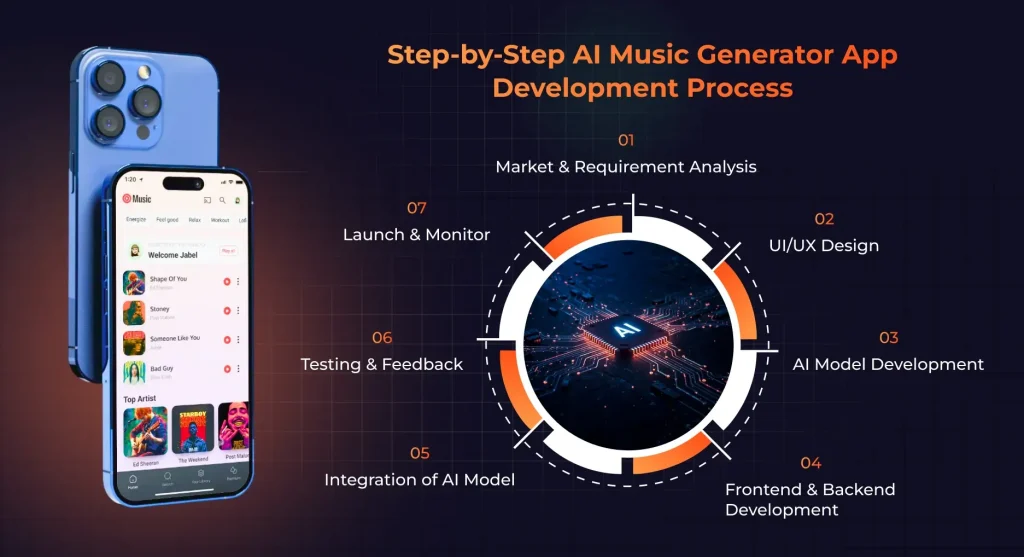
1. Market Research & Requirement Analysis
Begin by identifying the target audience: artists, influencers, agencies, brands, etc; and conducting a competitive analysis (reviewing Vox, Boomy, Suno, Musicfy, etc) to identify strengths and opportunities; and collecting datasets from compositions across a variety of music genres so the AI can train properly. You will want to define any regulations or compliance surrounding copyrights to avoid potential issues with IP.
2. UI/UX Design
Design a UI that’s attractive and easy for users to engage with and explore, using the latest UI frameworks (React Native; Flutter). You want to provide your user an accessible UI that is easy to navigate while allowing users to select their theme (colors and features) to promote creativity. User retention is driven directly by consistent themes (colors, icons, typography, etc.)
3. AI Model Development
Select a neural architecture (RNN/GAN/Transformer) based on the complexity of features your app will support (melody, lyrics, stem separation). Take advantage of training frameworks provided in Tensorflow, Pytorch, and data science libraries. For best results, iteratively refine your models with high-quality datasets to maximize output coherence and user satisfaction.
4. Frontend & Backend Development
Build strong server-side infrastructure; using Node.js or Django will deliver strong performance. Choose a relational database to support your many features (PostgreSQL, MongoDB), and use robust cloud services (AWS, Azure, etc.) with real-time processing libraries.
5. Integration of AI Model
Integrate the trained models that you invested so much time and energy into when developing your app architecture, taking advantage of generative composition, vocal synthesis, and audio editing capabilities. Consider APIs to allow your products to cross platforms for third-party integration.
6. Testing and Feedback
Testing must be thorough for bugs and glitches, including audio quality and user experience. Use both automated and human tests and consider security, accessibility, and effective operation. After the initial launch, get feedback from users, and utilize feedback to optimize or add features in subsequent launches.
7. Launch and Monitor
When your app and the technology is ready to launch, launch everywhere you possibly can (App Store, Play Store, web/cloud), and until then make sure you are using the best tools and analytics to capture the right data (Google Analytics, Redshift, BigQuery, etc.) and utilizing the full power of push notifications to get users and to keep users engaged. Give users the best support possible, and continuously improve, you will have every opportunity for success!
How Much Does It Cost to Build an AI Music Video Generator App?
The costs for developing a Movie Generator with music and an AI Music Generation App can vary depending on how deep the features go, the complexities of the tech and the approach to launch.
- MVP (Minimal Viable Product) – $20,000 – $50,000 (Basic music generation, limited customization)
- Growth Stage – $50,000 – $120,000 (A lot more music genres, lyrics, collaboration features, export features)
- Enterprise Level – $120,000 – $200,000+ (A lot more features: multi-user, royalty-free, brand integrations, DAW integrations, advanced deep-learning AI features, deep-dive analytics, scalability)
- Most apps will take on average 16 – 20 weeks to develop and based on your goals. Investing in the proper infrastructure, cloud services and post-launch support will go a long way and build long-lasting client trust.
Key things that impact costs:
- Team expertise and location
- Amount of time required for AI model training and R&D
- Quality of UI/UX design
- Licensing and legal consultation
- Levels of infrastructure hosting and scalability
Real-World Examples of Best AI Music Generators
These platforms showcase the diversity and power of Generative AI Music Apps in action:
| Name | Key Features |
| Boomy | Instant song creation, collaborative editing, free and premium tiers, advanced export, mobile/web support |
| AIVA | AI-composed orchestral music, customizable genres, robust melody and mood selection |
| Soundraw | Real-time composition, genre & mood selection, unlimited exports |
| Endel | AI soundscapes for wellness, personalized playlists |
| Amper Music | (Now Shutterstock) – Premium stock music, sophisticated AI composition |
| Mubert | API for real-time music generation; scalable for apps, games |
| Loudly | Instant music generation, AI-powered remix tools |
| Musicfy | Text-to-music, AI lyrics synthesis, social sharing features |
How to Monetize Your AI Music Generator App?
For a successful AI Music Generator App, the possible options for monetization include:
- Subscription Models: Charge recurring fees for premium features, HD music, or exclusive music genres.
- Freemium Tiers: Users access basic functionality free. Offer paid upgrades for the user to get access to other features and tools of your app.
- Pay-per-use: Users purchase/download the tracks/audios that they generate and the app provides opportunities for monetizing their content.
- Advertising: Add in-app ads, targeting users based on their musical preferences.
- B2B Licensing: charge music producers or brands the rights to use the music they create for commercial purposes.
- Collaborative Fees: Charge for real-time or collaborative music making and also access to export from the cloud.
Challenges in Building AI Music Generation App
Though there are many opportunities, developing a high quality AI Music Generator App Online is not plain sailing:
1. Data Quality & Diversity
To build a powerful AI Music Generator App, developers must have access to huge, high-quality musical datasets across a wide array of diverse genres, cultures, and languages. Having musical data which is poorly curated or has limits can result in uninspired, repetitive music that cannot inspire the creative users of the app. The challenge is to gather and license an array of data that has the most value when it is contemporary, classical, and obscure, fairly.
The balance of coverage is important when ensuring your app does not create reproducible cultural or musical biases that dissuade global users from utilizing the app in a fair and equitable manner.
2. Legal Complexities (Copyright & Licensing)
When making a Generative AI Music App, the developer has to be careful because music copyright law and IP laws are changing. Since the AI generally must learn from copyrighted works, there is a risk that tracks that are generated may inadvertently convert multi-layered protected melody-lines with or without samples. Developers can be careful by ensuring that the app only accepts properly licensed or royalty-free input data, and let the user know how the generated content can and cannot be fully used, monetized, edited, etc.
The best thing to do is discuss these matters with legal advisers and get a clear agreement with users about ownership and usage rights in any of the generated music created by the app. Trying to avoid a variety of lawsuits along the way or ambiguity around the user’s ownership and usage rights of the music being produced by AI will be tough.
3. Scalability & Performance
When processing audio in real-time, especially for elite and complex multi-track arrangements or collaborative situations, you will need the utmost backend infrastructure and the fastest, least obtrusive cloud resources. As user bases increase, and bottlenecks arise, a certain level of interactivity is replaced with slow rendering, app crashes, and essentially unusable programs.
4. Personalization vs. Privacy
Personalization and privacy through content recommendations, genre recommendations, recognizing notable “moods,” or user anchoring in an act of creativity generally necessitates analyzing a user’s activity, their preferences, and potentially their biometric feedback. Finding the right AI Development Services with experience in AI and music is your first step to overcome these hurdles.
Future of AI in Music Generation
Going forward with AI Music Generator App Development:
1. Hyper-personalized Audio Creation
Future AI Music Generation Apps will harness user listening behavior, real-time responsiveness, mood, and even biometric data (heart rate, emotion analysis, body temperature, etc.) to create personalized soundtracks for every situation. With spectacularly personalized soundtracks, users would receive real-time updates; this goes far beyond standard genre.
The soundtracks will be modified in real time according to the user’s intent and physical state. Examples include studying, working out, meditating, or other personal activities that influence listening needs.
This intelligent personalization sets new benchmarks for engagement and creativity in music experiences.
Every user receives uniquely generated compositions tailored specifically to them.
2. Seamless Integration of Music and AI-powered Video
The soon-to-be enhanced AI Music Video Generator will merge the line between audio and visual creation. The upcoming generation of apps will easily create synchronized, visually stunning music videos that will be developed as the music produces creation. Creators & brands will quickly compose, re-edit, & publish iterable music videos that are both sonically and visually original.
A deep learning model will smoothly aggregate and create videos and music based on user prompts.
This empowers creators to tell multimedia stories that move as quickly as human imagination.
It generates complete, ready-to-go multimedia productions tailored to diverse creative needs.
The system opens a wide range of creative options for every user.
3. Emotion-mapped and Context-aware Soundscapes
Generative AI Music Apps will soon be utilizing environmental data, social context, and real-time sensory data (via apps, wearables, and smart devices) to create background scores tailored specifically to a user’s situation. For example, think about stepping into a coffee shop and having music adjust based on the tone of the environment, or having a workout playlist that matches your running cadence.
As these technologies emerge and develop, generative music will be able to adjust just as quickly and dynamically as the world outside us, elevating the soundtrack to our everyday living.
4. Celebrity Voice Synthesis & AI Collaboration
With popularization of AI Celebrity Voice Generator Apps, music creators will soon be able to create songs with hyper-realistic celebrities, or collaborate with “virtual artists” that could be created to suit user preferences. The entire music landscape will be transformed for creation, licensing, and how fans engage by the development of radical new income streams for artists and rights holders.
New licensing models and responsible ethical standards to combat misuse will be needed; however, in the end, celebrity voice synthesis is set to disrupt not only music production, but entertainment experiences for creators and fans.
There will be continued collaborations between leading edge developers, platforms and artists – guided by leading AI Consulting Companies and Custom App Development Companies.
Why Choose A3Logics for AI Music Generator App Development?
A3Logics offers industry-leading experience in developing AI Music Generator Apps, pairing years of experience with the latest tech stacks:
- Expert Team: Qualified developers, data scientists, and creative UI/UX designers.
- Agile Work: An iterative workflow, high-quality deliverables, delivered right away.
- Tech Stack: We use TensorFlow, PyTorch, React Native, and AWS Cloud to be as efficient as possible.
- Custom Options: Custom features and a modular architecture for unique business requirements.
- Security: Built in two-factor authentication, and with TLS/SSL and OAuth.
- Seamless Costs: Our estimates are based on project scope, user needs, and where you want to grow.
Final Take
Developing an AI Music Generator App (for professional music video use or to share on Social Media) can be an arduous task. Because of this, proper planning, reactive tech, and great creative vision will be necessary for any project. The need for customizable generative music solutions seems to be increasing, therefore, investing in a platform like this is likely to result in scale growth, continued income, and endless creativity.
If you are looking for any kind of assistance in terms of AI music generator application, then you can always consider connecting with the custom app development company experts at A3Logics and get all the assistance you need.