What if the very mechanism for disbursing loans or insuring a policy could be reduced from weeks to a few minutes?
That’s the promise that drives change in underwriting today. Insurance and lending companies find themselves in the unprecedented position of having to go faster, take less risks, and provide personalized products in a world where data changes exponentially. However, the traditional underwriting process, which is based on manual file reviews and inflexible scorecards, just cannot make it.
Automated Underwriting Software is a totally new generation of systems that merge machine learning, predictive analytics, natural language processing, and robotic process automation to change underwriting from a process that is not just faster but more intelligent, open and wholly customer-centric.
The bottleneck that made things slow is now a competitive advantage!
In this blog, we will cover how this transformation is progressing and what is required to create Underwriting Automation Software systems from the ground up. We will examine the existing technologies, the challenges to be addressed, and the emerging trends. So here we go!
Automated Underwriting Software – Key Statistics
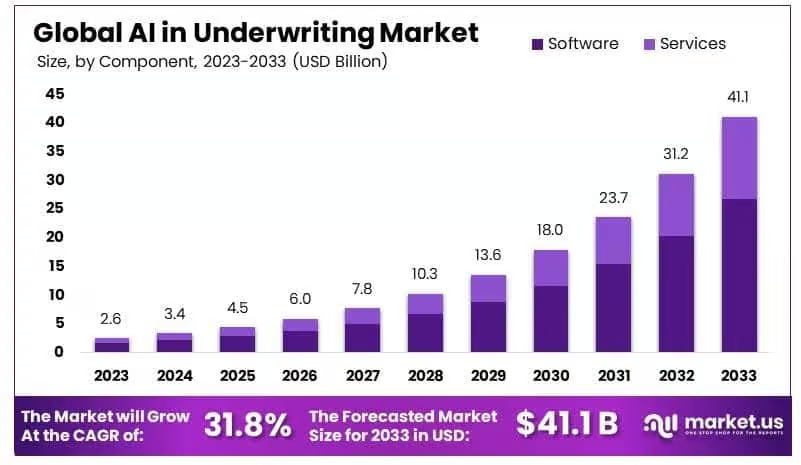
- Market Size: The worldwide AI in underwriting industry is anticipated to reach $41.1 billion by the year 2033, growing at a CAGR of 31.8%.
- AI Adoption: A survey among insurance companies revealed that 53% of the underwriting heads see at least half of the existing manual work to be automated in the near future.
- Efficiency Gain: The average underwriting time has been reduced from weeks to just 12.4 minutes. The AI is the game changer here, maintaining the accuracy upto 99.3% in risk assessments.
- Huge Investment: Over 65% of underwriting and claims professionals are planning significant investments in AI, with many budgeting over $10 million to modernize their operations.
What is AI in Underwriting?
AI in Underwriting is the software that automates, through the use of advanced algorithms and models, the underwriting processes such as assessing applicant risk, determining premium rates, and making decisions that were traditionally executed by underwriters. It changes the underwriting approach from rules-based to data-driven, from stagnant to dynamic.
- What it consists of is taking data from varying sources like credit bureaus, health records, IoT, and financial histories.
- Using machine learning models to predict the likelihood of risks such as a borrower defaulting on a loan or a person filing a claim after an accident.
- The use of natural language processing to comprehend uncontrolled inputs such as notes from doctors or disclosures from customers.
- RPA technology to perform semiautomatic tasks such as document validation and compliance checks.
Ultimately, we have a decision system that is faster to decide and more open to scrutiny.
How Automated Underwriting Software Works in Insurance and Finance?
The Automated Underwriting System adheres to a well-defined lifecycle that combines data pipelines, scoring models, and decision engines:
- Data Collection – The various components of customer data are fetched from internal sources, public databases and third-party APIs.
- Data Normalization – The inconsistent formats get standardized for unification i.e. compatibility across e-platforms.
- Risk Assessment – The AI models evaluate creditworthiness, mortality risk, or fraud probability.
- Decision Engine – The processes of approving, declining and referring to a manual review are all automated.
- Feedback Loop – The ultimate results are brought back for the models to learn and improve further.
In finance, Automated Mortgage Underwriting Software enrolls income, credit, and collateral data to issue conditional approvals. In the insurance sector, Automated Insurance Underwriting Software uses predictive models to set the policy terms according to customer risk profiles.
Both cases eliminate human review reliance but still have a manual check for tricky or borderline cases.
AI Technologies That Power Automated Underwriting Software
1. Machine Learning: The Brain of the Operation
Machine learning backs the concept of AI in Underwriting, helping the systems recognize patterns in huge data sets. Such associations are not possible with standard scorecards. Historical loan performance or claim outcomes provide data for supervised learning models, and anomaly detection relies on unsupervised learning.
For instance, underwriters anticipate claim severity with the help of ML in Insurance, whereas lenders resort to gradient boosting algorithms for refining risk scoring.
2. Predictive Analytics: Forecasting Future Risk
The predictiveness arises when we have historical data combined with the real time inputs. In the case of Automated Underwriting Software, underwriters can easily simulate “what-if” conditions. This is done to check how macroeconomic changes or health trends can influence risk.
3. Natural Language Processing (NLP): Reading Between the Lines
NLP allows the systems to clarify unstructured pieces of paperwork such as doctors’ notes, property assessments, and customer communications. This function reduces the bottlenecks in underwriting pipelines where human underwriters would otherwise take a manual check on files. In life insurance, NLP tools take crucial health indicators from EMRs, while in property insurance, they process adjuster notes to highlight the discrepancies.
4. The Role of Robotic Process Automation (RPA)
RPA automates tasks that are repetitive. Tasks may include cross-checking customer data against a compliance checklist or verifying the KYC process. By automating these mundane tasks, RPA helps to maintain error rates and reduces the time needed for decision-making.
The Strategic Advantages of AI-Powered Underwriting
1. Faster Decision-Making
The Automated Underwriting Software, which can give near-instant decisions, is a remarkable customer experience transformer. For instance, fintech lenders endorse loans in less than 10 minutes compared to the traditional process that takes several days for approval.
2. Improved Risk Assessment
AI is used to extract more information about the individual risk by processing vast amounts of data like social media signals, telematics, and wearable health gadgets. This means that scores like FICO are not used that bluntly, which leads to fairer results.
3. Enhanced Fraud Detection
Insurance fraud makes up nearly 10% of the total losses in the industry each year. The use of AI allows to spot erratic behavior patterns, such as minor repeat claims or incorrect income, by the trained models based on long datasets. Therefore, it helps not only to protect profit but also to comply with policyholders.
4. Data-Driven Market Expansion
AI empowers insurance companies to underwrite sectors that were previously not covered due to data insufficiency. For instance, an alternative credit scoring system assists thin-file applicants to get loans. On the other hand, the automated risk model helps in making micro-insurance financially feasible.
5. Personalized Products and Customer Experience
The automation of underwriting is a strong support for hyper-personalization. Real-time pricing, owing to dynamic tariffs, is applicable in the insurance field as it is possible to adjust premiums using actual risk such as telematics-based auto insurance. This not only aligns the interests of both parties (the provider and the customer) but also helps to build loyalty.
6. Scalability and Adaptability
Automated systems facilitate the processing of mass applications, such as those for mortgages during periods of low interest rates. As a result of scalability, organizations can remain agile even in challenging times.
7. Continuous Learning and Model Improvement
AI models refine and learn by themselves. Every single default loan or claim outcome increases the standard of the system. The self learning of AI models makes risk management stronger in the long run.
8. Competitive Advantage and Innovation
Organizations that adopt Underwriting Automation Software early are gaining the competitive edge. For instance, Lemonade and other digital-oriented insurers have developed their competitive advantage around instantaneous underwriting. Consequently, traditional players are now compelled to adopt such capabilities as a minimum requirement to compete.
Step-by-Step Process to Develop Automated Underwriting Software
Step 1: Define Business Objectives
Every software development only takes off with a strategic alliance. Organizations need to indicate whether the main goal is cost reduction, quicker individual loan approvals, better fraud detection, or wider market reach. The exact objective or intention of the project is needed to make the system design effective.
Step 2: Data Collection & Preparation
A considerable part of underwriting consists of accurate data. It consists of two types of data: structured data (credit scores, claims history) and unstructured data (medical notes, financial statements). Data cleaning and normalization render bias obsolete and improve output quality.
Step 3: Choose the Right AI Technologies
The adoption of a comprehensible technology stack is critical for organizations. In regulated environments, the use of more transparent logistic regression models is more favorable in the case of opaque deep learning methods. It is best to partner with a well established IT service provider to help you get clarity on the tech stack.
Step 4: Design Software Architecture
Automated Underwriting Software system architecture should encompass data flow lines, model training sectors, decision engines, and APIs to allow external services to be plugged in easily. Cloud-native infrastructure is paramount to ensure the scalability and resilience of the system. Microservices that allow for module updates, fast iterations, and easy maintenance are preferred.
Step 5: Build AI Models
These models are built on historical performance data. In mortgage lending, the models would calculate the probabilities of different borrowers defaulting, while claim incidence is the insurance model’s output. Validation against wider datasets ensures general validity.
Step 6: Develop Core Modules
With all the AI models set, it’s time to create the functional modules of the system. These include:
- Risk Assessment Engine – Risk profile is calculated by means of ML-operated models.
- Fraud Detection System – Acts by detecting anomalies and also cross-referencing databases to find potential threats.
- Rules Engine – Aligns the regulatory and the company-specific rules for a coherent decision-making process.
- Integration APIs – This is where the software itself interacts with external data facilities (like credit bureaus, government registries, electronic health records).
The integrity of all modules indicates that the Automated Underwriting System is a complete solution, not just a bundle of tools.
Step 7: Ensure Compliance & Security
The underwriting process is subject to stringent regulations. The compliance frameworks like GDPR, HIPAA, and NAIC Model Laws necessitate the systems to be transparent and fair. Integrating compliance checks into the architecture, building them in, reduces the risk of legal actions. Security control measures such as encryption, role-based access, and anomaly monitoring must be incorporated absolutely from the very beginning to be able to guard customer data effectively.
Step 8: Testing & Validation
The testing process is much more than a collection of functional verification checks. Validation demonstrates that models are free from systemic bias and that they perform accurately across demographic segments. System stress testing against higher application volumes that confirms system scalability is a stress test case, and user acceptance testing is utilized to confirm the workflow alignment.
Step 9: Deployment & Integration
The deployment of Automated Underwriting Software is rolled out in the production environment while it ensures back to back integration with older platforms like policy management or loan servicing systems. Hybrid deployment schemes (cloud + on-premise) are now standard in financial services seeking to maintain both the agility and security of their operations.
Step 10: Continuous Learning & Optimization
One big difference from conventional static systems is that Underwriting Automation Software needs constant adjustment and optimization. The retraining of models with new data is to ensure that they are relevant, while the underwriters’ feedback which is integrated, fine-tunes the usability.
Key Features of Automated Underwriting Software
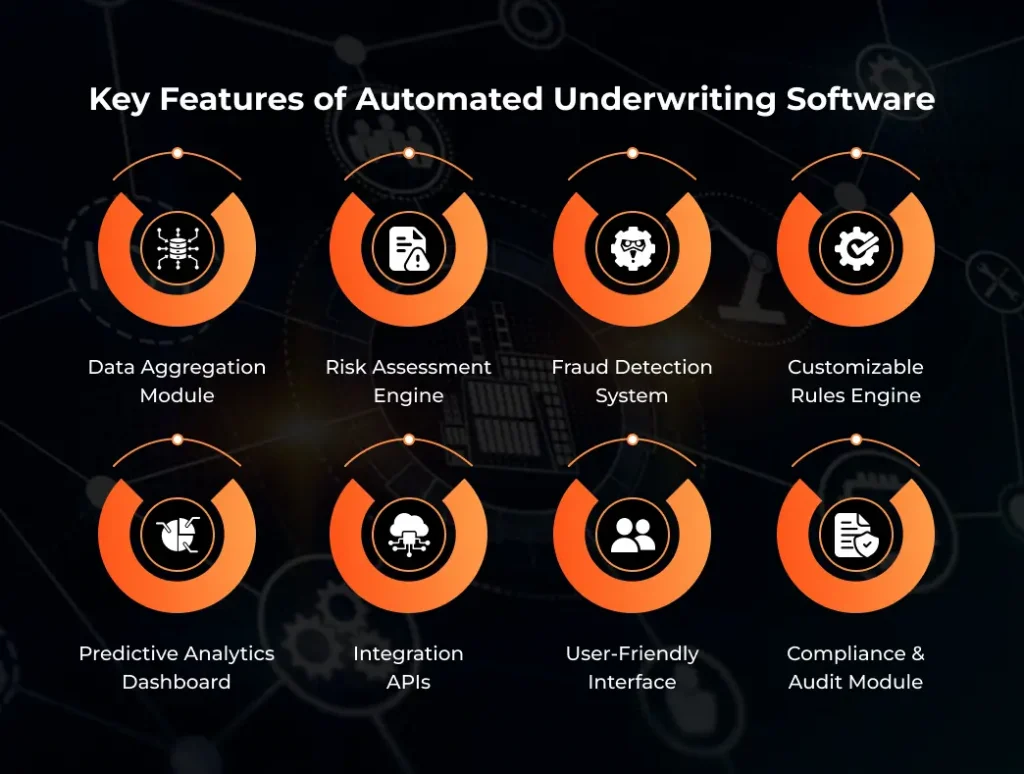
1. Data Aggregation Module
This tool collects structured and unstructured data from the organization, third-party, and IoT sources. The result is a detailed risk profile.
2. Risk Assessment Engine
Apart from other advanced AI models, the evaluated models include those on credit, mortality, and property insurance. Model integration with actuaries ensures accuracy.
3. Fraud Detection System
It uses anomaly detection and predictive analytics to identify real-time fraud indicators. Thus, claims leakage and loan losses are down.
4. Customizable Rules Engine
Insurers and lenders can enforce not only the regulatory rules but also the internal ones with the help of the rules engine. Customization is an avenue for aligning regional requirements and business strategies.
5. Predictive Analytics Dashboard
It offers decision-makers, the latest insights, trend visualizations, and performance benchmarks. Dashboards that are transparent for regulators and executives are among the most acceptable forms of communication.
6. Integration APIs
APIs are the connection points of the system with CRMs, core banking software, policy administration platforms, and credit bureaus, thus data is efficiently shared across the entire ecosystem of enterprises.
7. User-Friendly Interface
The interfaces are intuitive, with dashboards and guided workflows, to increase the uptake by underwriters, claims adjusters, and compliance officers.
8. Compliance & Audit Module
It tracks the decisions, logs the usage of the data, and prepares compliance-ready reports. This is a shield for those who are against money laundering and terrorist financing by adhering to the regulations.
Challenges of Developing Automated Underwriting Software
1. Data Privacy & Security
It is important to protect the sensitive data like medical records and credit histories against laws such as HIPAA and GDPR. The provision of secure pipelines through end-to-end encryption is mandatory.
2. Bias in Algorithms
Bias may lead to disproportionate harm, particularly in credit and insurance decisions. The institutions must have fairness testing and frameworks to prevent the risk of regulatory penalties and reputational damage.
3. Integration Complexity
Back-end API connectivity is often missing in many of the old banks’ and insurers’ systems. Finalizing the integration of up-to-date underwriting software with a very old feature set is one task that requires too much effort.
4. Regulatory Compliance
AI-facilitated decisions are to be made comprehensible. The use of black-box models is a risk of non-compliance if their verdicts are not justifiable to regulatory authorities or customers.
5. High Initial Investment
Enterprise-grade technology generally requires a big up-front investment in tech, people, and liability mitigation costs. Despite the long ROI being strong, the initial costs are a challenge for smaller companies.
6. Integration with Legacy Systems
The library is filled with institutions that depend on COBOL-based systems or jam-packed databases for troubled workflow modernization. Risks can be mitigated through middleware and phased migration strategies.

Types of Automated Underwriting Systems
1. Rule-Based Underwriting Systems
They operate on the pre-defined if/then logic. They are good for simple, low-risk products but not flexible enough in highly-variable risk situations.
2. Scorecard-Based Underwriting Systems
These systems use numerical scores (e.g., credit score thresholds) for automating decisions. They are still commonly used but are weak in the processing of non-traditional sources of data.
3. AI-Driven Underwriting Systems
They utilize modern ML and NLP models for data analysis and decision-making. These tools are the spine of modern Underwriting Process Automation.
4. Hybrid Underwriting Systems
They are rule-based engines that also combine AI-driven models, each complementing the other – the first providing safety through exact law interpretations and the second offering flexibility through data consumption.
5. Custom Underwriting Systems
They are brought to life by specially adopted vendors or by internal teams to meet the unique requirements of the organization. They often feature proprietary risk models or data that concern specific industries.
6. Mortgage Underwriting System
It’s a system that focuses on evaluating the borrower’s assets and all liabilities. Automated Mortgage Underwriting Software makes the lending process faster, while it still adheres to the standards set by Fannie Mae or Freddie Mac.
7. Insurance Underwriting System
The system is tailored for health, life, and property insurers. The Automated Insurance Underwriting Software includes the patient’s medical records and claims history for the calculation of premiums and exclusions in an efficient way.
Future of Automated Underwriting Software Development
1. Explainable AI (XAI) Becomes Standard
One of the major obstacles that AI in Underwriting is facing is transparency. Regulators are insisting that automated decisions be made clear. XAI ensures that institutions are capable of articulating why a policy was denied or the rationale behind the pricing of a mortgage.
Tools such as SHAP (SHapley Additive exPlanations) and LIME (Local Interpretable Model-agnostic Explanations) are becoming part of the standard suite integrated directly into Underwriting Process Automation workflows, thereby making AI decisions auditable and compliant.
2. Generative AI and Large Language Models (LLMs)
The arrival of Generative AI in Insurance represents an additional paradigm shift. LLMs can comprehend complex policy languages and summarize the necessary disclosures. Thereby, LLM can easily generate plain-language explanations for the customers. This not only fosters trust but also leads to an important reduction of legal ambiguity.
3. Integration with Decentralized Finance (DeFi)
The decentralized platforms have been trying out blockchain-based risk assessment. The combination of Automated Underwriting Software and DeFi protocols can lead to the development of transparent, immutable underwriting ledgers. Smart contracts can instantly change loan terms or insurance coverage driven by triggers in real time, like income changes or IoT sensor data.
4. Low-Code/No-Code Platforms
Insurers and lenders demand agility in the systems. There are many low-code tools available that allow analysts to configure underwriting rules without any developer involvement. This democratizes innovation and reduces dependence on scarce AI engineering resources. On the other hand, it is also advisable to partner with an AI Development Company and build in-house if privacy and data security are a concern.
5. Autonomous Decision-Making with Human Oversight
The route of Automated Underwriting System design is gravitating towards autonomous decisions for low-risk, low-value products, like microloans or travel insurance, while human oversight is left on high-risk cases. The hybrid approach is aimed at achieving both speed and accountability.
6. AI-Driven Regulatory Adaptation
As regulators modify the frameworks to tackle, besides other issues, AI, then the software must have adaptive compliance engines. For instance, NAIC and FINRA are writing principles for the fair use of AI in financial services. Future platforms will select compliance-as-a-service modules that will be self-updating, reflecting the latest legal changes.
A3Logics: Your Trusted Development Partner for AI Underwriting Solutions
Building enterprise-grade Underwriting Automation Software requires deep knowledge in AI, financial services, and compliance.
With more than 20 years of experience, A3Logics is delivering end-to-end Insurance Software Development Services, which cover steps from discovery architecture to AI model training and post-launch optimization.
The main differentiators are:
- Domain Expertise: A3Logics has delivered large-scale systems across insurance, lending, and banking, ensuring solutions align with industry regulations.
- Technology Leadership: From Automated Mortgage Underwriting Software to cross-industry solutions, A3Logics leverages machine learning, NLP, and RPA to design future-ready platforms.
- Security First: Advanced encryption, role-based access controls, and compliance-ready reporting frameworks are embedded into every deployment.
- Integration Capabilities: APIs and middleware expertise enable seamless interoperability with legacy systems, CRMs, and policy management platforms.
- Scalability: Cloud-native architectures ensure institutions can expand capacity as transaction volumes grow.
As a Mortgage Software Development Company, A3Logics also specializes in digitizing end-to-end loan processing, accelerating approvals while maintaining regulatory alignment.
Conclusion
The implementation of Automated Underwriting Software not only helps financial institutions to cut down expenses but also to detect fraud and speed up their processes.
However, the success mainly depends on strong data governing systems, transparent models, and scalable architectures. In 2025, smart leaders are already integrating predictive analytics, NLP, and RPA into underwriting workflows. They are forming AI-first financial ecosystems.
With the right expertise from A3logics, you can also build and be a part of ecosystem building for the world.
Don’t wait for inefficiencies and legacy systems to hold you back. Invest today in a future-ready underwriting solution, and let’s shape the next era of financial services together.
Connect with us now!