
Financial institutions have to juggle more financial data than any other industry. That’s because vast amounts of data is generated from transactions, customer interactions, numerous market indicators, and more. Things are not just confined to collecting this data but also interpreting it so that the potential of this data can be harnessed. Which, obviously, is not possible using traditional means. That’s when predictive analytics in finance comes into play.
In this post, we’ll discuss how companies can use data analytics to gain a competitive edge and also the various predictive analytics models in finance.
Predictive analytics is the use of modeling and statistical techniques to determine future performance based on current and historical data. Predictive analytics models in finance provide organizations with data-driven forecasts and insights. Using these forecasts, institutions can optimize their investment and trading, and at the same time facilitate budgeting.
In the financial sector, decisions can’t be made vaguely or on instinct alone. They must be driven by accurate and relevant data. Using data ensures that every choice is measurable, informed and is aligned with strategic goals.
Financial Analytics Market Trends
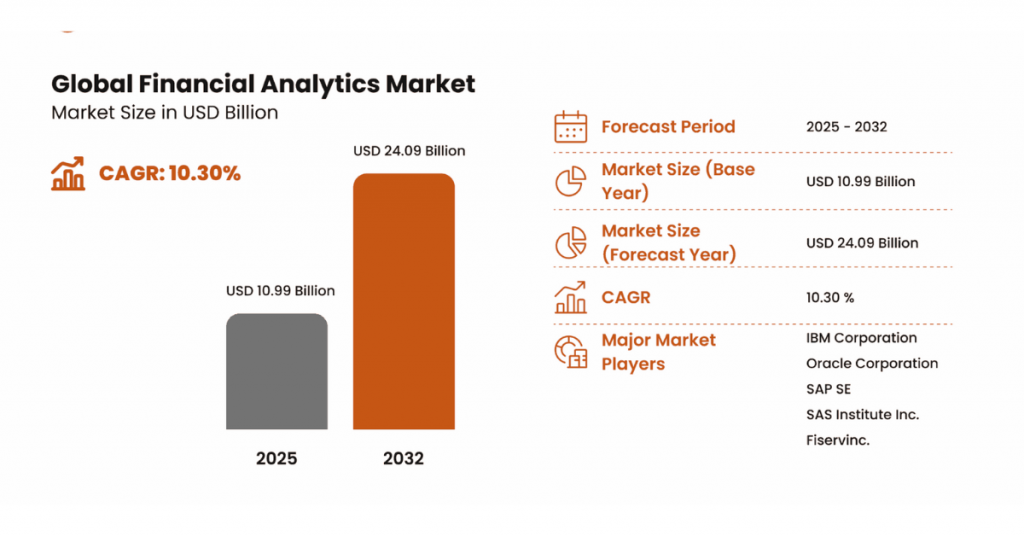
- Current adoption rate across banks, fintech, and enterprises
- With the use of predictive analytics in financial services, especially in risk management, financial institutions reported 20-40% reduction in losses.
- It is projected that by 2028, 80% of corporate finance will use predictive analytics.
- 66% of financial institutions believe that AI tools, including predictive analytics, are crucial for shaping the industry’s future.
- 82% of banks, investment managers and insurers, plan to increase investment in data analytics.
- Emerging technologies shaping financial analytics (AI, ML, Big Data, Cloud)
Here are some emerging technologies that are shaping the future of financial analytics –
> AI
When it comes to interpreting complex financial data, such as complex financial reports, AI is playing a pivotal role. It helps automate decision-making while at the same time adapting to a changing financial market. It can help automate data analysis, collection, and report generation, and also extract and summarize key information from unstructured documents. Since AI can uncover patterns, it also helps manage risks.
> ML
Machine learning is a subset of AI that primarily focuses on utilizing data and algorithms to enhance predictions and identify patterns, thereby improving predictions in areas such as market forecasting or credit scoring. It also helps in detecting hidden patterns.
> Big Data
In simple terms, big data in financial analytics can handle huge amounts of information quickly. It can further help in finding patterns and delivering insights. Using this capability, institutions can detect fraud, make accurate predictions, improve decision-making, and understand customer behavior.
> Cloud
Since financial institutions have to process a large amount of data, cloud solutions can enhance their operational efficiency, ensure robust security and compliance, and improve decision-making. Cloud backups can be particularly helpful in the event of unexpected disruptions.
Top Predictive Analytics Models in Finance
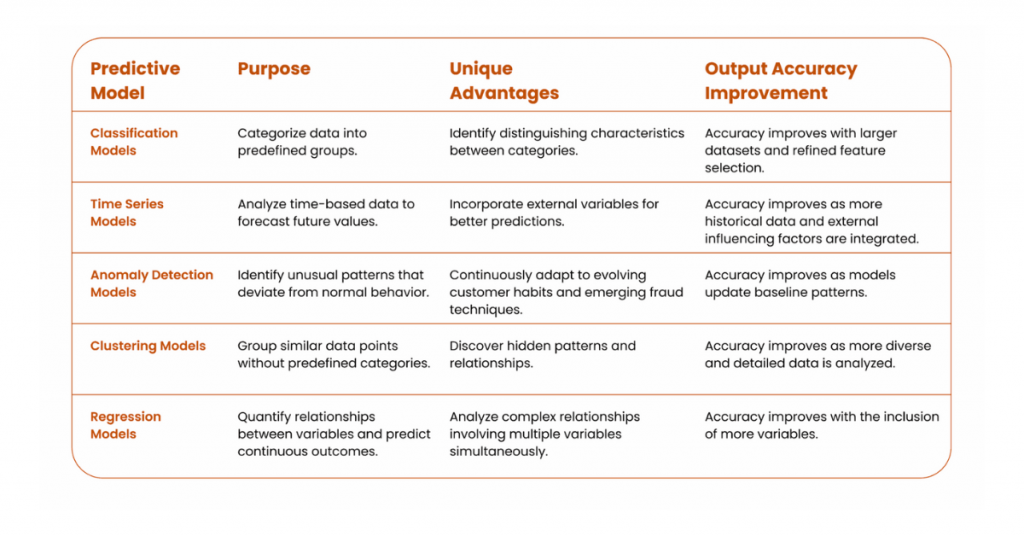
When it comes to analyzing financial datasets, it’s not one size fits all. Hence, it is essential to understand the different predictive analytics models in finance –
1. Classification Models
The model categorizes data based on its learning from historical data, and observes past trends to ascertain unique traits for different classes. For example, the credit approval model may take into account income levels, employment history, and credit score indicators. It is best suited for answering yes or no questions.
The models can help predict answers to questions such as –
- Can a loan be granted?
- Which segment does a new customer belong to?
- Is a particular transaction fraudulent?
2. Time Series Models
The predictive analytics models in finance capture a sequence of data points, using time as the input parameter. The model analyzes patterns, trends, and structures in historical data that are time-dependent and sequential. Considering that financial markets generate a continuous stream of time-based data, these models are used for risk management and investment strategies. It can also be useful in analyzing interest rate and stock price movements. Based on this data, institutions can make informed decisions.
3. Anomaly Detection Models
It is a model that is used to find out unusual patterns that deviate significantly from expected behavior. It analyzes real-time or historical data; flags observations that don’t align with the normal patterns. For instance, the model may track the repayment behavior of borrowers and flag them as potential risk if they miss payments.
4. Clustering Models
These predictive analytics models in finance group things by looking at how they are similar or different. They group together similar data points that have no predefined labels. The model examines the data and then attempts to identify natural groupings or hidden patterns. One example is how stocks or assets are grouped based on price movements, or sector behavior. This can help in identifying similar performing assets.
5. Regression Models
A regression financial model establishes a quantitative relationship between a dependent and an independent variable. For example, a quantitative relationship can be established between stock returns and interest rates. In another instance, relationship between market returns and portfolio risk levels, to predict future stock performance.
Why Use Predictive Analytics in Finance?
Here are some reasons why you should use predictive analytics in finance –
Data-driven decision-making
Predictive analytics in finance enables data-driven decisions by using machine learning, AI, and historical data to forecast future outcomes. This capability lets teams make proactive choices – they can perform fraud detection, investment planning, and financial planning.
Proactive risk assessment
Predictive analytics in financial services analyzes large volumes of data, including transaction records, customer information, and market trends. It uses this data to make informed decisions regarding product offerings, investment strategies, and market positioning.
Improved forecasting accuracy
Predictive analytics in finance helps in accurately forecasting outcomes by leveraging statistical models and data. This is done to anticipate future events; loan defaults, stock movements, and cash flow needs. It helps uncover hidden patterns and helps businesses manage risks proactively.
Competitive edge in the market
Predictive analytics in financial services helps institutions make informed decisions quickly. Institutions can adapt to a changing market. Predictive analytics gives financial institutions the flexibility to react quickly to changing market conditions like stock price swings or interest rate shifts. By spotting these changes early, they can adjust their strategies, discover new opportunities, understand customer needs better, and create innovative financial products.
Use Cases of Predictive Analytics in Finance
Here are some common predictive analytics use cases in finance that show how it’s effective –
1. Stock Trading & Portfolio Management
Predictive models can analyze patterns in the datasets that traders depend on and alter the investment process. In addition to that; diversification models help create a balanced investment portfolio by considering the riskiness of an investment, its potential earnings, and its correlation with other assets. Based on this, it can be adjusted.
2. Budgeting & Accounting
Budgeting and accounting are key examples of predictive analytics use cases in finance. Institutions can use models to analyze past spending, market trends, and economic indicators to create precise budget forecasts i.e. accurately predict future revenues, expenses, and cash flow to guide decision-making.
In accounting – predictive models can help automate routine tasks; tracking cash flows, invoice processing, monitoring accounts receivable, etc. These models can also help flag suspicious transactions so that fraud can be prevented at an early stage.
3. Marketing & Sales Personalization
Predictive analytics in finance can help study customer behavior. The models can help go through customer browsing behavior, purchase history, and demographic information. By being aware of the customer demands regarding financial products and services, institutions can carry out target marketing campaigns and eventually make the right offerings. There are also models that can help find out which of the customer segments can help increase profitability, and organizations can focus on prioritizing customer service for these segments.
4. Credit Scoring
Credit scoring is one of the best predictive analytics use cases in finance. Models monitor real-time user activity, including transaction patterns. They gather real behavioral data and don’t just rely on credit history. After collecting the data, the model formats and cleans it. It uncovers detailed behavioral profiles; income to expense ratios, gaps in payment activity, bill payment frequency, etc. The model learns from the input data and detects patterns that human creditors can’t; strong repayment habits, late payments, and defaults.
5. Fraud Detection & Prevention
With the use of predictive analytics in financial services, financial institutions such as banks can identify fraud at an early stage before it causes any damage. The systems using predictive analytics analyze patterns in transactions that particularly indicate malicious behavior. These systems consider details in a transaction such as size, location, types, etc.
Advantages of Implementing Predictive Analytics in Finance
Let’s discuss some of the key benefits of predictive analytics in finance –
1. Increased Revenues
Predictive models in finance; use past data and market trends to forecast cash flow accurately. This helps organizations plan investments correctly. They can manage their risks and allocate funds efficiently.
2. Easier Financial Planning
One of the advantages of predictive analytics in finance is that it allows for easier financial planning. That’s because it takes into account the wider scope of various factors and yields more precise results. This helps in better resource allocation and it also enhances stakeholder trust in forecasts.
3. Risk Mitigation
Risk mitigation is one of the critical benefits of predictive analytics in finance. It helps lenders prevent defaults by identifying high-risk applicants early on. In another instance, traders can adjust their trading positions using market risk analytics.
4. Superior Customer Experience
Since predictive analytics uses machine learning, it can help provide hyper-personalization. This means businesses can use predictive models to make personalized recommendations to customers.
Final Word
If you are planning to implement predictive analytics in finance, it’s essential first to understand which business areas can benefit from predictive analytics. You can start by identifying short-term business problems that predictive analytics can address. Focusing on these immediate challenges can give you a fair idea of your objectives, and you can allocate your data resources effectively.
For those just starting out; collaborating with an experienced provider in the financial domain can be highly beneficial. A partner like A3Logics can guide you on how you can use predictive analytics effectively – help define your goals, and identify the relevant data resources you can apply.
How Can A3Logics Help?
If you wish to unlock the power of financial data, you can partner with A3Logics, a trusted AI development company. We can help you unlock the potential of data to make smarter decisions, reduce risks, and gain a competitive advantage –
> Expertise in predictive analytics and AI development services
At A3Logics, predictive analytics in finance is our strength. We help businesses forecast trends so that they can make data-driven, smarter decisions and earn revenue. With our AI-driven solutions, they can convert financial data into actionable insights to plan their strategies and respond to changing market conditions.
> Tailored financial software development services
Our custom financial software development process begins with understanding your business goals and data workflows. After understanding your goals, we design solutions using AI and predictive analytics to address key challenges. With advanced machine learning services, we help institutions unlock meaningful data-driven opportunities and optimize performance.