
Financial technology (fintech) is an extraordinary area that has undergone a major change throughout the last few years, with Artificial Intelligence being one of the main agents of change. The finance sector is not an exception to the same as AI in Fintech App Development, transforming the way we engage with money, the way we pay bills online, and how we invest in investment platforms, risk management systems, and more.
The global artificial intelligence (AI) in fintech market is valued at USD 15.7 billion in 2025 and is expected to reach USD 68.5 billion by 2035, growing at a CAGR of 15.9%. Fintech, or financial technology, leverages advanced technologies to enhance, streamline, and automate various financial services, including banking and investment operations.
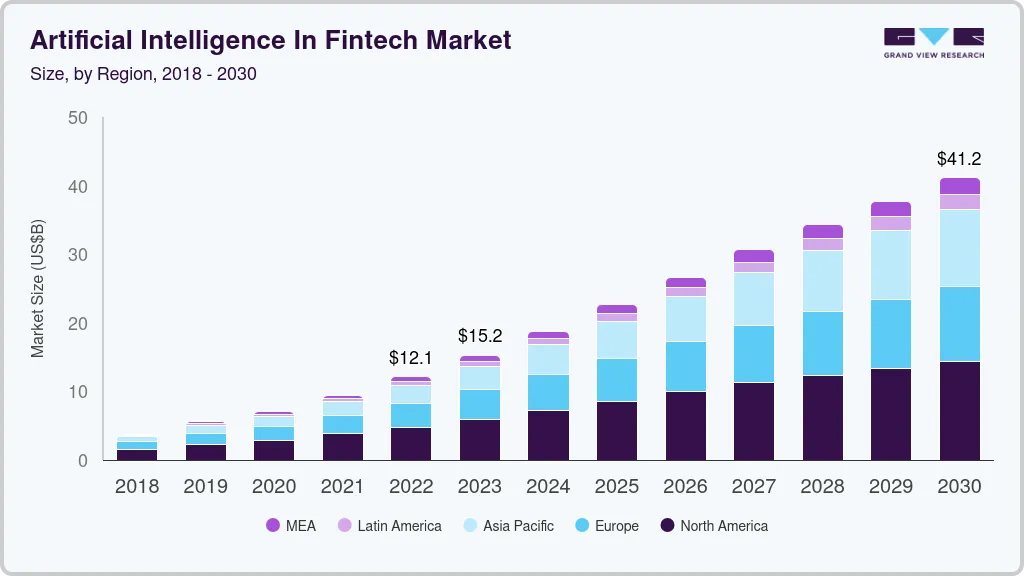
With the aid of AI and Machine Learning (ML) technologies, financial services are becoming smarter and less difficult, enabling them to be more human at the same time. The bespoke recommendations, intelligent automation, and foresight of the current fintech applications can know their customers, be cheaper to run, and take better decisions than ever.
This blog will touch upon how AI and ML are transforming fintech, how they are most often applied, the issues they involve etc.
Understanding AI and ML in Fintech
i. What is Artificial Intelligence (AI)?
Artificial intelligence refers to the duplication of human intelligence by machines. The application of fintech artificial intelligence is used to provide the decision-making process with automation, prevent fraud, predict customer behaviour, and become more efficient in general in terms of financial processes.
ii. What is Machine Learning (ML)?
Machine Learning is a sub-set of AI that enables the system to learn without any form of explicit historical data and programming. Machine learning can be applied in fintech sector to process high amounts of data, improvising risk models, and enhancing user experiences.
AI vs ML: The Key Difference
| Aspect | Artificial Intelligence (AI) | Machine Learning (ML) |
| Focus | Decision making and automation | Learning from the data and making forecasting |
| Goal | Focused human intelligence | Enhance performance over time through data |
| Example in Fintech | AI-powered chatbots for customer service | Machine learning models for credit risk scoring |
Together, artificial intelligence and machine learning empower fintech companies to automate manual processes, enhance security, and deliver intelligent, data-driven financial products.
Key Benefits of AI in Fintech App Development
The benefits of AI in Fintech App Development services are uncountable such as efficient, low-risk, and more customer-satisfactory. Below are the major advantages for the businesses.
1. Enhanced Operational Efficiency
AI-based automation assists to minimize manual work, reduce human error, and shorten the time to process loans, KYC verification, and monitor transactions, ensuring that the processes are faster and more productive.
2. Improved User Experience
AI-based customization means that fintech apps can understand how people use their applications and suggest the services, anticipate their needs, and develop a personalized financial plan, improving customer communication and satisfaction.
3. Advanced Security
The AI and ML identify suspicious actions, fraud, and cyber criminals in real-time. Fintech platforms become safer with time as predictive algorithms are constantly being trained on new data.
4. Smarter Decision-Making
Using predictive analytics, AIs facilitate data-driven insights. These insights are then used in making better lending, investment, and portfolio management decisions by financial institutions.
5. Cost Optimization
Automation minimizes labor expenses, eradicates duplication, and maximizes precision. Gradually, AI enables fintech firms to attain higher ROI without violating compliance and efficiency.

Top AI Use Cases in Fintech App Development
AI in Fintech app development is not a futuristic concept; it is already being integrated into numerous fintech. Below are the most influential AI Use Cases in Fintech App Development.
1. AI Chatbots & Virtual Assistants
AI-driven chatbots provide 24/7 support, give typical searches, and it is possible to give tailored financial guidance. Indicatively, other banks are using conversational AI to improve their customer care service and reduce their waiting time.
2. Robo-Advisors for Wealth Management
Robo-advisors are based on ML algorithms that analyze the trends in the market and form investment portfolios, depending on the risk-taking and objectives of the user. They create a wealth management strategy that is affordable to all people.
3. Fraud Detection & Risk Management
The AI models learn the patterns of the transactions and detect the anomalies in real-time to stop the fraudulent activity. This is useful in creating trust in financial institutions and adhering to security laws.
4. Credit Scoring & Underwriting Automation
The systems using artificial intelligence assess the creditworthiness of a borrower using numerous data points, including online traces and patterns of spending and deliver more credible and faster credit analysis.
5. Personalized Financial Insights
Fintech applications that use artificial intelligence can assess spending patterns, categorize spending and offer saving or investment advice, depending on the financial patterns of individual users.
6. Algorithmic & AI-Powered Stock Trading
AI trading systems process vast amounts of data and other market indicators to make fast and informed trading decisions in many cases, beating conventional strategies that are often human-driven.
7. RegTech & Compliance Automation
AI assists in automating compliance checks and audit trails, as well as regulations reporting. This minimizes the paperwork and makes financial institutions compliant with the changing international standards.
Comparison of Top AI Use Cases in Fintech
| Use Case | Key Benefit | Example |
| AI Chatbots | Enhances user engagement | Kasisto’s conversational AI |
| Robo-Advisors | Automated investment planning | Betterment, Wealthfront |
| Fraud Detection | Prevents financial losses | Mastercard Decision Intelligence |
| Credit Scoring | Faster loan approvals | ZestFinance |
| Personalized Insights | Improves financial literacy | Bud Financial |
| AI Trading | Data-driven trading | QuantConnect |
| RegTech | Simplifies compliance | Ascent RegTech |
Real-World Examples of AI in Fintech
Fintech leaders are using AI to transform the way financial services are conducted. Below are the real-world examples of AI in fintech.
1. Enova
Enova applies the latest AI-driven lending platforms to identify the amount of creditworthiness more efficiently and expeditiously. The predictive analytics model enhances the rate of loan approvals, minimizing risks, and performance of the portfolios by constantly learning about the behavior of the borrowers and real time financial data.
2. ZestFinance
ZestFinance aims to provide machine learning algorithms on credit underwriting to enable lenders to make more transparent, fair and fast loan decisions. It reduces bias and expands access to credit on underbanked consumers using thousands of non-traditional data points.
3. Canoe
Canoe uses AI-based automation to eliminate, label, and verify complex financial document data to asset managers. This will save much in terms of mainly man-hours of work, eliminate problems of mis-entry of data and allow firms to focus on analysis, compliance, and efficiency of client service.
4. Bud Financial
Bud Financial is a combination of AI and open banking data to provide insights into the customers. Its artificial intelligence assists banks with offering personalized product suggestions, enhancing financial wellness products, and designing customized digital experiences that enhance customer experience and trust.
5. Kasisto
The conversational AI system of Kasisto is used to develop intelligent bank chatbots that can comprehend natural language. It helps financial institutions to provide 24/7 personalized customer service, easy complex inquiries, and increase user satisfaction with contextual, human-like online interactions.
Key Challenges in AI-Powered Fintech App Development
Although it has its pros, the implementation of AI Fintech App Solutions is not the easiest task. It comes with various challenges which are listed below.
1. Data Privacy and Compliance
AI in fintech app development has to be compliant with such laws and standards as GDPR and PCI DSS in order to handle sensitive financial information and guarantee the confidence of the users, transparency, and compliance with international privacy and security policies.
2. Model Accuracy & Bias
AI models are based on pure, unbiased data. False or biased data may be causing incorrect predictions, influencing lending and fraud detection, as well as general financing decision-making.
3. Integration Complexity
The implementation of AI in the current financial system will need technical skills and data alignment, and smooth deployment is not easy without interfering with business operations and data transfer.
4. Security Concerns
There are threats of hacking and information leaks of AI systems. The elements of strong encryption, continuous observation, and ethical AI governance are essential to achieve security and compliance.
5. High Initial Investment
Developing AI-enabled fintech applications requires costly investments in infrastructure, talent, and data processing software, yet businesses cannot realize returns at a regular pace.
6. Regulatory Hurdles
Changing financial rules force fintech firms to navigate carefully, demanding agility, domain expertise, and constant legal scrutiny to stay compliant while innovating with AI.
How to Get Started with AI in Fintech App Development
The development of an AI App in Fintech is a project that needs structured implementation. Here’s a step-by-step roadmap on how we incorporate AI in fintech app development.
1. Define Your Objectives
Before adding AI to your fintech app, statistically define your objectives. It may be automating processes and satisfying customers, detecting fraud more effectively, or making decisions, yet whichever way, clear measurable objectives will ensure that in the early phases of business needs and AI capabilities alignment.
2. Gather and Prepare Data
The success of AI in fintech app development depends on the quality of data in a high-quality and well-structured way. Ensure to locate suitable data sets, remove duplicates, and pseudonymize any sensitive information. Although they should also ensure that they do not violate data protection laws, including GDPR or PCI DSS.
3. Choose the Right AI Technology Stack
Choose the most suitable AI tools, frameworks, and programming languages. Options includes Python, TensorFlow, and PyTorch. Combine them with NLP and predictive analytics APIs that are financially workflow compatible to develop advanced fintech systems that will scale.
4. Build & Integrate Models
Author, architect, and streamline AI in ML for fintech app to identify patterns, anticipate behavior, or personalize user-experiences. The models are readily adaptable to the architecture of your fintech app, and do not need to disrupt the existing systems and performance.
5. Test and Validate
Trade AI algorithms with real-life financial data and previous data. Models are also tested under different market conditions, which is a process of validation, and the aim is to reduce bias and improve the overall trustworthiness of a system to the extent that it may be rolled out on a large scale.
6. Deploy Securely
Providing control mechanisms, role-based access, and effective encryption in the deployment. The safe processing of transactions, customer data, and system integrity is possible with the safe architecture in an AI-based fintech ecosystem.
7. Monitor & Optimize
Post-deployment AI model performance. Periodically update data sets, re-train algorithms, and optimize processes to maintain the models’ accuracy, prevent drift, and adjust with minimal effort to changes in the financial market.
How A3Logics Can Help?
A3Logics will be a reliable collaborator to companies that intend to seize the capability of AI in Fintech App Development. A3Logics has years of experience in fintech innovation, which is combined with profound technical knowledge, compliance, and security.
Why Choose A3Logics?
- Proven Expertise: We are experts in AI-Powered Fintech Apps, combining automation, predictive analytics, and intelligent risk modeling.
- Comprehensive Services: We deal with end-to-end execution of projects, including AI consulting and creation of custom fintech apps, and secure deployment.
- Compliance & Security: Our solutions are compliant with international standards, such as the PCI DSS or ISO certifications, and provide the highest data protection.
- Fintech Domain Experts: We know the special needs of the financial systems and develop the strategies that guarantee agility, scalability, and profitability.
Being a developer of a new fintech platform or upgrading the existing one, A3Logics can assist you in designing, developing, and deploying AI-driven solutions that can revolutionize your business environment.
Conclusion
Artificial Intelligence is no longer an optional upgrade; it is the core of the future of fintech app development. AI can be used to make fintech innovators competitive in a constantly evolving digital world because predictive analytics and automation are the main components of hyper-personalized financial services.
By teaming up with a professional service provider like A3Logics, the companies can be assured of using AI Fintech App Solutions capable of enhancing performance, enhancing security, and providing unprecedented user experiences. It is high time to incorporate AI in fintech since the future of finance is in the hands of the first movers.