
The insurance sector is undergoing a swift and irreversible transition to digital experiences. Customers want faster claims processing, convenient policy management, immediate communication, and personalized recommendations. This transformation has led to the emergence of a new generation of mobile solutions that streamline all the aspects of the insurance lifecycle.
Consequently, insurance mobile app development has ceased to be a nice-to-have feature but a necessary investment that insurance companies and agencies aspiring to remain competitive must undertake.
Previously, customers were required to use paper documents, phone calls and in-person visits only to handle a policy or make a claim. Today, insurance mobile app development enables insurers to deliver a cohesive and uninterrupted experience across devices. Starting with the onboarding process and going all the way to renewal, a single mobile application can be used to manage data retrieval, document uploads, payments, tracking claims, risk assessment and communication with customers.
Insurance Mobile App Statistics and Market Size
The mobile insurance market is growing at a pace never seen before as customers turn to digital self-service. Recent studies indicate that the insurance mobile app market in the world is estimated to amount to $26.7 billion by 2032. The adoption rate among users remains high. 82% of policyholders report that they prefer using a mobile application to manage insurance. Indeed, 78% of best performing life insurers currently provide self-service mobile portals.
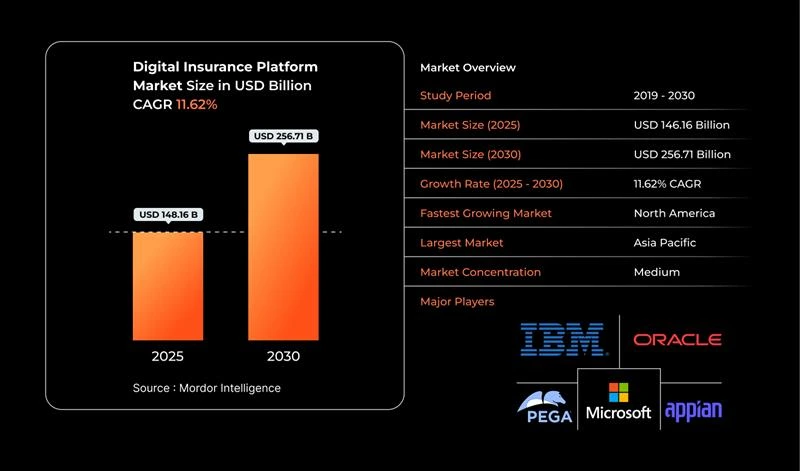
In the meantime, the digital insurance sector is expanding, with the digital insurance platform market projected to increase to approximately $256.71 billion by 2030 as compared to $148.16 billion in 2025. The online insurance market involving mobile channels was estimated at $229.12 billion in 2022 and is expected to hit $513.49 billion by 2032.
Insurance Mobile App Development Benefits
Faster and More Accurate Claims Processing
Mobile applications simplify claim documentation by allowing customers to upload documents, images, and event summaries in real time. Automated systems reduce human intervention, minimize processing time, and improve accuracy. This leads to quicker settlements, fewer disputes, and a more positive customer experience, which in turn drives brand loyalty.
Lower Operational Costs Through Digital Automation
Insurance firms cut down on a lot of costs by replacing manual processes with automated digital processes. Mobile applications minimize paperwork, load on call centers, and administrative overhead. Digital signatures and online policy updates, coupled with automated notifications, reduce repetitive activities of the staff and streamline daily operations, making them efficient.
Improved Risk Assessment Using Real-Time Data
Modern insurance mobile app features capture user information through telematics, behavior tracking, and real-time input. These insights enable insurers to be more precise in risk estimation and customize premiums. Improved data means that underwriting is better, fraud is detected earlier, and more competitive pricing policies are offered depending on the needs of individual customers.
Convenient Policy Management for Customers
The application enables customers to view policies and get documents, renew their covers and update personal details. This will offer a convenient self-service experience where phone calls or actual visits are not necessary. Convenience improves customer satisfaction and increases frequent interactions throughout the policy lifecycle.
Higher Customer Retention Through Digital Experiences
Customers who find the digital interaction smooth will be more likely to remain with their insurer. Mobile apps give 24/7 access to support, claims, payments and updates, creating trust and decreasing frustration. Customized notifications and useful tools strengthen the bond between the policyholder and the insurer.

Types of Insurance Mobile Apps by Uses
(a) Consumer Side Insurance Apps
Consumer insurance applications enable the policyholder to access the policy details, payments, renewals and claims using smartphones. Users can upload documents at any point, review coverage, chat with support teams, and track claim progress. The experience is made more personal and quicker. The convenience and transparency will promote a more serious interaction, decrease the reliance on offline support, and establish long-term credibility between customers and insurers.
(b) Insurance Agent Mobile Apps
The agent mobile apps provide brokers and field agents with the ability to manage clients, leads, and policy applications more effectively. It offers quote generation, document management, sales tracking, and customer communication under a single space. Connectivity with CRM solutions will provide real-time access to customer information and performance data. Flexibility and simplified processes enable agents to provide faster service, close more leads and retain better customer relationships.
Industry-Wise Insurance Mobile App Types
(a) Health Insurance App Development
Health insurance applications enable users to check their policies, coverage, claims and track medical costs from one place. There are numerous applications that offer virtual consultation, immediate access to licensed healthcare providers, and medical history trackers. These features enable users to feel more in control of their health and also assist insurers in understanding customer requirements.
(b) Vehicle Insurance App Development
Vehicle insurance apps deal with policy information, collision reporting, photo submissions, and tracking claims. Driving insights that are driven by telematics allow insurers to develop personalized premium estimates and reward safer driving behaviors with customized incentives. With the assistance of professional insurance mobile app development services, the insurers will be able to assess risk better and provide timely information to the customers.
(c) Property Insurance App Development
Homeowners and renters can use property insurance apps to manage their policies, report damages and request an inspection within a short time. They facilitate uploading photos and videos to facilitate easier claims and occasionally connect to smart home devices to provide early risk notifications. This increases cover of houses and properties and also provides the insurers with insights on quicker decision-making.
(d) Life Insurance Mobile App Development
Life insurance apps provide users with the easy option of monitoring policy status, tracking premium schedules, coverage options, and beneficiaries. Most of the applications have financial planners and the ability to store documents safely. These applications simplify long-term planning and give insurers structured communication channels to better engage with customers.
(e) Travel Insurance Mobile App Development
Travel insurance applications guide the user on local and global travels by providing immediate contact numbers and coverage details as well as rapid claims submission. They usually offer real-time travel alerts, hospital locator tools, and lost or missing baggage claims. This makes the travelling experience of the policyholders safer and more confident.
(f) Business Insurance Mobile App Development
Business insurance apps enable businesses to handle liability policies, worker compensation claims, property coverage, and certificates under a single platform. They facilitate incident reporting, document uploads, and fast renewals. These tools not only make business compliance and risk management easier but also allow insurance companies to work more efficiently with simplified data and organized processes.
Top Insurance Apps to Inspire Your Insurance Mobile App Development Roadmap
1. GEICO

The GEICO insurance mobile app is characterized by its very responsive design and customer-friendly interface. Digital ID cards allow users to access their policies, pay bills, request roadside assistance, and do a lot more with just a few taps. It has a photo-based damage estimation tool that enables the initiation of claims without physical inspections. The app also provides real-time updates, safety reminders, and travel assistance. GEICO is one of the most convenient digital insurance companions for policyholders.
2. State Farm

State Farm consolidates various insurance and financial products on a single platform. Policyholders have the flexibility to review coverage, file claims, schedule payments, and contact support. Its Drive Safe and Save program applies driving data to personalize discounts, which encourage safer habits. The advantage of the app is its fully fledged ecosystem, which allows users to manage auto, home, and banking features within a single platform. Such a degree of integration is suitable for insurers seeking a wide range of digital activity.
3. Progressive

Progressive offers its customers immediate access to policy details, driver and vehicle data, bill payments, and claims. Its guided claim-filing system enables users to post photos, videos, and incident notes through their phones. The app also includes roadside assistance requests, coverage explanations, and multi-policy visibility for customers with multiple lines of insurance. Its robust performance and intuitive navigation make complicated insurance work seem easy and uncomplicated.
Understanding Various Insurance Mobile App Business Models
1. Commission-Based Model
With this model, insurers, agents, or aggregators will be able to receive a commission on each policy that is purchased using the app. It works well for marketplaces, comparison platforms, and brokerage apps. The more users adopt it, the more revenue is made, which makes it a scalable business model for startups and multi-provider platforms that offer a variety of insurance categories.
2. Subscription-Based Model
This model involves insurers or brokers making a recurring payment to get access to the mobile platform, tools or digital services. The subscription can include features such as analytics dashboards, CRM, automated workflows and claims management modules. It provides stable recurring income and can be used in SaaS type insurance systems aimed at agencies, TPAs or enterprise insurance settings.

3. Freemium Model
The freemium model provides simple insurance services at no cost and complex services at a fee. Users are able to edit policies or obtain quotes free of charge, but higher-quality services such as sophisticated analytics features, telematics connectivity, or financial planning platforms might be accessible via a paywall. This model is appealing to large numbers of users and helps bring about conversions by adopting features gradually.
4. Direct Sales Model
In this case, the insurance company would be selling its policies without a middleman through the app itself. Users are able to view plans, compare, buy coverage and renew. This model boosts profitability by removing commission-based expenses, enhances customer relations and gives the insurers complete control of pricing, features and personalized digital service delivery.
5. Marketplace Aggregator Model
This model brings several insurers within a single application and lets customers compare coverage, cost, and benefits before purchase. The platform generates revenue by commissions, lead generation fees, or sponsored listings. It builds customer confidence through open comparisons and assists the user in identifying the most appropriate policies while attracting massive traffic and impressive monetization prospects.
What Are the Key Features for the Insurance Mobile App?
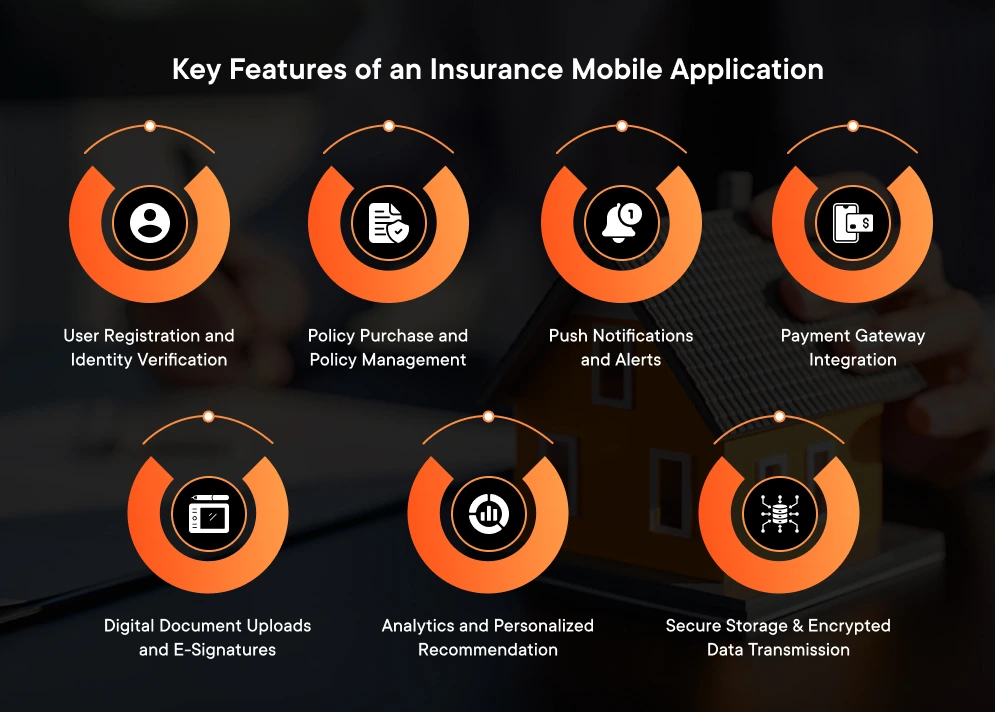
User Registration and Identity Verification
Secure onboarding enables a user to create their account, verify identity, and access customized services. Strong authentication enhances trust, eliminates fraud, and makes policyholders transact safely with their insurance data.
Policy Purchase and Policy Management
Users are able to research plans, compare coverage, purchase policies, and maintain existing ones. This aspect simplifies updating, renewal, and monitoring of premiums and informs customers about their insurance requirements instantly.
Digital Document Uploads and E-Signatures
Customers have the option of uploading the necessary documents, providing proofs, and digital signatures. It assists in minimizing the paperwork, accelerating approvals, and facilitating a complete digital insurance process that enhances convenience to users and insurers.
Payment Gateway Integration
Payment gateway integration is among the most critical insurance mobile app features that enable users to pay premiums, set up automatic payments and transact securely. Various payment methods ease the process and facilitate recurrent payments with a well-documented transaction history.
Push Notifications and Alerts
Notifications remind customers of renewals, premium deadlines, claim statuses, offers, and policy changes. This guarantees prompt communication and enhances interaction without necessarily having to check the app manually.
Analytics and Personalized Recommendations
AI-driven analytics provide tailored policy recommendations and premium insights, as well as risk calculations. These recommendations enable the user to make informed decisions and give the insurers a better insight into the customer’s needs.
Secure Storage and Encrypted Data Transmission
Strong encryption ensures that the customer data, documents, transactions and communications remain private. This protects sensitive information, enhances compliance, and builds trust in the users regarding the security structure of the application.
Claims Automation Workflows
Claims automation workflows enable administrators to efficiently manage and streamline the entire claims process from submission to settlement. Through the dashboard, admins can view and track all incoming claims (FNOL), automatically assign them to relevant agents or departments, and monitor their progress across different stages such as review, approval, or rejection.
Policy Lifecycle Management
Policy lifecycle management allows administrators to oversee the complete journey of an insurance policy, from creation to renewal and closure. The dashboard provides tools to create, update, and manage policies while tracking their status, such as active, expired, or pending renewal. It also supports automation of renewal notifications and reminders, ensuring better customer retention.
Fraud Detection System
The fraud detection system equips administrators with tools to identify and prevent fraudulent activities within the insurance ecosystem. Using advanced analytics or AI-based insights, the dashboard displays fraud risk scores for each claim and detects suspicious patterns such as duplicate submissions or abnormal data entries. Administrators can flag high-risk cases for further investigation.
Technologies Required to Develop an Insurance Mobile Application
Developing a high-performing insurance app requires modern technologies for both the front end and backend. Technologies include:
| Layer | Technology Options | Purpose / Use Case |
|---|---|---|
| Frontend (Mobile App) | Flutter, React Native, Swift (iOS), Kotlin (Android) | Build cross-platform or native mobile applications |
| Backend (Server-side) | Node.js, Java (Spring Boot), .NET Core, Python (Django/FastAPI) | Handle business logic, APIs, authentication, claims processing |
| Database | PostgreSQL, MySQL, MongoDB, Firebase | Store user data, policies, claims, transactions |
| Cloud Platform | AWS, Microsoft Azure, Google Cloud | Hosting, scalability, storage, serverless functions |
| API Layer | REST APIs, GraphQL | Communication between frontend and backend systems |
| Authentication & Security | OAuth 2.0, JWT, Firebase Auth, Azure AD | Secure login, identity management, user authentication |
| Payment Integration | Stripe, Razorpay, PayPal | Premium payments, renewals, transactions |
| AI/ML Integration | TensorFlow, OpenAI APIs, AWS SageMaker | Fraud detection, risk assessment, chatbot, underwriting automation |
| Telematics / IoT (Optional) | GPS APIs, IoT SDKs, OBD devices | Usage-based insurance (PAYD, PHYD models) |
| Document Processing | OCR (Tesseract, AWS Textract), IDP tools | Extract data from claims, policies, KYC documents |
| Push Notifications | Firebase Cloud Messaging (FCM), OneSignal | Alerts for claims, renewals, policy updates |
| Analytics & Tracking | Google Analytics, Mixpanel, Firebase Analytics | User behavior tracking, app performance insights |
| DevOps & CI/CD | Docker, Kubernetes, GitHub Actions, Jenkins | Deployment automation, scalability, version control |
| Testing Tools | Selenium, Appium, JUnit, TestFlight | Functional, UI, and performance testing |
| Compliance & Security | GDPR tools, HIPAA (if applicable), encryption (SSL/TLS) | Data protection, regulatory compliance |
| Third-Party Integrations | CRM (Salesforce), PAS systems, Payment APIs | Integration with insurance ecosystems |
| Admin Panel (Web) | React.js, Angular, Vue.js | Manage users, policies, claims, dashboards |
Stand Out Your Insurance Mobile Apps with AI Features
AI in insurance can transform both user experiences and administrative workflows. Below are AI capabilities that enhance functionalities and insurance
AI Capabilities for Insurance App Users
- Personalized policy recommendations
- AI-powered chatbots for 24×7 support
- Smart claims submission with document scanning
- Fraud detection alerts
- Predictive analytics for premium estimates
AI Capabilities for Insurance App Admins
- Automated underwriting assessments
- Intelligent risk scoring and analysis
- Claim fraud detection tools
- AI-based customer insights dashboard
- Workflow automation for policy approvals
Legal Compliance to Consider While Insurance App Development
1. HIPAA
HIPAA applies when insurance apps manage medical records or health policy information. Developers must enforce strict safeguards that protect stored data, control access and secure all transmitted information.
2. GDPR
GDPR regulates applications that process the data of EU citizens and mandates clear, legal data processing. Users are given the rights to view, update or demand the deletion of personal data.
3. CCPA
CCPA mandates a transparent disclosure regarding the data collection and sharing of California residents. Opt-out options and robust controls that ensure personal data protection should be provided to users.
4. PCI DSS
PCI DSS is relevant when mobile applications are used to process card payments. Unauthorized access or misuse of payment information must be stopped by use of secured gateway, encrypted transactions and protective controls.
5. State and Country Specific Insurance Regulations
The laws of regional insurance establish regulations on underwriting, claims procedures and policy administration. The local licensing requirements and consumer protection standards guarantee the legality of the operation in every jurisdiction.
How Much Does It Cost to Develop an Insurance Mobile App?
The overall insurance app development cost varies with complexity, features, design, technology stack, and region of development.
Basic Insurance Mobile App Development Cost
A simple insurance mobile application has the following basic features: user registration, easy policy management, claims and basic notification. Development typically has a small team, minimal backend development and no sophisticated integrations. The average price is between 20,000 to 40,000 dollars; based on the design and platform requirements.
Medium Complex Insurance Mobile App Development Cost
The medium-complexity app has more sophisticated dashboards, payment gateways, document scanning, chat support, analytics, and CRM or third-party integration. This tier will need a bigger development team and more robust security layers. Prices are usually between 500,00 and 100,000 dollars, depending on the complexity of functionality and coverage of the platform.
Highly Complex Insurance Mobile App Development Cost
The most complicated insurance applications come with features such as AI-powered claims automation, telematics, custom analytics engines, automated underwriting, multi-level user roles, and enterprise integrations. These involve a lot of planning in the architecture, cloud hosting and premium security. The cost of development will typically start from 150,000 dollars and may go up based on scalability.

Why Is It Essential to Hire the Right Insurance App Development Company?
The selection of an appropriate insurance app development company is essential due to the fact that insurance platforms demand industry-specific expertise, high regulatory standards, and good security practices. A skilled team knows the policy structures, claims procedures, user expectations, and complicated integrations such as payment gateways or underwriting systems. The right partner also offers continuous maintenance, performance optimization, and updates to keep your insurance mobile app competitive.
How Can A3Logics Help You With Insurance Mobile App Development?
A3Logics has insurance software development expertise that enables insurers to have secure, scalable, and well-designed applications based on their business requirements. The team offers strategic planning, UI and UX design, custom functionality, API integrations, cloud deployment, and extensive quality testing. Their experience in the industry guarantees adherence, data protection, and efficient user experiences. Having a long history of working in insurance solutions, A3Logics reduces the risks of development, enhances product performance, and ensures a shorter time-to-market with reliable continued support.