
To reduce operational inefficiencies, carriers are increasingly integrating automation in the insurance industry are facing a fundamental change. To cut down on the labor-intensive, slow, and expensive side of the business, the focus of the transformation has now moved to touchless claims insurance. Insurers increasingly use AI, machine learning, IoT, and predictive analytics, and as a result, they steadily move toward a future where 80–90% of claims run without human intervention. Moreover, recent advancements already demonstrate significant progress toward making this vision a practical reality.
Automated touchless claims handling is no longer a goal which is far away from the present. Many worldwide insurers are already implementing this as a feasible strategy to raise customer satisfaction, reduce the costs of administration, and deepen their operational efficiency period further than ever before. In this blog we are going to be taking a look at the insurers’ shift to touchless claims for carriers prompted by the rapidly evolving digital ecosystem.
What Is Touchless Claims Processing and How Does It Work?
Touchless claims insurance processing is when an insurance claim is fully settled automatically without the need for any human interaction. After the claimant submits all necessary information—maybe a photo, a document, or telematics data—the system goes and gathers, analyses, verifies, and resolves the claim completely on its own by using preset rules, AI decision models, and insurer guidelines.
Basically, a touchless claim relies heavily on an advanced automation technology backend. AI algorithms actively extract the required data from uploaded documents, and computer vision now estimates the extent of the damage with greater precision. Furthermore, predictive analytics calculates the risk and likelihood of settlement, while rule-based engines then determine the exact payout amount. With automation there is a 50% reduction in claim lifecycle time with automated workflow and AI-powered FNOL. All these elements are combined to remove the need for a claim adjuster to manually check, confirm, or reevaluate the information.
By doing so, the company is able not only to vastly increase the speed of the procedure but also to make the results more consistent and objective across different types of claims.
Why 80–90% Touchless Claims Are Becoming Possible?
There are numerous improvements that have come about simultaneously to make a very high degree of health insurance claims automation possible. The vast data, advanced machine learning models, affordable cloud infrastructure, and fast-growing connected devices enable insurers to automate workflows. These workflows previously required human oversight.
AI in claim management systems are capable of classifying claims in an instant, thus figuring out the cases that can be automatically handled and those that need manual intervention. Also, insurers are progressively depending on the integrations with external data sources such as repair networks, health records, telematics providers, property databases, and fraud-detection systems. This approach removes the need for customers to provide extra information and thus, it becomes easier for the decision-makers to arrive at a conclusion quickly.
Automation platforms can now handle complex tasks like damage estimation, liability assessment, and fraud prevention. Analysts from McKinsey and LexisNexis predict 80–90% automation will soon become the industry standard. Analysts from McKinsey and LexisNexis have forecasted that 80-90% automation is not only achievable but will very soon become the standard of the industry.
Key Benefits of Touchless Claims for Modern Insurers
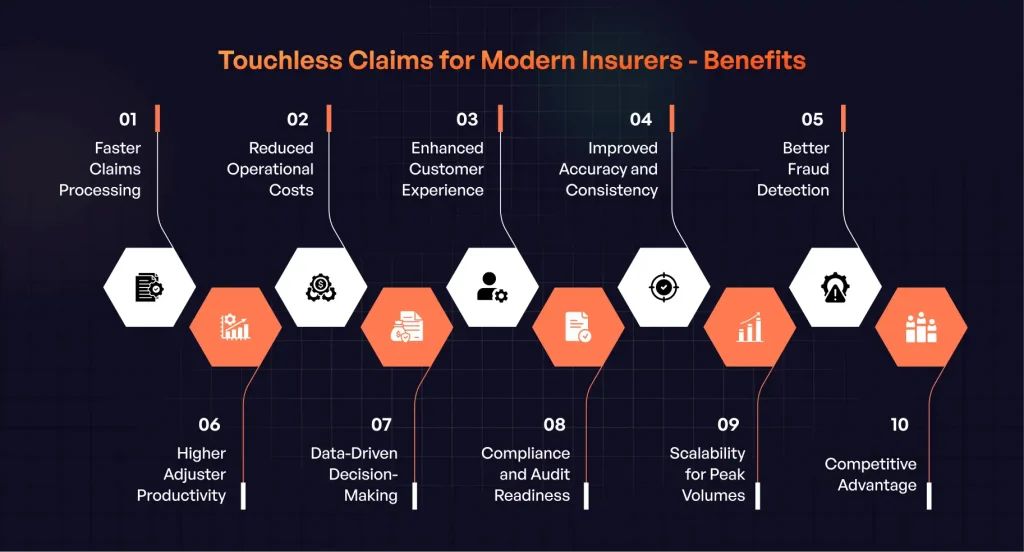
1. Faster Claims Processing
Touchless claims inherently reduce settlement times a lot of times by eliminating manual handoffs. Also, processes such as data extraction, document validation, triage, and routing are automated. Through AI and rules-based engines, insurers are capable of handling simple claims within a few minutes whereas earlier it used to take days and thus the payout of claims will be faster increasing the satisfaction of policyholders.
2. Reduced Operational Costs
Claims processing automation greatly reduces the need for a large manual team. It also minimizes administrative burdens like data entry, verification, and investigation. By making the processes more efficient and enhancing the levels of straight-through processing, the insurers can allow themselves to cut their operational expenses by a large margin and, at the same time, can allocate the resources towards the tasks that bring them a higher value and which require human expertise.
3. Enhanced Customer Experience
With touchless claims insurance customers can easily file their claims using mobile apps, portals, or AI-powered assistants and at the same time get instant updates on the status. The quick inspections and fast settlements are the main features of these seamless experiences that, in effect, strengthen customer trust and loyalty, especially in competitive insurance markets where being responsive makes the biggest difference.
4. Improved Accuracy and Consistency
There are situations where the manual review process can lead to inconsistencies, delays, and errors of the human factor. To avoid this, AI-driven health insurance claims automation standardizes the evaluation process by uniformly analyzing the claim data and making decisions based on the set rules, probability models, and historical accuracy patterns. In this way, it is guaranteed that every claim is evaluated with the same exactness and fairness.
5. Enhanced Fraud Detection
Automated insurance claims platforms implement machine learning, predictive analytics, and anomaly detection to quickly locate suspicious patterns. To minimize fraudulent payouts, these systems detect irregularities such as repeated claim behavior, mismatched documentation, or inconsistent incident details and thus, help the insurers to a great extent.
6. Greater Adjuster Efficiency
Automating routine tasks lets adjusters focus on investigating complex, high-severity cases that require expert judgment. This system boosts productivity, reduces burnout, and improves claims management quality, enhancing the overall process.
7. Data-Driven Decision-Making
Every automated claim interaction creates structured and high-quality data. The insurers can utilize these datasets for trend analysis, pricing optimization, risk segmentation, and predictive modeling. Access to performance metrics makes decision-making faster, more accurate, and in line with business goals.
8. Compliance and Audit Readiness
Touchless claims methods keep the record of every action, decision, and data point automatically, thus they are always ready for an audit. This enables insurance companies to comply with requirements without any difficulties, keep their processes standardized, and have perfect documentation available for audits, lawsuits, or regulatory review.
9. Scalability for Peak Volumes
Insurance companies are likely to experience sharp increases in the number of claims due to natural disasters, seasonal events, or policy renewals. By means of automation, they are capable of scaling their operations without the need for a proportional increase in the number of employees. The efficiency of processes remains the same despite the increase in volume, thus the companies are allowed to retain the quality of their services during periods of high demand.
10. Competitive Advantage
The adoption of touchless claims by a carrier allows it to provide services of a higher speed, accuracy, and convenience, thus standing out from the competition. It is a strong differentiator in the saturated insurance market that leads to higher customer loyalty, increased customer acquisition, and a stronger brand reputation over time.

How AI and Machine Learning Power the Future of Touchless Claims Automation?
Without AI, there would be no touchless claims. Computer algorithms analyze the data from the past claims to understand the patterns, foresee the results of the claims, and decide the settlement amounts to be the most profitable. Algorithms become better all the time as they take in more data points.
Systems using Natural Language Processing can understand the content of medical reports, police statements, invoices, and legal documents instantly, thus the time for manual review is almost zero. AI-powered OCR can convert data in different formats into structured data, thus the processing of invoices for healthcare and repair estimates can be done much faster.
By employing these technologies, the insurers can get to a point where they can have a completely automated contactless claims pipeline.
Predictive Analytics in Claims: Automating Decisions Before They Happen
Predictive analytics gives insurance companies the means to figure out the best way to handle each claim. Essentially, the models take a look at past data, current information, and even the surroundings to be able to tell which ones are low risk, medium risk and high risk. Those that fall under the low risk category are given the green light automatically whereas those of high risk are sent for closer examination.
As a result of this, the number of unnecessary manual interventions thus significantly decreases, and claim adjusters get the chance to deal with more complex cases. Besides this, predictive modeling is also useful in calculating claim costs, pinpointing fraud signatures, and suggesting the most appropriate actions, thus giving insurers a chance to avert losses in advance.

How Insurers Can Implement Touchless Claims Automation — Step-by-Step
1. Align Strategy & Define Success
Insurance companies should determine which claims to handle automatically, the desired level of straight-through processing, and how automation aligns with their digital transformation strategy.
2. Map Your Current Claims Flow and Data Landscape
It is necessary for insurers to understand in detail their current processes for intake, investigation, approvals, and fraud checks before automating. Locating bottlenecks, expensive areas, and manual handoffs helps in revealing areas for optimization.
3. Build the Data & Ingestion Foundation
Non-intervention claims have to be supported by very accurate data. Insurance companies need to have in place very good systems that can reliably ingest both structured and unstructured data coming from documents, photos, telematics, customer inputs, and third-party databases databases.
4. Choose Core Automation Platform & Tech Components
Deciding on the most suitable mixture of technologies is a must. When insurers integrate these components with their existing policy administration and claims systems, they directly create a seamless automation ecosystem. Moreover, this integrated setup efficiently supports straight-through processing, enabling faster and more consistent claim outcomes.
5. Model Development & Validation
Insurers should train AI models for fraud detection, damage assessment, routing, and decision-making using historical claims data. They must strictly validate models to ensure accuracy, fairness, and compliance.
6. Implement Workflows, Integrations & APIs
By integrating APIs for identity verification, payment processing, repair networks, medical billing, and regulatory databases, insurers create a seamless automation ecosystem. This ecosystem allows AI, computer vision, predictive analytics, and rule-based engines to extract data, assess damage, calculate risk, and determine exact settlements. As a result, automated decisions can be executed end-to-end without any human intervention.
7. Compliance, Security & Governance
Implementing well-functioning governance frameworks, audit trails, encryption, and access controls ensures that insurers handle highly sensitive information securely.
Real-World Case Studies: Insurers Already Achieving High Automation Rates
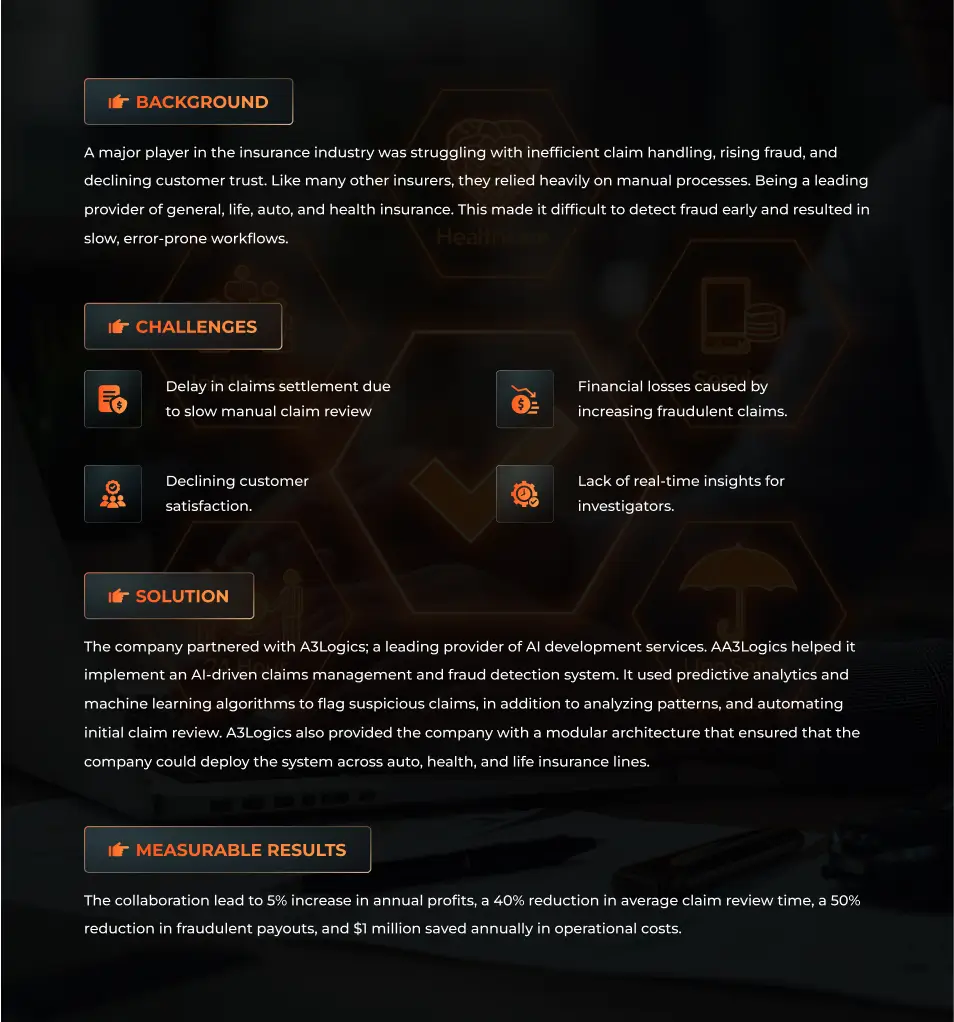
ClaimPro, a leading insurance company, struggled with slow, error-prone manual operations. Rising fraudulent claims stretched resources and delayed accurate service to genuine policyholders.
In order to eliminate the problems of increasing fraud and deteriorating operational efficiency, ClaimPro decided to work with A3Logics to deploy an advanced AI-powered fraud detection system. A3Logics created a scalable, machine-learning-based, data-driven model that could automatically classify claims, detect the pattern of fraudulent activity, and issue real-time alerts for fraud.
They examined the historical claims data to find the fraud indicators, while the predictive models kept the investigators ahead of the emerging trends. The integrated dashboards showed clear fraud scores, actionable insights, and automated reports, thus allowing quick and accurate decision-making. This change helped the company streamline investigations and increase efficiency. It also positioned them as a future-oriented leader in automated claims management.
You can take a deeper look at our Case Study here.
Transforming Claims with Intelligence
Role of IoT, Telematics and Connected Devices in Automated Claims Settlement
Connected devices are the major power behind the transformation of touchless claims. Telematics sensors and AI for car insurance claim approval systems offer real-time data about: driving behavior, accident impact, and vehicle health, which empower insurance companies to automatically issue claims and evaluate liability. In the case of property insurance, IoT devices reveal water leaks, fire risks, and structural damage, thus allowing the first reporting of the claim and fast settlement.
Also, wearables and health monitoring gadgets used in the medical field provide insurers with an uninterrupted data stream which is very helpful in accurate claim adjudication. AI for auto claim management software bring down the fraud risk, facilitate claim verification, and lower the need for the submission of evidence by the claimant.
Accelerate Your Touchless Claims Journey with A3Logics
A3Logics is a leading insurance software development company that helps carriers deploy next-generation claims automation systems efficiently. The company offers a complete range of solutions specially designed for insurers, brokers, and TPAs, starting from AI-powered OCR to NLP-based document ingestion, predictive modeling, and workflow automation.
As a prominent Custom Health Insurance Software Development company, A3Logics is also involved in system modernization, platform integrations, data engineering, and cloud transformation. Besides, its proficiency is deep enough to allow custom health insurance software development, thereby enabling carriers to create a system that is not only scalable and secure but also compliant for automated claims processing.
A3Logics is also very progressive in offering a broad range of Advanced InsurTech Software Development Services and is strategically committed to partnering with insurers in their journey towards the adoption of touchless claims—this being facilitated by their solid domain knowledge and multi-industry experience.

Final Thought
The next generation of insurance claims processes will be automated. Rapidly evolving AI, machine learning, IoT, and predictive analytics enable 80–90% claim automation. Insurers using touchless claims achieve faster processing, cost savings, better accuracy, and higher customer satisfaction. Those delaying this transformation risk falling behind as customer expectations continue rising.
It is definitely the moment for insurers to revamp their claims management and create a well-thought-out plan leading to touchless health insurance claims automation.