Insurance companies today struggle with rising claim costs because of shifting public attitudes, and aggressive legal action. These factors disrupt pricing and push insurers towards heavy losses. That’s where the concept of social inflation in insurance comes in.
It talks about how claim costs across insurance domains rise faster than normal economic inflation. It further refers to situations in which legal trends, societal attitudes, and jury expectations increase insurers’ liability.
An analysis by the Insurance Information Institute and the Casualty Actuarial Society found that legal system abuse and related litigation trends contributed $231.6 billion to $281.2 billion to increased liability insurance losses over the past decade.
To mitigate these losses, the need of the hour is to adopt analytics solutions for social inflation. In this post, we’ll discuss how these modern solutions can identify risk signals, detect unusual claim patterns, and predict litigation outcomes.
What is Social Inflation in Insurance?
Social inflation in insurance means that the rising costs of insurance claims exceeding standard economic inflation. It is driven by growing public sympathy for claimants; expanding definitions of liability, higher jury awards, and aggressive legal strategies. These factors cause escalate claims beyond actuarial expectations.
Social Inflation Insurance Trends and Statistics
- A 2024 report stated that litigation costs drove US liability claims by 57% over the past decade.
- The practice of an outside party investing in lawsuits in exchange for a percentage of the settlement or judgment grew by 414% in the US from 2012 to 2017.
- The third-party litigation funding industry is valued at $17 billion and may increase up to $30 billion by 2028.
What Are Analytic Solutions for Social Inflation in the Insurance Industry?
Analytics solutions help insurers identify, quantify, and mitigate the drivers of social inflation using:
1. AI and Machine Learning
Where machine learning in social inflation in Insurance helps identify emerging legal behaviors and jury-award risks, AI in Underwriting improves pricing accuracy, risk selection, and guideline automation.
2. Predictive Modeling
Analytics solutions for social inflation; such as predictive modeling, help insurers manage it by leveraging data and machine learning. These solutions help forecast claims that are likely to become expensive; or that may go to litigation.
3. Claims Severity Prediction Systems
With the help of AI and machine learning; claims severity prediction systems estimate how costly a claim may become. In the context of social inflation in insurance, these systems help insurers better price risks and allocate legal resources.
4. Social Sentiment Tracking
Social sentiment tracking in social inflation and insurance; helps insurers find out what society feels about accidents, businesses, and compensation. For this, it monitors public opinion across social media platforms, news forums, and online discussions.
5. Fraud Detection Analytics
Even in minor accidents, there is a high probability of unusual claimant behavior or exaggerated damages. Using fraud detection analytics in social inflation insurance, insurers can detect suspicious patterns and prevent inflated claims.
6. Litigation Outcome Forecasting
In AI for social inflation in insurance litigation outcome forecasting uses AI and historical legal data to predict how claims are likely to be resolved. This also includes the verdict size and the expected settlement amount.
7. Attorney Behavior Profiling
Attorney behavior profiling is an analytic solution for social inflation in insurance that analyzes lawyers’ past strategies and actions to predict their future strategies. By using AI to analyze claim types; settlement patterns, and court tactics, insurers can identify which claims may escalate into costly litigation.
8. Market and Jury Trend Analysis
As an analytic solution used in social inflation insurance; market and jury trend analysis uses data-driven methods to identify emerging market patterns and predict jury verdicts. These tools give insurers early warning signals; empowering faster and smarter decision-making.
Use Cases: How Analytics Solutions Combat Social Inflation in Insurance
1. Early Identification of High-Risk Claims
To combat social inflation in insurance, analytics solutions use AI in claims management. AI identifies and predicts outcomes with high accuracy; enabling insurers to anticipate high-severity claims. The strategy aligns insurance costs with customers’ risk profiles; ensuring that higher-risk customers are charged higher.
2. Better Litigation Management
Analytics solutions improve litigation management by identifying early indicators that could convert a routine claim into a complex legal dispute. Insurers can refine litigation tactics so they match the specific challenges of each claim dispute.
3. Fraud Detection and Prevention
Analytics solutions for social inflation insurance help insurers identify abnormal patterns; that indicate exaggerated claims or unusual claimant behavior. Behavioral analytics, for instance, can highlight sudden shifts in medical billing, legal involvement, and damage estimates that commonly arise before an inflated claim.
4. Loss Reserving Improvements
Analytics solutions help insurers forecast future claim costs more accurately. By studying past claims and legal trends; companies can set aside the right amount of reserves and avoid surprises. This also guides smarter pricing decisions and strategic planning.
5. Enhanced Underwriting
AI enhances underwriting by using a broader range of data points into risk assessments. This leads to more accurate pricing models that show the true risk profile of policyholders.
How Predictive Analytics Helps Insurers Reduce Social Inflation?
Predictive models analyze vast datasets to forecast:
1. Claim Severity
Predictive analytics helps insurers estimate; how costly a claim might eventually become. By analyzing past claims and emerging trends, companies can plan better and reduce financial exposure caused by social inflation in insurance.
2. Litigation Probability
Analytics predicts how likely a claim might reach the court. Insurers can study case patterns and attorney behavior to focus resources and manage risks linked to social inflation and insurance.
3. Expected Settlement Value
Analytics solutions for social inflation use predictive models; to estimate a claim’s likely payout based on current trends and historical settlements. This lets insurers negotiate; and set reserves accurately.
4. Attorney Aggressiveness
Analytics studies attorneys’ past tactics strategies. Based on this data; insurers can analyze how aggressively attorneys have pursued claims. They can plan defense strategies and control costs.
5. Fraud Likelihood
Predictive tools detect unusual claim patterns and suspicious behavior. By flagging high-risk claims; insurers can look into claims at an early stage and prevent losses.
6. Nuclear Verdict Probability
By analyzing jury behavior and past cases; predictive analytics helps insurers estimate the likelihood of nuclear verdicts. By identifying high-risk claims; insurers ensure enough funds are available. They also enable proactive legal strategies such as early negotiation.

Using AI and Machine Learning to Detect Social Inflation Drivers Early
AI-driven insights allow insurers to:
1. Spot Claim Anomalies
Machine learning and AI for social inflation help detect claim anomalies; in the early stage by analyzing data for unusual patterns. For example; flagging property damage claims filed after minor storms; or car accident claims that may come with higher repair costs.
2. Identify Early Indicators of Litigation
AI for social inflation enables insurers identify early indicators of litigation. It does this by analyzing various aspects; like attorney behavior, claims, and historical court data. It flags disputes that are likely to escalate into costly lawsuits.
3. Predict Claimant Behavior
AI in insurance studies patterns in past claims and current interactions. It takes into account attorney involvement; to spot signs that a claimant may escalate the case or seek a higher payout.
4. Detect Coordinated Legal Strategies
AI and ML detect coordinated legal strategies by identifying repeating patterns used by the same law firms and large set of claims. The patterns include identical demand letters, similar medical reports, etc, designed to inflate claim value.
5. Forecast High-Cost Claim Scenarios
AI and ML are used to forecast high-cost claim scenarios; that can lead to large payouts. The systems identify early signs that may go into litigation. The signs include examples such as complex injuries, rising medical costs, or aggressive attorney involvement.
Machine learning continuously adapts to new social and legal trends.

Text Mining and NLP Tools to Identify Attorney-Driven Claims
Natural Language Processing (NLP) identifies:
1. Red Flags in Claimant Statements
The tools analyze claimant statements; for exaggeration or unusual language. Insurers can identify such language and red-flag it to control claim costs.
2. Aggressive Legal Language
In the context of social inflation and insurance, AI tools leveraging text mining and NLP detect threatening or aggressive language. In defense; insurers can prepare defenses and mitigate loss.
3. Inconsistencies in Narratives
Text mining identifies gaps and contradictions in claimant accounts. By identifying such inconsistencies, insurers can carry out further investigation.
4. Trends in Attorney Demand Letters
NLP tools track recurring patterns in demand letters from law firms. By identifying such patterns; insurers can respond with a strategy and reduce payouts.
5. Fraudulent Patterns across Multiple Claims
AI analyzes multiple claims for similar suspicious behavior. By detecting these fraudulent patterns early; insurers can intervene at the right time; and control the financial impact that going into litigation may lead to. This speeds up fraud detection and also helps prevent litigation.
Building an Enterprise Data Strategy to Control Social Inflation
A robust data strategy includes:
1. Data Governance
Establishing clear policies, standards, and ownership; ensures data quality, consistency, and compliance. Proper governance lets insurers; to trust their information and make informed decisions; across various insurance-related operations.
2. Integrated Claims + Legal + Underwriting Data
Combining claims, legal, and underwriting data into a centralized system provides a complete overview of risks. Integration helps in better analysis and risk assessment.
3. Real-time Data Ingestion
Collecting data from various sources; makes sure that information is current and actionable. Real-time updates; allow faster detection of anomalies and immediate response to growing risks.
4. Predictive Modeling Infrastructure
A robust infrastructure supports building, testing, and implementing predictive models. It enables simulation of scenario and risk forecasting, allowing insurers to plan ahead.
5. Analytics Dashboards
Interactive dashboards; provide visual summaries of claims, legal trends, and risk metrics. They allow executives to analyze performance; and spot potential areas of concerns.
6. Continuous Model Training
Regularly updating predictive models with new data ensures accuracy over time. Continuous learning improves detection of emerging patterns and adapts strategies to evolving claims and legal behaviors.
This ensures accuracy and long-term scalability.
Best Practices to Successfully Adopt AI and Analytics for Social Inflation Mitigation
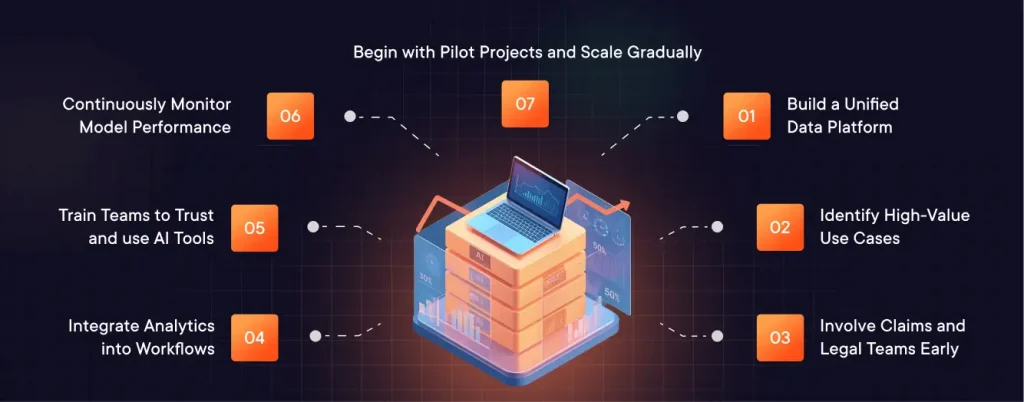
1. Build a Unified Data Platform
Put all relevant data from claims, legal, external sources, and underwriting at a central platform. This will help ensure consistency, and it’ll be easier to analyze the data for later purposes.
2. Identify High-value Use Cases
Pinpoint those litigation scenarios; and claim types that drive long legal cycles or high payouts. Prioritize these for analytics development.
3. Involve Claims and Legal Teams Early
It is important that you engage legal experts; and claims adjusters when the solution is being designed. Their insights make sure that the model reflects real-world cases.
4. Integrate Analytics into Workflows
Integrate advanced technologies – like AI, ML and predictive analytics; into legal processes and claims. These will help you make informed decisions; and improve response time to growing risks.
5. Train Teams to Trust and Use AI Tools
Once you have built the platform; provide hands-on training and clear explanations of how the model works and provides outputs. Building trust encourages employees to enhance decision consistency and rely on AI recommendations.
6. Continuously Monitor Model Performance
Regularly check model accuracy; detect drift, and tweak parameters. Regular monitoring of parameters makes sure model relevance and maintains predictive power; as claims and legal environments evolve.
7. Begin with Pilot Projects and Scale Gradually
Start with small projects to check if the impact of the solutions is as expected. Successful pilots; provide the evidence for large scale adoption and reduce risk during enterprise-wide rollout.
Applying Analytics Across the Insurance Value Chain
1. Underwriting Analytics to Price Emerging Social Risks
Underwriting analytics enables insurers to evaluate shifting legal trends; societal attitudes, and behavior of claimants. It enables more accurate pricing of emerging social risks; protecting portfolios.
2. Claims Analytics to Reduce Severity and Cycle Time
Claims analytics reduces severity and cycle time of settlements; by identifying high-risk claims early and guiding adjusters with data-driven insights. It also speeds up decisions; through automated trials; and real-time claim insights.
3. Legal Analytics to Assess Litigation Strategies
To evaluate attorney behaviors; past rulings, and jurisdiction patterns, insurers can use legal analytics. These can help anticipate litigation direction and guide defense strategies which can further improve escalating claim costs.
4. Portfolio Analytics to Identify High-Risk Jurisdictions
Portfolio analytics helps insurers spot regions where legal trends or claim behaviors drive higher loss severity. It uses historical outcomes and jurisdiction patterns to guide pricing and risk-control decisions.
5. Reinsurance & CAT Liability Analytics
Insurers can utilize intelligent analytics tools to predict future severity, detect abusive patterns, and recommend effective strategies. They can maintain stable loss ratios and ensure premium adequacy.
Why Choose A3Logics for Analytics Solutions to Address Social Inflation in Insurance?
Wish to control losses from social inflation? Partner with A3Logics; leverage AI and analytics for smarter claims management.
A3Logics provides expert Software Development Services, combining industry knowledge, agile methods, and innovative technology.
As a seasoned Insurance Software Development Company, we build AI-driven analytics solutions that detect high-risk claims, optimize workflows, and help insurers manage escalating costs.
Final Thought
As far as insurers are concerned, social inflation in insurance needs to be addressed since it increases claim severity and creates major uncertainty for financial planning. In that context, we have discussed analytics solutions that can detect early warning signals and improve legal risk assessment. With strong AI Development Services, insurers can modernize decision-making and reduce exposure to unpredictable litigation trends.