The insurance industry is transforming from the inside out, and claims management is probably the area where this change can be most clearly seen. Claims handling, as it has been, is slow, largely manual, and very much dependent on the knowledge and skills of the adjuster. Thus, claims leakage, inconsistent decision-making, fraud, and increasing administrative costs have been, and still are, the main problems that insurers struggle with. Meanwhile, customer expectations have also changed. The policyholders of today require almost immediate responses, fast settlements, and digitally enabled interactions.
This is the point at which AI claims automation becomes indispensable. To note, it is not a futuristic idea that is far away in time; rather, AI is very much present and is changing the way insurers detect fraud, assess damage, predict severity, route claims, and improve the overall claims outcomes. As the competition becomes tougher, insurance carriers have to be equipped with effective means which will reduce leakage, improve loss ratios, and speed up cycle times to provide them with a competitive advantage— and that is on top of maintaining fairness and regulatory compliance.
Implementation of AI claims automation is at the core of working condition transformation, turning operational challenges into opportunities, and making the whole process much more efficient, timely, and compliant with regulations, thus, it’s no longer an option situation but rather a necessity of operational nature that sets the path to the future of claims resourcing at highest levels of professionalism.
What Is AI Claims Automation and Why Insurers Need It Now More Than Ever?
AI automation in the claims department means using technologies such as machine learning, natural language processing, computer vision, predictive modeling, and intelligent workflows to simplify and make more efficient the entire claims lifecycle.
Basically, it is a process whereby the human intervention in the performance of a task which is repetitive and of a routine nature is drastically reduced by the system while, in cases that are complicated, the decision-making power of the human is strengthened.
As McKinsey predicts, AI claims automation could reduce overall claims costs by up to 30%, while dramatically improving settlement speed and customer trust. In a competitive market, insurers that fail to adopt AI risk falling behind in both efficiency and profitability.
How AI Helps Insurers Reduce Claims Leakage and Strengthen Loss Ratios?
1. Enhancing Accuracy in Claim Assessment
By using AI models to analyze: medical records, adjuster notes, photos, repair estimates, and any other data, more consistent and precise assessments can be achieved. Consequently, this leads to a reduction in overpayment, elimination of human oversight errors, and the right claim decisions being ensured for every occasion.
2. Identifying Fraud Early in the Claims Lifecycle
Artificial intelligence can identify fraudulent behaviors by spotting anomalies, unusual behavioral patterns, staged accidents, inflated invoices, and suspicious claimant histories. It helps in the identification of such instances at FNOL, thus giving the opportunity for investigators to intervene before fraudulent payouts are made.
3. Automating Document and Image Analysis
For example, computer vision tools can automatically assess the damages to a vehicle or estimate the losses of a property using the pictures given. At the same time, the assistance of NLP in the retrieval of data from different types of documents such as PDFs, forms, and reports can be acknowledged. In this way, there is no room for manual data entry errors and the process of settlement is expedited.
4. Improving Reserve Accuracy with Predictive Modeling
With the help of machine learning, it becomes possible to foresee various scenarios of future claim costs, the amount of settlements, and any other complications that may arise. Higher quality reserves are the factors which are directly responsible for good financial planning and loss ratio stabilization.
5. Strengthening Compliance and Reducing Procedural Leakage
AI follows regulatory guidelines and internal rules to ensure every step is completed correctly. Moreover, it prevents process gaps and errors. As a result, compliance-related leakage decreases and fewer cases require audits.
6. Enhancing Recovery and Subrogation Opportunities
AI uncovers third-party liability cases and missed recovery opportunities with ease. Moreover, it identifies details manual reviews overlook. As a result, recovered amounts increase.
7. Detecting Provider and Vendor Overbilling
Through the help of machine learning, inputs, medical billing habits, and benchmark data can be compared. Eventually, this will reveal any instances of inflated charges or provision of unnecessary services. This will help carriers to accomplish the goal of paying only for what is truly necessary and appropriate.
8. Optimizing Claim Workflow to Reduce Handling Costs
AI orchestrates workflows efficiently by assigning tasks automatically and routing claims correctly. Consequently, it removes bottlenecks across processes. As a result, cycle times decrease and operational efficiency rises.
9. Ensuring Consistent Decision-Making with AI-Powered Rules
An ML-powered rule-based engine can ensure the same standard is applied when it comes to evaluations done by different: adjusters, policies, and regions. Thus, the issue of subjectivity in decision-making will be lessened.
10. Reducing Litigation Exposure Through Faster, Fairer Settlements
The issue of litigation risk is being lowered through faster evaluations and fairer decisions that, in turn, lead to the reduction of disputes as well as an increase in customer satisfaction.
AI-Powered Fraud Detection to Protect Loss Ratios and Reduce Risk Exposure
Fraud remains one of the most significant contributors to claims leakage. AI prevents fraud proactively rather than reactively by using anomaly detection, behavioral analytics, entity resolution, and link analysis. It uncovers hidden relationships between claimants, providers, vendors, and prior suspicious activities that are nearly impossible to identify manually.
For insurers, AI-driven fraud detection means fewer false positives, quicker investigations, stronger loss ratios, and greater protection from organized fraud rings. The result is a much healthier bottom line and a more trusted claims process.
How AI Enhances Claims Triage for Faster and More Accurate Decision-Making?
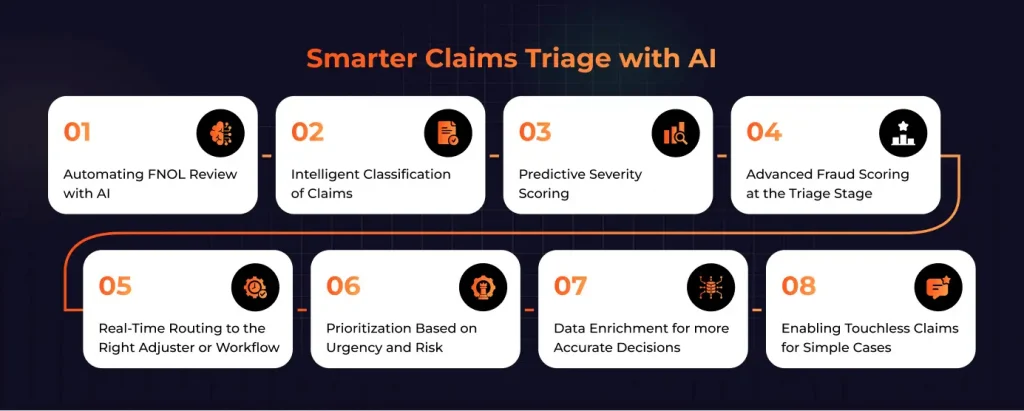
By automatically evaluating the claims at the very moment they are reported, AI Automated Claims Management radically alters the manner in which decisions are taken in claims triage, thus it permits quicker as well as significantly more accurate routing and prioritization.
1. Automating FNOL Review with AI
AI immediately goes through the FNOL data, it can do this by grabbing the key info from the text, voice, or pictures and then it itself decides the claim’s validity and complexity.
2. Intelligent Classification of Claims
Automation groups claims by severity, type, and required expertise. Consequently, it reduces errors caused by manual classification. Additionally, this improves processing accuracy.
3. Predictive Severity Scoring
Machine learning models are helping a lot by predicting how severe a claim is going to be, and their result can be used for more accurate reserve allocation or routing the claim to the right adjuster.
4. Advanced Fraud Scoring at the Triage Stage
The evaluation of fraud here is done at the very first stage thus if there are any fraud attempts they can be looked into before the money is paid by routing them to SIU teams.
5. Real-Time Routing to the Right Adjuster or Workflow
By the means of automation, the claims can be given to the most suitable handler therefore the speed and accuracy get improved.
6. Prioritization Based on Urgency and Risk
AI through the use of it ensures that the high-risk and time-sensitive cases will be taken care of first thus the results will be better and so will be customer satisfaction.
7. Data Enrichment for More Accurate Decisions
AI is aggressive in the pull of data from third-party sources, telematics, IoT devices, weather data, and historical claims, and still, it finds time for the triage process.
8. Enabling Touchless Claims for Simple Cases
Low-risk claims move through straight-through processing without human involvement. As a result, adjusters focus on complex cases. Additionally, this division improves overall efficiency.

The Role of Machine Learning in Predicting Claims Severity and Settlement Costs
ML models utilize these resources: historical claims, policy data, accident reports, images, billing patterns, and regional trends, for forecasting both severity and expected settlement. Such a forecast is what sets the insurers the accurate reserve levels, keeps them away from under-reserving, gives them the opportunity to plan resources better, and thus help them in leakage reduction to an overall extent. Besides, predictive accuracy also results in fewer disputes, quicker settlements, and improved negotiation outcomes.
Integrating AI Claims Automation with Legacy Insurance Systems
1. Understanding the Integration Challenge
Legacy systems often operate as inflexible, non-API platforms that store data in silos. Consequently, they make integration difficult. Additionally, these limitations slow modernization efforts.
2. Using Middleware and Integration Layers
Middleware connects modern AI systems with older core platforms. Moreover, it restores smooth and reliable data flow.

3. Leveraging RPA for Non-API Legacy Interactions
RPA is an agent that imitates human activities when it comes to getting or putting data in a place of no API.
4. Introducing a Claims Data Layer or Data Hub
One single, all-in-one solution, i.e. a data hub, standardizes claims data and helps AI models by supplying them with clean and useful inputs.
5. Implementing Event-Driven Claims Automation
Events like FNOL submission or document upload can be seen as real-time AI workflow triggers.
6. Standardizing Data Through MDM (Master Data Management)
MDM provides an environment of data uniformity, that is of top quality and is accessible for all systems and channels.
7. Using Secure APIs to Connect AI Models with Core Systems
API’s help in establishing secure links between models, touchless claims insurance systems, and databases thus facilitating communication among them.
8. Ensuring Compliance and Governance During Integration
Compliance frameworks ensure AI-driven processes stay transparent and auditable. Moreover, they keep these processes ethically aligned.
Why Choose A3Logics for AI Insurance Claims Processing Automation?
A3Logics is a company focusing on insurance software development services which are specifically designed for insurance carriers. Our software development services combine: cutting-edge ML models, unattended workflows, and integration know-how to transform claims processes from FNOL to settlement. They offer the delivery of personalized underwriting engines, effortless fraud detection tools, smart triage systems, and document-processing pipelines.
By having thorough expertise in Guidewire, Duck Creek, and other core systems, A3Logics is the custom health insurance software development company that ensures trouble-free integration as well as enterprise-grade compliance. Their GenAI features deliver the power to the adjusters in the form of automated summaries, decision support, and quick evaluations of even the most intricate cases.
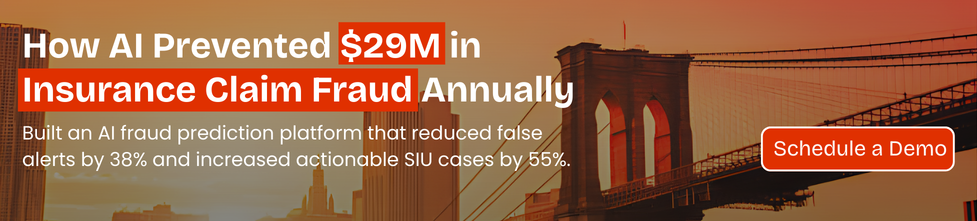
ClaimPro, our client, was one such case. They were the one who had a major challenge in the face of a rising fraud problem and inefficiencies of the traditional manual processes in their business. As a result, their capacity to provide services was impaired, and losses of considerable size were caused. A3Logics came to the rescue with an AI-powered fraud detection framework that would accomplish these tasks swiftly and allow for decision-making on a real-time basis. The fraudulent claims went down by half, and the annual profits increased by 5% after the implementation of this solution.
Read more about how our experts revolutionized ClaimPro’s workflows here.
Final Thought
AI claims automation is the tool that is changing the face of insurance in the future. It helps in leakage reduction, accuracy improvement, fraud prevention, and settlement acceleration. Insurers implementing AI now will experience stronger loss ratios, lowered operational costs, and much better customer experiences. The transition is already on the way–those who accept it sooner will be the leaders in the next era of digital claims excellence.