
Miss one client call, and you lose money.
Delay your response, and your competitor wins.
In 2026, the successful law firms are the most efficient and responsive.
Nowadays, clients expect things online without delay. They want to submit docs online and schedule consultations fast without waiting for office hours. Firms that use manual forms and spreadsheets risk delays and lost prospects. However, on the other side, cloud based client intake software for legal firms helps their future clients to submit details securely from any device, at any time, with much faster speed.
The legal AI market is exploding. The global legal AI market is estimated to reach $19.3 billion by 2033, with a 29.1% CAGR. This is a staggering number, showing the urgency for law firms to adopt fast. The surge also showcases that cloud-based developments are a major part of the growth.

In this blog, we will understand how cloud based client intake software for legal firms really works, the benefits of it, key features, use cases, and more. Let’s get started!
What Is Cloud-Based Client Intake Software for Legal Firms?
Cloud Based Client Intake Software for Legal Firms is a digital platform that collects, qualifies, organizes, and sends potential client data through a secure cloud infrastructure. Modern intake systems work in cloud based legal software environments that are hosted on secure and remote servers. This is different from static intake forms.
The software lets you:
- Online intake forms that are organized
- Checks for conflicts that happen automatically
- Routing tasks and workflows
- Safe collection of documents
- Tracking with integrated CRM
- Analytics in real time
When used correctly, the software works with other legal cloud software platforms. It can have tools for managing cases, billing, documents, and communication. All of these things work together to make a single operational ecosystem instead of a separate intake function.
Many businesses also invest in having custom legal client intake software development so they can customize workflows and automation rules to fit their own practice areas and internal processes.
How Cloud Technology Powers Modern Legal Intake Systems?
A remote server infrastructure that lets people access data safely, grow their businesses, and get regular updates is what makes cloud computing in legal industry. Modern intake systems use:
- Encrypted data transmission (TLS/SSL)
- Access control based on roles
- Authentication with more than one factor
- Monitoring the system all the time
- Backups that happen automatically
The ABA’s Formal Opinion 477R stresses that lawyers have a duty to take reasonable steps to keep client information from being accessed by people who shouldn’t. Intake systems that follow SOC 2 or ISO 27001 standards have documented controls that are in line with these professional duties.
With cloud computing for law firms, intake platforms can automatically increase their storage and processing power when there are a lot of inquiries.
Cloud based legal software companies also offer automatic updates, which lower security risks and make sure that the software is compliant with the law without having to hire extra IT staff.
Why Law Firms Are Rapidly Adopting Cloud-Based Client Intake Software?
1. Increasing Client Expectations for Digital Convenience
Clients now expect quick access online. If signing up feels slow, they leave fast. Updates must be plain to see. Booking appointments should take little time. Waiting too long could cost trust. Cloud based client intake software for legal firms helps meet these needs. The software creates frictionless engagement to maintain and fulfill clients’ expectations.
2. Remote and Hybrid Work Environments
The ABA survey shows that law firms still do a lot of work from home. Intake staff, lawyers, and partners often work in more than one place.
Cloud computing for legal firms makes it possible for any authorized device to safely access intake data. This cuts down on problems with operations and makes it less dependent on servers in the office.
3. Growing Competition Among Legal Practices
The legal market is getting more and more competitive. Businesses that spend money on digital marketing get a lot of inquiries, but they have trouble turning those leads into customers without structured intake processes.
Integrated cloud based client intake and CRM software for legal firms lets you see where leads come from and how long it takes to respond. This information is directly used to improve marketing ROI.
Difference Between Cloud-Based and On-Premise Intake Solutions
| Feature | Cloud-Based Intake Systems | On-Premise Intake Systems |
| Infrastructure | Hosted remotely via secure servers | Hosted on firm-owned local servers |
| Upfront Cost | Subscription-based, predictable pricing | High hardware and IT capital expenditure |
| Updates | Automatic vendor-managed updates | Manual installation and downtime required |
| Security | SOC 2 / ISO 27001 options | Firm-managed security controls |
| Accessibility | Remote access via secure login | Limited to office network unless VPN configured |
| Scalability | Elastic scaling via Cloud Computing Services | Hardware-dependent expansion |
| Disaster Recovery | Automated backups | Requires in-house redundancy planning |
Subscription-based legal SaaS models lower the risk of infrastructure problems and move the responsibility for cybersecurity to specialized providers with their own security teams.
Benefits of Cloud-Based Legal Operations Platforms
1. Centralized Legal Data Management
Modern legal cloud software puts all intake data into one place where it can be trusted. Centralized dashboards cut down on duplicate data entry and mistakes made by administrators.
2. Enhanced Collaboration and Remote Accessibility
By leveraging cloud computing for legal firms, a lawyer and an intake coordinator can share live data at the same time. The level of transparency effectively eliminates the risk of internal slowdowns; hence, the outputs can be delivered more quickly.
3. Improved Security and Compliance
SOC 2-certified cloud based legal software vendors focus on tracking, encrypting and maintaining an audit trail of all operational activities in a business. This means that they are, in fact, following the ABA cybersecurity recommendation.
4. Cost Efficiency and Predictable Pricing
Choosing a subscription pricing model means that you won’t have to worry about the costs of hardware depreciation or emergency IT interventions. Besides providing a fixed budget, this financing method also allows you to enjoy the best functionalities.
5. Automation of Legal Workflows
Cloud based client intake software for legal firms can be programmed to do follow-ups, perform conflict checks, send document requests, and get approval through routing automatically. These kinds of steps result in less time being spent on administrative work.
6. Real-Time Reporting and Analytics
The integrated dashboards give the key figures such as conversion rates, client intake time, and other KPIs that enable management to make informed decisions.
7. Faster Deployment and Updates
The deployment time frames are quite shorter than on-premise deployments. Vendors also handle updates centrally, preventing operational issues.
8. Better Vendor and Contract Management
High-quality enterprise platforms come with vendor tracking and contract lifecycle management tools. These two tools, when properly connected, ensure that the entire flow of the legal work is seamlessly linked to the intake phase.
Key Features of Cloud-Based Client Intake and CRM Software for Legal Firms
1. Customizable Online Intake Forms
Dynamic forms let you collect data that is specific to your practice. For instance, personal injury intake needs information about the accident, while corporate onboarding needs information about the business.
2. Automated Workflow Management
Depending on the type of case, the jurisdiction, or the availability of the attorney, workflow engines route leads. It cuts down on manual triage.
3. Secure Document Upload and Storage
Encrypted portals make sure that professionals keep their clients’ information private.
4. eSignature and Digital Engagement Letters
Electronic engagement letters speed up the process of bringing on new clients and cut down on delays caused by manual paperwork.
5. Integration with Legal Case Management Systems
Seamless integration with larger cloud legal software ecosystems stops people from entering the same data twice and makes sure that matters stay on track.
6. Client Communication and Notifications
Automated SMS and email confirmations make clients more likely to respond and less likely to leave the intake process.
7. Calendar and Appointment Scheduling
Online scheduling tools work with lawyers’ calendars. This cuts down on communication back and forth.
8. CRM Reporting and Analytics
Dashboards in cloud based client intake and CRM software for legal firms give executives a clear view of how well the pipeline is doing.
Companies that want to get a better look at their marketing ROI and conversion metrics often hire developers for custom legal CRM software development that connects intake data with revenue forecasting and client lifecycle analytics.
9. Customizable Client Lifecycle Stages
Companies can set up stages in cloud-based client intake software for legal firms, from “New Inquiry” to “Retained,” to help them keep track of things in an organized way.
Legal Cloud Software: Use Cases by Practice Area
1. Personal Injury Law Firms
Digital marketing campaigns bring in a lot of inquiries for personal injury practices. A report from Clio says that personal injury firms often get dozens of calls every day. Lead leakage is unavoidable without automated structured intakes.
a. Rapid Intake for Accident Claims
Speed is very important in personal injury cases. Intake software lets you create forms that work well on mobile devices, send automated acknowledgment messages, and send cases right away to intake specialists. Cloud computing in legal industry lets firms handle more inquiries after big accidents without putting too much stress on their infrastructure.
b. Medical Record Collection Automation
Personal injury cases need a lot of medical paperwork. Automated document requests cut down on the need for manual follow-up. Secure upload portals also make sure that privacy practices are in line with HIPAA.

2. Family Law Practices
a. Sensitive Data Handling
Secure online intake portals enable clients to conveniently and securely share their financial documents and personal disclosures with the attorneys. Cloud legal software environments that are SOC 2 compliant provide features such as audit trails and role-based access controls that adhere to ABA cybersecurity recommendations.
b. Confidential Intake Workflows
Family law firms set up cloud based client intake software for legal firms so that only certain types of matters can be accessed internally. Automated workflows help structured review processes and keep sensitive information from being seen by people who don’t need to see it.
3. Immigration Law Firms
a. Multi-Language Intake Forms
Immigration procedures often involve multiple languages. Dynamic multilingual forms are supported by modern platforms. This feature makes it easier for clients to access and use the service, especially in immigration practices with a lot of clients.
b. Document-Heavy Case Processing
Immigration cases need passports, visas, proof of employment, and other documents. Legal cloud software with integrated document portals does away with submissions by email. This lowers the risk and makes things clearer for the organization.
4. Corporate and Business Law Firms
a. Structured Business Client Onboarding
Leveraging cloud based client intake software for legal firms can securely gather the incorporation documents, ownership structures, and compliance certificates. Also, a multi-office law firm can have standardized client onboarding processes throughout the offices.
b. Contract Documentation Workflows
Cloud based legal software offers integrations between the intake modules and the contract management systems that allow uninterrupted matter lifecycles. This lowers the need to carry out the same administrative tasks twice and also allows better control of the operations.
Common Challenges When Adopting Cloud-Based Client Intake Software
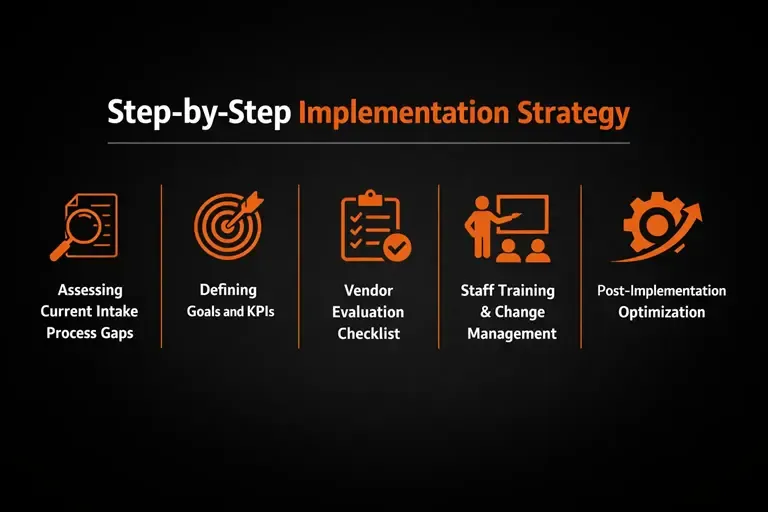
1. Staff Adaptation Issues
Typically, staff training is highly underestimated and, therefore, turns out to be a hindrance to the introduction of new technology. No matter how great a client intake software is, it will never make a business profitable if employees continue working manually. Therefore, management should not only implement the software but also properly train the staff, set performance standards, and provide an accountability structure.
2. Data Migration Concerns
If you keep your old records and make the new legal cloud software platform your main one, then the data migration job is going to be very difficult. In that case, businesses should divide their migration plans into different phases so that they do not get confused and the work is not disrupted.
3. Integration Complexities
It is not easy to mix different systems, e.g., client intake, billing, and case management, which can become a major problem if APIs are not appropriately set up. Choosing providers experienced in cloud computing in legal industry lowers the compatibility uncertainties.
4. Budget Constraints
A subscription may be a good alternative to financing that decreases capital expenditure, but management still ought to be capable of assessing license costs over time. On the other hand, the time saved by the automation process normally accounts for the subscription fee in the very first year after its implementation.
Future Trends in Cloud-Based Client Intake Software for Legal Firms
1. AI-Powered Intake Chatbots
AI-powered chatbots built into cloud based client intake software for legal firms screen leads before a person looks at them. These tools gather structured case data, which makes the work of the intake staff easier and speeds up response times.
2. Predictive Lead Scoring
The software’s advanced analytics look at the characteristics of inquiries and past conversion patterns. Predictive lead scoring helps businesses put the most important leads at the top of their list.
3. Voice-Enabled Intake Solutions
Voice-assisted data capture is a new part of cloud computing for legal firms, especially for clients who use mobile devices first and want to interact without any problems.
4. Blockchain for Secure Document Verification
Blockchain-based verification models are still being developed, but they are being looked into in the legal world as a way to check the authenticity of documents.

Why Choose A3Logics for Cloud-Based Client Intake Software Development?
Choosing the right development partner will affect how well the system works in the long run. A3Logics is a law firm software development company that has been making secure, scalable platforms for regulated industries for more than 20 years.
Our method stresses:
- Security architecture that follows SOC 2
- Integrations with existing cloud legal software ecosystems that use APIs
- Custom workflow design that fits with the firm’s practice areas
- Infrastructure that can grow with enterprise-level cloud computing services
We build client intake software that is safe, easy to use, and can grow with your business.
Conclusion
Cloud based client intake software for legal firms has benefits that extend far beyond the mere provision of a piece of automation. As it breaks down the traditional client onboarding process, it empowers the office staff to develop an efficient, safe, and smart onboarding method that encourages collaboration.
However, technology delivers value only when it aligns with your firm’s unique workflows and strategic objectives. That is where experienced partners matter.
A3Logics brings deep expertise in legal software development services. Our team works collaboratively with law firm leadership to understand operational challenges and develop solutions that integrate seamlessly with existing systems.
Connect with us today!