Digital technologies are transforming the insurance industry in a significant way as they are altering the way insurance companies handle policy management, risk evaluation, and claims. Commercial auto insurance has become more complicated with the increase in fleet size, changing regulations, and the necessity to assess risks in real-time. Insurance companies are obliged to provide prompt services, precise price quotes, and flawless customer experiences.
Businesses are investing in commercial auto insurance software development to accommodate these demands. Such solutions automate the underwriting process, streamline claims and enhance operational efficiency. In the era of AI, telematics, and data-informed insights, insurers will have a more productive approach to risk management and remain competitive in an ever-changing market.
What is Commercial Auto Insurance Software?
Commercial auto insurance software is an advanced digital tool that can assist insurers to handle policies, underwriting, claims, and risk evaluation of vehicles owned by businesses. In contrast to personal auto insurance systems, it accommodates various needs like multi-vehicle policies, different types of drivers, and variances in usage between fleets. With custom commercial auto insurance software development, companies may centralize their operations and enhance their decision-making with data-centered insights.
This kind of software is very important in streamlining the insurance operations of commercial fleets. It helps insurers to automate the creation of policies, premium calculation, renewal, and endorsement without compromising industry regulations. Organizations can combine telematics, analytics, and reporting applications with the assistance of commercial vehicle insurance software development to have a better insight into vehicle utilization and driver actions.
Who Needs Auto Insurance Solutions?
1. Insurance Providers
Commercial vehicle insurance companies use digital platforms to administer underwriting, claims, and compliance. These systems simplify the operations and minimize manual errors. They also facilitate quicker issuance of policies and better customer experience.
2. Fleet Management Companies
Fleet management companies deal with high volumes of vehicles, drivers as well as operational data on a daily basis. Software solutions are used to assist them to track fleet performance, monitor risks, and maintain compliance. It will lead to improved performance, reduced downtime, and improved control over the costs.
3. Logistics Businesses
Logistics companies have complicated supply chains that rely on fleet stability and hazard control. Insurance software assists them to handle coverage, track the driver behavior and manage claims in an effective way. This will make the operations smoother and reduce financial losses.
4. Delivery Service Providers and E-commerce Companies
E-commerce and delivery companies depend on the timely and secure transportation of products. Various vehicles, drivers and routes are managed through insurance platforms. They also help in quick processing of claims which reduce disruptions and enhance customer satisfaction.
5. Ride-Sharing and Mobility Service Operators
Ride-hailing businesses operate dynamically with vehicles that are heavily utilized but with different driver profiles. Insurance software allows real time tracking and dynamism in policy management. This assists in mitigating risks, enhancing coverage, and promoting transparency of operations.
6. Brokers and Insurance Agents
Brokers and agents are the intermediaries between insurers and clients that demand effective tools to handle policies and customer relationships. Quoting, renewals and documentation are made easy using software solutions. They also promote communication and increase overall productivity.
Market Overview and Stats of Commercial Auto Insurance
The commercial auto insurance sector is steadily growing due to fleet expansion, growing logistics needs, and a more complicated risk. The global commercial auto insurance market is estimated to grow to approximately $219.2 billion by 2026.
The market will grow at an average rate of approximately 9.1% over the next decade and may hit a mark of more than $390 billion by 2033. This growth is being fuelled by telematics adoption, new regulatory demands, and building of e-commerce logistics networks.
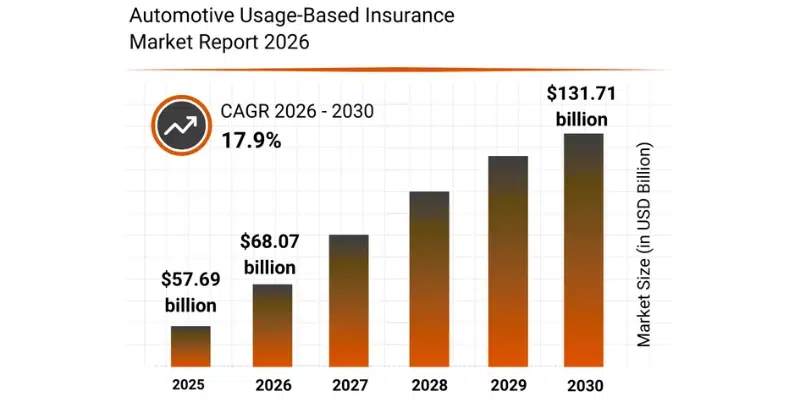
On a bigger scale, the world motor insurance market will reach $2.13 trillion by 2026, which is an obvious sign of the massive opportunity in the business world. In addition, there is also an increase in the usage-based insurance, and the market will reach $68 billion in 2026 because of the growth in the use of telematics and data-based pricing models.
Key Benefits of Commercial Auto Insurance Software Development
Faster Policy Underwriting and Quoting
New platforms automate underwriting by evaluating the driver history, car data, and risk profiles in real-time. It reduces the amount of manual work and increases the speed at which quotations are generated. This allows insurers to offer accurate policies in a short time and improve customer satisfaction in general.
Improved Fleet Risk Assessment
Advanced systems are based on the idea of using real-time telematics information and history to assess fleet risks in a more precise manner. Risky drivers, unsafe roads, and mechanical problems become more detectable. Enhanced understanding leads to proactive risk management and premium pricing.
Automated Claims Processing
Automation simplifies the entire process of claims including submission, verification, and payment. Digital processes speed up approvals and minimize paperwork. This will result in improved processing time with enhanced transparency and trust among customers.
Better Compliance and Reporting
Insurance platforms facilitate compliance with emerging requirements by providing in-built compliance monitoring features. Automated reporting creates proper records and audit trails without human intervention. Organizations minimize both legal and regulatory risks and ensure regulatory alignment.
Enhanced Operational Efficiency for Insurers
Automation reduces repetition of tasks in policy management, claims handling and reporting. Teams can dedicate more time to strategic work. Enhanced workflow results in reduced operation costs and resource optimization.
Types of Commercial Auto Insurance Software Solutions
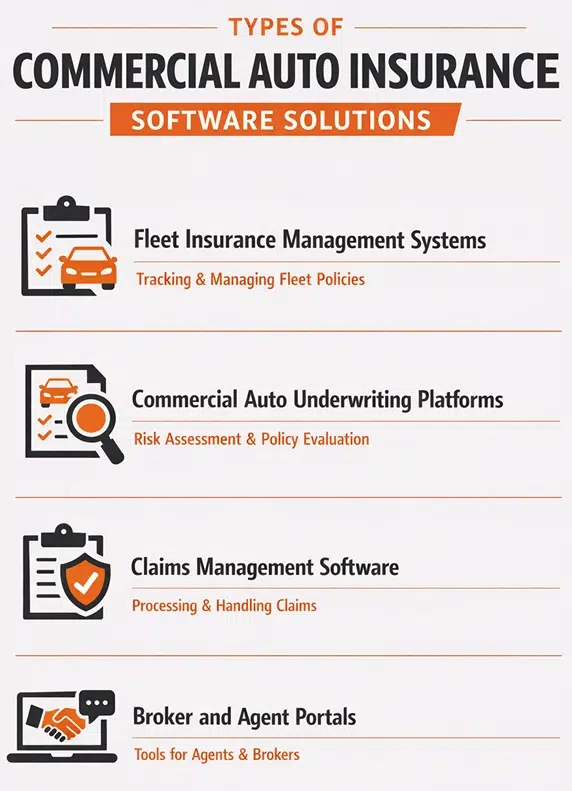
Fleet Insurance Management Systems
Fleet insurance management systems deal with the policies covering more than one vehicle as a single account. They store vehicle data, driver data and coverage information in a central hub that is easily accessible. This renders them as an essential component of commercial auto insurance software development for insurers with large fleets.
Commercial Auto Underwriting Platforms
These platforms automate the process of underwriting by assessing risk (through records of drivers, vehicle usage habits, and history). Advanced algorithms provide precise pricing and policy terms in a short period of time. This helps insurers save on manual work and achieve uniformity in their underwriting processes.
Claims Management Software for Fleet Vehicles
Claims management software facilitates the entire claims process of commercial vehicles. It enables the possibility to submit claims online, manage and keep track of their statuses. Rapid processing contributes to reduction of errors and enhances the experience of policyholders and insurers.
Broker and Agent Portals for Commercial Auto Insurance
Broker and agent portals provide a single portal where intermediaries can oversee policies and dealings with clients. It will have features such as quote generation, policy issuance and communication features. This increases efficiency and enables agents to provide more customized services at a faster rate.
Core Features for Commercial Auto Insurance Software Development
1. Policy Management Features
Policy Creation and Lifecycle Management
The policy generation tools allow the insurers to come up with personalized policies depending on the fleet size, risk factors and coverage requirement. The system is used to handle the whole lifecycle, including issuance and expiration. This will guarantee coherence, minimize errors and make the policy administration easier.
Multi-Vehicle Policy Administration
Commercial policies tend to have a single plan that covers a wide range of vehicles with different risk profiles. Vehicles are easily added, removed and modified within policies via software. This flexibility facilitates effective management of fleets in commercial vehicle insurance software development.
Renewal and Endorsement Management
Automated renewal system reminds the stakeholders prior to policy expiry and simplifies the process of renewing the policy. Endorsement management enables rapid changes in terms of coverage, vehicles or drivers. This makes policies more accurate and saves a lot of time in administration.
Digital Document and Certificate Management
Insurance software stores policy documents, certificates and compliance records in a safe and digital manner. Users can find documents, download or share them in real-time when needed. This enhances accessibility and does away with manual dependency or paperwork.
2. Fleet Management Features
Fleet Vehicle Registration and Tracking
The system keeps a well-documented list of every vehicle that is registered in a fleet. Location, usage and operational status are viewed through real-time tracking. Businesses and insurers will be able to track fleet actions better and react to possible risks.
Driver Information Management
Software has detailed driver profiles such as license, driving history, and behavior records. Driver information is readily accessible to facilitate risk assessment as well as compliance audits. Accurate driver insights make it easier to maintain safer fleet operations.
Vehicle Inspection Records
Vehicle status, safety, and compliance are digitally recorded in inspection logs. Such records help to identify the issues which are likely to occur even before they become serious. Frequent monitoring increases the security of the fleets and reduces the odds of unpredictable claims.
Maintenance History Tracking
Maintenance records every service, repair, and change of spare parts of each vehicle. Past records can be used to trace the recurring problems and schedule maintenance. Better upkeep supports efficient and long-term fleet reliability.
3. Claims Management Features
Digital Claim Submission
Policyholders have the option of using easy to use portals or mobile applications to file claims online. All the necessary information such as the documents and pictures are captured in the system. This makes it easier and quicker to initiate claims.
Damage Assessment Tools
Advanced tools study the damage to vehicles with the help of images, videos, or AI-driven models. These tools are more accurate in estimating costs and severity of repair. Fewer manual checks will speed up the assessment of claims.
Claim Investigation Workflow
Systematic procedures take the insurers through verification, fraud, and claim validation measures. All the stages are monitored to provide accountability and transparency. Effective procedures minimize fraud cases and enhance the general claim management.
Settlement and Payment Processing
The system automates the settlements of claims by computing payouts in terms of policies and evaluation of damages. Integrated payment gateways facilitate fast and prompt disbursement. Faster settlements enhance efficiency and align with modern commercial auto/vehicle insurance software features.

Advanced Features For Commercial Auto Insurance Software Development
AI-based Risk Scoring for Fleet Vehicles
AI-based models examine the behavior of drivers, vehicle usage, and past data to score the risk in an accurate manner. These scores can be used to divide fleets according to various risk levels by the insurers. This enhances the underwriting accuracy in commercial auto insurance software development and helps in the dynamic pricing approaches.
Telematics Integration for Driver Behavior Monitoring
Telematics systems record the actual information like speed, braking and route trends of vehicles in a fleet. Insurers have a better understanding of the driver performance and operational risks. Constant tracking will encourage safer driving practices and facilitate use-based insurance policies.
Fraud Detection
Fraud is detected with advanced algorithms that detect inconsistencies and unusual patterns in claims data. Suspicious activity can be pointed out to be investigated further. Insurers minimize financial loss and have more control over the integrity of claims.
AI-powered Car Damage Detection
AI-driven technologies scan pictures and videos to identify vehicle damage in seconds with high accuracy. The speed and consistency of inspection processes are enhanced between claims. This lessens the manual work and enhances accuracy of assessment in custom commercial auto insurance software development workflows.
Predictive Analytics for Claim Forecasting
Predictive models involve the use of past claims data and external factors to predict future trends in claims. Insurers will be in a position to foresee risky scenarios and organize resources. Financial planning and general risk management strategies are improved by data-based forecasting.
Real-time Dashboards
Interactive dashboards offer real-time policy, claim, and fleet performance metrics. Decision-makers can track significant indicators through intuitive visual reports. Rapid availability of insights favors informed decision-making and increases the clarity of operations within the teams.
Role of AI, Telematics & IoT in Commercial Auto Insurance
Driver Behavior Monitoring Using Telematics
Telematics devices gather real-time information about the driving habits like speed, braking and acceleration, and route analysis. Insurers are able to use this data to study the performance of drivers and the amount of risk that they pose. This helps to promote safer driving and usage-based insurance models.
AI-Powered Accident Detection
AI algorithms process images, sensor data, and past data to identify vehicle damage and determine the intensity of an accident. Automation testing minimizes the use of manual checks and increases the speed of claim verification. Quick assessments enhance accuracy and reduce the time required to process claims.
IoT Sensors for Fleet Safety Monitoring
IoT-based sensors constantly monitor the health of the vehicles as well as engine performance, tire pressure and the environment. Timely identification of possible problems can be used to avoid failures and minimize the risk of accidents. This enables companies to enhance the safety of the fleet and also reduces maintenance expenditures.
Predictive Risk Modeling for Fleet Operations
AI-based predictive models predict potential risks based on the historical data, driver behavior and operating patterns. Preventive measures are taken in advance by insurers for the identification of high-risk situations. Information-driven decisions help to make smarter decisions and optimize pricing, coverage, as well as risk management strategies.
Technology Stack for Commercial Auto Insurance Software Development
The correct technology stack is an important aspect of how to build commercial auto insurance software, as the choice will directly affect performance, scalability and long-term success.
| Category | Technologies / Tools | Key Functions |
| Frontend Technologies | Angular, React, Vue.js, Flutter, React Native | User interface development for web and mobile platforms |
| Backend Development Frameworks | Java, Python, Node.js, .NET | Business logic processing, data handling, system integrations |
| Cloud Infrastructure & Scalability | AWS, Microsoft Azure, Google Cloud | Hosting, resource allocation, application scaling |
| API Integrations | REST APIs, CRM systems, ERP systems, Telematics, Payment platforms | Third-party system integration and data exchange |
Commercial Auto Insurance Software Development Cost
Depending on various factors, the commercial auto insurance software development cost greatly differs.
Project Scope and Complexity
The general scope of software contributes significantly to development cost. Simple platforms that have less functionality do not need as many resources, whereas enterprise-level systems need a lot of architecture and integrations. Higher complexity raises the time of development, testing, and investment.
Features and Functionalities
The number of features as well as their complexity directly affect the cost of development. Simple modules cost less while advanced features, including Artificial Intelligence (AI) analytics, telematics, and automation require additional expertise. This leads to feature prioritization as a necessity in balancing performance and budget.
Technology Stack
The kind of technologies used affects development and maintenance costs in the long run. Newer structures, cloud based structures and scalable structures can be associated with increased costs at the outset. Nevertheless, such technologies provide improved performance, flexibility and future scalability.
Integration Requirements
Development becomes more complicated as it integrates the third-party software, such as telematics, payment gateway, and CRM systems. Any integration will need secure APIs, testing and maintenance. This will add to the expenses but will improve the functionality and overall experience of the system.
Development Team and Location
Developers are available at different costs depending on the geographical location and the level of expertise. Regions with higher labor costs have teams that are more expensive than offshore developers. Selecting the appropriate team will guarantee quality delivery without being expensive.
Maintenance and Support
Maintenance after the launch is a critical component of the overall development cost. Ongoing investment is needed to update the software on a regular basis and fix bugs as well as improve its performance. This makes the software safe, effective and in line with the changing business needs.
- Basic software – $30,000 to $60,000
- Mid level solution – $60,000 to $150,000
- Enterprise level platform – $150,000 to $300,000

Why A3logics is the Right Insurance Software Development Partner
Deep Domain Knowledge
A3logics has the experience of developing software specific to the insurance industry. Their knowledge of underwriting, claims and compliance makes sure that the solutions are in line with the business reality. This will minimize risk in development and accelerate successful project delivery.
Expertise in Commercial Vehicle Insurance Software Development
The team is very competent in providing solutions for fleet and commercial vehicle insurance business. They deal with complexities such as multi-vehicle policies, driver risk assessment, and integration of telematics. Businesses will have efficient and scalable platforms created for industry-specific challenges.
Proven Track Record
A3logics has been able to execute large scale projects in commercial auto insurance software development for various markets. Their architectures are geared towards managing increasing user demands and growing amounts of data with ease. This guarantees reliability and scalability as the business operations grow.
Strong Capabilities in AI, IoT, and Cloud Technologies
Artificial intelligence, IoT, and cloud computing are the high-tech technologies that A3Logics employs to design modern platforms. These technologies facilitate smarter risk analysis, real-time monitoring, and enhanced performance of the system. Solutions are competitive and flexible within a fast-changing digital environment.
Customized Solutions
A3logics is specialized in developing software, which is specific to business models and workflows. Their solution provides flexibility in features, integrations and scalability options. Businesses get tailored solutions that can meet custom needs and long-term growth goals.
Conclusion
The commercial auto insurance industry is experiencing a sharp transition, which involves artificial intelligence, telematics, and IoT. Contemporary solutions are allowing insurers to simplify the underwriting process, enhance risk evaluation, and speed up claim adjudication more accurately. Commercial auto insurance software development assists organizations to increase their efficiency, minimize manual efforts, and provide more reliable services to customers.