
A new age in the digital world has begun with the introduction of blockchain technology, which makes it possible to create decentralized apps (dApps). Blockchain, which is based on security and transparency, eliminates the necessity for middlemen in peer-to-peer communication. This has caused a number of sectors to welcome the possibility of improved security and censorship resistance provided by dApps.
It’s common knowledge that one must adhere to a clear development process and employ good software engineering techniques that are dependable and maintainable. In the overall picture of blockchain development, the latter should emphasize the significance of system design, testing, security assessment, specialized notions, and demand elicitation.
Among high-speed blockchains that use cryptographic time sampling, Solana is frequently used. The blockchain systems’ transaction speeds are a key factor in network traffic. A fast transaction speed will allow Solana to provide improved exchange services for on-chain transaction confirmation.
A world of possibilities, creativity, and efficiency awaits you if you want to develop a dApp on Solana. This blog post will guide you through every step of creating a dApp on Solana, from understanding how it works to successfully building your own. If you want to use blockchain technology in your business or as a developer, learning how to make dApps on Solana can give you an edge in Web3.
What is a dApp?
“Decentralized apps (dApps) are a new type of software that runs on a decentralized network, such as blockchain technology.” dApps use decentralized peer-to-peer networks instead of centralized servers like programs do. This makes environments more secure and reliable.
The basic framework for dApp is blockchain, a decentralized ledger technology that guarantees cryptographic security and immutability. Smart contracts are agreements that are written in code and can be carried out automatically in dApps. These are important because they automate and enforce application rules, do away with the need for middlemen, and make things clearer and more efficient.
Importance of dApps
- Utilize blockchain’s security properties to build trust rather than relying on centralized administrators.
- By guaranteeing that records cannot be changed, the blockchain’s immutable ledger lowers the possibility of data tampering.
- With blockchain-based systems and no traditional middlemen, dApps can potentially offer financial services to those who are underbanked or unbanked.
- Smart contract automation of procedures not only speeds up transactions but also reduces related expenses, making dApps more cost-effective.
- Users from all around the world may engage with and profit from dApps because of their decentralized structure, which eliminates the restrictions imposed by centralized platforms.
In essence, you are constructing a decentralized system when you develop a dApp on Solana, with the backend logic being driven by the blockchain architecture of Solana.
Building dApps on Solana – Key Statistics
- Solana has a far greater throughput of up to 65,000 transactions per second (TPS), compared to Ethereum’s 15 TPS, which is much faster, making it a boon to create a dApp on Solana.
- It’s Proof of History (PoH) in creating a dApp on Solana, based on protocol implementation, facilitates quicker consensus and lowers latency.
- It is to be believed that the average transaction price to create a dApp on Solana is $0.00025, which is incredibly low.
- The usefulness of creating a dApp on Solana is because of its low transaction speed and scalability. This makes Solana a cost-effective decentralized app (dApp) when one compares it to Ethereum.
- The number of dApps in Solana currently passes the number of 600. This includes categories like gaming, NFTs, and DeFi.
Why Should You Create a dApp on Solana?
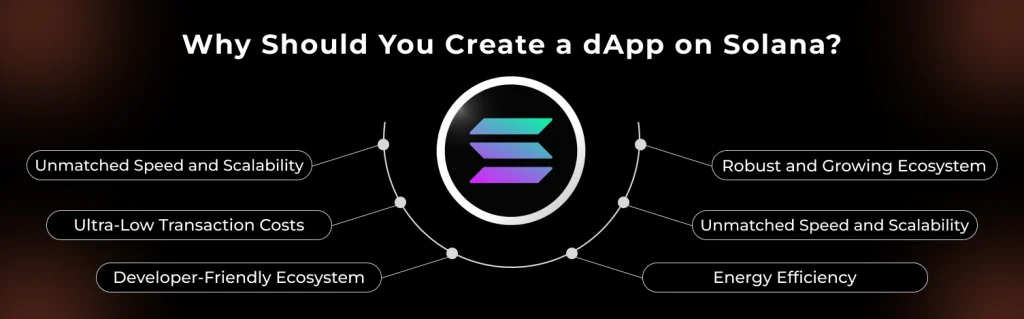
1. Unmatched Speed and Scalability
- To solve scalability problems that conventional blockchain networks encounter, Solana blockchain technology offers a possible remedy. Processing speed and scalability can execute thousands of transactions per second.
- To create a dApp on Solana, it combines a PoH mechanism with PoS (Proof-of-Stake). This consensus allows transactions that can be low-latency and high-throughput.
- Scalability is the function best suited to Solana, and this allows Solana to have large-scale applications. These applications can be social media platforms and gaming, where it’s crucial to have fast transactions.
2. Ultra-Low Transaction Cost
- Users and developers may engage with the network at a reasonable cost, thanks to the incredibly cheap gas prices while creating a dApp on Solana. For firms looking to develop dApps on Solana without incurring significant infrastructure expenditures, this is a game-changer.
- When it comes to gas fees, Solana is among the least expensive blockchains, costing about $0.025.
3. Developer-Friendly Ecosystem
- In order to create a dApp on Solana, Rust is used to build all of the decentralized apps. It’s among the most popular programming languages, which Solana uses to solve memory safety and thread concurrency problems.
- Its native token standard, Solana Program Library (SPL), facilitates the development of dApps on Solana by enabling asset tokenization and a variety of DeFi applications that support ecosystem growth.
4. Robust and Growing Ecosystem
- A number of initiatives are being attracted while creating a dApp on Solana. These include DeFi systems, Gaming applications, and NFT markets.
- This ecosystem is defined as a healthy ecosystem. Provides functions that include infrastructure that is robust, a community that is engaged, and also focuses on innovation.
- This led to an increase in the frequency of new projects and initiatives. This helps in the Solana ecosystem to expand and attract both consumers and developers.
5. Decentralization and Security
- The Solana network is verified by thousands of autonomous nodes, guaranteeing that your data is safe and immune to censorship.
6. Energy Efficiency
- As a dApp is created on Solana, it reduces its environmental impact with technologies such as its Proof-of-Stake (PoS) network.
- The energy used for each Solana transaction is comparable to that of a few Google searches.
- Solana’s Prof-of-Work (PoH) approach is far more sustainable than an energy-intensive network, making it ideal for developers looking for green blockchain options.
By facilitating quicker and less expensive transactions, Solana has the potential to completely transform the financial industry’s payment system. Additionally, it helps improve supply chain management by guaranteeing safe and transparent product tracking.

How Does the Solana Blockchain Work for dApp Development?
1. Proof-of-History (PoH)
PoH is a consensus technique that significantly enhances Solana’s network security and decentralization. It offers a robust and trustless timestamping method that removes the requirement for a centralized time source. By compiling a history of every occurrence on the Solana network, PoH is able to capture timestamps.
2. Tower BFT
Solana’s unique PBFT implementation, Tower BFT, prioritizes liveness over uniformity. Tower BFT lowers latency and message overhead by using Solana’s PoH as a clock before consensus. It lowers the overhead of communication between validators by utilizing the historical timestamps. It guarantees that the network can tolerate malevolent actors while preserving the finality of transactions.
3. Sealevel
With as many cores as the validator has available, Solana can handle tens of thousands of contracts concurrently. Due to the fact that Solana transactions specify every state that a transaction will write or read during execution, Solana is able to perform transactions in parallel. Not only can many non-overlapping transactions run simultaneously, but it also enables concurrent execution of operations that are just accessing the same state.
4. Formal Verification for Smart Contract Correctness
One method used in smart contracts to ensure the code satisfies its criteria and operates as planned is formal verification. It provides a deterministic demonstration of correctness that eliminates every possibility of ambiguity by using local reasoning and rigorous mathematics. Solana allows developers to construct and verify formal proofs of correctness for smart contract code by applying logic, type theory, and mathematical proofs.
Steps to Create dApps on Solana
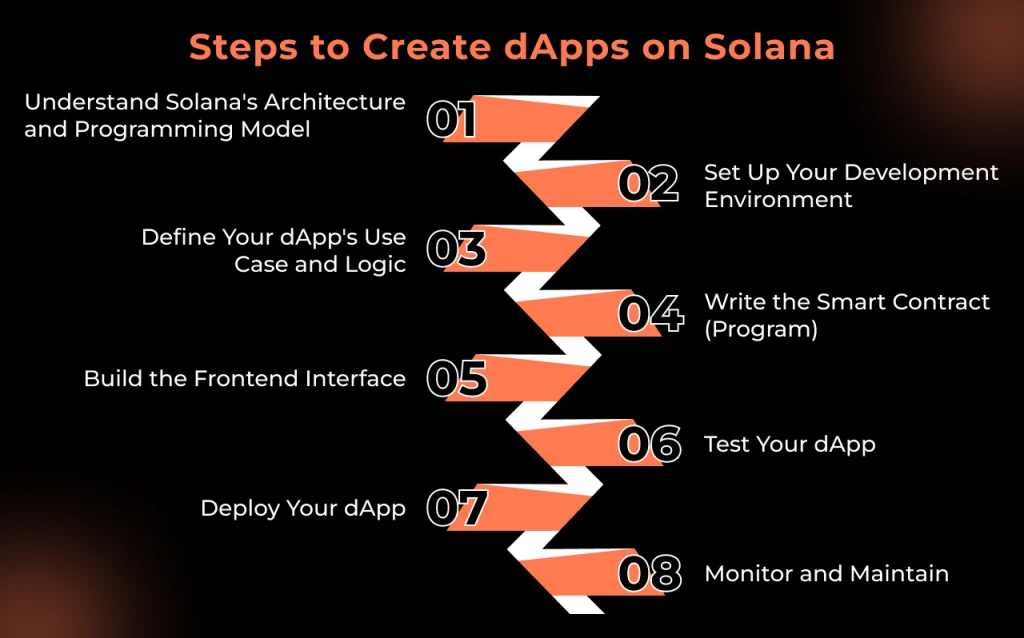
1. Understanding Solana’s Architecture and Programming Model
- Start by learning the way in which Solana programs or smart contracts work in order to create a dApp on Solana.
- Then understanding of how Solana accounts are used to store data, and how its runtime model handles transactions.
- Solana’s system is designed to be scalable and high throughput, which calls for a somewhat different methodology than Ethereum-based development.
- Go through the Solana documentation and become acquainted with the anchor framework for a more efficient smart contract creation process.
- Proficiency should be in Rust to create a dApp on Solana, which is considered to be the main programming language for Solana smart contracts.
2. Set Up Your Development Environment
- Use the official installation command to begin installing the Solana CLI for further development of creating a dApp on Solana.
- Since Rust is the primary language used to write Solana smart contracts, install Rust next.
- The Anchor framework is strongly advised as it makes the process of creating and implementing contracts easier.
- Frontend developers may utilize React and Node.js to build user interfaces that communicate with Solana’s blockchain.
- Before making your contract public, test it in a controlled setting by connecting to the Solana testnet or setting up a local validator.
3. Define your dApp’s Use Case and Logic
- Clearly state the dApp’s goals and essential features while creating dApps on Solana.
- Specify if the dApp will be used as a DAO, an NFT marketplace, a DeFi platform, or for any other purpose.
- This stage affects how the smart contract is designed, how the accounts are organized, and how users interact with it overall.
- Ensures security, usability, and scalability.
4. Write the Smart Contract (Program)
- Write and organize the software using the Anchor framework and Rust in accordance with the previously established logic.
- An “Initialize” method that saves data into a Solana account is a basic example.
- Safe and secure execution of application logic is provided by smart contracts. Which, in a way, becomes immutable on the blockchain as they are implemented.
- Proper testing and auditing of contract code is necessary to prevent mistakes and vulnerabilities.
5. Build the Frontend Interface
- The next step in creating a dApp on Solana is to build the frontend interface so that users can interact with the dApp.
- Creating a frontend interface that utilizes frameworks like Next.js or React with the “@solana/web3.js” library.
- With the help of the interface, customers engage with smart contracts straight from their browser by connecting to wallets that should be compatible with Solana. Examples: Solflare and Phantom.
- The frontend interface should provide safe transactions, easy access to program states for users, and real-time blockchain data.
6. Test Your dApp
- Accuracy must be verified with the help of Solana’s devnet and Anchor test suite. This ensures the correctness of smart logic.
- Check that the user interface functions consistently in various situations and wallet integration.
- To find possible issues of inefficiencies, provide fake data, and mimic different user interactions.
- Thorough testing lowers the possibility of problems after deployment and helps guarantee a seamless experience for users.
7. Deploy Your dApp
- The smart contracts may be deployed to the Solana mainnet with the help of the command “Solana program deploy.”
- Selecting a dependable hosting option is necessary for the frontend interface, such as Vercel or IPFS.
- Everything is linked and operates correctly in the mainnet environment.
8. Monitor and Maintain
- Tracking transactions and network activity.
- Using tools like Solana Explorer.
- Recording issues and user behavior in runtime, with the help of tools in frontend monitoring like Sentry.
- Configure RPC monitoring to keep track of node problems and performance.
- The main maintenance is when there is continuous updation of the frontend and community engagement. The usual help will be to have user feedback, finding and fixing the problem, and adding new features to improve the experience of customers.
How Much Does It Cost to Build a dApp on Solana?
- Basic dApp: The cost of developing a simple dApp on Solana, for example, if created by a small business, might range from $5,000 – $25,000.
- Mid-level dApp: The cost of hiring a mid-sized company for the development of a Mid-level dApp on Solana ranges from $30,000 – $60,000.
- Advanced dApp: Large Solana dApp Development Company charges much more for the development of an advanced dApp on Solana, starting at $60,000 – $120,000.
Factors Influencing Cost
- Design/UI/UX
- Complexity of smart contract
- Backend Integration
- Frontend Integration
- API Integration
- Testing and audits
- Maintenance and updates
For your development needs, hire a Blockchain Development Services they can give you the right guidance. For instance, building dApps on solana for healthcare is different from creating one for real estate, and the budget is more for innovative crypto projects. A financial dApp usually costs $60,000 or more, while blockchain-based social media might cost anywhere from $50,000 to $120,000.
Examples of Popular dApps Built on Solana
1. Magic Eden

Magic Eden, a leading NFT marketplace for collections suited in Solana, has seen tremendous growth in popularity because of its easy-to-use interface, quick transactions, and affordable fees. For those who want to start their own collection, it also features a Creator Studio. Although it began as a Solana project, it currently supports a number of EVM chains in addition to Ethereum and Bitcoin.
2. Raydium
One of the best-rated DeFi dApps on Solana, which is frequently referred to as the fastest blockchain globally, is Raydium. The Swap and bridge features help users to easily switch tokens or utilize the inbuilt warmhole factors to bridge them to EVEM chains. With its Automated Market Maker (AMM) methodology, which is based on Solana, Raydium is a prominent DEX that provides features like yield farming and liquidity pools. Its liquidity pools and staking capabilities let users receive incentives based on the anticipated annual percentage yield (APY) by staking their Solana tokens.
3. Audius
Audius is a Solana-based decentralized music streaming system. It aims to address a number of issues facing the music business, including the presence of intermediaries and ownership opacity. The goal of Audius’ platform, which is driven by its own AUDIO coin, is to bring node operators, artists, and fans together. Music uploaded by artists can be listened to for free by fans with the help of discovery and content nodes.
4. Star Atlas
A highly ambitious next-generation Metaverse game project is being developed on Solana. Through an extraordinary synergy of a decentralized ledger and a virtual environment, Star Atlas has given birth to a truly sovereign metaverse that goes beyond the boundaries of gaming. That’s because Star Atlas has integrated player ownership of in-game assets, such as spacecraft and territory, through a blockchain-based economy. Players may interact cooperatively and competitively inside the game’s universe and build alliances.
5. Phantom

It is a non-custodial bitcoin wallet. Users may store and manage their digital assets. Phantom offers a token swap option; however, it only considers Salona as currency. It enhances the Phantom app’s usefulness for users by supporting collectibles and NFTs. They may be seen or traded by users on their app. The Phantom wallet may be downloaded as a mobile application or used as a browser extension. By letting its customers produce their own private keys, Phantom keeps track of them on their behalf.
Common Mistakes to Avoid When Creating dApps on Solana
1. Not Optimizing Contract Structure
- Program size is strictly limited by Solana, and contracts that are too large or poorly designed may result in deployment difficulties or higher expenses.
- To adhere to size restrictions, developers must modularize their code and eliminate superfluous logic. Efficient structuring facilitates the management of updates and maintenance.
2. Ignoring Wallet Compatibility
- Not integrating well-known Solana wallets while creating a dApp on Solana, like Phantom, is a mistake developers normally commit. Users will encounter difficulties linking their accounts if the created dApp does not support popular wallets, which can significantly lower adoption.
- Enabling transactions and facilitating a smooth onboarding experience requires flawless wallet compatibility.
3. Poor UI/UX Integration with Smart Contracts
- If users cannot readily engage with a strong backend, it is worthless. Many developers overlook frontend usability in favor of concentrating just on smart contract functionality.
- To provide a user-friendly dApp experience, an intuitive user interface, transparent feedback, and a responsive design are essential.
4. Skipping Devnet or Testnet Trials
- It’s dangerous to launch straight into the mainnet without first testing on the testnet or devnet. These settings are necessary to find errors, confirm reasoning, and guarantee consistent performance.
- Ignoring them can lead to expensive mistakes and contract failures in real-world situations.
5. Neglecting Gas Optimization and Data Handling
- Despite Solana’s cheap transaction fees, bad on-chain data management, and wasteful compute unit usage can lower performance and raise expenses.
- For long-term scalability, developers should minimize duplicate calculations, improve data structures, and effectively manage account storage.
6. Lack of Support
- A lot of developers undervalue the need for technical and community help. Even an excellent dApp may not be able to keep users if there are no active lines of communication, documentation, or user assistance.
- Trust and Adoption may be greatly increased by creating an active community and providing prompt assistance.
7. Rushed Token Models
- When a token is launched without enough forethought, it frequently results in unequal distribution, security flaws, or a lack of usefulness.
- For governance, ecological incentives, and sustainability, a carefully considered tokenomics model is essential. Give careful thought to supply constraints, vesting dates, and practical use cases.
Why Choose A3Logics as Your Solana dApp Development Company?
1. Expertise in Rust and Anchor
- We are able to create safe, effective, and maintainable Solana smart contracts since our engineers are very skilled with Rust and the Anchor frameworks as we create a dApp on Solana.
- We guarantee efficient code that satisfies security and performance requirements thanks to our in-depth understanding of Solana’s programming architecture.
2. Focus on Innovation
- At A3Logics, we actively investigate new tools, trends, and technologies to be on the cutting edge of blockchain developments.
- We approach every project with an innovation-first mentality, whether it’s deploying next-generation features or testing out novel Web3 use cases.
3. UX/UI Design
- With an emphasis on clarity, wallet engagement, and procedures unique to blockchains, our design team creates user interfaces especially for Web3 settings.
- End users may easily navigate complicated blockchain activities with a straightforward and captivating user experience.
4. Focus on Security
- Our whole department process incorporates security and adheres to best practices.
- The practices include threat modeling, safe key management, and smart contract audits to guarantee that your dApp is resilient to vulnerabilities.
5. Support for Integrations with Wallets, NFT Tools, and DeFi Protocols
- We facilitate smooth interactions with well-known Solana wallets like Phantom, NFT infrastructure tools, and DeFi Protocols.
- Our experience guarantees effective communication between your dApp and the larger Web3 ecosystem, regardless of whether you are developing an NFT marketplace or a DeFi app.
6. User-Friendly Interfaces
- As we create a dApp on Solana, your dApp will be both functional and user-friendly thanks to our user-first design methodology.
- To enable customers to engage with blockchain-based systems with confidence, we place a high priority on user-friendly navigation, streamlined onboarding, and unambiguous feedback.
6. Customized Solutions
- Every blockchain project is unique. We provide completely customized solutions that are in line with your target market, technological specifications, and business plan in order to make your Solana dApp stand out in the crowded Web3 market.

Final Thought – Create a dApp on Solana
Future development in dApps will involve grouping users with access to certain resources and processing more sorts of data. dApps diversity is defined by the range of architectural designs, each with distinct features and working methods. The fundamental technology that powers dApps is blockchain. The core elements of the blockchain ecosystem guarantee functionality, security, and performance of dApps. All these are functions of Solana, and creating a dApp on Solana is a wise choice for developers and companies. Solana’s unmatched speed and scalability, low transaction costs, and security offer the perfect environment for the development of dApps. Get in touch with the leading DEFI Development Services to get started on your project today!