Data is driving businesses in many ways in today’s economy. In 2025, data is not only changing the complete business landscape but it is redefining the way we live and work. Data Science, Big Data Analytics, and Artificial Intelligence are the most important trends in today’s fast-moving market. The data analytics sector is growing at an incredible rate as more and more companies use data-driven models to make their business operations more efficient.
Organizations are becoming increasingly interested in data analytics for things like making decisions based on facts, using data-driven models, and adding more data-focused products to their lineups.
Almost two-thirds (65%) of firms have already used or are actively researching AI technology for data and analytics. Businesses are realizing that data can unlock new revenue opportunities and are onboard to leveraging this data.
These new data analytics trends 2025 can help businesses deal with a lot of changes and unknowns. In this blog we have taken a look at some of the data analytics trends 2025 that are becoming a normal part of the business.
What is Data Analytics?
Data analytics is the process of gathering, analyzing and converting raw data into information. There are various processes of data analysis that are automated to mechanical processes and algorithms to make the raw data into human understandable format. The global data analytics market is expected to reach $132.9 billion by 2026, growing at a 30.08% CAGR from 2016 to 2026. Data analytics optimizes the business performance and streamlines the decision making process with the right data.
Data analytics is a broad term that consists of various forms of data analysis. Using data analysis any data can be simplified and transformed this is helpful in gaining insights into trends and metrics that can often get overlooked in the sea of data. Data is the key to growth, with the right data it is easy to find the right direction for growth. Today’s businesses are rapidly embracing data and making data analytics a crucial part of businesses today!
What are Data Analytics Trends?
Data analytics trends 2025 are the newest changes or improvements to a well-known app or piece of software. They’re like the new features that programmers add to help the program work better or give it new functions. These trends remind us that the discipline of data analytics is always becoming better and finding smarter ways to handle and use data. Just like how a software update can make a program better for you. These trends can usually help businesses and organizations make better decisions by helping them look at data more carefully.
Why Data Analytics is Essential for Businesses
In today’s world data is the king. Businesses that know how to leverage the data are bound to succeed. Let’s take a look at the various ways that data analytics can benefit businesses.
1. Informed Decision Making
One of the best things about data analytics is that it removes guesswork from important (and even small) business choices. Businesses can use historical data to figure out where they are now, guess what will happen in the future, and find and reduce risks. With the data analytics businesses are able to draw insights from the data to make informed decisions with less to no scope of errors.
2. Improving Operations and Efficiency
Businesses may keep up with their competitors (or perhaps beat them) and fulfill the growing customer demand for smooth and quick experiences by being more productive and efficient. By finding ways for data gathering and data analytics can help a business enhance its overall efficiency and procedures.
- Stop doing manual work (and the costs that come with it)
- Find places where production slows down and make workflows more efficient and stronger.
- Get the most out of your supply chain operations
3. Improved Customer Experiences
To keep customers and make more money, businesses need to know what their customers buy and when they buy it. Companies can build closer ties with their customers by using a mix of the following methods to figure out what products and services they want and need
- Data about behavior
- Data about people
- Psychographic information
- Data about transactions
We all know how good it feels when a firm seems to “get” you when a product or service shows up at just the perfect time. A lot of the time, this is because of good business intelligence and data analytics.
4. Improved Marketing and Sales
There isn’t a firm out there that doesn’t want to improve its sales performance.
In this case, data analytics and business intelligence can be quite helpful. Businesses that use data-driven marketing strategies make five times more money than those that don’t. In particular, data analytics makes it possible to:
- Better marketing messages that could appeal to both new and old customers
2. A better understanding of which keywords bring in visitors and turn them into customers
3. Making higher-level content decisions based on what the target audience likes and how they interact with it
Companies can also use data analytics to keep track of which products and services are selling well and make predictions about sales patterns. They can then use this qualitative data to improve their product management, development, and marketing strategies with the use of data visualization tools.
5. Researching The Market And Your Competitors
Businesses need to have a full understanding of their industry and keep up with changes so they can make changes and improvements when needed. Companies can use data analytics to look at their competitors’ prices, marketing strategies, social media reach, and other things. Business leaders can make smart choices to make sure they are doing the right things to be on top of their field.
Top 10 Data Analytics Trends in 2025
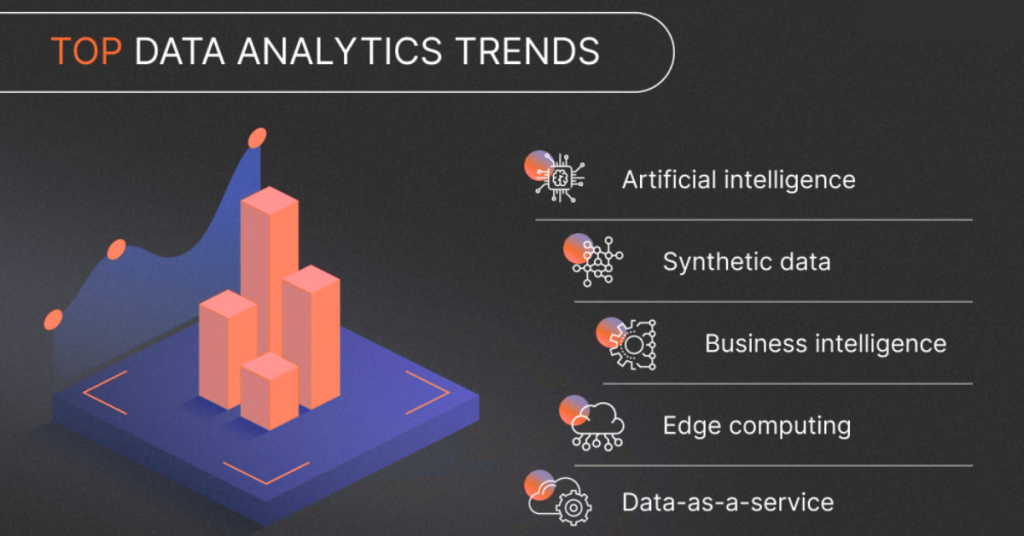
Data analytics is quickly gaining rapid popularity emerging as a much needed method for leveraging data. Most of the businesses are looking to make use of this data to extract information. This rising demand for data analytics solutions has seen a rise in data analytics trends 2025. In this section we have taken a look at the top 10 data analytics trends 2025.
1. Smarter and Scalable Artificial Intelligence
Artificial intelligence in 2025 is developing into a more adaptive, scalable, and context-aware form. Smarter AI systems are able to do sophisticated analytical tasks, create insights with little human intervention, and learn continuously from new streams of data. Organizations are bringing AI into analytics pipelines to identify patterns, automate decision-making, and personalize customer experiences at scale.
Additionally, the scalability of AI platforms allows them to handle both real-time and large batch processing, which makes them well-suited for enterprises handling vast, dynamic data sets in sectors like healthcare, finance, and retail.
2. Agile and Composed Data & Analytics
Composed and agile data & analytics focus on modular, reusable, and adaptable analytics pieces that can be rapidly composed and changed by organizations. Instead of constructing monolithic systems, companies today prefer composable architectures—microservices and APIs—that enable fast innovation and flexibility.
The trend accelerates cross-department collaboration, minimizes time-to-insight, and enables users to personalize analytics workflows at runtime. Agility in 2025 is imperative to react to market changes, regulation changes, and customer demand, and composability becomes the foundation of analytics strategies today.
3. Hybrid Cloud Solutions and Cloud Computing
Hybrid cloud approaches are gaining traction as data analytics trends 2025 as businesses look for flexibility, scalability, and cost-effectiveness. Organisations blend public and private clouds to balance workloads according to security, performance, and compliance requirements. Data analytics platforms designed for hybrid setups enable hassle-free data movement, integrated governance, and single monitoring across setups.
Cloud-native analytics platforms also provide elastic scaling, allowing organizations to manage and analyze huge amounts of data without substantial infrastructure costs. With growing data velocity and diversity, hybrid models of the cloud offer a strong foundation for high-performance and agile analytics.
4. Data Fabric Architecture
Data fabric is transforming the way organizations deal with distributed data. It is an integrated data integration layer over diverse sources, allowing direct access, governance, and analytics. Data fabric architectures are being implemented in data analytics trends 2025 to enable real-time insights, metadata management automation, and minimizing data silos.
Data fabrics use machine learning and knowledge graphs to connect data in an intelligent way irrespective of format or location. This speeds up decision-making, minimizes IT overhead, and improves data quality, enabling technical and non-technical users to extract value from data more effectively.
5. Edge Computing for Faster Analysis
Edge computing brings data processing nearer to the source—be it IoT sensors, mobile endpoints, or industrial sensors. In 2025, this decentralized model reduces latency, saves bandwidth, and facilitates quicker decision-making. Real-time edge analytics allows organizations to respond immediately to data gathered from vehicles, smart factories, or retail spaces. For applications such as predictive maintenance, autonomous systems, or real-time personalization, edge analytics is not only quicker but also safer since sensitive information does not have to travel to the center of servers.
6. Augmented Analytics
Augmented analytics leverages machine learning, natural language processing (NLP), and automation to improve the way users engage with data. It streamlines data preparation, insight creation, and even narrative, making analytics more accessible to non-technical users. In 2025, companies will embed augmented analytics into day-to-day operations to make faster decisions and lessen dependence on data experts.
For instance, a marketing director can inquire of a platform in natural language why sales fell last quarter—and get instant AI-driven answers. Data’s democratization is bridging the distance between data complexity and business acumen.
7. The Death of Predefined Dashboards
Static, pre-set views and traditional dashboards are giving rise to dynamic, automated insights. In 2025, users no longer just use fixed reports—they engage with current data through conversational analytics, customized alerts, and AI-powered narratives. This is a trend that points toward “decision-centric” analytics where insights are actually proactively pushed based on context and behavior. Rather than searching in dashboards, users get the most important information precisely when they need it, making analytics more action-oriented and intuitive.
8. XOps (DataOps, MLOps, AIOps)
The XOps—a collective term for DataOps, MLOps, AIOps, and DevOps—transforms the way enterprises operate analytics. XOps concentrates on automating and streamlining the deployment, monitoring, and governance of data, AI, and ML models. In 2025, XOps makes scalable, consistent, and dependable analytics pipelines enterprise-wide. Agility, reusability, and collaboration are emphasized, with XOps closing the divide between business units, IT, and data science, driving innovation while providing compliance and performance.
9. Engineered Decision Intelligence
Engineered decision intelligence (DI) integrates data, analytics, AI, and business rules to build smart, automated decision structures. In 2025, DI is being infused into fundamental enterprise systems—from CRM to ERP—to enable real-time decision-making. Different from legacy decision models, DI learns and adjusts to new data and results continually.
Through combining both structured and unstructured data, it enables organizations to consider alternatives, forecast outcomes, and suggest the optimal solution. This engineered methodology converts analytics from a support function to a key component of operating strategy.
10. Next-Level Data Visualization
Advanced data visualization in 2025 moves beyond static charts to immersive, interactive, and storytelling experiences. Software now integrates augmented reality (AR), 3D modeling, and natural language questioning, enabling users to navigate rich data sets naturally. Visual narrative is increasingly a core aspect of analytics communication, making the findings more engaging and easier to grasp. With help from AI for chart choice and story creation, visualizations can adapt automatically to context and audience. These technologies guarantee that data is not just viewed—but grasped and addressed.
Industry Applications of Data Analytics Trends in 2025
Data analytics has a key role to play in various industries. With so much data being stored everyday, it is important that the industry wise data is being used to provide tailored solutions. In this section we are going to take a look at the industry-specific analytics trends:
1. Data Analytics in the Healthcare Industry
Through AI diagnoses, predictive modeling, and individualized treatments, healthcare analytics is changing care. Better patient monitoring and faster actions are possible with real-time IoMT and EHR information. The latest data analytics trends in healthcare, helps clinicians provide proactive, cost-effective, patient-centered care by promoting value-based care, increasing outcomes, and assuring regulatory compliance.
Here are some of the most recent data analytics trends in healthcare:
> AI-Powered Diagnostics
Advanced machine learning models are improving the accuracy of diagnoses by looking at medical images, lab results, and patient information. AI techniques can find unusual things like cancers, fractures, or rare diseases faster than older approaches. This means that treatment can start sooner and there are fewer mistakes in diagnosis.
> Predictive Analytics for Patient Outcomes
Healthcare providers employ predictive models to guess how a patient will do, how likely they are to be readmitted, or how well they will respond to treatment. Using these data analytics trends in healthcare, doctors are looking at both past and present data, doctors can make care plans that are more personalized, lower the risk of problems, and raise the overall quality of care.
> Value-Based Care & Population Health
Data analytics helps value-based care by finding out what costs the most and analyzing how well different groups are doing. Providers utilize analytics to better manage chronic diseases, increase preventative care, and cut down on hospitalizations, all of which lead to improved health outcomes at reduced costs.
> Personalized Medicine
Personalized treatment approaches that take into account genetic data, lifestyle, and environmental factors are becoming more common. Analytics platforms combine genetics and patient data to suggest treatments that are best for each person, which greatly increases the effectiveness of treatments.
> Real-Time IoMT Analytics
IoMT devices make a lot of real-time data. Analytics platforms process this data right away so that they can keep an eye on patient vitals, send alerts for abnormal readings, let doctors manage patients from a distance, and speed up emergency responses.
> Data Governance in Healthcare
With so much sensitive data out there, strong governance is needed to protect privacy, follow the law, and keep quality high. To follow rules like HIPAA and GDPR, healthcare analytics now focus on data lineage, security measures, and ethical AI use.
2. Data Analytics Trends in Accounting
AI-driven automation, cloud platforms, and predictive analytics are changing accounting. Real-time financial dashboards and fraud detection technologies improve visibility and accuracy. Data analytics trends in accounting streamline compliance, forecasting, and reporting, helping accountants and CFOs make faster, wiser choices with fewer manual processes and higher scalability.
Let’s check some of the data analytics trends in accounting:
> AI Automation and Fraud Detection
AI makes things like processing invoices, reconciling accounts, and keeping audit trails easier. More and more, predictive models and anomaly detection algorithms are being utilized to find fraud and flag strange transactions in real time, which lowers financial risks.
> Cloud-Based Accounting Platforms
With cloud analytics, you may access financial data in real time from any location. Centralized dashboards help accountants and CFOs keep an eye on performance, make tax filing easier, and improve communication between departments or remote workers.
> Predictive Financial Analytics
It is now possible to predict future income, costs, and cash flows based on data. Machine learning algorithms look at past trends, market data, and customer behavior to come up with flexible budgeting techniques and financial models.
> BI Dashboards for Finance
Business Intelligence (BI) dashboards give you real-time access to important financial data. Decision-makers can keep an eye on KPIs like profit margins, ROI, and working capital with easy-to-understand visualizations. This makes financial planning faster and more accurate.
3. Data Analytics Trends in Insurance
Insurance firms are leveraging Data Analytics Trends 2025 to refine risk assessment, automate claims, and implement usage-based policies. Real-time telematics and unified data sources enable personalized premiums, while responsible AI ensures ethical decision-making. Predictive analytics and hyper-automation are reducing costs and improving customer satisfaction through quicker, more accurate services and fraud prevention.:
> Unified Data Streams for Risk Assessment
Insurers are putting together full risk profiles by combining information from IoT devices, claims history, credit ratings, and social activity. These combined data streams make it possible to do more accurate underwriting and offer policies that are more tailored to each customer.
> Hyper-Automation in Claims Processing
Hyper-automation uses AI, RPA, and analytics to make the claims process faster and easier. It cuts down on the need for people to get involved, cuts down on mistakes, and speeds up payments, which makes customers happier and makes the business run more smoothly.
> Telematics & Real-Time Policy Adjustments
Telematics devices in cars give insurers real-time data about how people drive, so they can change premiums based on how people actually drive. This concept of insurance based on usage encourages safer driving and makes pricing match real-world hazards.
> Responsible AI in Insurance
Ethics are affecting how AI is used in pricing, underwriting, and claims. To keep trust and make sure AI-driven judgments don’t discriminate or lie, there must be openness, justice, and conformity with the law.
4. Data Analytics Trends in Manufacturing
Data analytics trends in manufacturing empowers smarter operations with predictive maintenance, digital twins, and IoT-based quality control. Real-time edge analytics improves decision-making on factory floors, while supply chain visibility ensures agility and resilience. These innovations reduce downtime, boost productivity, and optimize inventory and production planning across the entire manufacturing lifecycle.
Here are some of the data analytics trends in manufacturing
> Predictive Maintenance
Manufacturers can figure out when machines will break down by looking at data like vibrations, temperature, and sound waves. This cuts down on unplanned downtime and makes maintenance programs as efficient as possible, which saves money and increases uptime.
> Digital Twin Technology
Digital twins are virtual copies of real things that are always getting new information. They let manufacturers run simulations, make performance better, and test changes without affecting real processes.
> IoT-Driven Quality Control
Sensors built into production lines gather data to keep an eye on quality in real time. Analytics systems immediately indicate deviations, allowing for early remedial steps and guaranteeing product consistency.
> Edge Analytics on Factory Floors
Edge computing lets data be processed on-site, which cuts down on latency and bandwidth use. It helps manufacturers examine production data on-site, which lets them make decisions in real time and respond better to problems that come up in the course of business.
> Real-Time Supply Chain Visibility
Analytics tools now give you a full view of your supply chain, including inventory levels, shipping statuses, and supplier risks. This visibility lets producers deal with problems before they happen, find the best suppliers, and cut down on lead times.
5. Retail Data Analytics Trends
Data Analytics Trends in Retail to forecast demand, personalize shopping experiences, and implement dynamic pricing. By analyzing customer behavior, social sentiment, and real-time sales data, businesses can segment audiences effectively and respond to market trends instantly. These Data Analytics Trends in Retail drive better inventory management, targeted promotions, and improved customer engagement across physical and digital channels.
> AI for Demand Forecasting
Retailers are utilizing AI to predict demand with great accuracy by looking at sales history, the weather, market trends, and calendars of sales. This makes it easier to manage inventory, which means fewer times when you run out of goods or have too much of it.
> Market & Consumer Behavior Predictions
Retail analytics technologies keep an eye on how people act in real time on websites, applications, and in shops. These insights help with product placement, campaign timing, and assortment planning so that they meet the changing needs of customers.
> Smart Customer Segmentation
Retailers develop micro-segments by looking at things like consumer demographics, buying habits, and patterns of engagement. This lets you run very focused advertising, which increases conversion rates and customer loyalty.
> Sentiment & Trend Analysis
Natural Language Processing (NLP) tools look at reviews, social media, and feedback to see how people feel about something. Retailers utilize this information to make changes to products, customize messages, and spot new trends in the market.
> Dynamic Pricing Strategies
Retailers utilize real-time data to set prices that change based on demand, competition, and how much stock they have. Competitive pricing keeps customers happy while maximizing revenues.
Embrace Advanced Data Analytics with A3Logics
A3Logics provides data analytics services that are specifically designed to propel your organization to new heights. With A3Logics’ expertise, you obtain a comprehensive analytics platform designed to extract meaningful experiences from your data, fostering informed independent direction and strategic planning.
A3Logics’ solution goes beyond traditional analytics by adding cutting-edge developments like machine learning and artificial intelligence to provide predictive and prescriptive analytics. This entails comprehending previous data, forecasting future trends, and recommending appropriate actions.
A3Logics stands out for its commitment to customization, ensuring that the analytics solution fits smoothly with your unique business requirements. The platform provides simple interfaces that make sophisticated data accessible to all levels of clients within your organization.
With A3Logics, you’re not just investing in analytics; you’re investing in a partner who is dedicated to optimizing your data consumption for increased competence and competitive advantage. The benefits apply to a wide range of industries, including healthcare and banking.
A3Logics’ analytics solution professionals can help you identify patterns, minimize risks, and recognize amazing opportunities that might otherwise go unnoticed. The platform’s flexibility and versatility ensure that it grows alongside your organization, adjusting to evolving data requirements.
Conclusion
Finally, the next data analytics trends 2025 promise to transform how firms use their data. From smarter AI and agile analytics models to the rise of hybrid cloud solutions and the growing importance of data visualization, these trends often provide new chances for businesses to get insights and make sound decisions. Organizations can stay ahead of the curve in an ever-changing data world by understanding these trends, which drive innovation and provide competitive advantages.