Employment is no longer just about pay and titles anymore. In 2025, employee benefits will increasingly be the factor that sets great businesses apart from the average ones. Today’s employees not only expect healthcare and paid time off, but they also seek more comprehensive offerings. In fact, they now want personalized, flexible, and bundled benefits that improve their health, finances, and work-life balance. Moreover, businesses must ensure employee benefits compliance to avoid legal issues and maintain employee trust.
Therefore, staying ahead of evolving expectations and regulations is key to attracting and retaining top talent.

Employers need to change their benefits approach to attract, engage, and keep the smartest and brightest workers, even as competition for talent is fiercer than ever. This blog talks about employee benefits, which include everything from cutting-edge wellness programs to AI-powered career advancement. This official guidebook is for you if you are an employer who wants to improve your benefits or an employee who wants to know what is coming your way.
Not following the rules can not only lead to big penalties and lawsuits, but it can also damage employee trust and the company’s brand. This complete book has all the information, checklists, and the most up-to-date employee benefits compliance checklist for small employers that your HR and leadership teams will need to get ready for the year ahead.
Employee Benefits Compliance: Key Stats
They are extra payments that workers get in addition to or instead of their standard remuneration. An employee benefit in India makes people happier at work, boosts morale, and keeps workers longer. Benefits range from health and retirement plans to wellness and mental health programs, work/life balance practices, and cash allowances.
- In the past year, 63% of companies changed at least one of their benefits policies because of new laws.
- In 2024, 58% of organizations had to go through at least one compliance audit or inquiry relating to perks.
- 47% of HR leaders said that keeping up with changes to employee benefits compliance was the most time-consuming part of managing benefits.
- In 2024 alone, U.S. businesses had to pay more than $2.7 billion in fines and settlements for not following benefits rules.
Employee Benefits Compliance: Synopsis

They are extra payments that workers get in addition to or instead of their standard remuneration. An employee benefit in India makes people happier at work, boosts morale, and keeps workers longer. Benefits range from health and retirement plans to wellness and mental health programs, work/life balance practices, and cash allowances.
Compliance with employee benefits is making sure that all employer-sponsored benefit plans follow all federal, state, and local laws. This includes offering required health insurance, retirement plans, leave policies, and welfare benefits, as well as keeping track of plan documents and disclosures.
A strong employee benefits compliance checklist needs more than simply corrections after the fact; it also has to keep an eye on things ahead of time, especially since 2025 will see more improvements to employee benefits compliance than ever before.
Compliance isn’t only about following the law; it’s also about fairness, openness, and making sure that employees have a good time at work. Reliable support for employee benefits compliance and regular audits are increasingly standard business practices for firms.
Why Compliance Matters More Than Ever in 2025?
Compliance with employee benefits is making sure that all benefit schemes and activities follow the law. This includes keeping correct records, giving out benefits that are required by law, and appropriately managing optional benefits.
If you don’t follow the rules for perks, you could face fines, lawsuits, broken relationships with employees, and a loss of faith in your company. Your employees are counting on you to keep your word, and the law requires you to do what you said you would do.
Employers must take steps to make sure that their benefit programs meet all legal standards. Employee benefits compliance updates are not optional. As of 2025, all responsible companies must make sure that their employees’ benefits are in line with the law.
Why? First, the law has become more complicated because new rules about things like mental health parity, pay transparency, leave expansion, and fertility coverage have come into effect in the US and around the world. Second, regulators have stepped up their audits and enforcement, especially after the most recent updates on compliance for employee perks. Third, employees want more managed benefits services that are tailored to their changing requirements and legal protections that keep their rights safe.
Why the Focus on Benefits Compliance Now?
- 71% of employers feel that the speed at which updates to employee benefits compliance have been made has increased since 2021.
- Almost half of small businesses have trouble with the employee benefits compliance checklist for small businesses since they don’t have enough resources or knowledge.
- In 2024, the number of fines for submitting the ACA wrong went up by 13% compared to the year before.
- New legislation about family leave and openness caused a 29% rise in calls to HR for help with compliance.
Key Federal Laws You Must Follow for Employee Benefits Compliance
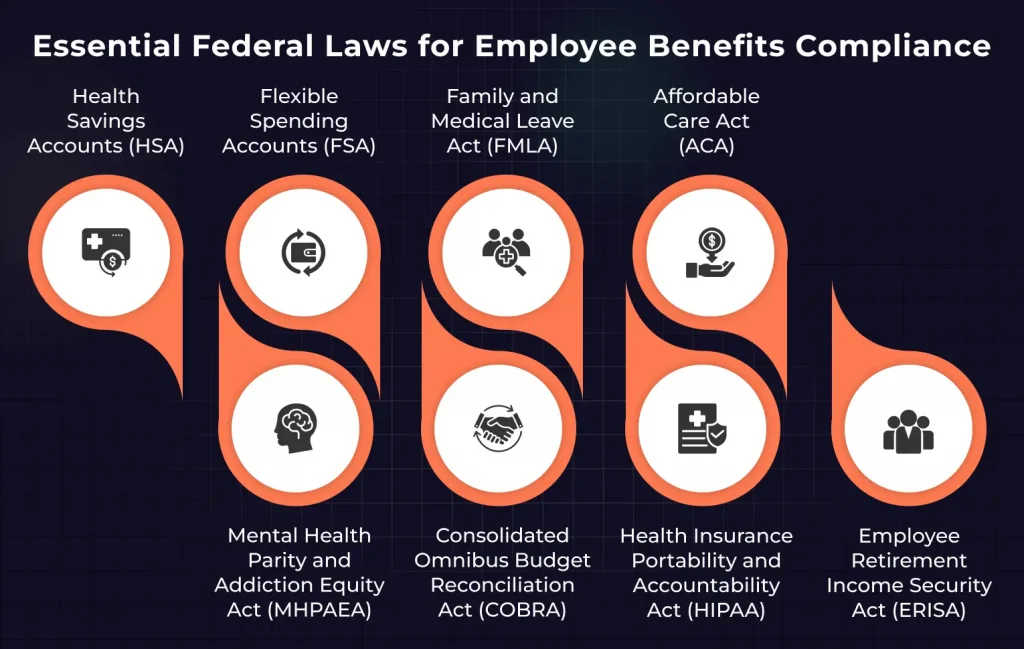
Your employee benefits compliance checklist is based on a strong understanding of what the federal government requires. These basic laws define the lowest standards for businesses:
1. Affordable Care Act (ACA)
Companies with 50 or more full-time employees must provide health insurance that is cheap and meets basic standards. To follow the ACA, you need to file annual reports (Forms 1094-C and 1095-C) and keep track of hours and costs very carefully. Keep up with changes to annual penalties and the limits on what you may afford.
2. Consolidated Omnibus Budget Reconciliation Act (COBRA)
COBRA says that firms with 20 or more employees must keep health insurance for workers and their families who lose it because of a qualifying occurrence. Your employee benefits compliance checklist should include things like notice requirements, election periods, and keeping track of premium payments.
3. Health Insurance Portability and Accountability Act (HIPAA)
HIPAA sets rules for how health information should be kept private and safe. It also makes sure that group health plans follow certain regulations about privacy, security, and notifying people about breaches. These laws are meant to stop discrimination based on health conditions.
4. Employee Retirement Income Security Act (ERISA)
ERISA sets clear requirements for disclosures, fiduciary duties, funding, and claims processes for retirement and many health plans. Therefore, your compliance checklist should include several critical elements. For instance, it must cover annual filings such as Form 5500, along with required disclosures like the Summary Plan Description (SPD) and Summary of Material Modifications (SMM).
In addition, it should ensure timely notices are sent to participants. Furthermore, staying organized and proactive in meeting these obligations is essential to avoid penalties and maintain regulatory compliance.
5. Health Savings Accounts (HSA) & Flexible Spending Accounts (FSA)
The IRS sets rigorous limits on these tax-advantaged accounts every year, and they must follow strict standards against discrimination and proof. Employers must make sure that the plan documentation is correct, the contributions are correct, and the relevant notices are sent out on time.
6. Family and Medical Leave Act (FMLA)
Under the FMLA, qualifying employees can take 12 weeks of unpaid, job-protected leave for family and medical reasons. During FMLA absence, employers must send out notices on schedule and keep group health benefits.
7. Mental Health Parity and Addiction Equity Act (MHPAEA)
Health plans must give mental health and drug abuse coverage that are just as good as medical and surgical benefits, including copayments, visit limitations, and out-of-pocket charges. New audits in 2025 will make enforcement stricter, so plans must routinely check and certify that they are equal.

Other Key Federal Laws & Considerations
In addition to the biggest federal regulations, the following laws are important parts of your employee benefits compliance checklist for small and large businesses:
- The Americans with Disabilities Act (ADA) says that people with disabilities can’t be discriminated against and that reasonable adjustments must be made, such as giving them equal access to benefits.
- The Age Discrimination in Employment Act (ADEA) protects workers 40 and older from unfair benefits that are based on their age.
- The Genetic Information Nondiscrimination Act (GINA) says that benefits and jobs can’t be based on genetic information.
- The Women’s Health and Cancer Rights Act (WHCRA) says that group health insurance must cover post-mastectomy care.
- The Newborns’ and Mothers’ Health Protection Act (NMHPA) sets minimum hospital stays for mothers and their newborns.
- Creditable Coverage Disclosure (Medicare Part D says every year, workers must be told about the status of their prescription drug plan.
- The CHIP Reauthorization Act (CHIPRA) gives qualified dependents the right to be notified and to enroll.
Employers must also keep an eye on mandated disclosures, update plan documentation every year, and follow new rules about reporting and privacy.
New 2025 Regulations You Can’t Afford to Miss
As 2025 approaches, there will be a number of big changes to employee benefits compliance that make it hard to keep up with them.
- ACA Penalty Changes: Starting in 2025, the individual penalty for not providing affordable, minimum-value coverage will be $362.50 per month for each full-time employee. Affordability is now fixed at 9.02% of family income.
- Mental health parity: Federal authorities are paying more attention to mental health benefits, with a focus on physician management, network sufficiency, and coverage equality.
- More states are requiring paid family leave: In 2025, several states, including as Colorado, Oregon, and Illinois, will offer or increase paid family and medical leave.
- Gender-affirming and Fertility Coverage Mandates:New rules in states like California and New York say that group health plans must cover gender-affirming procedures and fertility preservation.
- Wage Transparency Regulations: States are making it harder for firms to post job openings without showing wage ranges; if they don’t follow the requirements, their benefits plans could be audited.
Employers need to keep a careful eye on these changes about compliance with employee benefits and change their programs as needed.
State-Specific Employee Benefits Compliance Checklist
The employee benefits compliance checklist for small and large businesses is different in each state. Here are several important 2025 state compliance touchpoints:
1. California
- Paid Family Leave (PFL): It is money you get when you take time off from work to care for a sick family member or for medical reasons.
- CalSavers Retirement Program: Eligible employers automatically enroll their employees in retirement.
- Health Insurance Mandate: Even some small businesses will face penalties if they don’t follow the rules.
2. New York
- Paid Family Leave: The best paid leave policy in the country.
- Short-Term Disability (STD): Disability insurance that employers must offer.
- Law on Wage Transparency: Employers must provide salary ranges in employment ads.
3. Massachusetts
- Paid Family and Medical Leave (PFML): It is a state-run program that covers most workers.
- Requirements for health insurance contributions: Employers have to provide “fair share” payments.
- Earned Sick Time Law: Required to earn paid sick leave.
4. Washington
- WA Cares Fund: Long-term care insurance that you have to have.
- Paid Family and Medical Leave: a strong benefit run by the state.
- Equal Pay and Opportunities Act: There are strict laws for pay transparency and fairness.
5. Oregon
- OregonSaves Retirement scheme: State retirement scheme for employees without employer-sponsored plans.
- Compensated Leave Oregon: A new state-run program that gives people compensated time off for family and medical reasons.
6. Illinois
- Secure Choice Retirement Program: Required automatic employee enrollment.
- Leave for Victims of Domestic or Sexual Violence: Mandated leave protections.
7. Colorado
- Family and Medical Leave Insurance (FAMLI): Up to 12 weeks of paid leave.
- Equal Pay for Equal Work Act: Severe penalties for pay discrimination.
8. New Jersey
- Family Leave Insurance & Temporary Disability Benefits: Extensive coverage and employer reporting obligations.
- Healthcare Coverage Reporting: Strict state filings in addition to federal requirements.
If you don’t meet these regional duties, you could face compliance failures and serious penalties.

How A3Logics Helps You Stay Compliant with Employee Benefits Regulations
In 2025, keeping up with employee benefits compliance typically requires using cutting-edge technology and getting help from experts. A3Logics’ Employee Benefits Administration Services help businesses automate important operations like checking eligibility, reporting, and policy disclosures. This makes sure that every item on their employee benefits compliance checklist is handled quickly and correctly.
Their Managed Benefits solutions offer personalized, hands-on help, regular checks on employee benefits compliance updates, and proactive suggestions. A3Logics gives employers the tools they need to quickly respond to changes in the law, lower risks, and make every step of employee benefits compliance support easier by combining payroll, HR, and benefits data.
Final Thought
Compliance with employee benefits is more than just checking off boxes; it’s a complicated, always-changing job that is essential for keeping employees happy and the company strong. Using a well-made checklist for employee benefits compliance for both small and large enterprises, and keeping an eye out for updates on employee benefits compliance, will set your business up for long-term success.
Adopting technology-driven Benefits Compliance Solutions and collaborating with reputable suppliers for employee benefits compliance support can guarantee you respond proactively to new legislation, regulatory adjustments, and workforce demands.