The food delivery business is leading the way of digital transformation because of changing customer expectations, new technologies, and creative business models. The food delivery app business models have been a major force in changing how people order and enjoy meals as convenience and speed become more important for modern consumers. If you want to be competitive in 2025, you need to know about the newest trends in online meal delivery business models, whether you’re a business owner, a restaurant owner, or just someone who loves technology.
This article looks at the most important food delivery business models, the state of the worldwide market, and what trends will change the industry in the future. We will also look at the business model of food delivery apps, provide you a full canvas, and give you useful tips if you want to make your own food delivery app.
Understanding the Food Delivery Business Models
The main idea behind the meal delivery business model is to connect customers with restaurants through digital platforms, make ordering easy, and make sure that food is delivered on time. Food delivery apps’ business strategy is meant to make things as easy as possible for users while also giving eateries a wider audience and making their operations more efficient. Some important parts of a successful meal delivery company model are:
- Platforms collect menus from different restaurants so that customers may look through and order from a wide range of cuisines.
- Managing the delivery of meals to customers, either through in-house fleets or outside partners.
- Making money through ads, subscriptions, delivery fees, and commissions.
- Offering a user-friendly interface, tracking in real time, and tailored suggestions.
The growth of on demand app development services has made it easy for anyone to get into the industry.
This means that startups may now launch new food delivery app business models that are suited to specific niches or locations.
Food Delivery App Business – Global Market Size
The market for meal delivery apps throughout the world is growing very quickly. Depending on the source and approach used, the market is expected to be worth between USD 98.5 billion and USD 173.57 billion in 2025. Some estimates say that by 2034, the market might be worth more than USD 400 billion, with a compound annual growth rate (CAGR) of more than 17%. The Asia-Pacific area is in the lead, bringing in more than a third of all global revenue. China, India, and Southeast Asia are all big contributors. Some of the main reasons for this rise are:
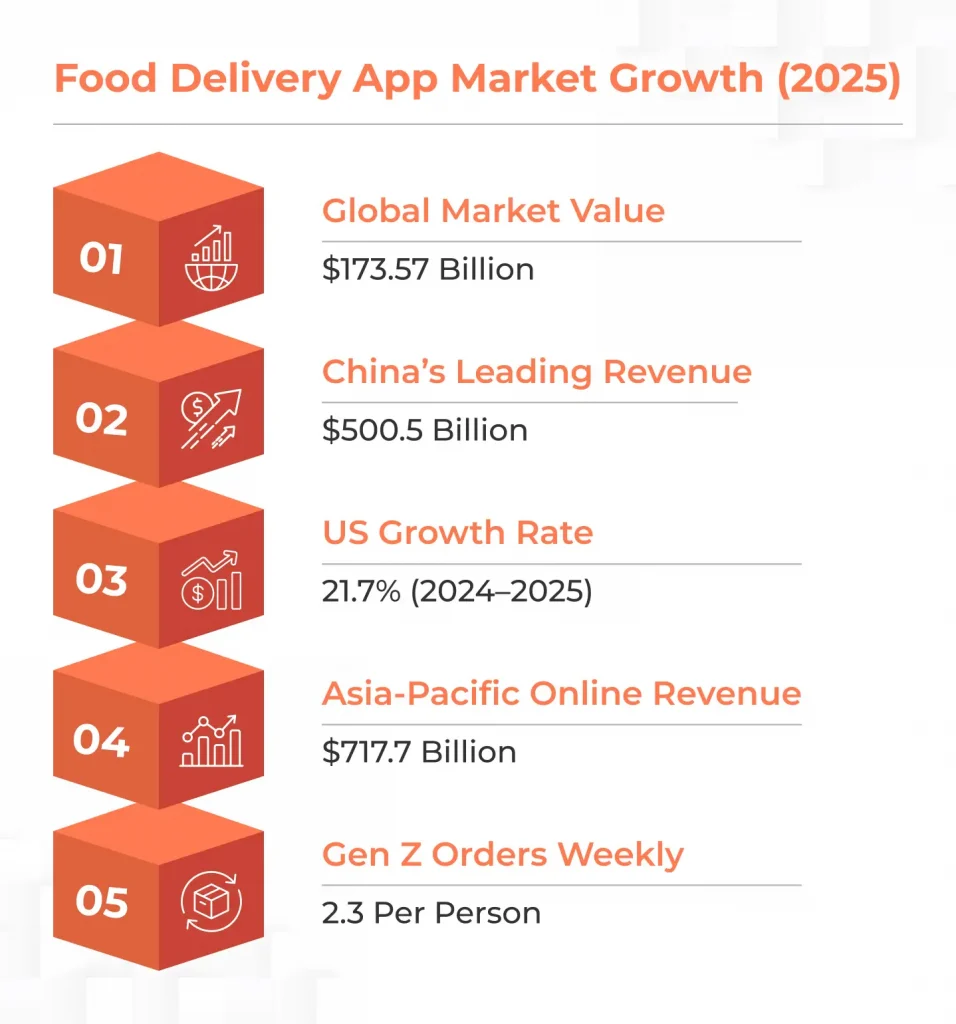
- More than 85% of people around the world own a smartphone, and this number is considerably higher among younger people.
- Broadband and mobile data are widely available, which makes it easy to order online.
- More and more, people want convenience, speed, and choice, which is driving up demand for online meal delivery business models.
These trends show that there is a lot of room for both new and established businesses to come up with new ideas in the food delivery app business model.
Top Food Delivery App Business Models in 2025
In 2025, the following food delivery app business models will be the most creative and important to watch:
1. Subscription-Based Delivery Services
Subscription arrangements are now a key part of the business plan for meal delivery services. DoorDash, Uber Eats, and Deliveroo are examples of platforms that give users monthly or yearly memberships that come with free or cheap delivery, special promotions, and other benefits. This method builds client loyalty, gets them to order more often, and gives businesses a consistent stream of repeat revenue. Users get value from saving money and making things easier, while restaurants get value from having predictable demand and keeping customers longer.
Advantages
- Predictable recurring revenue for platforms and restaurants
- Increases customer retention and order frequency
- Offers cost savings for frequent users
- Enhances brand loyalty and user engagement
Disadvantages
- Less appealing to infrequent or casual users
- May reduce per-order profit margins
- High churn if value isn’t maintained
- Complex to manage multiple subscription tiers
2. Hyper-Local Partnerships & Community Commerce
Hyper-local food delivery services let people find restaurants, bakeries, and other food sellers that are close to them. This business model for food delivery service focuses on quick delivery, helping local companies, and lowering costs of doing business. Hyper-local platforms give users a more personal and community-driven experience by working closely with local businesses and delivery people. Commissions or subscriptions are the main ways that businesses make money, and they focus on keeping customers and getting them involved in the community.
Advantages
- Faster delivery times for local customers
- Supports small businesses and local economy
- Personalized, community-driven customer experience
- Lower delivery costs within small geographies
Disadvantages
- Limited market reach outside local area
- Scaling up is challenging and resource-intensive
- Revenue potential capped by local demand
- Reliant on strong local partnerships
3. Platform-as-a-Service (PaaS) for Restaurants
Restaurants can create their own branded delivery applications with less initial cost thanks to Platform-as-a-Service (PaaS) offerings. These platforms give you the technology, logistical, and marketing help you need to compete with third-party aggregators. PaaS models give restaurants the power to keep client information, manage the user experience, and avoid paying excessive commission fees. This method is especially appealing to well-known restaurants and chains that want to connect with their customers directly.
Advantages
- Lower upfront cost for restaurant technology
- Restaurants keep control of customer data
- Avoids high commissions from aggregators
- Customizable branding and user experience
Disadvantages
- Restaurants manage their own delivery logistics
- Requires technical know-how for effective use
- Ongoing subscription or service fees apply
- Less exposure compared to large aggregator apps
4. Virtual Brands & Ghost Kitchens (Cloud Kitchens)
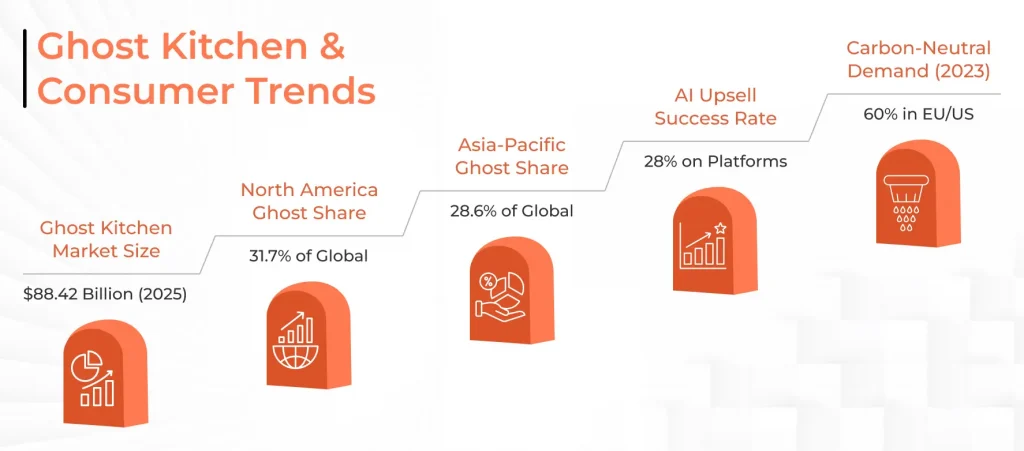
Ghost kitchens, which are sometimes called cloud kitchens, are places that solely provide food and don’t have a place for people to eat. This type of food delivery app business model lets operators run many virtual brands from one kitchen, which makes things run more smoothly and lowers costs. Cloud kitchens are great for new and established firms who want to reach more people without having to pay the hefty costs of regular restaurants. Real-time order tracking, inventory management, and easy interaction with numerous delivery platforms are some of the features that food delivery apps provide that help ghost kitchens.
Advantages
- Lower overhead than traditional restaurants
- Flexible menu and brand experimentation
- Rapid market entry and expansion possible
- Efficient use of kitchen resources and staff
Disadvantages
- No physical presence for walk-in customers
- High competition in delivery-only space
- Dependence on digital marketing for visibility
- Limited direct customer interaction and feedback
5. Direct-to-Consumer (D2C) Models
With direct-to-consumer (D2C) food delivery apps, restaurants may contact directly with customers instead of going via third-party platforms. Restaurants have more control over branding, pricing, and client connections with this type of online meal delivery business strategy. D2C applications generally have loyalty programs, tailored recommendations, and special deals that help businesses engage with their customers better.
Advantages
- Complete control over the relationship with the customer
- Higher profits by not using third parties
- Loyalty programs and deals that are made just for you
- Direct access to data and input from customers
Disadvantages
- A lot of promotion is needed to get new users.
- Not as many people can see it as on aggregator platforms
- Costs of developing and maintaining technology
- It’s harder to compete with applications that have more than one restaurant.
6. B2B Food Delivery Apps for Corporate and Industrial Use
B2B food delivery apps offer bulk meal delivery services to businesses, industrial parks, and huge groups of people. Food delivery apps that work this way focus on large orders, scheduled deliveries, and menus that can be changed. To make food service easier for employees and clients, B2B platforms commonly work with catering firms and corporate cafeterias.
Advantages
- Large, regular orders from businesses
- Long-term agreements with corporate customers
- Menus that can be changed to fit your needs
- Streamlined logistics for planned deliveries
Disadvantages
- Managing orders and sending bills is hard.
- Only available on weekdays and during business hours
- A lot of dependence on a few big clients
- Less brand recognition among regular people
7. Sustainable and Eco-Friendly Delivery App Models
More and more, businesses and consumers are making sustainability a top priority. Eco-friendly food delivery app models focus on using packaging that breaks down naturally, delivery options that don’t add to carbon emissions, and programs that cut down on waste. Customers can choose more eco-friendly delivery choices on these platforms and support eateries that care about the environment.
Advantages
- Draws in customers who care about the environment
- A good brand image and a way to stand out
- Less waste from packaging and delivery
- Possible government incentives or collaborations
Disadvantages
- More expensive items that are good for the environment
- In some places, there aren’t many eco-friendly delivery options.
- Customers that care about price may not like it
- Needs excellent alignment between suppliers and logistics
Food Delivery App Business Model Canvas
The Business Model Canvas (BMC) is a tool that helps business owners see and plan the most important parts of their food delivery app business model. Here is a list of the most important parts:
| Element | Description |
| Key Partners | Restaurants, delivery personnel, payment gateways, technology providers |
| Key Activities | Order management, delivery logistics, customer support, marketing |
| Key Resources | Mobile app, backend infrastructure, delivery fleet, customer data |
| Value Propositions | Convenience, speed, choice, personalized recommendations, loyalty programs |
| Customer Relationships | Customer support, feedback loops, loyalty rewards, personalized communication |
| Channels | Mobile app, website, social media, email, SMS |
| Customer Segments | Individuals, families, offices, events, corporate clients |
| Cost Structure | Technology development, marketing, delivery logistics, customer acquisition |
| Revenue Streams | Commissions, delivery fees, subscriptions, advertising, white-label solutions |
1. Key Partners
Key partners are restaurants (local, chain, and cloud kitchens) that provide the food; delivery people or third-party logistics companies that handle the delivery; payment gateway providers that make sure transactions are safe; technology vendors that host, maintain, and analyze the app; marketing affiliates and influencers that help find new customers; and packaging suppliers that provide eco-friendly or branded materials. Making strategic partnerships with grocery stores, drink companies, or even health and wellness brands can help the service grow and give customers more ways to connect with it.
2. Key Activities
The major tasks include building and maintaining the mobile and online platform, bringing on and managing restaurant partners, processing and tracking orders, coordinating delivery logistics, making sure customers get help, and running digital marketing efforts. It is also important to keep making the app better, set up loyalty programs, use data analytics to make it more personal, and make sure that food safety and local laws are followed. To keep customers happy and the brand’s reputation high, delivery people need to be trained often and service quality needs to be checked.
3. Key Resources
Some of the most important resources are the mobile app and backend software infrastructure, a skilled development and operations team, a strong network of restaurant partners, a fleet of delivery people (either in-house or contracted), a complete customer database, and intellectual property like proprietary algorithms for routing or personalization. Brand reputation, consumer trust, and connections with payment processors or marketing agencies are also important assets that help businesses develop and stay in business.
4. Value Propositions
The software is incredibly convenient because it lets users order from a lot of different restaurants with only a few taps. Fast and reliable delivery, real-time order tracking, personalized suggestions, unique discounts, and loyalty benefits all add value. The platform gives restaurants more exposure, access to a wider range of customers, and data-driven insights to help them run their businesses better. Other things that might add value are eco-friendly delivery alternatives, the ability to customize meals to fit your diet, and easy connections to digital wallets or incentive systems.
5. Customer Relationships
To build great relationships with customers, you need to be able to help them quickly (via live chat, phone, or email), be open about the progress of their orders, and solve problems before they happen. AI-driven recommendations, customized promos, and loyalty schemes that make things more personal encourage customers to come back. Push notifications, feedback surveys, and social media engagements that get people involved help keep a sense of community and trust. Dedicated account managers and frequent performance assessments help restaurant partners work together in ways that are good for both sides in the long term.
6. Channels
The main way to utilize the service is through the mobile app, which makes it easy to browse, order, and pay. Additional channels include the website, social media sites for marketing and interaction, email newsletters for promotions and updates, SMS alerts for real-time notifications, and working with influencers or affiliate marketers. A partner dashboard or portal makes it easier for restaurants to maintain their menus and execute orders. Connecting with voice assistants or smart gadgets is a new way to order without using your hands.
7. Customer Segments
People and families that live in cities and want convenience, businesses that need group or scheduled orders, students and young professionals who want speed and variety, and health-conscious people who want dietary options are some of our main customer groups. Restaurant partners can be everything from small, local restaurants to big national chains and cloud kitchens. Event planners, seniors, and persons with special dietary needs are some other groups that may need different marketing and service techniques.
8. Cost Structure
The biggest costs are developing and maintaining technology (including updating apps and hosting servers), paying employees and delivery people, promoting and getting new customers, processing payments, providing customer support, and getting insurance for liability and delivery. Extra costs could be packaging, onboarding partners, following the rules, and rewards for loyalty programs. As the company grows, spending a lot of money up front on data analytics, AI, and automation might help keep expenses down.
9. Revenue Streams
The main sources of income are commissions from restaurant partners (a percentage of each order), delivery costs charged to clients, and subscription fees for premium services like free delivery or special specials. In-app ads, featured restaurant placements, data analytics services for partners, and white-label solutions for restaurants who want their own branded delivery app are all ways to make extra money. Some platforms also make money by teaming up with grocery or retail brands or by providing catering and bulk order services to businesses.
Business Model of Top Food Delivery Apps
1. DoorDash Business Model
DoorDash is an aggregator that connects customers with local eateries and handles the whole delivery procedure. The business makes money by charging restaurants a commission, customers a delivery fee, and people who sign up for its DashPass program a subscription fee. DoorDash’s strong logistical network and marketing tools enable restaurants to reach more people and make more money.
2. Uber Eats Business Model
Uber Eats uses Uber’s existing network of drivers to deliver food quickly and reliably. The company makes money by charging restaurants a fee for each order and by charging delivery costs and running its Uber One subscription program. People like Uber Eats because it is easy to use, has a lot of restaurants to choose from, and works well with the Uber app.
3. Grubhub Business Model
Grubhub is one of the oldest and most well-known meal delivery services in the U.S. The business works with nearby eateries, handles online orders, and does deliveries with its own drivers or those of other companies. Grubhub makes money by charging delivery fees, commissions, and running ads. The software gives restaurants useful information and insights about their customers so they may improve their services.
Future Trends in Food Delivery App Business Models
The rise and demand for food delivery apps is getting so enhanced, that there is a lot more to come. We have sorted out the below future trends that can bring a lot more out of food delivery app business models. Check it out.
1. AI-Powered Personalization & Predictive Ordering
Artificial intelligence is changing the way food delivery apps work by making it possible to give very tailored recommendations, predict orders, and change prices on the fly. AI algorithms look at what customers like, what they ordered in the past, and what’s popular in the area to recommend dishes and make delivery routes better.
2. Automated Delivery (Drones and Robots)
Drones and robots are going to change the way food is delivered by making it cheaper, faster, and allowing for contactless service. To keep ahead of the competition, top platforms are putting money into technologies that allow for driverless delivery.
3. Integration with Smart Kitchens and IoT
IoT devices in smart kitchens can handle things like making orders, keeping track of inventory, and checking quality. Integration with applications that deliver food makes things run more smoothly and makes them more efficient.
4. Immersive Menu Experiences with AR/VR
Augmented reality (AR) and virtual reality (VR) are being utilized to make menu experiences more realistic, letting customers see what they want to get before they order it. This new idea makes people more interested and lowers the number of returns.
5. Gamification and Loyalty Programs
Gamification elements like awards, badges, and challenges make customers want to buy again and make them more loyal. Loyalty programs are an important part of the online food delivery business model. They keep customers coming back and make them purchase more often.
6. Voice Search and Smart Assistant Integration
Ordering via voice using smart assistants like Alexa and Google Assistant is becoming more and more common. Food delivery applications are adding voice search so that people can order without having to use their hands.
Why Partner with A3Logics for Your Next-Gen Food Delivery App?
Working with a top food delivery app development company like A3Logics gives you access to the latest technology, industry knowledge, and solutions that can grow with your business. A3Logics is an expert in on demand app development, and they can help you make your own food delivery app with sophisticated features, strong security, and easy integration. A3Logics can help you stay ahead in the competitive food delivery market, whether you’re starting a new business or improving your current one.
Final Takeaway: Food Delivery App Business Models
The business model for meal delivery apps is changing faster than ever before because of new technology and shifting customer needs. There are a lot of ways to expand and stand out, like subscription-based services, ghost kitchens, hyper-local platforms, and sustainable delivery strategies. In the fast-paced world of internet meal delivery, entrepreneurs and restaurants may do well by keeping up with the latest trends, using the correct technology, and working with a reliable mobile app development company.