One thing that is essential for a warehouse is to keep the right products available. This helps process orders efficiently and ensure that the customers receive their items accurately and on time. Traditional warehouses that rely on manual labor and paper-based tracking, struggle to keep with expectations; whether in terms of seamless operations or growing customer expectations. In such a scenario – warehouse automation isn’t just a technical upgrade but a strategic necessity.
The scope of warehouse automation system development is evident by the fact that the global warehouse automation market is projected to reach $93 billion by 2031. In this post, we’ll understand what warehouse automation is, the trends shaping warehouse automation, and best practices that can help businesses streamline operations and improve efficiency.
What is Warehouse Automation?
Warehouse automation refers to the use of automated systems and technology to manage and execute a variety of tasks in a warehouse. These range from load picking, packing and shipping of products. The primary intent of warehouse automation is to reduce or eliminate human assistance and labor-intensive duties that involve manual data entry, and physical work.
How do Automated Warehouses Work?
Step 1 – Arrival
Automated warehouses work by combining robotics, smart software and sensors to manage goods efficiently with minimal human involvement. When items arrive at the warehouse – they are scanned or tagged using RFID or barcodes. This data is then captured in a Warehouse Management System which knows exactly where every item needs to be stored.
Step 2 – Moving Products to Stations
Next, warehouse automation technologies such as autonomous mobile robots (AMRs), AS/RS, Conveyor, and Sortation Systems move the items to the designated locations. They further stack or sort them efficiently.
Step 3 – Picking and Dispatching
Once the order comes in, the Warehouse Management System calculates the fastest routes and assigns the tasks to robots or conveyor systems to pick the items. AMRs or automated guided vehicles transport the items to packing stations. Along the way, sensors and cameras ensure accuracy and check for any errors or misplaced items.
Step 4 – Shipping
Finally, the packed goods move to shipping zones. Technologies such as AI and predictive analytics further monitor inventory shortage, alert about replenishment needs, and minimize downtime.
Types of Warehouse Automation Technologies
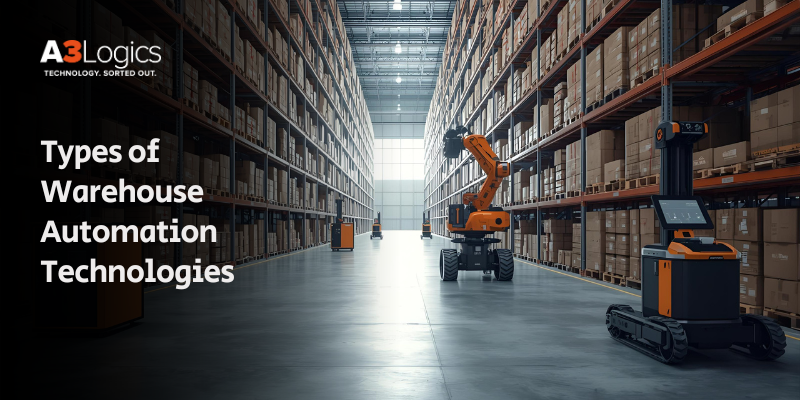
There are various kinds of warehouse automation solutions that can help warehouses reduce manual tasks and enhance operations –
1. Goods-to-Person (GTP)
Goods-to-person is one of the warehouse automation solutions in which products are brought to a person by fixed or autonomous mobile robots (AMRs). The person doesn’t have to move from his or her location; instead, the items needed to prepare an order reach their pick stations.
2. Automated Storage and Retrieval Systems (AS/RS)
AS/RS leverages hardware and software technologies such as AI in warehouse automation, including warehouse automation software to automate handling, replenishment processes, and item storage. It does this within a far denser physical footprint and compact storage space.
3. Automatic Guided Vehicles (AGVs)
These are driverless, mobile robots that use sensors, software, and navigation systems to transport materials without human operators. This class of warehouse automation uses wires, magnetic strips, and sensors to navigate a fixed path through the warehouse. It is not suitable for a warehouse where there are a lot of workers.
4. Autonomous Mobile Robots (AMRs)
Autonomous mobile robots are transport robots designed to transport objects autonomously. They navigate the warehouse freely based on dynamic routes generated by software. The warehouse automation software optimizes the movements of the AMRs and assigns a perfect route for each task.
5. Pick-to-Light and Put-to-Light Systems
These are the two picking methods that use light signals and are connected to the automation warehouse management systems. Both systems feature light displays on picking shelves. In put-to-light, the operator places the product in boxes or drawers; in pick-to-light, the operator removes the quantity of goods indicated by the containers.
6. Voice Picking and Tasking
The voice-picking and tasking system directs workers to the location where they can pick or put away products. For this, they use headsets and speech recognition software.
7. Conveyor and Sortation Systems
As a part of AI in warehouse automation solutions, conveyor and sortation systems, sort and track packages based on size, destination, and weight, improving production rates in distribution centres and warehouses.
Role of AI in Warehouse Automation
Artificial Intelligence and its subsets are increasingly being integrated into warehouse management systems. Let’s discuss their role in brief –
1. Machine Learning for Inventory Optimization
As a part of AI in warehouse automation, machine learning algorithms play an important role. The algorithms can help analyze past data to optimize stock levels, forecast future trends, and make the right decisions. For instance, in a warehouse, ML can predict inventory levels so that stocks can be replenished or overstocking can be prevented.
2. Natural Language Processing for Voice-Powered Operations
Using natural language processing or spoken words, workers can provide instructions to voice-picking systems on what orders should be picked. They needn’t display messages or print texts.
3. Computer Vision for Quality Checks and Tracking
One aspect of AI in warehouse automation software is the use of computer vision. The technology enables machines to interpret visual information. When applied in warehouse automation systems, it can be used for tasks such as inventory tracking, real-time monitoring of stock, etc. It can also be used to conduct quality checks, where it can check the status of items and ensure that facilities are working properly.
4. Robotics Process Automation for Routine Tasks
Robotics Process Automation in an automated warehouse management system can be used to perform and automate repetitive tasks, such as moving goods or picking and packing them. There are sensors embedded in these systems, apart from AI algorithms, through which they can easily navigate the warehouse. These machines can operate continuously and consistently, thereby minimizing human errors.
5. Digital Twins in Warehouse Simulation
Digital twins facilitate modeling, simulation and refinement of various warehouse automation processes before actually installing the system. By creating a digital twin, companies can enhance system installation times and also increase operational efficiency. With the help of digital twins, companies can test and assess system throughput and the system behavior of warehouse management systems in advance before installing them.
Best Practices for Automating Warehouse Management Workflows
1. Conducting a Warehouse Audit and Identifying Pain Points
By conducting warehouse audits, you can identify slow, manual, and error-prone tasks. Regular audits can help you touch upon specific pain points such as inefficient picking, inaccurate inventory, etc. You can subsequently choose the right technologies and increase return on investment.
2. Setting Clear ROI and Performance Goals
When planning to venture into warehouse automation software development – it is important to set clear ROI and performance expectations. By estimating the return on investment; you can understand when the benefits will start to outweigh your budget. It is also key to establish metrics to monitor the performance of automated systems in accordance with your goals.
3. Choosing the Right Type of Automation for Your Business
Choosing the right type of automation solution is important since it enhances operational efficiency and helps achieve long-term success. To choose the right type of automation; evaluate your current operations, take a purview of the technological landscape, and gauge your future growth expectations.
4. Prioritizing Employee Training and Change Management
To ensure that all your employees are well-versed in warehouse automation technologies, develop comprehensive training programs tailored to different roles within your organization. At the same time; implement change management strategies to foster a culture of innovation and address resistance.
5. Integrating Automation with ERP and Supply Chain Systems
When considering data warehouse modernization, ensure that the warehouse automation systems integrate with your ERP suites and supply chain systems. By incorporating ML algorithms and API technology, you can integrate automation systems with ERP suites to create end-to-end automated business platforms. With the help of IoT devices such as RFID tags, sensors, and other wearable devices, you can monitor equipment and streamline supply chain operations.
6. Continuous Improvement and Monitoring KPIs
KPIs or key performance indicators in warehouse automation provide real-time visibility into system performance. For example, you may observe a steady throughput and consider things to be going smoothly, but if the MMBO (Mean Missions Before Obstruction) is declining, it could indicate growing congestion or obstructions that the robots are facing. It is important to compare performance between teams and facilities to check if things are on track.
Benefits of AI in Warehouse Automation
Let’s have a look at some of the benefits of integrating AI in warehouse automation –
1. Increased Efficiency and Productivity
AI in warehouse automation operates 24/7; without breaks or fatigue, resulting in increased operational capacity and throughput. Various automation technologies like conveyor systems, AS/RS, etc, reduce the time taken for various warehouse related tasks such as packing, picking, and sorting.
2. Real-time Inventory Visibility
With the integration of IoT in warehouse management, warehouses can get visibility into all aspects of operations in real-time – from inventory levels to equipment status. This further facilitates more accurate decision making.
3. Cost Savings through Reduced Labor and Errors
In all data warehouse types, AI powered warehouse automation software helps automate labor intensive and repetitive tasks. This reduces dependence on manual labor, leading to savings in labor costs. Since there is reduced dependence on manual labor, automated systems deliver precise results and reduce chances of errors.
4. Enhanced Customer Satisfaction with Faster Deliveries
In an automated warehouse management system, the border processing is tremendously fast. This implies that customers can receive their deliveries at a much quicker rate. And, it’s not just about speed, it’s also about precision; customers receive exactly what they order, enhancing trust and satisfaction.
5. Improved Sustainability and Energy Management
Warehouse automation solutions promote sustainability. Through the use of new route planning methods and algorithms, they help limit greenhouse gas emissions and the impact of logistics operations. They employ modules, which when not in use consume minimal energy.
Real-World Examples of Successful Warehouse Automation
1. Amazon

Amazon, a global leader in e-commerce uses robotics (known as Amazon Robotics) in its fulfillment centers for rapid picking and packing. Talking in numbers, it has over 750000 robots that sort, lift, and carry packages. It also uses automated barcode scanning and labels; unique barcodes are placed on incoming products and on the shelves where they reside.
2. Walmart

Walmart exemplifies how AI in warehouse automation can be used to streamline operations. It has built an Intelligent Retail Lab that uses AI-powered camera sensors to monitor shelf space availability and product stock levels throughout different areas inside each of their stores. When stock levels are low, alerts are sent to the staff.
3. DHL

DHL, one of the world’s leading logistics companies, uses machine learning for predictive maintenance in warehouses. The sensors gather data about equipments’ functionality. The data is analyzed using AI algorithms to find out if machines require maintenance. This helps mitigate any chances of errors much before they surface.
4. Nike

Nike has implemented a Goods-to-person picking system in its distribution center in Japan; This automated system uses robots to carry products and packages on shelves directly to warehouse workers for fulfillment of orders. The automation has enabled Nike to provide same-day delivery to customers.
5. Sandman

Sandman Group is one of the leading wholesale distributors of consumer electronics in the Baltics. It implemented an AutoStore system for warehouse automation. The system provides high-density scalability and flexibility and high-density storage capabilities.
Challenges in Implementing Warehouse Automation
Even though warehouse automation comes with its share of benefits; it also poses certain challenges as well –
1. High Initial Investment Costs
High initial costs can be a barrier when implementing warehouse automation. Automation technologies require significant expertise and capital. Smaller companies may not have the budget. They may further not have the trained in-house staff to work with automation technologies.
2. Integration with Legacy Systems
Integrating automation technologies can pose a major challenge; as they may not communicate properly with legacy systems. This may potentially lead to operational disruptions.
3. Workforce Resistance and Training Gaps
Workers might resist new technologies from the fear of losing jobs or not being able to adapt to the latest technologies. The introduction of new technology may lead to temporary disruptions when some workers may not be fully trained to operate systems.
4. Cybersecurity and Data Management Concerns
Cyberattacks can target AI in warehouse automation. Protecting sensitive information while maintaining system integrity can pose a major challenge. Another challenge that may arise is ensuring data quality and consistency, as well as integrating disparate systems to prevent data silos.
Latest Warehouse Automation Trends
1. Hyperautomation
Hyperautomation is the use of technologies such as AI, ML, and Robotic Process Automation (RPA) to monitor various warehouse operations. These technologies optimize everything, right from order fulfillment to shipping and inventory management.
2. Edge AI
When implementing AI in an edge computing environment; devices can make decisions in milliseconds. By processing data closer to its source; edge computing reduces response times to potential issues.
3. Generative AI for Simulation and Planning
Generative AI can be used to create realistic scenes and optimize layouts. It can help in simulation and planning, and can analyze factors like order patterns and product groupings to suggest optimal item placement.
4. Growing Role of Robotics in Automated Warehouses
Mobile robots are used in warehouses across the globe for tasks such as picking goods, moving objects around, etc. They help minimize human errors and work 24/7. Many robots have sensors installed along with advanced AI algorithms that help them navigate the warehouse and locate items.
5. Predictive Analytics for Demand Forecasting
For proactive management of inventory, predictive analytics is used in warehouses. It uses AI, data analysis, and machine learning to analyze historical and real-time warehouse data.
6. Computer Vision in Warehouse Management
Computer vision systems interpret visual information from the surrounding environment and are used in activities such as quality control, inventory tracking, and real-time monitoring.
7. AI-Powered Autonomous Mobile Robots (AMRs)
These robots use artificial intelligence and sensors to detect obstacles to navigate environments independently and transport goods, especially in areas where there is a lot of traffic.
8. Cloud-Based Warehouse Management Systems (WMS)
A cloud-based WMS is 100% cloud-based; meaning that all data generated in the logistics facility is stored in the cloud through cloud computing. This data can be accessed from any device via an internal connection. External servers are used to run and store the program data, and businesses don’t need to store any hardware on their premises.
Why is A3Logics Your Ideal Partner for Implementing Warehouse Automation?
1. AI Development Company
At the outset, we are a seasoned AI development company that offers next-gen solutions that conform to your business needs. We can help you with the complete lifecycle of AI – data preparation, model training, and integration into existing services.
2. Custom Software Development Services
We excel at delivering custom warehouse management software development solutions with which you will be able to optimize order management, inventory tracking, and the shipping process.
3. Warehouse Automation Consulting
Our consultants can help you create a strategic roadmap tailored to your unique warehousing needs. We analyze your warehouse operations and recommend the right automation tools to help you enhance your operations.
Conclusion
Traditional warehouse methods, such as manual record-keeping, physical stock counting, and heavy reliance on forklifts for product movement, are no longer sufficient to meet modern demands. This guide explains how implementing warehouse automation can streamline logistics and supply chain management, helping businesses achieve greater efficiency, accuracy, and scalability.