You arrive at the office with a different agenda for the day, and suddenly you have a client who wants an urgent policy update, an agent struggling with the latest quote information, and a claim request stuck for a small reason.
With so much to do, you are suddenly juggling various tasks and addressing your employees from time to time!
In most cases, scattered data, disconnected tools, multiple spreadsheets, and complex workflows simply add to the struggles. Solution?
Insurance agency management software can replace chaos with clarity, automate what slows you down, and give your team the freedom to focus on serving your clients right.
At A3logics, we understand your needs and offer custom insurance management software development to deliver a solution that meets your business requirements.
Let’s explore how modern, AI-driven insurance agency software development can transform your operations and what it costs to build one that fits your business perfectly.
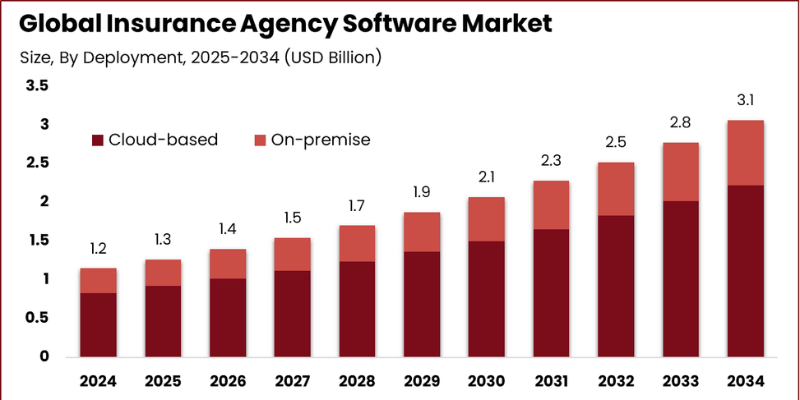
Stats and Market Size of Insurance Agency Management Software
Benefits of Investing in Custom Insurance Agency Software Development
When you invest in custom insurance agency software development, you get tailored automation that significantly increases operational efficiency and minimizes human error in your processes.
Our team understands that customer experience is the key to growth for insurance-like businesses and develops solutions that offer personalized, fast service compared to off-the-shelf options.
Key benefits of custom insurance software development:
Automate Workflow for Your Agency
A custom solution for your insurance agency aligns with your internal processes, including claim processing, underwriting, and policy renewals.
While the regular work is automated, you can be sure that manual data entry is reduced and errors are minimized.
Improve Efficiency and Productivity
After your routine tasks are automated, experts integrate the solutions into your existing workflows. This gives your employees time to focus on higher-value work, helping you save on operational costs.
Enhance Your Agency’s Data Security & Compliance
Custom software development lets you integrate robust security measures such as encryption and role-based access control. We understand how important it is for your solution to meet specific regulatory requirements and protect your clients’ sensitive data.
Get Scalable and Flexible Solutions
You can always reach out to the developers for additional needs, and these systems can easily be updated to include new products, features, or technologies such as pattern- or AI-based fraud detection.
Offer Better Customer Experience
Custom software development allows you to integrate features that can make operating your business easier, like real-time tracking, rapid claim settlements, and personalized services.
Data-Driven Insights
With custom software, you can analyze and capture data to understand your customers, claim patterns, and overall premium patterns, refine your products, and identify new market opportunities.
Types of Insurance Agency Software
Before building or updating your agency’s technology stack, let’s understand the different types of insurance technology available.
Each of these solutions serves its own purpose, and depending on your agency’s business model, you might need one or more of them when planning insurance agency management software development.
Agency Management Systems (AMS)
This software is the complete package for managing your insurance business. It takes care of everything from policies, clients, documents, commissions, renewals, and day-to-day operations. It is the “central nervous system” of your insurance agency.
Customer Relationship Management (CRM) Software
CRM Software stores customer information, interactions, notes, and communication history in a single place. You can also keep track of leads, stay organized, personalize conversations, and create lasting relationships without having to search through emails and spreadsheets.
Policy Management Module
The policy management system covers all aspects of creating, amending, redoing, and eventually cancelling policies. You can see the state of the policy in real time, including current policies, policy history, fibre optics, etc., allowing your staff members to provide quick, accurate responses to customer requests.
Quote & Underwriting Management
You can accelerate your quoting process by pulling information, applying rating criteria, and automating underwriting. This lets you compare your product with competitors, assess risk accurately, and produce quotes more quickly than ever, improving overall customer satisfaction while reducing turnaround time.
Claims Management Module
The claims submission, review, verification, and settlement process is streamlined through this module. Agents can view all aspects of a claim, including progress, required documents, and communication history. This helps speed up claim resolution and reduces the risk of errors.
Lead & Sales Pipeline Management
All leads can be tracked from the first interaction through to the final sale in this module for managing pipelines, automating follow-ups, scoring leads, and determining prospect status, so that the sales force has the tools to close more business without missing opportunities.
Commission & Revenue Management
With this feature, you can automatically track commissions, pay agents, and split commissions with carriers, and view revenue reports. Get an overall claim summary automatically tracked and compiled without manual calculations, providing an accurate financial view by automating payment errors and reducing administrative burden.
Document Management System
All policies, claims, regulatory requirements, and documents received from clients will be stored securely in a searchable database. You will be able to access each document quickly, so you spend less time searching file folders or other files, and you will achieve a better overall workflow for your agency.
Workflow Automation & Task Management
The software automates your mundane daily tasks, e.g., approving new hires, renewing subscriptions, and reminding customers to pay their bills, ensuring they are completed on time and maintaining high employee productivity.
Reporting & Analytics Dashboard
You’ll be able to track real-time sales performance, policies, claims, revenue trends, and agent performance. The use of dashboards will allow you to make quicker, data-driven decisions and identify areas that are slowing down your business or impacting your agency’s operations, helping you improve future growth.
Multi-Channel Communication Module
With this module, you can communicate with your clients via email, text/SMS, and chat, and integrate your phone system into a complete communications solution that enables faster replies and smoother interactions, improving the overall customer experience across channels.
Compliance & Audit Management
The use of a compliance management system will help keep your agency compliant with all applicable regulations by providing a record of document verification with tracking and maintainability, and by automating verification processes.
You will also be better able to track risk and be audit-ready by avoiding hours spent manually completing compliance requirements through the automation of the compliance management system.
AI-Powered Features to Consider for Insurance Agency Software Development
With advanced AI integrated with your insurance agency software, everything out there, scaling becomes easier, security is tighter, and customers get exactly what they want.
Predictive Lead Scoring
With the help of artificial intelligence (AI), leads will be ranked based on behavioral trends, level of engagement, and likelihood of converting into customers. As a result, your agents will devote their time and energy only to the most productive leads, prioritize follow-up activities, and close deals much more quickly since they won’t have wasted time pursuing irrelevant leads.
Customer Churn Prediction
Using AI to find patterns, you can identify customers who are at risk of leaving your agency. By getting notified early on, you can proactively address any service-related concerns, so your client doesn’t leave you for another insurance agency.
Personalized Policy Recommendations
By using information about a customer’s past behavior and current interests, AI can suggest a range of policy options that meet the customer’s needs. Because these selections are so hyper-personalized, you can also create cross-sell opportunities and satisfy customers with coverage options tailored to them.
AI Chatbots & Virtual Assistants
Automated chatbots using artificial intelligence to handle routine questions, create quotes, cycle calls & provide 24/7 support to customers. You are helping reduce your staff’s workload & providing an instant source of support for customers anytime & anywhere.
Fraud Detection & Risk Alerts
An AI system uses OCR technology to analyze claims, documents & transactional patterns to identify potentially fraudulent activity, providing immediate notification of any detected fraudulent activity. It helps you minimize fraud risk, improve compliance, and make better decisions.
Automated Document Processing
The data from completed applications can identify a customer, be available in seconds (without manual entry, reducing errors), and expedite the claims, onboarding, and underwriting processes.
AI-Driven Sentiment Analysis
You can solicit and gather customer sentiment through various channels, including text messages, phone calls, and emails, to understand how they feel about your services. Any negative expressions identified will be addressed promptly; likewise, positive communication will be made even more frequent.
Predictive Analytics & Forecasting
The software needs to analyze sales trends to identify customers who may be renewing only based on their buying patterns, accurately predict claim volume, assist with resource and capacity planning, and support better business decision-making.
Intelligent Workflow Automation
Artificial Intelligence learns your organisation’s working habits, you can automate those processes, streamline your workflows, and rid yourself of the common repetitive and low-value tasks that can create congestion and reduce productivity and performance.
Campaign Optimization & Personalization
You can analyze consumer behavior to personalize marketing messages so they better connect with the target audience and improve the overall effectiveness of the marketing campaign.
Required Integrations for Insurance Agency Management Software
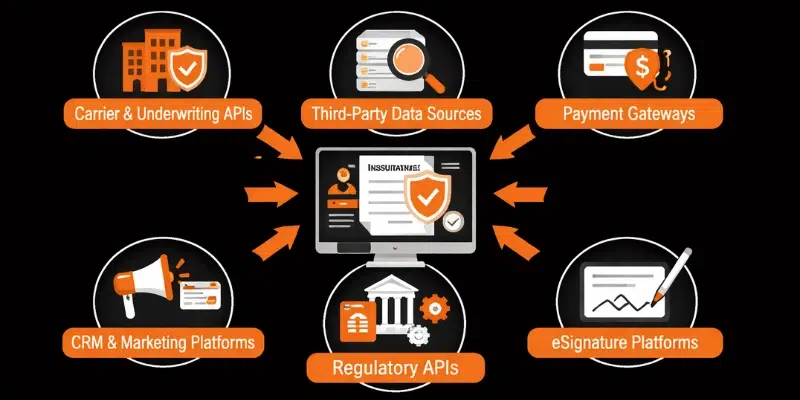
The true potential of insurance agency software lies in its ability to integrate seamlessly with every single platform/tool/system that your team already depends on. The simpler the integrations, the less manual administrative activity that your team members will have to complete. Consequently, your business’s efficiency and accuracy will be high.
Here are the essential integrations your agency software should include:
1. Carrier & Underwriting APIs
Carrier integrations provide real-time rate, underwriting guidelines, policy, and quote data directly from carriers, thereby minimizing the time your team spends on back-and-forth communication and ensuring accurate data every time.
2. Third-Party Data Sources
Using third-party data integration (e.g., identifying who you are, how you will pay your premium, and information about your home and car) allows you to make quicker, more reliable decisions with little or no human interaction.
3. Payment Gateways
Integrating with payment gateways, such as Stripe and PayPal, or ACH processors makes it possible for clients to pay their premiums online. This enables seamless billing, reduces late payments, and gives your clients several secure ways to pay.
4. CRM & Marketing Platforms
When you connect CRM, email marketing, and sales platforms, you can synchronize leads, automate follow-up actions, and maintain a unified communication across your agency.
5. Compliance & Regulatory APIs
By integrating with compliance API’s, you can ensure that your agency stays compliant with state and federal insurance regulations by helping confirm that your agents are licensed to sell insurance, tracking business licenses, and conducting due diligence on your customers (KYC/AML).
6. Document & eSignature Platforms
The integration of platforms such as DocuSign or AdobeSign streamlines the issuance of policies, onboarding new customers, and processing claims without having to chase customers for signatures.
A3Logics ensures that your Agency Management System integrates with all the tools your agency requires to succeed and that they work harmoniously.
Top Platforms to Develop Insurance Agency Management Software
When considering creating insurance agency software, selecting a platform or foundation is one of the biggest decisions. Making the right selection can help accelerate development, enhance scalability, and optimize long-lasting savings for your company.
1. Salesforce Financial Service Cloud
Salesforce is an ideal option for those seeking a flexible, highly customizable solution that supports enterprise-level automation. Main Benefits of Using Salesforce:
- Advanced customer relationship management and customer lifecycle management features
- Ability to automate workflows & approvals
- Strong security and compliance frameworks
- Artificial Intelligence, enabled by the Salesforce Einstein Application, provides business insights through data analysis.
- Large network of third-party applications that integrate directly with Salesforce
2. Zywave
Zywave specializes in sales enablement and maximizing customer interaction to support the needs of agencies looking to expand.
- Quoting tools/sales pipeline
- Dashboards for client engagement and communication
- Content directories based on specific industries
- Real-time marketing analytics and performance reporting
- Integration ability across all agency systems
3. Vertafore
This has been one of the leading providers of technology for the insurance industry since it began developing online systems more than two decades ago. Vertafore delivers a comprehensive set of fully integrated solutions to support agencies of every size.
Key Features:
- Complete agency management solution
- Claims Management, Policy Management, Document Management
- Included Compliance and Licensing tools
- Carrier Connectivity for Quick Quotes
- Scalable Architecture for Growing Agencies
4. Applied Systems
The goal of Applied Systems is to streamline agency operations through modern, automated insurance technology.
Main Features:
- Complete management of the policy and client lifecycle
- Cloud-based AMS that can be accessed via mobile devices
- Automated document and eSignature capabilities
- Real-time insurance carrier connectivity
- Business intelligence dashboards
Regulatory Compliance for Insurance Agency Software Development
A3Logics builds your software in accordance with the agency’s compliance regulations, built into the design rather than added afterward. This gives your organisation the protection, security, and alignment it requires with regulatory compliance.
These are just a few of the compliance standards that the software you develop needs to comply with:
i. HIPAA
HIPAA establishes security protocols for medical data, requires data encryption, and mandates controlled access to medical data.
ii. SOC 2 Type II
SOC 2 Type II includes standards and guidelines that relate to data security, availability, confidentiality, and processing integrity (all of which are extremely important).
iii. PCI-DSS
If you accept credit cards for online transactions, PCI DSS compliance will help ensure the security and privacy of the individuals making the payments.
iv. GDPR/CCPA
If your company serves clients globally or in a state where the CCPA or GDPR is enforced, those laws must be complied with and applied regarding data privacy, consent, and usage rights.
v. Insurance Regulations by State
There will be different rules and regulations by state regarding licensing requirements, data retention, communication (record retention), and audits of the company’s activities.
vi. KYC/AML Compliance
KYC helps confirm the identities of customers or vendors. AML helps to prevent fraud and foster goodwill in the customer/vendor relationship during both the onboarding and claims process.
vii. Audit Log/Activity Tracking
You should maintain an audit log of all actions within the software you develop, which will help to keep your organisation audit-ready year-round.
Insurance Agency Software Development Process at A3logics
A3Logics uses a development process that provides ongoing communication (back and forth) so you are aware of each step during the entire process until it is completed.
A summary of the process for getting your custom-built insurance agency up and running is provided below:
Phase One: Discovery and Requirements Analysis
We will establish a comprehensive understanding of your agency’s operations, including your workflow, potential bottlenecks, compliance issues, third-party integrations, and future goals. This phase sets the stage for creating a solution that integrates seamlessly with your operations.
Phase Two: UI/UX Design & Prototyping
Once we understand the agency’s needs, we will create screens (UI) and user journeys (UX) that your agents will want to use. The UI/UX design will be simple, intuitive, responsive, and accessible, accurately representing how the system will appear and function.
Phase Three: Technical Architecture Development
Our engineers will design a secure, scalable, and robust technical architecture specifically for an insurance agency’s workflow. The system will be designed as a complete solution, encompassing customer relationship management (CRM), policy management, claim processing, commission processing and management, and automation to support future growth and expansion requirements.
Phase Four: Third-Party Integrations
Third-party integrations can include carrier APIs, payment processors, CRM systems, compliance applications, analytic systems, etc., which together provide a comprehensive solution to streamline operations and eliminate manual work through fully automated processes.
Phase Five: QA, Testing & Security Audits
The custom software will undergo a comprehensive testing phase before it goes into production. Testing includes workflow, performance, mobile usability, security, and compliance testing to confirm the system works as intended.
Phase Six: Deployment & Training
We provide a secure environment for implementing your new system and training your agents, administrators, and teams, ensuring a great user experience from day one.
Phase Seven: Ongoing Support & Enhancements
As your business evolves, so do your needs; as regulations change, so do those requirements; and as technology advances, so do your expectations from technology. We continue to work with our clients on a long-term basis to provide support, enhancements, and upgrades, keeping them at the cutting edge of technology.
How Much Does It Cost to Develop Insurance Agency Software?
There is no reason that estimating the cost of developing AI software for insurance should be a mystery. Each project will be unique; however, there is a very simple way to get a good ballpark figure on your investment. By using a formula to break down the different areas of impact and calculate your total investment (the final number), you will have a good idea of what to expect.
To give you an idea, here is a simplified formula to estimate the total cost to develop insurance agency management software:
Total Cost = (No. of Hours x Rate) + (Costs of Tools/Technology) + Other Expenses
Let’s look at each component of the total cost calculation.
- Number of Hours: The number of hours required to complete the project will depend on the size, desired features, and complexity of the AI models.
- Rate: This is the rate paid to each developer, designer, and AI specialist, based on their level of experience and the market in which they work.
- Tool/Technology: If you are using premium tools or APIs, such as GPT-3 or AWS, you will incur additional licensing costs.
- Other Expenses: Additional costs such as hosting, data storage, security functionality, and ongoing maintenance costs can add up over time.
The average cost of developing insurance agency software ranges from $50,000 to $ 500,000, depending on features, developer engagement model, tech stack, etc.
Why A3Logics as Your Insurtech Partner
When you collaborate with us, you are not simply hiring developers; you are employing a team that genuinely cares about the insurance industry and has firsthand knowledge of how agencies conduct business, what stresses agents, what customers expect, and how compliance impacts every aspect of a workflow.
1. Deep Insurance Domain Expertise
With many years of experience in the insurance industry, we are familiar with how companies operate. Therefore, we can develop software more quickly and provide products that function better for your agency.
2. Proven Experience in AMS, CRM & Claims Platforms
We have provided full-scale AMS, CRM, and Claims software solutions to multiple insurance agencies and have therefore developed software based on our clients’ real-world use.
3. Strong Focus on Security & Compliance
We will build a software solution for your agency designed to meet or exceed all applicable laws and regulations/regulations regarding HIPAA, SOC 2, GDPR, and PCI DSS, so you will not be subject to security breaches or compliance issues.
4. Custom Solutions Tailored Around You
At this time, we do not offer cookie-cutter type solutions to our clients. We will create a software solution tailored to your specific needs, including functionality, workflow, processes, and business goals.
5. Long-Term Support of Your Software
As your company grows, your software will grow with you. We will continue to provide software updates/new features/ integrations, and accountable technical support throughout your relationship with us.
Conclusion
If you’re struggling to juggle your policies, clients, claims, and day-to-day activities across multiple tools, know that you aren’t the only one; many others face similar issues. Fortunately, there are many ways to improve your overall productivity and efficiency. Leveraging insurance software development, automation via an online insurance agency system can streamline your operations, enable your staff to work at a much faster pace, and provide your clients with a better experience.
At A3Logics, our team can build an automated, AI-driven insurance agency system for you, with a fully customized user interface, to help your agency run more smoothly and be better prepared for future developments.