
The insurance industry is on the verge of a radical change — AI, predictive analytics, automation, and the ability to make decisions in real-time based on data are some of the developments that will revolutionize the industry. AI in insurance through machine learning has touched every part of modern insurers, going from underwriting and risk scoring to claims processing and fraud detection.
Nonetheless, AI’s ability to be gigantic in adoption technology scenarios hinges on only one thing – data of the highest quality.
Regardless of how innovative your machine-learning model is or how much money you put into digital transformation, your AI system will always be the worst if it is the data you are working with that is bad. In an environment where risk, pricing, compliance, and customer trust are vital, data of poor quality may cause serious mistakes that increase the costs of the company, attract regulatory penalties, and deteriorate decision-making.
Therefore, having Data Quality Management (DQM) is vital at this point. Powerful DQM strategies guarantee that the data you have is accurate, consistent, complete, timely, compliant, and that it can be processed by AI.
The blog explains the necessity of data quality management for insurers in the AI era, the challenges they face, best practices they can adopt, the future they can expect, and in what manner A3Logics as leading insurance software development company can be of assistance in creating AI-ready data ecosystems.
What is Data Quality Management?
Data Quality Management (DQM) refers to the mechanisms, procedures, and the governance model that together support the data being accurate, consistent with the set standards, complete, reliable, and capable of use for both operations and analytics. In a recent survey 64% of organizations surveyed rate quality as the top data integrity issue, and distrust of data for decision support has risen from 55% in 2023 to 67%.

Data Quality in Insurance Encompasses:
- The verification of customer, policy, and claims data to be ingested
- Cleaning the data from inaccuracies, duplicates, and inconsistencies
- Obtaining data practices regulatory compliance
- Tracking quality issues in data real-time
- Handling the lineage of data and metadata
- Making data more accessible for the new kinds of data analysis and AI
Why Data Quality Is the Foundation of AI Success in Insurance?
AI and machine learning thrive on high-quality data. If the data is poor, biased, incomplete, or inconsistent, the resulting predictions will be unreliable.
In insurance, this leads to:
- Mispriced products
- Unfair risk scoring
- Incorrect claims decisions
- Missed fraud events
- Regulatory violations
AI needs data that is:
- Structured
- Updated
- Accurate
- Free from bias
- Consistent across systems
- Properly labeled
- Compliant with privacy laws
Without data quality management, AI becomes a high-tech liability instead of an asset.
Key Data Quality Dimensions That Power AI Accuracy in Insurance
1. Accuracy
Accuracy guarantees that data is error-free and that it is an accurate representation of the world without any distortions or misrepresentations.
It is vital for insurers because even a small error—such as an incorrect claim amount, a wrong risk factor, or an outdated customer detail—can disrupt the entire system. Consequently, AI findings become inaccurate, prices are set incorrectly, and false fraud alerts are triggered.
2. Completeness
Incomplete data creates gaps that cannot be understood by AI which eventually forces the models to make assumptions some of which may be incorrect.
It can be caused by missing fields in application forms, partial medical histories, or incomplete claim details leading to inaccurate risk assessment and slow down automation processes. Complete records allow AI to get a glance of the whole picture and thus make predictions with a high level of confidence.
3. Consistency
The data should be consistent when viewed on any platform, be it underwriting systems, CRM, policy administration systems, claims platforms, or third-party sources.
In case the customer’s address or risk score shown by one system is different from what another system displays, AI models get mixed up resulting in conflicting outputs and failure of integration. Consistency is the glue that holds together the datasets within the company.
4. Timeliness
AI performs at its best when it receives updated or real-time data. However, using old telematics data, stale claim statuses, or outdated customer profiles can reduce the accuracy of dynamic pricing, real-time fraud detection, and automated claims decisions. Therefore, keeping timely data in the system ensures that AI models operate based on the latest insights and events.
5. Validity
Valid data is data that meets certain pre-established criteria in terms of its structure, rules, and value ranges.
Take for instance:
- Age cannot be negative
- Claim categories have to be the same as the ones that have been predefined
- Premium amounts must follow the set business rules
Invalid data points hamper automation workflows and lead to errors in the AI processes that are downstream.
6. Uniqueness
Uniqueness is the factor that decides that there would be no duplicate records. Duplicate customer profiles, repeated policy entries, or multiple versions of the same claim can break machine learning models, which may lead to overestimating risk and thus causing confusion at the operational level.
Deduplication is necessary for insurance data quality management and if one wants to create datasets that are not only clean but also trustworthy.
7. Relevance
The most important thing for the AI training and decision-making process for Insurance Data Management is the meaningfulness and necessity of data. The presence of irrelevant or noisy data may corrupt algorithms, make the model more complex, and cause its accuracy to decrease.
Relevance makes certain that the dataset is composed of only those variables that directly affect the process of underwriting, pricing, customer behavior, and fraud analysis.

Top Data Quality Challenges that Insurers Face in the AI Era
1. The Siloed & Disparate Data Ecosystem
Insurers are mostly running on fragmented legacy systems, which means that underwriting, claims, policy admin, CRM, and agent portals are all data silos. Such datasets are also inconsistent, non-integrated, and as a result, AI training becomes difficult, and predictions are inaccurate.
2. Proliferation of Unstructured Data
More than half of insurance data are such as emails, handwritten documents, PDFs, adjuster notes, medical records, and images that are unstructured. It is extremely difficult for AI to achieve high accuracy and to automate routine tasks without advanced NLP and OCR tools, which in turn, produce fewer usable outputs.
3. Data Bias and Fairness
If there are biased historical datasets (e.g., overly represented demographic groups or biased risk factors) used for training, AI models may learn these biases and thus, produce biased decisions. Hence, unfair underwriting decisions, discriminatory pricing, or inaccurate fraud detection may be some of the results of these biases.
4. Data Lineage and Explainability (The “Black Box” Problem)
Insurance companies should trace how data move through various systems and how AI models come to final decisions. In the absence of clear lineage and explainability, regulators question model fairness, and auditors find it difficult to verify the outputs, especially in areas such as underwriting, pricing, and claims.
5. Data Freshness and Latency
Real-time AI applications require real-time data. Outdated telematics data, old claim status or stale customer details lower the accuracy of models and have a negative effect on time-sensitive activities like dynamic pricing or instant fraud detection.
6. The Volume, Velocity, and Veracity of New Data Sources
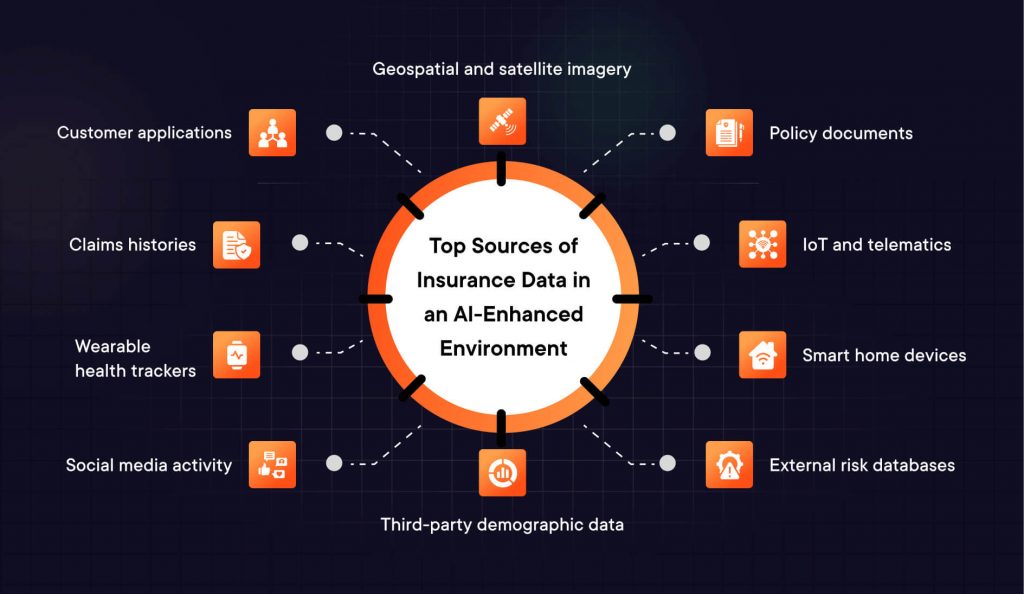
The data produced by IoT devices, connected cars, wearables, third-party risk databases, social media, and open banking are very large. One of the major operational challenges is to ensure that these data streams are accurate, reliable, and in line with the business rules.
7. Inconsistent Data Labeling for Model Training
To train models for the classification of AI in claim management, fraud detection, damage detection, and customer sentiment analysis, the acquisition of data with proper labels is essential. Inconsistent labeling substantially decreases the reliability of the model and leads to its performance becoming very weak, a situation especially true for supervised learning.
Best Practices for Ensuring High-Quality Data in Insurance AI Models
1. Automated Data Validation at Entry
To implement real-time validation during policy issuance, claim intake, and customer onboarding will help in detecting mistakes or incomplete data, and thus, data quality at the source is ensured.
2. AI-Based Data Cleansing
By employing machine learning in an automatic mode, it becomes possible without manual intervention to detect anomalies, correct formatting errors, complete missing fields, and remove noise in large datasets.
3. Standardized Data Formats Across Channels
AI in underwriting, claims, agents, brokers, and customer portals adoption of uniform data standards (e.g., ACORD formats) would lead to integration conflicts being mitigated and becoming more reliable.
4. Regular Data Profiling
Always analyzing data sets, the company can discover data quality problems: duplications, missing values, inconsistent fields; long before they become a problem for machine learning models.
5. Continuous Monitoring for Anomalies
There should be automated monitoring systems that can detect abnormal patterns, unauthorized entries, or unexpected data peaks which could result in wrong AI predictions.
6. AI-Driven Deduplication
Machine learning matching techniques may be employed to identify duplicated customer records, repeated claims, and overlapped entries in different systems so as to have cleaner and unified datasets.
7. Strict Data Governance Policies
Setting up clear ownership, access controls, stewardship roles, and quality KPIs will ensure that there is accountability and that the data remain consistently of good quality throughout the insurance enterprise.
8. Real-Time Data Integration from All Sources
The integration of telematics, wearables, IoT devices, claim reports, policy systems, CRM platforms, and external databases into one data pipeline. This pipeline is continuously updated and unified and will make real-time data flow possible.
9. Employee Training on Data Correctness
Train underwriting, claims, and back-office employees in such a way that they will be able to reduce errors, perform standardized intake procedures, and realize the importance of data for AI model performance.
How Poor Data Quality Impacts Underwriting, Claims and Fraud Detection Models?
1. Slower Claim Settlements
Missing or incorrect claim attributes, such as event dates, policy numbers, coverage limits, or documentation, make it challenging for automated systems to validate claims rapidly.
2. Incorrect Claim Decisions
AI models for claim adjudication that are trained on poor-quality data may result in the rejection of legitimate claims and the acceptance of fabricated ones.
3. Increased Claims Leakage
Data inaccuracies can cause overpayments, duplicate payments, and improper settlements. Claims leakage becomes a significant financial issue when automation is heavily dependent on unreliable data points.
4. Inefficient Claims Automation
Data of poor quality interferes with the performance of automated workflows such as document extraction, fraud scoring, damage estimation, and reserve calculations.
Impact of Poor Data Quality on Fraud Detection Models
1. Missed Fraud Cases (False Negatives)
Poor data causes the model to point to less suspicious behavior, thereby allowing fraudulent claims to pass undiscovered.
2. Too Many False Alerts (False Positives)
Incorrect data increases model noise that, in turn, leads to the triggering of needless alerts and consequently overwhelms the investigation teams.
3. Weak Machine Learning Detection Models
When ML models are trained on: incomplete, biased or inconsistent datasets their predictive power is greatly diminished. Fraud analytics lose the capability to detect slight anomalies or newly emerging fraud patterns.
4. Difficulty in Linking Fraud Networks
The inconsistencies and duplicates that exist in data make it difficult for AI models to link the related entities, thus allowing fraud networks to continue without being detected.
Role of Automation and AI in Improving Data Quality Management
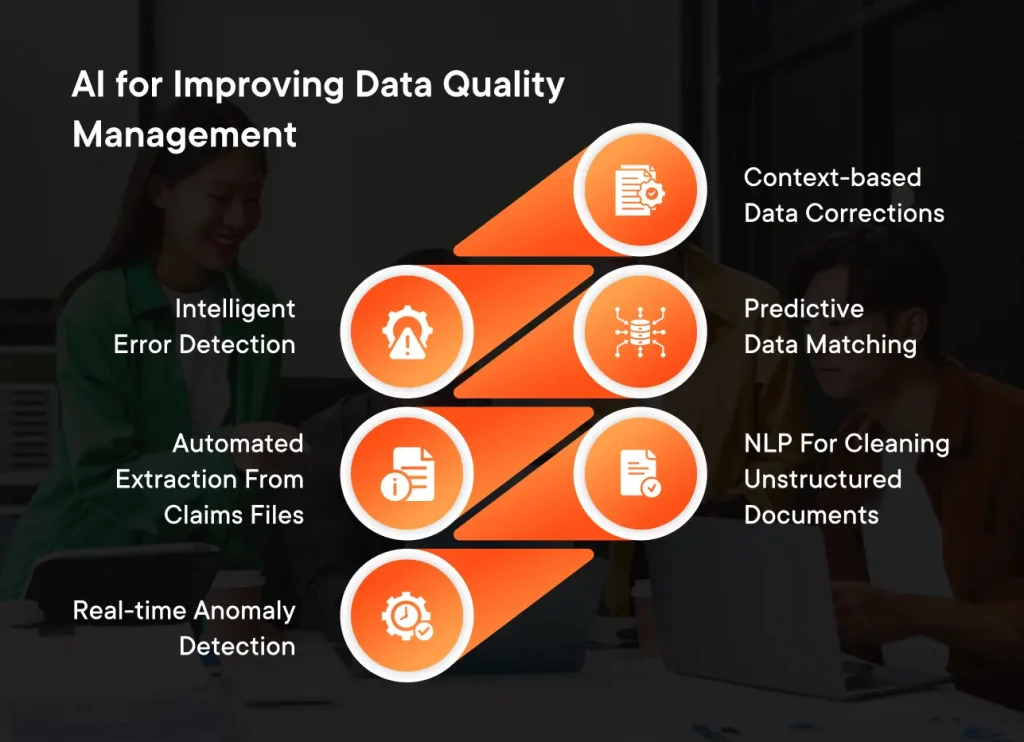
1. Intelligent Error Detection
AI is capable of automatically flagging anomalies, wrong values, missing fields, or patterns that significantly differ from previously accepted norms, thereby enabling the improvement of data accuracy at the first attempt.
2. Context-Based Data Corrections
Machine learning models are able to grasp the context—like claim type, policy category, or risk class—and hence they can perform the auto-correction of mismatched or illogical entries.
3. Predictive Data Matching
The AI-powered matching algorithms connect fragmentary customer records or duplicate claims that reside in different systems and, thus, create a unified, trustworthy data view.
4. NLP for Cleaning Unstructured Documents
Advanced NLP processes handwritten forms, emails, adjuster notes, hospital records, and PDFs to extract unstructured data and convert it into a structured format. Furthermore, AI models can easily access these cleaned fields for deeper analysis and better decision-making.
5. Automated Extraction From Claims Files
OCR and NLP automatically locate and extract key data from documents. Moreover, these technologies identify damage estimates, medical details, descriptions, and provider information, which significantly reduces manual errors and omissions.
6. Real-Time Anomaly Detection
AI is around the clock attentive to data streams and as a result, it is capable of very fast locating any abnormal behavior, suspicious activity, or unexpected changes in underwriting and claims datasets.
Ensuring Compliance and the Ethical Use of Data in AI-Powered Insurance Operations
Insurers should make sure that they are in line with the following requirements:
1. GDPR (General Data Protection Regulation)
This regulation secures customer data all over the EU and it involves the management of highly regulated consent, protection of privacy, and transparency in the use of personal data in AI models.
2. CCPA (California Consumer Privacy Act)
By this law, consumers are given the power to control the manner in which their data is collected and used. Insurers must provide opt-out facilities; ensure proper data utilization, and allow for unambiguous disclosures.
3. NAIC Model Laws
These regulations deal with data security, consumer information protection, and fair underwriting practices related to the U.S. insurance sector.
4. HIPAA (Health Insurance Portability and Accountability Act)
HIPPA is very significant for health insurers as it requires the securing of medical data; the setting up of strict access controls, and the AI systems’ compliance with health-based underwriting and claims.
5. Global Solvency and Consumer Protection Standards
For instance, standards like Solvency II lay down the requirements for: capital adequacy, risk transparency, and data accuracy. That is the reason they are very important when AI models are used for regulatory reporting and actuarial calculations.
Future Trends in Insurance Data Quality Management
1. Autonomous Data Quality Frameworks
Self-learning, AI-driven data systems will be in charge of the continuous cleaning, validation, and enrichment of insurance data thus the need for human intervention will be minimal and the data will be accurate even if they are voluminous.
2. GenAI-Driven Data Cleaning
Advanced GenAI models will be able to automatically recognize that certain data are anomalous, they will also be able to complete that which is missing, unify formats, and correct inconsistencies all this with the help of contextual comprehension.
3. Real-Time Cross-Platform Harmonization
In real-time, insurers will be able to unify data from policy, claims, CRM, IoT, telematics, and third-party sources through data pipelines that will give them access to an updated single source of truth.
4. Advanced Risk-Specific Data Enrichment
AI will be able to assess the risk better if it gets more data from the external environment—for example, it can use geospatial analytics, environmental data, socio-economic datasets, and behavioral insights.
5. Zero-Touch Claims and Underwriting Pipelines
Complete automated workflows will take advantage of high-quality, up-to-date data so they will be able to make instant claims decisions, automatic underwriting, and easy policy issuance without the intervention of a human.

Why Choose A3Logics for Insurance Data Quality Management Services?
A3Logics as a leading software development service provider offers a combination of technology know-how, AI engineering, and data governance prowess, which the company uses to support insurers in setting up dependable data ecosystems that are fit for the future.
1. Proven Expertise in Insurance Data Engineering
We offer Custom Health Insurance Software Development Services that are not only secure and scalable but also tailored to the requirements of the various facets of the insurance industry.
2. AI-Driven Data Quality & Cleansing Solutions
The AI-powered models we employ can locate: anomalous data instances, restore data consistency; and fuse data from various sources to get higher precision and trustworthiness.
3. Advanced Automation for Real-Time Data Processing
We build automated pipelines of the kind that are indispensable for the non-stop validation, transformation, and monitoring of data that is flowing through the insurance ecosystem.
4. Compliance-Focused Data Governance
Our offerings follow the standards set by GDPR, CCPA, HIPAA, NAIC, and global solvency regulations. Moreover, they ensure that all data activities are carried out in a secure and ethically responsible way.
5. End-to-End Support for AI-Driven Insurance Operations
Our collaboration does not end with the design of data frameworks but extends to the training of models and the construction of dashboards.
Final Thought
The quality of decisions in an AI-driven insurance environment is dependent on the quality of data. To underwrite with precision, automate claims, or accurately detect fraud are just some of the areas where insurers are not allowed to make mistakes, have inconsistencies, or display weak data governance. If they employ the proper data quality management practices and get the right technology partner, insurers will be in a position to create operations that are not only smarter but also more ethical and sustainable.
A3Logics is the company that can provide the necessary resources for this transformation journey and make insurers’ data their strategic asset capable of fueling high-performing AI systems and yielding sustainable competitive advantage advantage.