
If you run an insurance company, risk isn’t just part of your business. It is your business.
Every premium priced, every claim approved, every underwriting rule written, it all circles back to one thing. How accurately can you measure uncertainty?
But the ground has shifted. Climate patterns aren’t as predictable as they used to be. Digital fraud has become common. On top of this, regulators now require much more detailed reporting, and customers expect instant decisions.
Amid all this, if your internal risk monitoring still leans on manual reports, you are probably straining yourself every day.
AI-Driven Insurance Risk Management Software Development isn’t about modernization; it’s about clear control over your data and fair decisions.
What Is Insurance Risk Management Software?

In simplest words, Insurance Risk Management Software gives you a consolidated view of everything your company stands for.
In practice, it is a system that integrates underwriting data, claim patterns, operational controls, compliance obligations, third-party risks, and financial exposure into a single, living framework.
Traditional systems used to record risk events after they happen, whereas AI-driven Insurance risk management software development builds systems that predict patterns before they escalate.
The software eliminates the need to wait for quarterly reviews to identify portfolio imbalances, flags concentration risks as it builds, and surfaces anomalies during the review process rather than after payments.
Insurance Risk Management Software—Stats and Facts
- The worldwide market for risk management software will increase from USD 32.72 billion in 2031 at an annual growth rate of 16.55%.
- Environmental, Social, and Governance (ESG) risk modules are growing at the fastest pace (21.65% per annum), primarily driven by regulatory disclosure requirements.
- North America leads the worldwide market share (37%) as of 2023.
- The primary use of the cloud will grow rapidly (20.92%) and become the most trusted source, driven by lower costs and greater flexibility.
- Small and medium enterprises (SMEs) are the fastest-growing segment of the market (16.98% per annum).
- Automated tools such as Archipelago Analytics can process data in less than 15 minutes per account (95-98% accuracy), compared with 2-4 hours for manual processing at about 85-90% accuracy.
- The use of AI-powered predictive models (48% of insurers use them) and automated risk assessment tools (72%) is increasing rapidly, and this trend will continue to grow in 2023 and beyond.
- Centralized data, faster, more accurate service, and improved compliance management are the most important benefits of using risk management software.
What Types of Risks Are Addressed by Insurance Risk Management Software?
Risk in insurance isn’t neat or isolated from its operations and workflow. One weak link can quietly amplify another. That’s why Insurance Risk Management Software Development focuses on multiple risk layers at once, not in silos.
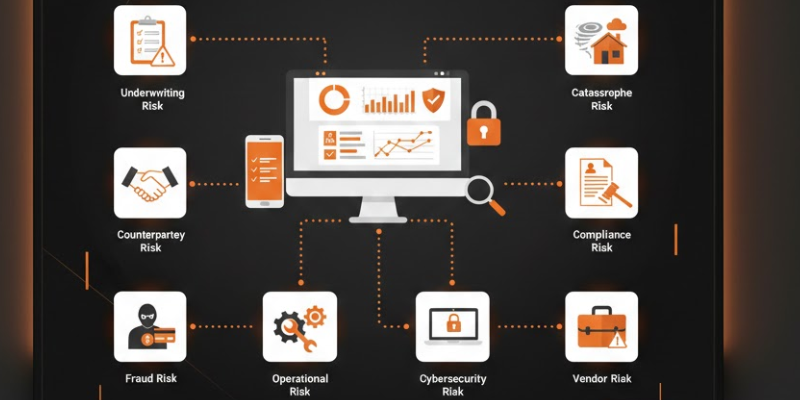
Here’s how each type plays a role:
1. Underwriting Risk
Underwriting risk is the risk of financial loss arising from incorrect risk assessment, improper premium pricing, and uncontrolled events such as catastrophes. This occurs when an insurance company pays out more in claims than it has collected in premiums due to unexpected events that increase the rate at which claims occur, increase claim costs, or change the overall environmental, regulatory, or economic conditions affecting the insuring company’s operations.
2. Credit and Counterparty Risk
Your team relies on reinsurers, brokers, and financial partners. If your counterparty fails to fulfill its obligations, you may be exposed to additional risk immediately. Credit risk also applies to insurers, as policyholders may fail to pay premiums.
Financial indicators, such as risk management software, are used by insurance companies to monitor financial health and concentration risk, enabling them to reduce reliance on less reliable partners.
3. Operational Risk
Internal processes that do not work as expected, as well as failures in systems and processes, are generally sources of operational risk. An operational problem or failure in a procedure may lead (a) to dissatisfaction among the insurer’s customers or (b) to regulatory issues or compliance problems.
Risk management software can help identify and track inefficient processes, detect operational errors, and control operational problems before they reach a critical mass.
4. Fraud Risk
Fraudulent claims, manipulated identity, and collusion within an organization put margins at risk without drawing attention to themselves. Because artificial intelligence systems can assess behavioural patterns and anomalies in real time, they can identify fraud much more quickly than manual reviews. Early detection of fraud can lead to a greater reduction in financial losses and reputational damage.
5. Catastrophe Risk
Natural disasters and systemic events that result in loss of life or damage to entire communities’ physical infrastructure, economies, and overall financial systems affect capital reserves.
The complexity of modeling climate-change-related disasters has increased significantly, enabling insurers to build reserves and reinsurance strategies by simulating a range of worst-case scenarios using historical data, predictive analytics, and comprehensive stress testing.
6. Regulatory and Compliance Risk
Because insurance companies operate within highly regulated frameworks, any lack of governance, reporting failures, or late filing of reports could result in a fine or reputational damage.
Using risk management software to automate ongoing compliance management activities (along with maintaining a complete and accurate audit trail and ensuring the accuracy of all reporting) greatly reduces the burden of manual review & oversight.
7. Cybersecurity Risk
In your daily operations, you handle sensitive financial data and customer personal information. A breach of this data will disrupt business operations and erode customer confidence in the insurance company. Cybersecurity risks may include data breaches, ransomware attacks, system vulnerabilities, and other threats to an insurance company’s data assets.
8. Third-Party and Vendor Risk
Indirect exposure to outsourcing partners, technology vendors, brokers, and other service providers can occur. If a vendor fails, claim processing may be interrupted, service levels may be impaired, and compliance violations may occur. Risk management applications will continuously monitor third-party performance, financial condition, and contractual compliance to mitigate potential cascading operational impacts from failures by third-party service providers.
Why AI-Driven Systems Matter
What makes AI-driven Insurance Risk Management Software different is its ability to connect these risk layers.
A vendor disruption may increase operational strain. That strain may delay reporting. Delayed reporting may increase compliance exposure. AI models quickly recognize those correlations, mapping cause and effect in real time.
Top AI-Driven Insurance Risk Management Software in the Market
Some of the top software for insurance risk management that experts admire and take inspiration from for better features and applications are:
1. Gradient AI

With a data lake containing vast amounts of information, it specializes in underwriting and claims analytics and develops tools to value risks and predict loss ratios. It also develops specialized analytical tools, such as SAIL for Group Health Insurance, to help underwriters make better decisions.
2. Origami Risk
Has developed a range of AI tools for risk management and offers additional AI-powered tools, including a generative AI tool for summarizing claims and a set of TCOR analytics for evaluating financial risk.
3. Zego

Designed to provide commercial motor vehicle insurance, with an emphasis on AI-driven customization of policies and fraud detection.
These platforms demonstrate what’s possible. But many insurance companies pursue custom AI-Driven Insurance Risk Management Software Development because competitive differentiation often lies in the nuances of their underwriting models and governance structures.
Core Features of Insurance Risk Management Software
Let’s move beyond theory and look at what truly powers a modern, AI-driven risk environment.
1. Centralized Risk Data Aggregation
Insurance risks don’t reside in a single system. Underwriting data takes one space; claims are another matter; finance is a different story; and compliance documentation is handled elsewhere.
With risk management software, you can create a single location for all your risk data, consolidating information in a central risk repository.
When you combine all risk data, you will improve visibility, break down silos, and make final decisions based on a more complete understanding of the situation, rather than relying solely on multiple sources.
2. Risk Scoring and Exposure Analysis
Not every region or policy carries the same level of risk. With risk scoring, you can measure the probability or the exposure across different areas, products, or broker networks. It shows where you may be overly concentrated and which areas need adjustments.
Instead of relying on guesswork, you can make decisions that are defined by numbers and trends.
3. Real-Time Monitoring and Alerts
You definitely don’t want to take months or quarters for the reviews. Continuous tracking enables you to monitor your activity in real-time. If you experience anything out of the ordinary, the system will instantly alert you, allowing you the opportunity to take appropriate action.
Your team will then be able to intervene at the right time, rectify issues quickly, and prevent them from escalating and causing major losses.
4. Policy, Controls, and Incident Management
Strong governance isn’t just about creating written policies; an insurance risk platform will monitor control effectiveness, provide evidence of monitoring results (e.g., test results), and facilitate tracking remediation work. Incidents are recorded, assigned, and tracked in a structured case management system.
This creates accountability for all users, strengthens an organization’s internal control system, and provides clear, concise documentation for regulators and auditors.
5. Scenario Modeling and Stress Testing
The success of an insurance provider continues to depend on being prepared for the unpredictable, particularly when the potential impact of disasters, economic recessions, stock market volatility, or other systemic shocks is modeled.
Tools can help develop a reinsurance structure or capital buffer to provide sufficient risk capacity for an insurance company, without having to guess the risk distribution across its structure or buffers.
6. Audit Trails and Reporting Dashboards
Traceability is also very important for the insurance industry, which operates under significant regulatory scrutiny.
All risk-related actions in the system are documented in audit trails that capture all acts or decisions for the audit period. Reporting dashboards then convert that information into reports that provide structured, organized insights to meet the requested requirement.
Insurers can produce documentation, eliminating the risk of exposing governance and operational transparency issues and reducing the need to search for documents during an audit.
7. Predictive Risk Analytics and Early Warning Systems
Developers understand that traditional reporting may not capture the nuanced changes revealed by predictive analytics. They create AI models that evaluate historical patterns, emerging trends, and behavioural indicators to estimate potential declines in underwriting quality or claims performance.
An early warning system provides advance notice, allowing an insurer to adjust its strategy before the risk manifests as higher loss ratios.
8. Regulatory Compliance and Risk Reporting Automation
Chasing down compliance data across departments takes too long. With automated compliance reporting, you can generate accurate regulatory reports in minutes rather than weeks.
By pulling real-time data into the system, flagging any gaps, and maintaining your audit readiness, you’ll be able to stay compliant, decrease manual errors, and eliminate the chaos of last-minute reporting.
9. Third-Party and Vendor Risk Management
Your outsourcing and reinsurance partners, by themselves, might have a much greater effect on your risk profile than you think. This feature will enable you to track vendor performance, financial exposure, and compliance status in a single dashboard. You will be able to identify red flags sooner, manage your reinsurance dependencies more effectively, and reduce the risk of surprises that could impact your operations.
10. Workflow Automation and Risk Case Management
It’s important to respond quickly when there’s a risk-related incident; therefore, you should avoid relying on multiple email chains. Automated workflows route incidents to the most appropriate stakeholder immediately. Tracking progress, assigning ownership, and resolving incidents takes much less time with insurance risk management software that provides complete transparency into what is happening.

Role of AI, Machine Learning, and Advanced Analytics in Risk Management
Artificial intelligence doesn’t replace actuarial expertise. It enhances it.
i. Predictive Risk Modeling and Early-Warning Systems
Predictive modelling utilizes historical claims data, underwriting results, and external factors to identify emerging risk groups before a loss increase. Early warning systems will provide real-time alerts. The ability to adjust premiums (price), coverages (terms and conditions), and reserves allows insurers to limit volatility across their portfolios.
ii. Behavioral and Anomaly Detection
Artificial intelligence-based monitoring systems can identify activity that deviates from established behavioral norms. This is particularly valuable in fraud detection and monitoring operational activities. Alerts will be generated whenever a pattern deviates from normal expectations and will provide the opportunity for further review of the situation. Insurers will have reduced the number of leaking claims due to fraud and improved controls by using methods other than solely manual claim evaluations.
iii. Continuous Risk Assessment and Recalibration
Risk scores will no longer remain static for an entire year between annual evaluations. Dynamic models are updated continuously with new claim data, financial information, and market indicators.
Insurers will adjust their exposure and experience fewer unforeseen shocks, resulting in improved overall portfolio stability.
Integration with Core Insurance Systems
Your core systems are the spine of everything. You connect those cores to digital channels, broker portals, third-party data feeds, and fraud tools. You do this through API-first architecture, microservices, middleware, and cloud platforms. Not because it sounds modern, but because you need real-time data to move.
Risk intelligence is useless if it floats in a dashboard disconnected from operations. It has to plug directly into your core workflows.
i. Policy Administration Systems
You need immediate access to policy data, endorsements, renewals, and coverage limits. When integrated, risk insights influence pricing and coverage decisions in real time. No manual back-and-forth. No lag between analysis and action.
ii. Claims Management Systems
Claims data tells you what is really happening in your portfolio. Loss trends. Emerging patterns. Integration feeds those signals straight into monitoring models so you can adjust reserves, flag anomalies, and reduce leakage before it spreads.
iii. Underwriting and CRM Platforms
When underwriting tools connect to customer profiles and broker interactions, decisions become consistent. Exposure data aligns with relationship history. Sales, service, and underwriting operate from a single risk narrative rather than three slightly different versions.
iv. Business Intelligence Tools
Clean integration means structured data flows into dashboards without duplication. Forecasting improves. Performance tracking stabilizes. Regulatory reports stop conflicting across departments. You see one version of the truth.
Fragmented systems blur insight. Unified systems sharpen it.
Security, Compliance, and Regulatory Considerations
If you are building or modernizing an insurance risk management system, security is not a feature you add at the end. It shapes everything. Architecture, budget, vendor selection, timelines. All of it.
You’d be dealing with policyholder records, claim histories, payment data, and, in some cases, their medical details. This means your workflow must align with global standards.
This isn’t just what you are dealing with, but how responsibly you are managing all of it.
Risk management for third-party data is as important as it is for yours. Your vendors, cloud providers, and analytics partners extend your risk surface. If their controls fail, your name is still on the regulator’s letter.
1. Key Security and Technical Considerations
a. Data Protection
You encrypt sensitive data, whether it is stored in databases or moving across APIs. You restrict access by role and verify identity through Multi-Factor Authentication. Customer and financial information stays compartmentalized, not casually exposed across environments.
b. System Security
In most cases, you’d rely on automated patch management and routine vulnerability scanning. With smart tools, you can analyze behavioral patterns so that any emerging threat doesn’t go unnoticed. Waiting for a monthly or quarterly review to understand a situation is no longer the reality!
c. API Security and Integration
When you are working with both legacy core systems and other platforms, you apply Zero Trust principles. Each API request is validated, each connection is authenticated, and API governance frameworks define who has access and under what conditions. This is the standard for these types of environments; security by design is the expectation.
d. Resilience and Continuity
You plan for failure before it occurs. Your Business Continuity Plan (BCP) includes tested disaster recovery sites and backup procedures. You follow secure development processes through your DevSecOps processes. Before code is deployed, it must be reviewed, scanned, and locked down. Therefore, your Recovery Time Objectives (RTOs) are not theoretical; they are documented and executed.
2. Regulatory and Compliance Requirements
a. Data Privacy and Security
Depending on the location of your business, you may have to comply with data protection and cybersecurity regulations such as the General Data Protection Regulation (GDPR) in Europe, the Health Insurance Portability and Accountability Act (HIPAA) in the United States for healthcare data, and the Payment Card Industry Data Security Standard (PCI DSS) for credit card transactions.
Each regulatory framework has its own requirements for handling customer data, including obtaining customer consent, notifying customers of breaches, minimizing the amount of data collected, and retaining audit trails.
b. Data Residency
In addition to complying with the regulations outlined above, you may be required to keep your customers’ insurance records physically located within defined geographic regions. Therefore, your cloud strategy shouldn’t focus solely on scalability; it should also consider data location and legal compliance.
c. Third-Party Risk Oversight
You have established formal vendor contracts that include appropriate data protection clauses, and you assess your partners’ security controls before providing services and periodically thereafter. If you have a weakness in your supply chain, it will weaken your overall internal cybersecurity defences.
d. Structured Framework Adoption
By aligning your program with recognized frameworks, such as the NIST Cybersecurity Framework or ISO 27001, you ensure consistency, measurable compliance, and a common language for the Board to use when discussing your program.
If your risk management system is technically advanced but loosely governed, the gap will eventually surface. Security, compliance, and resilience are not the tech advancement you need. They’re the foundation stones that let you innovate without hesitation.
Custom Insurance Risk Management Software Development Process
The development journey typically includes:
- Requirements discovery and risk mapping
- Solution design and architecture planning
- AI model development and validation
- System integration and testing
- Deployment, monitoring, and continuous optimization
AI-Driven Insurance Risk Management Software Development is iterative. Models improve with data maturity.
You don’t launch and walk away. You refine.
Custom Build vs Buy: Choosing the Right Risk Management Approach
The factors that determine if you should construct or purchase an insurance risk management software system are based on both your level of required flexibility and your timeframe for obtaining results.
When you are dealing with highly specific risk models, workflows, or compliance structures that are vital to your competitive edge, building a Risk Management System is the right choice.
On the other hand, purchasing a Risk Management System is typically the best option when you are looking for speed, predictable costs, and vendor-driven, ongoing updates to the system over deep customizations.
How Much Does It Cost to Develop Insurance Risk Management Software?
Now let’s address the practical question.
Insurance Risk Management Software Development Cost depends on scope, AI sophistication, integration complexity, and compliance requirements.
Mid-sized insurance providers typically invest between $150,000 and $500,000 for a tailored solution.
Enterprise-scale platforms with advanced predictive analytics, stress modeling, and deep system integration can cost more than $1 million.
Key cost drivers include:
- Preparing Data and Sorting
- AI model complexity
- Regulatory automation requirements
- Security infrastructure
- Integration scope
Development timelines range from 6 to 12 months.
It’s a meaningful investment. But unmanaged exposure, compliance penalties, or preventable fraud can easily surpass development costs.
Business Benefits of Insurance Risk Management Software
For insurance companies and providers, the impact shows up clearly:
i. Lower loss ratios
By understanding risk in real time, you can reduce avoidable losses by mitigating high-risk exposures early, improving pricing models, and proactively adjusting underwriting strategies. With greater clarity into claims trends, you can prevent leakage, protect long-term profits, and allocate your reserve funds more effectively.
ii. Improved fraud detection
Using analytics, you can identify suspicious activity sooner by analyzing trends across claims, payments, and customer data. Your use of automated alerts and predictions will help you quickly identify anomalies, preventing fraudulent claims and unnecessary investigations.
iii. Faster Regulatory Reporting
By centralising your structured data and automating your report generation, you can streamline your path to compliance. Instead of manually reconciling spreadsheets, you can create accurate, audit-ready reports on time, reducing regulatory pressure and administrative overhead.
iv. Stronger Capital Allocation
When you understand portfolio-level risk in real-time, you are better able to allocate funds to capital on a strategic basis. Advanced modelling enables you to make informed decisions on reserves, reinsurance purchases, and investment planning by using risk concentrations as the basis.
v. Increased Operational Transparency
You have one view of your underwriting, claims, and financial performance. Your shared, mutually agreed-upon dashboards eliminate measurement inconsistencies, help coordinate cross-departmental efforts, and support leadership decisions based on consistent, trustworthy data.
vi. Greater Resilience During Volatility
Using real-time data and scenario modeling, you can respond more quickly to market changes, natural disasters, and unknown risks, and assess your portfolio, adjust your pricing, and remain consistent in volatile conditions.
vii. Risk Becomes Measurable
By using structured data and predictive modeling, you turn uncertainty into a quantifiable metric. Partnering with an experienced Insurance Software Development Company ensures reliable risk indicators replace gut decisions, enabling disciplined governance and greater confidence when developing strategies across your organization.

The Right Insurance Risk Management Software Development Partner Is Important
The right partner understands actuarial assumptions, regulatory landscapes, AI governance, and integration architecture. You’re not looking for someone to build screens. You’re looking for someone to build confidence into your risk framework.
At A3logics, we understand your business needs, identify your problems, and create solutions that don’t just solve problems but scale as your business scales.
Conclusion
Insurance has always been about calculated bets. But the calculations are getting more complex. The stakes are getting higher. The variables are multiplying.
AI-Driven Insurance Risk Management Software Development isn’t about chasing innovation trends. It’s about protecting capital, reputation, and long-term viability.
It’s whether your current risk infrastructure can handle the next shock event without forcing you into reactive mode. If you’re unsure, that’s probably your answer.