IoT in Insurance: The Internet of Things (IoT) refers to a network of smart, connected devices that collect and exchange real-time data with no human intervention. These devices leverage sensors, software, and the internet to monitor, analyze data.
The growing impact of IoT can be seen across various industries. The devices help in automation, and smarter decision-making. Where in agriculture, sensors monitor soil and climate conditions, in healthcare, wearables track patient vitals continuously.
> Why the insurance industry is adopting IoT?
With real-time data from smart devices such as wearables, and home sensors, insurers can assess risk more accurately. They can detect fraud early, and offer quicker, and more personalized services.
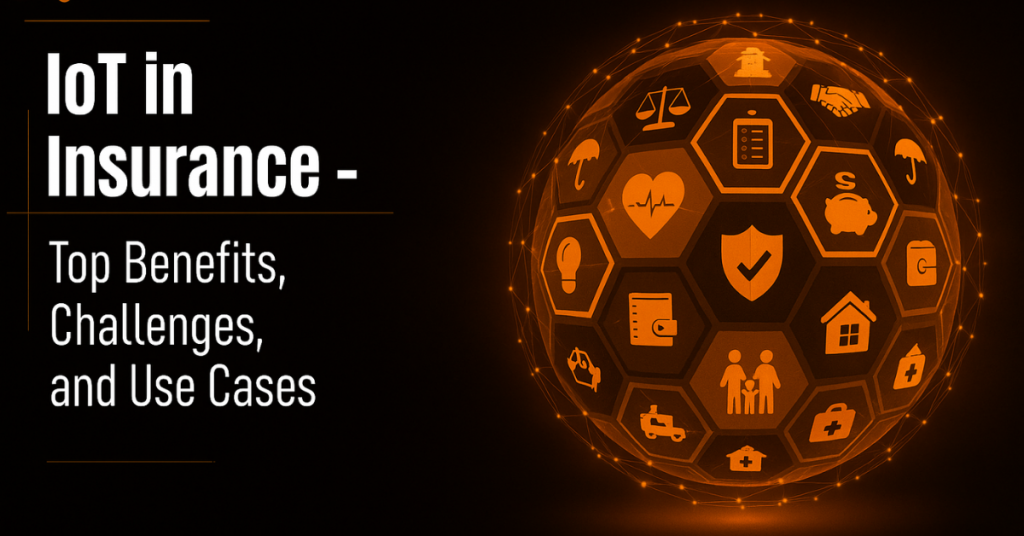
This blog reveals how IoT is changing the way insurance works—making risk assessment smarter, claims faster, and customers happier. It covers the biggest benefits, like reduced costs and real-time decisions, and explores use cases across auto, health, property, and agriculture. You’ll also learn about major challenges like data privacy and system integration, and how insurers are solving them with smart strategies.
IoT in Insurance – Stats and Facts You Must Know
- The IoT insurance market is worth USD 52.78 billion in 2025.
- The global IoT insurance market is estimated to grow to USD 200.56 billion by 2030.
- Property and casualty dominated revenue in 2024, accounting for 48.3%.
- Cloud environments account for 63.7% of the IoT insurance market, which will grow at a 33.8% CAGR.
(Source).
Key IoT applications in the insurance industry
IoT infrastructures capture and transmit data in real time, assisting insurance professionals with numerous responsibilities.
1. Risk assessment
IoT devices collect more information than potential policyholders generally provide, letting underwriters to develop full risk profiles and precisely evaluate whether and on what terms to grant applicants coverage.
2. Loss Prevention
Insurance firms can reduce compensation amounts by encouraging policyholders to use IoT-enabled warning systems and smart gadgets to alert them in the event of an accident and help avoid breakdowns or damage.
3. Claim processing
IoT technology assists claims adjusters in investigating and resolving claims by automatically identifying insured occurrences and communicating facts about them, including data on the factors determining the reimbursement amount.
4. Fraud detection
IoT devices collect and transmit authentic real-time data on insured events and policyholder behavior, confirming claims and assisting businesses in lowering the likelihood of fraud, accurately disbursing monies, and reducing disputes.
Industry-Driven Use Cases of Insurance IoT
There are various benefits of IoT in insurance. From automotive insurance to life insurance, in this section let’s take a look at some of the IoT insurance use cases.
1. Automobile Insurance
Telematics data can help auto insurance carriers make judgments about personal and commercial insurance.
- Automatically receiving accident data from connected vehicles for claim start.
- Assessing risks based on collected vehicle information, such as mileage, health, fuel efficiency, and location.
- Developing insurance coverage based on a driver’s behavior data, including driving speed, steering wheel rotation, braking method, and the time of day the vehicle is primarily utilized.
- Offer cheaper premiums for safer driving or well-maintained autos.
2. Life and Health Insurance
Life and health insurers are increasingly establishing campaigns to encourage customers to utilize fitness trackers and IoMT devices to track and share their personal information in exchange for better deals.
- Creating bespoke insurance coverage based on the customer’s activity data, such as steps taken, distance traveled, workout duration and frequency.
- Evaluating hazards via vital sign tracking, such as heart rate, temperature, blood pressure, glucose levels, and sleep habits.
- Developing targeted incentives for people who live a healthy lifestyle or actively manage chronic conditions.
3. Property Insurance
Home insurance carriers can use IoT technology to not only tailor offers for homeowners and renters, but also reduce reimbursement for losses caused by fires, water leaks, burglaries, and other catastrophes at clients’ houses through IoT-enabled risk prevention.
- Determining risks, establishing policy pricing techniques, and deciding on the payout amount based on the data collected from smart home devices on home security and environmental conditions
- Notifying policyholders to ensure preventive maintenance of home fixtures, appliances, or amenities in order to reduce claims
4. Agriculture Insurance
Insurance companies employ IoT sensors and linked devices in agriculture to monitor weather, assess agricultural risks, and give tailored insurance coverage.
- Determining risks and setting insurance terms based on information on equipment and machinery status, weather conditions, animal health, and soil factors
- Creating parametric insurance offers for non-damage-related rewards based on identified risks.
- Streamline FNOL submissions by detecting drought, flood, or insect infestation.
Major Challenges in Implementing IoT in Insurance
1. Disruption to Traditional Insurance Models
> Reworking underwriting and pricing systems
IoT introduces real-time, behavior-based data that forces insurers to shift from static, historical models to dynamic, personalized pricing. This requires a complete overhaul of traditional underwriting processes, which can be complex and time-consuming.
> Integration with legacy systems
One of the key IoT challenges in insurance is that many insurers still rely on legacy IoT systems. Integrating IoT data into these outdated platforms is often expensive and technically complex. Without seamless integration, insurers struggle to fully leverage IoT insights for claims, underwriting, or customer engagement, thereby delaying their digital transformation.
2. Limited Adoption in Health and Life Segments
> Privacy concerns
Collecting health and behavioral data from wearables raises serious privacy concerns because this data is deeply personal, including information such as sleep patterns, heart rate, and activity levels. Many users fear that insurers may use this data to charge higher premiums based on health patterns, or worse, deny coverage.
> Lack of standardization
There is no universal format for IoT data collected from wearable devices. This inconsistency in format is one of the major challenges in IoT in the insurance Industry. It makes it hard for insurers to aggregate data across platforms, run unified risk models, or compare one customer’s data with another’s.
3. Data Management & Ownership Issues
> Huge volumes of unstructured data
One of the flip sides of insurance IoT solutions is that they generate massive amounts of unstructured data, such as ECG data from wearables, drone footage from property damage, and engine noise patterns from connected cars, among others. Since this data cannot always be read by standard systems, insurers need advanced tools to process it, which further leads to a surge in costs. Additionally, ascertaining whether the data belongs to the customer, device maker, or insurer can create further challenges in IoT for insurance, leading to ethical, legal, or operational complications.
> Regulatory compliance (e.g., GDPR, HIPAA)
Regulatory compliance presents a significant challenge in IoT implementation within the insurance industry due to the sensitive nature of the data collected. These regulations mandate strict controls on data collection, processing, storage, and transfer, which can be difficult to achieve given the decentralized and often insecure nature of many IoT devices.
> Who owns the data insurer, customer, or device maker?
In the context of implementing IoT in insurance industry, data ownership is a complex issue with no simple answer. Generally speaking, the data generated by IoT devices can be categorized into three main areas: insurer data, customer data, and device-maker data. Where the customer owns the data related to their personal information and usage patterns, the insurer owns the data related to risk assessment and policy management. The device maker owns data related to functionality and device performance.
How A3Logics Helps Insurers Leverage IoT Effectively?
To enjoy the benefits of IoT in insurance industry, it is essential that it is implemented correctly. A3Logics is a seasoned IoT development company that comes with deep experience in the insurance sector, combined with industry expertise in IoT development. Here is how A3Logics helps insurers leverage IoT effectively –
- Custom IoT development solutions for insurers
ChatGPT said:
At A3Logics, we offer Insurance Software Development Services to create tailored systems for insurers that utilize data analytics and connected devices to enhance various aspects of their business, including claims processing, risk assessment, and customer engagement.
- Integration with existing insurance platforms
We integrate IoT with your existing insurance platforms by connecting smart devices to tools like risk scoring engines, policy administration systems, and fraud analytics platforms. This allows real-time data to enhance decision-making, reduce delays, and improve operational efficiency without disrupting your existing systems.
- Expertise in data analytics, device integration, and regulatory compliance
We ensure your IoT systems operate smoothly, remain secure, and comply with key regulations, including GDPR and HIPAA. We handle everything—from connecting different devices to turning their data into clear, valuable insights. This means you can confidently use IoT to improve operations, reduce risk, and stay fully compliant without hassles.
Conclusion
IoT is no longer optional; it’s becoming essential for the future of insurance, as clearly shown throughout this blog. We explored how IoT in insurance industry improves risk assessment, claims processing, and customer experience, along with real-world use cases across industries auto, health, property, and more.
While challenges such as data privacy and integration exist, they can be addressed with the right strategy, partners, and technology choices. Insurers who embrace IoT today won’t just stay relevant—they’ll lead. The future of insurance is connected, intelligent, and already underway.