
Have you ever thought why your life or health insurance premium remains the same even when you make a change in your lifestyle? This question sits at the core of What is Pay as you live (PAYL) insurance. Pay-As-You-Live life and health insurance is a new form of insurance wherein the premiums depend on how an individual actually lives. Rather than basing their judgment solely on age or previous medical reveals, insurers consider the current health behavior, wellness trends, and preventive health care practices. This change is enabled by Pay as you live life (PAY) insurance software development that can provide ongoing, analytics-based personalization.
The Pay as you live (PAYL) insurance model operates by gathering health and lifestyle information using wearables, medical IoT and connected health platforms. This data is then transformed into health and mortality real-time risk scores by using advanced analytics and AI models. Relying on these insights, premiums, incentives, and benefits are adjusted dynamically over time, resulting in a responsive and adaptive insurance experience.
Life and health carriers are adopting continuous risk pricing, because of the increasing claims, their exposure to chronic conditions, as well as customer demand to be transparent. Pay-as-you-live (PAYL) life and health insurance development offers insurance companies a chance to become more proactive when it comes to risk management, as opposed to being reactive, which increases profitability, engagement, and sustainability.
Market Evolution Toward Behavior-Rated Premiums
The rapidly evolving life and health insurance market is shifting towards the behavior-rated model of premiums because of the increasing healthcare expenses and shifting consumer demands. The global health insurance market is expected to expand by around 7.3% till 2029. In the US, the average employer-sponsored family health insurance premiums have hit almost $27,000 per year, pointing to mounting cost pressures that compel insurers to reconsider traditional, fixed-price pricing models.
Meanwhile, the consumer willingness for personalized insurance has hit a tipping point. Research indicates that close to 88% of consumers currently anticipate insurers to provide customized products, and more than two-thirds of young policyholders will submit lifestyle and health information to receive reduced premiums and wellness benefits. Behavior-rated pricing has led to quantifiable improvements in loss ratios, engagement and retention, which validates the transition to PAYL-driven insurance models.
Benefits of Pay-As-You-Live (PAYL) Insurance Model
For Policyholders:
Fair and Personalized Premium Pricing
The premiums given to policyholders are calculated according to actual lifestyle and health practices as opposed to fixed demographic presumptions. Individuals who actively take care of their health are no longer classified under risky profiles.
Financial Incentives for Healthy Living
The positive behaviors that are rewarded within the PAYL model are regular activity, quality sleep and preventive care adherence. Premium discounts, wellness rewards or increased coverage benefits are some advantages that could be achieved by policyholders due to constant healthy habits.
Improved Health Awareness and Prevention
Long-term health patterns can help policyholders gain a vision of how to lead a healthy lifestyle by regularly accessing health insights, behavioral scoring, and wellness feedback. Predictive factors help to take precautionary measures before things get out of control.
For Insurers:
More Accurate Risk Assessment
PAYL insurance enables the insurers to assess the real-time behavioral and health data rather than the historical disclosures. Continuous underwriting enhances mortality and morbidity prediction accuracy.
Reduced Claims Frequency and Severity
Healthier behavior adoption, consequently, reduces high-cost medical events and slows chronic disease progression. Moreover, preventive care significantly lowers hospitalization rates and costly treatment expenses.
Higher Customer Retention and Engagement
Wellness-based insurance promotes regular communication other than once a year. Involved policyholders tend to stay longer, enhancing the customer lifetime value.
Core Insurance Principles of Pay-As-You-Live (PAYL) Insurance Model
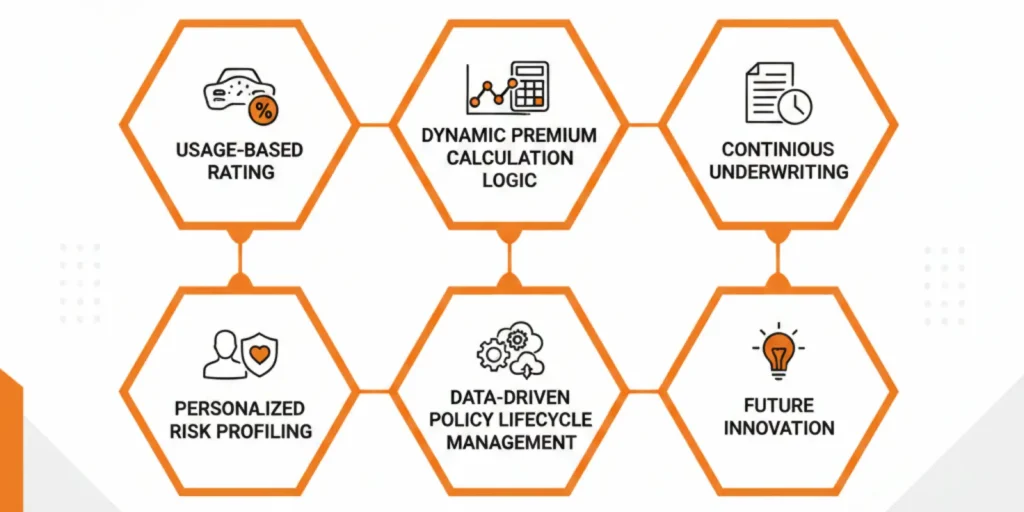
Usage-Based Rating for Life & Health
Usage-based rating, instead of relying on broad demographic assumptions, actively replaces them with data drawn from real-life lifestyle and health behaviors. As a result, risk evaluation no longer depends on generalized statistical groupings; rather, it directly reflects measurable factors such as physical activity levels, sleep patterns, vitals stability, and compliance with preventive care. In this way, premiums are not estimated based on how a policyholder is statistically classified. Instead, they are dynamically aligned with the individual’s actual lifestyle and day-to-day health behaviors.
Dynamic Premium Calculation Logic
Dynamic premium calculation keeps adjusting the prices according to revised health and behavioral risk indicators. Rather than recalculating annually, the premiums are reconsidered at pre-determined times like monthly or quarterly. Pay as you live (PAYL) health insurance development is based on AI-powered rating engines that use compliant risk modifiers.
Continuous Underwriting & Risk Assessment
Continuous underwriting makes underwriting a constant process rather than a one-time event. The data on health, lifestyle, and adherence are periodically re-evaluated to identify risk improvement or deterioration. For insurers, it lowers the level of volatility in claims and helps them manage long-term risks more effectively.
Personalized Risk Profiling for Living Risk Identity
A dynamic living risk identity is assigned to each policyholder as opposed to a risk class. This profile changes with time as health habits, illnesses and lifestyles alter. AI models combine biometric, clinical and behavioral data into interpretable risk scores. The outcome is highly individual insurance cover in accordance with individual life patterns.
Data-Driven Policy Lifecycle Management
Data-driven policy lifecycle management applies analytics to control all insurance processes. Real-time insights are used to issue policies, endorse, renew, and modify benefits instead of manually reviewing them. Automated decisioning enhances speed, consistency, and compliance.
Best PAYL Insurance Platforms in the Market To Inspire Your Development Journey
1. John Hancock Vitality

One of the earliest major implementations of PAYL-inspired life insurance is John Hancock Vitality. Specifically, it combines wearables, fitness applications, and consumer health activities to continuously monitor lifestyle behavior. As a result, the program rewards healthy actions with points that then translate into premium savings and tangible benefits. From a development perspective, therefore, it demonstrates how behavioral data, incentives, and life underwriting coexist within a regulated framework.
2. Discovery Vitality

Discovery Vitality is an established, ecosystem-based PAYL platform deployed across multiple geographies and insurance lines. Moreover, it integrates health insurance, life insurance, banking, and wellness rewards into a unified behavioral risk model. Consequently, the platform uses dynamic health scoring to influence premiums, benefits, and partner rewards. From a development standpoint, therefore, it demonstrates scalable data ingestion, partner APIs, and sustainable long-term engagement design.
3. AIA Vitality

AIA Vitality adapts the PAYL concept for diverse regulatory and cultural markets across Asia-Pacific. Accordingly, the platform emphasizes preventive care, physical activity, and routine health examinations as insurance value inputs. Moreover, its modular framework allows rewards, devices, and engagement strategies to be localized effectively. Consequently, it serves as a valuable reference for insurers developing region-specific PAYL insurance platforms.
Technology Pillars of Pay-As-You-Live (PAYL) Insurance Model
1. IoT & Wearables in Life and Health Insurance
Wearable technology and IoT, increasingly, collect real-world health and lifestyle data from policyholders. In practice, these devices monitor vitals, activity, sleep, and adherence patterns in near real time. Consequently, this continuous data stream forms the behavioral foundation of PAYL risk assessment.
2. AI-Based Health and Mortality Risk Scoring
AI applications, therefore, process biometric, behavioral, and clinical data to predict health deterioration and mortality probabilities. Moreover, these models remain dynamic as new information continuously refines their predictions. Consequently, insurers use these insights to enable ongoing underwriting and proactive risk intervention.
3. Machine Learning for Behavioral Rating
Machine learning models determine the relationships between daily lifestyle habits and long-term health outcomes. Behavioral scores are directly affected by activity consistency, sleep quality and preventive care. These scores are used to create dynamic pricing logic in Pay as you live (PAYL) insurance platform development workflows.
4. NLP for Medical Records & Insurance Documents
NLP, therefore, extracts structured information from unstructured medical records and insurance statements. Moreover, it identifies diagnoses, procedures, medications, and clinical context at scale. Consequently, NLP reduces manual underwriting effort while improving decision accuracy and speed.
5. Computer Vision for Medical Image & Report Analysis
Computer vision models, therefore, interpret medical prescriptions, diagnostic scans, and handwritten documents efficiently. Moreover, they automate validation, classification, and anomaly detection across claims and underwriting workflows. Consequently, this approach improves turnaround times and reduces human error in document-intensive processes.
6. Cloud vs Edge Computing in Health Data Processing
Edge computing, therefore, processes sensitive health data on devices to ensure low latency and privacy. Meanwhile, cloud computing supports machine analytics, AI training, and long-term data storage. Consequently, PAYL platforms adopt hybrid architectures to balance performance, scalability, and compliance.
7. API-Led Ecosystem Enablement
Wearables, healthcare providers, insurers, and third-party services, therefore, connect through API-led architectures. Moreover, APIs enable secure data exchange, modular integrations, and rapid ecosystem development. Consequently, this flexibility allows PAYL platforms to evolve without disrupting core insurance systems.
Wearables & Health Data Collection Stack for PAYL Insurance Model
1. Biometric Data
PAYL insurance risk intelligence is based on biometric data. Monitoring continuous signals such as heart rate, sleep quality, glucose variability and ECG patterns provides insight into actual trends in health behavior. Through these measures, the insurers will be able to abandon the traditional approach of underwriting and embrace dynamic, evidence-based assessment of mortality and morbidity.
2. Consumer Wearable Devices
Consumer wearables, such as smartwatches and fitness bands, therefore, provide high-frequency lifestyle and wellness data. Moreover, they measure activity, sleep, stress, and vitals in real-life settings. Consequently, their widespread adoption makes them ideal for scaled PAYL insurance engagement and behavior-based premium adjustments.
3. Medical Wearable Devices
Medical wearables provide clinical-grade precision in particular conditions and chronic monitoring. New technologies such as continuous glucose monitors and ECG patches generate controlled health data. This information builds confidence in underwriting, and justifies PAYL products for a high-risk or chronic-care population.
4. Medical IoT and Remote Patient Monitoring
IoT and RPM devices in healthcare, therefore, enable continuous monitoring beyond hospitals and clinics. Moreover, they track vitals, treatment adherence, and signs of recovery at home. Consequently, for PAYL insurance, RPM data supports proactive risk detection, early intervention, and reduced claim severity.
5. Clinical & Electronic Health Records
EHR systems offer longitudinal medical history, diagnoses, procedures, and lab results. Combined with wearable data, they put real-time indicators into clinical context. Such a combination allows proper risk stratification and justifiable AI underwriting.
6. Standardized Healthcare APIs & Protocols
Interoperable health data exchange is possible with the help of standards such as FHIR and HL7. They guarantee uniformity of data formats across providers, devices and insurers. Standardization simplifies the complexity of integration and enhances the speed of PAYL platform scalability across healthcare ecosystems.
7. Health Provider & Ecosystem Sources
Hospitals, labs, pharmacies, and telehealth platforms complement PAYL data pipelines. These sources confirm treatments, diagnoses and adherence to preventive care. Data obtained by the provider enhances the accuracy of underwriting and facilitates value-based insurance.
8. Adherence & Reliability Data Sources
Adherence information monitors medication use, compliance in therapy, and participation in preventive care. Reliability measures evaluate coherence and completeness of wearable and device data streams. Collectively, they assist insurers to differentiate between long-term stable healthy behavior and temporary or cheating patterns of activity.

3rd Party Integration Required for PAYL Insurance Software Development
1. CRM Integrations for Life & Health
CRM integrations bring together prospect, policyholder, and partner data in sales and servicing journeys. They facilitate individual onboarding, wellness response initiatives, and renewal procedures based on dynamic PAYL premiums.
2. Hospital & Clinic Data Exchange APIs
Clinical records, diagnostics, and treatment events can be accessed safely with the help of hospital and clinic integrations. HL7 and FHIR APIs standardize the exchange of data on admissions, discharge summaries, lab results and care episodes.
3. TPA and Health Provider System Integrations
Third-party administrator integrations link care coordination systems and provider networks to claims processing engines. Such integrations allow validation of eligibility, pre-authorizations, cashless hospitalization processes, and reconciliations of settlements.
4. Payment, Billing & Policy Distribution APIs
APIs of payment and billing enable real-time collection of premiums based on usage, behavior, or change of health score. Frictionless transactions are guaranteed by integration with payment gateways, digital wallets, banks and distributors.
5. ServiceNow Integration for Claims, ITSM, Case and Workflow Orchestration
ServiceNow integration allows the organization of workflows in the claims management, customer cases, and IT services operation. It assists in tracking SLA, automatic task allocation, exception management, and audit compliant governance.
6. Document Intelligence API Layer
Document intelligence APIs use machine learning to automate the ingestion and interpretation of medical reports, prescriptions, discharge summaries, and policy documents. OCR, NLP, and classification models derive structured information out of unstructured data.
7. Cloud AI Connectors
Cloud AI connectors integrate vision, language, forecasting, and anomaly detection managed services into PAYL risk and claims pipelines. They enable scalable testing, model management, and fast deployability across the environments.
AI-Driven Risk & Rating Engine for PAYL Insurance Software Development
1. Mortality Risk Model Design
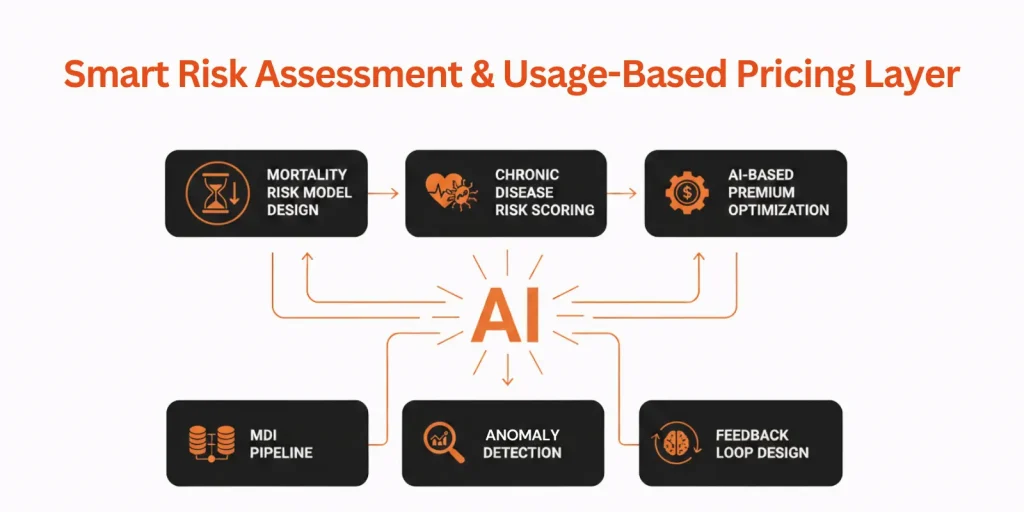
AI-based mortality models are based on biometric trends, lifestyle, medical history, and demographic. These are fundamental modules provided by Pay as you live life (PAY) insurance software development solutions to facilitate uninterrupted underwriting.
2. Chronic Disease Risk Scoring
Chronic risk engines determine the likelihood of long-term diseases such as diabetes, cardiac diseases, and hypertension. The models constantly refresh the risk scores based on wearable data, clinical indicators, and adherence rate.
3. AI-Based Premium Optimization
Premium optimization engines strike a balance between actuarial fairness, profitability, regulatory limits and customer incentives. AI simulations are used to test pricing situations to sustain the ratio of losses and promote healthier policyholder behavior.
4. Medical Document Intelligence (MDI) Pipeline
MDI pipelines are based on OCR, NLP, and classification models to gain structured data out of medical reports. This automation enhances the accuracy of underwriting, validation of claims and speed of medical risk assessment.
5. Anomaly Detection for Health Insurance Fraud
Anomaly detection models detect abnormal patterns of health data, suspicious behavior of claims, and billing irregularities. Machine learning constantly optimizes fraud indicators based on historic and real-time data.
6. Re-Training and Feedback Loop Design
New behavioral, claims, and health outcome data are used to retrain AI models on a regular basis. Feedback loops would provide accuracy, control bias, regulatory compliance, and consistency with the changing trends in population health.
Policy Administration System (PAS) for PAYL Insurance Model
1. Dynamic Policy Creation and Updates
The PAS allows modular policy design that is configurable and responds to changing health behaviours, risk scores, and coverage rules. Policy attributes are automatically updated without manual endorsement or policy reissuance.
2. Real-Time Premium Adjustment Module
This module re-calculates premiums utilizing continuous health, lifestyle and adherence data feeds. Adjustments are made according to the predetermined actuarial thresholds without losing transparency, auditing and regulatory requirements.
3. Rule Engine for Life & Health Policy Logic
A centralized rule engine is used to regulate eligibility, price limits, rewards, fines, and compliance limitations. It enables business users to make logical adjustments without the need to write code, which makes product iteration faster.
4. Automated Billing & Invoicing
Billing cycles are dynamically adjusted according to recalculations of premiums based on changes in behavior or risk. The system offers flexible invoicing, prorations, refunds, and payment gateways integrations.
5. Customer Self-Service Portal
The portal provides policyholders with live access to premiums, health indicators, rewards, and policy conditions. It allows users to control consent, devices, payments and update policy.
Claims Automation and Processing in PAYL Platforms
1. AI-Powered FNOL for Health Insurance
AI-based FNOL automates the processing of claims based on policy information, health indicators and events. It minimizes manual entry, enhances precision and facilitates quicker downstream triage and settlement.
2. Hospitalization & Treatment Claim Triage
Smart triage sorts hospitalization and treatment claims by severity, coverage, and risk indicators. This assigns high importance to urgent cases, places claims in their proper order and reduces processing delays.
3. NLP for Claim Medical Attachments
NLP derives diagnoses, procedures and timelines out of unstructured medical attachments such as discharge summaries. It normalizes data to validate, decide, and automatically adjudicate claims processes.
4. Computer Vision for Medical Reports, Scans, Prescriptions
Computer vision is used to scan medical records, scans, and prescriptions to confirm treatment and cost. It identifies irregularities, raises possible fraud, and expedites validation of evidence during claims processing.
5. Claims Decisioning & Approval Workflow
Automated decisioning is a combination of rules engines and AI risk scores that is used to determine the eligibility of claims. The approval workflows are dynamically adjusted, and are used to guarantee compliance, consistency, as well as expedited settlement results for policyholders.
6. Fraud Detection During Claims Intake
During intake, real-time fraud detection is done based on behavioral patterns, medical anomalies, and historical claim data. This will avoid early leakage, which lowers the costs of investigation and false payouts for insurers.
7. Payout Calculation for Health & Life Policies
Payout calculation engines calculate benefits based on dynamic premiums, benefits coverage policy and conditions. Pay as you live (PAY) insurance software development is based on these capabilities, which guarantee correct settlements with regard to current policy state and regulatory restrictions.

UI/UX Design Framework for Pay-As-You-Live Insurance
1. Policyholder Dashboard for Health & Mortality Insights
The dashboard is a consolidated representation of health indicators, lifestyle patterns, and mortality rates. It assists the policyholders in comprehending the direct effect of everyday conduct on insurance cover and long-term protection.
2. AI Risk Score & Wellness Visualization
Visual risk scores simplify and transform complex AI calculations into simple intuitive charts and indicators. Such transparency will create confidence since it demonstrates clearly how wellness activities influence the personal risk profiles.
3. Premium Transparency UI for Dynamic Pricing
High-quality interfaces show the effect of behavioral changes on pricing in real-time. The correlations between the level of activity, health progress and adjustment of the premium can be viewed instantly by the user.
4. Claims Status and Document Upload Experience
The claims interface provides easy submissions with guided uploads, real-time validation, and status updates. Well-defined status indicators alleviate the anxiety and remove uncertainty when processing claims.
5. Mobile-First Policy Experience
Mobile-first design will provide constant engagement using smartphones and wearables. It allows access to health insights, policy updates, claims actions, and wellness nudges anytime.
6. Accessibility and Inclusive UX Standards
Inclusive design adheres to standards of accessibility like WCAG so as to accommodate diverse users. The availability of features such as readable typography, voice support, and multilingual features will guarantee fair insurance experiences for every policyholder.
Pay As You Live Life Insurance Software Development Roadmap
1. Agile Execution Strategy for Life & Health Products
Implement agile delivery to manage changing actuarial logic, health data sources, and regulatory demands effectively. Short sprints permit faster feedback, repeated compliance validation, and gradual rollout of PAYL capabilities.
2. MVP Planning for Pay-As-You-Live Health & Life Policies
Define an MVP that includes core wearable integration and basic risk scoring, as well as dynamic premium adjustments. The method justifies the Pay as you live (PAYL) insurance model within a short time and reduces initial technology and regulatory risk.
3. CI/CD Pipeline for Regulated Insurance Environments
Use secure CI/CD pipelines, audit trails, approval gates and rollback. This guarantees quick but compliant Pay as you live life (PAY) insurance software development in regulated health and insurance settings.
4. UAT, Sandbox, and Pilot Rollouts
Conduct pilot programs and run control sandboxes with real users, devices and claims scenarios. This stage authenticates user experience, high quality logic, and operational preparedness prior to the enterprise-wide production rollout.
5. Production Release Governance
Build good governance that includes model approvals, pricing controls, security monitoring and compliance reporting. This guarantees stability, credibility, and scalability of Pay as you live (PAYL) insurance platform development in the long-term.
Testing and Validation
1. Wearable & Biometric Data Validation
Check accuracy, consistency, and integrity of wearable and biometric data across devices, firmware versions, and environments. Cross-device tests and calibration guarantee valid inputs for risk models.
2. Mortality and Health Model Benchmarking
Compare benchmark models of mortality and health risk with actuarial tables, historical claims and external data. Measurements include AUC, calibration, back-testing and stress scenarios across different population segments.
3. Medical Document AI Accuracy Testing
Test medical document OCR accuracy, entity extraction, coding, and clinical context understanding across different formats and languages. Outputs are validated by human review sampling with clinician-labeled ground truth.
4. Compliance and Security Testing
Conduct compliance and security testing to meet HIPAA, GDPR, regional insurance requirements, data residence and internal governance. Tests that are specific include penetration testing, access control, encryption testing and audit logging.
5. Pilot Feedback and Policy Optimization
Conduct pilot programs to get real-life feedback regarding the fairness of prices, engagement, wellness incentives, and operational performance before rolling out on a mass scale. Insights support tuning of policy, calibration of models and enhancement of the user experience.
Deployment and Monitoring of PAYL Insurance Software
Secure Wearable Onboarding & Deployment Strategy
Secure wearable onboarding defines a trusted device identity, user consent and encrypted data channels during activation. Scalable deployments on consumer and medical device ecosystems are made possible by automated provisioning and remote lifecycle management.
Cloud Environment Configuration for Regulated Health Data
Regulated health and insurance workloads are set up in cloud environments with data residency, encryption, and compliance controls. Audit logging and zero-trust networking safeguard policy and biometric information throughout platform lifecycles.
AI Model Monitoring
The monitoring of AI models follows performance, drift, and bias across mortality, chronic disease, and fraud models. Constant review keeps it accurate, explainable, and regulable because health behaviors and risk patterns evolve.
Policy Engine Monitoring and Updates
The monitoring of the policy engines ensures that rating rules, premium calculations and benefits logic are correct against approved product filings. Controlled updates bring new wellness regulations, pricing and regulatory modifications without disturbing the ongoing policies.
Observability and Incident Response
Observability gives visibility to data pipelines, APIs, devices and user journeys in the PAYL platform. System, data and security problems can be detected and resolved through automated alerts and response workflows.
SLA-Bound Maintenance Framework
A SLA-bound maintenance framework outlines uptime, performance, support and recovery guarantees for PAYL insurance systems. Proactive maintenance and optimization guarantee platform stability, compliance, and ongoing improvement during the product lifecycle.
Team Structure Required
IoT Engineering Team
Designs wearable integrations, device authentication, real-time data ingestion, edge processing and secure telemetry pipelines.
AI and ML Engineering Team
Develops predictive mortality, morbidity, behavioral models, feature engineering pipelines and scalable risk scoring services platforms.
Policy Administration System Engineering Team
Writes dynamic policy setups, rating policies, endorsements, renewals, and lifecycle processes for PAYL products insurers.
Claims Automation Engineering Team
Deploys AI-based claims intake, triage, adjudication, fraud detection, payouts, and scale automation of straight-through processing.
Data Science Team
Develops statistical models, names data sets, tests assumptions and collaborates with actuaries on risk models.
Medical NLP Specialists
Gather information through clinical notes, discharge summaries, prescriptions, and reports with medical language proficiency.
Cost to Develop PAYL Insurance Software
1. Basic PAYL Insurance Software Development Cost
This tier, therefore, targets small-scale wearable integrations, rule-based wellness scoring, and basic PAS connectivity for pilot programs. Typically, investment ranges between $150,000 and $300,000 and covers fixed pricing groups, compliance foundations, reporting, and cloud deployment.
2. Mid-Level PAYL Insurance Software Development Cost
Mid-level development, therefore, enables data ingestion from multiple devices, AI-based health risk scoring, and behavior-driven premium adjustments. Typically, development costs range between $400,000 and $900,000 and include PAS development, claims workflows, fraud detection, mobile apps, and scalable cloud infrastructure.
3. Advanced PAYL Insurance Software Development Cost
Complex development, therefore, enables live underwriting, continuous pricing, and enterprise-level automation for life and health products. Typically, investment ranges between $1.2 million and $3 million and includes medical NLP, computer vision, and MLOps governance. Moreover, it supports multi-region compliance and large-scale medical IoT data processing at scale.
Challenges and Mitigation
1. Wearable Data Reliability
Wearables may generate poor-quality or noisy biometrics data as a result of device quality, human behavior or sensor drift. Mitigation needs calibration algorithms, cross-device normalization, and regular testing against clinical-grade benchmarks.
2. Regulatory Product Approval Complexity
Dynamic pricing and continuous underwriting models, however, often create regulatory uncertainty for PAYL insurance products. Therefore, early involvement of regulators, sandbox trials, and clearly explicable actuarial reasoning help accelerate product acceptance. Moreover, these approaches significantly reduce compliance risks while improving transparency and regulatory confidence.
3. AI Explainability in Life & Health Premium Pricing
Unless transparent, AI-based premium adjustments may seem framed opaquely by regulators and policyholders. To ensure the presence of trust and regulatory acceptance, explainable AI models, audit trails, and human-readable risk factors are needed.
4. Privacy-First Architecture Challenges
Continuous health data collection is a significant privacy, consent, and data minimization concern. The privacy-by-design model that enables the granular control of consent, data anonymization, and a strict constraint on the intentions of using the data will mitigate both regulatory and reputational risks.
5. Scaling Medical IoT Data Pipelines
Medical IoT systems, however, generate massive data volumes that can overwhelm existing infrastructures. Therefore, elastic cloud scaling, event-driven architectures, and edge preprocessing ensure reliability without compromising performance or compliance.
6. Risk Transparency and Customer Trust Barriers
When value exchange is ambiguous, policyholders might not trust the effect of behavior on premiums. Clear dashboards, quality impact simulations, and good reinforcement using rewards will contribute to establishing long-term customer trust and involvement.
Conclusion
Pay-as-you-live insurance, fundamentally, represents a structural revolution in life and health risk pricing, management, and experience. By aligning premiums with real-world behavior and health indicators, carriers can shift from reactive claims payers to active wellness collaborators. In the long term, therefore, the model delivers measurable benefits by improving loss ratios, enhancing risk predictability, and increasing engagement and customer trust.
The most important success factor is execution. It is necessary to have a powerful InsurTech implementation partner whose understanding of AI, health data, compliance, and insurance platforms is profound. Similar to what has been emphasized in this Pay as you live (PAYL) insurance guide, investing early in scalable PAYL technology ecosystems will place carriers in a place of competitive advantage and future growth.