One of the biggest arguments in business is whether it’s better to do tasks in-house or hire someone else to do them. Outsourcing can be cheaper and more efficient, but having people work for you gives you greater direct control over day-to-day operations. You can choose the ideal way for your needs by learning about both of these methods and their advantages and cons. This article talks about in-house work vs outsourcing, the pros and cons of each, and when to use both.
Choosing the best method affects not only compliance, but also expenses, employee satisfaction, and corporate growth, as rules, technology demands, and worker expectations rise. Here we will discuss in-house vs. outsourced benefits administration in detail. In fact we will break down both choices, show how they compare side by side, and give you professional advice on how to choose the one that is best for your business.
What is In-House Benefits Administration?
Companies can handle employee benefits more efficiently and at a lower cost using in-house benefits administration systems. It is done with the help of bespoke benefits administration software solutions that are made to fit the needs of the business. These solutions are meant to automate duties related to managing benefits, like enrolling employees, talking to them, and making reports.
Managing all of an employee’s benefits processes in-house means doing it with the company’s own resources, HR team, or a specialist benefits administrator. In this case, internal workers take care of things like choosing a plan, talking to employees, enrolling them, making sure they follow the rules, and fixing problems. Some companies build their own software and operate it themselves, which gives them complete control over every aspect.
Key Stats
- More than 47% of organizations with more than 500 employees utilize in-house benefits administration models as their main way to manage benefits.
- 39% of small and medium-sized businesses say that keeping benefits in-house takes up more than 20% of their HR team’s work.
Now when you are clear about the in-house benefits administration, let’s understand all about the outsourced one to make proper decisions and achieve our objectives.
What is Outsourced Benefits Administration?
Outsourced benefits administration solutions mean engaging a third party to handle responsibilities like enrolling employees in benefits and managing them. The supplier uses their software, HCM solutions, and knowledge to take care of things like enrolling employees, communicating with them, making sure they follow the rules, and reporting. In this part, we’ll talk about the pros and cons of using outsourced benefits administration systems.
Key Stats
- More than 50% of businesses throughout the world now hire outside companies to handle part or all of their benefits-related tasks.
- By 2032, the market for outsourcing benefits administration is estimated to be worth $1.7 billion. In 2025, companies would pay an average of more than $115 per employee on these services.
- 63% of businesses spent more on outsourcing last year, which shows that they trust specialized vendors more.
- Companies say they save 30% to 70% on administrative costs on average when they convert to outsourcing benefits administration.
As you are clear about both forms of benefits administration, it is important that you look into differences to make get ahead with clarity. Check out the section below as we discuss in-house vs. outsourced benefits administration.
Key Differences Between In-House and Outsourced Benefits Administration
Check the table below and get complete understand of the differences and move ahead:
| Aspect | In-House Benefits Administration | Outsourced Benefits Administration |
| Cost | Higher due to staffing, tech, and compliance costs | Predictable, often lower, with less internal overhead |
| Control | Full oversight and customization | Less direct control; relies on vendor processes |
| Expertise | Requires in-house specialists | Access to specialized, up-to-date knowledge |
| Employee Interaction | Direct, personalized communication | Managed by vendor, potential for indirect communication |
| Scalability | Limited by internal HR capacity | Highly scalable as business grows |
Below we highlight the things to think about when putting anything into action while addressing in-house vs. outsourced benefits administration.
One essential choice to make after learning about outsourcing vs. in-house is whether to do the implementation in-house or outsource it. You need to think carefully about this key strategic choice
When determining whether to do something in-house or hire someone else to do it, these are the most important things to think about:
1. Core Competencies and Strategic Importance
In-House
If the task or project is particularly important to the company’s core strengths and strategic vision, it should be handled in-house. It is directly linked to the company’s main business areas and should be handled in-house to gain control and encourage new ideas.
Outsource
You can outsource things that aren’t important to your business but need to be done so you can focus on more important things and that don’t provide you a competitive edge.
2. Things to Think About When It Comes to Cost
In-House
Working in-house could mean spending more money up front on staff, training, and infrastructure. But in the long run, it can save money because you don’t have to pay extra fees to an outside source.
Outsource
Outsourcing can help you handle projects that involve particular skills that you only need for a short time in a cost-effective way. So, you may avoid having to pay for things like salaries, benefits, and employment taxes all the time.
3. Quality Influence
In-house
Since the team is closely related to the company’s culture, it can have more direct influence over how work is done and what is delivered. This can lead to greater quality control.
Outsource
The quality of work can change depending on the outsourcing partner, but these risks are lower if you use a trusted supplier and make appropriate quality control agreements.
4. Availability of Resources
In-House
A corporation can do in-house work if it has the skill it needs in its current personnel or can attract that talent to fill certain types of roles.
Outsource
If your internal team doesn’t have the abilities needed because the task requires a very specialized area of knowledge or there is only a short-term rise in demand that your internal team can’t handle, you can outsource for that.
Pros and Cons of In-House Benefits Administration
Below pros and cons that can help you with all the clarity about in-house benefits administration and make it easy for you to make decisions. Check it out.
Pros
- When companies handle their own benefits, they have complete control over every part of their benefits package.
- HR staff who work in-house talk directly to employees, which helps them understand their requirements better and create stronger relationships with them.
- Managing benefits in-house lets you customize them a lot. Companies can make strategies that take into account the different needs, wants, and priorities of their employees.
- A strategy for managing benefits in-house can fit better with the company’s overall HR and people strategy.
- Internal HR teams know a lot about the company’s goals, the demographics of its employees, and how things work on a day-to-day basis.
Cons
- It might be costly to keep a benefits administration department in-house. Companies need to spend money on HR workers who are in charge of benefits management, as well as regular training,
- Internal HR staff may not have the knowledge they need to handle benefits issues including legal compliance, plan design, and technology integration.
- Managing benefits on a daily basis can take a lot of time and effort for in-house personnel.
- When a corporation handles its own benefits, it is the only one responsible for following the rules.
- To provide a smooth, modern benefits experience, you need strong technology platforms for enrollment, communication, data management, and reporting.
Pros and Cons of Outsourced Benefits Administration
Below pros and cons that can help you with all the clarity about outsourced benefits administration and make it easy for you to make decisions. Check it out.
Pros
- Organizations can hire outside organizations to handle their benefits administration, which offers them access to teams of specialists in benefits legislation, plan design, compliance, and technology.
- Companies can save a lot of money by outsourcing the management of benefits. External suppliers can offer more advanced services at a lower cost per employee than most in-house teams since they spread their fixed costs over numerous clients.
- When you outsource regular, transactional benefits chores, the provider takes care of them, which lets your internal HR teams focus on more important things like developing talent, building a strong culture, and designing the company.
- The best benefits administration outsourcing firms spend a lot of money on the latest technology platforms that have capabilities like mobile enrollment, real-time analytics, integration with payroll and HR systems, and AI-driven decision support.
- Outsourced solutions are naturally scalable, so it’s easy to change the quality of service when the firm grows, enters new markets, or changes its benefits strategy.
- Many outsourced suppliers have easy-to-use digital platforms, support in multiple languages, and access to benefits information 24/7. Employees may quickly and easily sign up, make adjustments, see plan information, and fix problems.
- When you outsource, you give some of the compliance risk to the vendor, who is then responsible for keeping up with rules and putting in place the necessary processes.
Cons
- Companies give up some control over the process when they outsource benefits administration.
- Outsourcing can make it hard to communicate, especially if the provider’s support crew isn’t fully integrated into the company’s culture and ways of doing things.
- Outsourced providers try to give great service, but their services have to be the same for a wide range of clients.
- Moving benefits administration from in-house to outsourced might cost money up front for things like moving data, integrating systems, educating employees, and managing change.
Factors to Consider When Choosing Between In-House and Outsourced Benefits Administration
Look at these factors to choose the model that works best for your business:
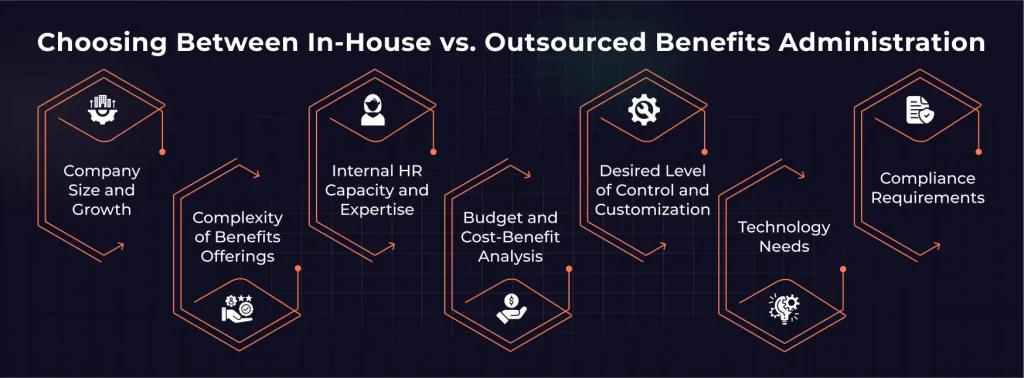
- Outsourcing benefits administration might be helpful for larger companies that are growing quickly. At first, small businesses may want to do everything in-house, but as their demands grow, they may want to hire outside help.
- The more different your benefits options are, the more a company that specializes in outsourcing benefits administration may help.
- Check your HR team’s talents and time. Are they better at doing administrative work or strategic work?
- Compare the expenses of staffing, systems, training, and compliance fines to the fees charged by the service provider.
- If you need unique benefits or personal monitoring, it may be better to do things in-house.
- Outsourced benefits administration frequently offers better technology for less money up front.
- Businesses that operate in more than one state or country have a larger chance of not following the rules. Outsourcing can assist lower this risk.
How to Transition from In-House to Outsourced Benefits Administration?
Changing from in-house to outsourced benefits administration is a big but manageable move if you do it the proper way. At first you need to look at your current HR processes, technology, and needs. After this, you need to figure out what you want to accomplish, like cutting costs, making sure your employees follow the rules, or making their work experience better.
Then you must consider choosing a company that handles benefits administration outsourcing that has a lot of experience, strong references, and cutting-edge technology. When you work together on a gradual rollout, set clear deadlines, and figure out what training is needed. After this, migration and comprehensive testing will help protect sensitive employee data.
Why Choose A3Logics for Benefits Administration Outsourcing Services?
A3Logics is a one of the top names in the business offering benefits administration outsourcing services. Below are the reasons that show why you must not think twice and consider us for your needs of Employee Benefits Administration Services.
- Providing Managed Benefits to make things easier, make sure everything is legal
- We make sure to help you with solutions that give employees a smooth experience.
- A3Logics helps businesses at every level, from the first transition to continuous optimization,
- Also we are going to assist you with real-time analytics, compliance monitoring, and specialized support.
These reasons show why you must not think twice and consider A3Logics as your top choice and get the most return since they focus on security, openness, and working with clients.

Final Thought
Hopefully you have got complete clarity about the choice between in-house and outsourced benefits administration. It completely depends on the size of the firm, its needs, the cost, and how much you value experience and scalability.
Many businesses consider outsourcing services are more efficient, lower risk, and have better technology. But companies that want full control or have specific benefits may be happier with in-house models. So, you can connect with the experts at A3Logics and get all the assistance you need. Good luck!