Inflation reaching an all-time high. Unstable geopolitics. Supply chain problems that keep happening. And the possibility of another wave of pandemics. The business world today is full of change and uncertainty.
Organizations need more than just standard tools to deal with these problems; they need access to real-time data and full awareness of the supply chain. But just having access to data isn’t enough. Companies also need to be able to evaluate and make sense of this data in a way that turns insights into strategic action. This is where the role of supply chain analytics comes. With the worldwide supply chain analytics market is growing quickly.
By 2032, it is expected to be worth USD 32.71 billion, with a compound annual growth rate (CAGR) of 16.7% from 2025. We can see a rapid rising demand for supply chain data analytics solutions.
In this blog, we’ll talk about the basics of supply chain analytics, such as its main benefits, the many types of analytics, how to analyze data, how to optimize processes, and how supply chain data analytics are changing how decisions are made in the supply chain.
What Is Supply Chain Analytics?
Supply chain analytics employs data analytics tools and methods to make supply chain management, operations, and efficiency better.
Modern supply chains create a lot of big data since they are so huge and complicated. This data may be used to find trends, find problems, and come up with smart solutions. Supply chain analysts utilize supply chain analytics to get useful information that can assist them make important decisions about how to build, keep up, and improve supply chains.
As e-commerce gets bigger and more important, there is a greater demand for well-trained analysts who can understand the supply chains that support it.
How Does Supply Chain Analytics Work?
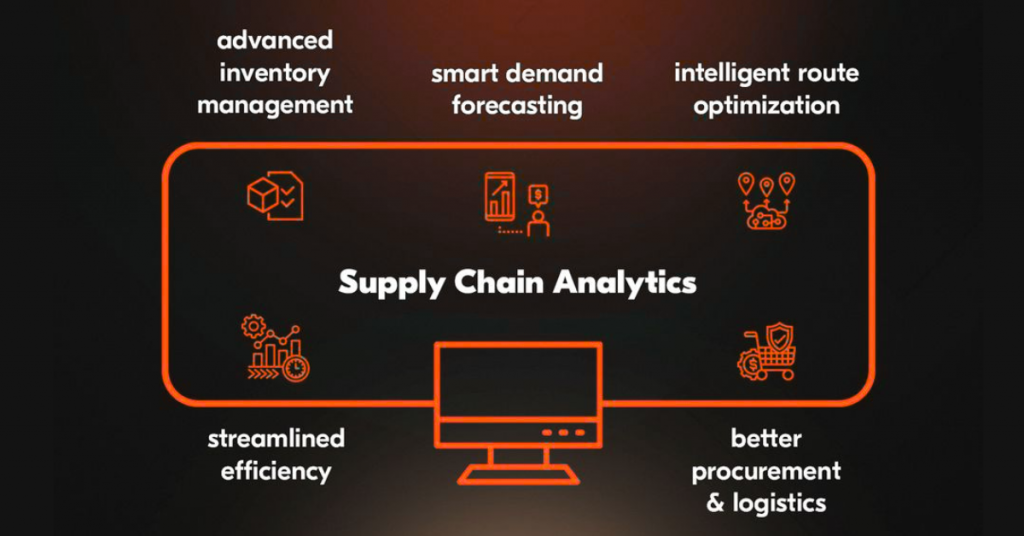
Supply chain analytics use innovative ways to collect, store, and analyze data to make supply chain operations run better. Supply chain analytics collect the right data from different company systems and outside sources. Then, the data goes through procedures including cleansing, statistical modeling, machine learning algorithms, and data visualization tools to assist firms get useful information.
You can see these insights on dashboards, in reports, and in collaborative analytics tools. They help you make decisions based on data to improve the accuracy of your forecasts, lower your risks, keep your expenses down, and design the best networks.
Industries Benefiting from Supply Chain Analytics
The core of many industries lies in their supply chain. Here are some of the companies that are benefitting from supply chain data analytics.
> Retail & E-commerce
E-commerce sites and retail companies majorly depend on supply chain data analytics for demand forecasting, inventory management, and route optimization of deliveries. Through real-time intelligence on purchasing patterns and stock movement, companies can prevent stockouts, minimize overstocking, and enhance customer satisfaction by offering timely product availability and delivery.
> Logistics & Transportation
Supply chain analytics is crucial in logistics, used in optimizing routes, managing fleets, and scheduling deliveries. Through traffic patterns, fuel usage, and shipment analysis, businesses are able to reduce delivery expenses, minimize transit time, and improve supply chain visibility overall.
> Manufacturing
Manufacturers employ analytics to optimize production calendars, control raw material procurement, and track machine performance. Data analytics-enabled predictive maintenance minimizes downtime, while demand forecasting maintains production output in sync with market demand, effectively increasing efficiency and profitability.
> Automotive
The auto industry is aided by supply chain analytics through enhanced part sourcing, handling complicated supplier networks, and coordinating production with shifts in global demand. Supply chain data analytics also aids just-in-time (JIT) manufacturing, assisting automakers in reducing inventories to lean levels without compromising availability.
> Energy & Utilities
For utility and energy companies, analytics facilitates supply chain management for maintenance services, fuel, and equipment. It refines demand projections for electricity or gas consumption as well as aids in sustainability by providing insights on where energy can be conserved and waste minimized.
> Healthcare & Pharmaceuticals
In pharma and healthcare, supply chain analytics guarantees timely distribution of life-saving drugs, medical supplies, and vaccines. Real-time tracking and demand planning manage cold chain logistics, avoid stockouts, and meet stringent regulatory requirements, while patient care quality is ensured.
Key Features of Effective Supply Chain Analytics
To really unlock value, supply chain analytics platforms should have an excellent suite of features built to address the changing needs of contemporary businesses. These features of Supply Chain Analytics is what makes it a powerful solution:
1. Real-Time Data Processing
The capacity to process and analyze data in real-time enables businesses to respond in real-time to supply chain disruptions. Real-time analytics enables early detection of bottlenecks, delays, and anomalies—enabling teams to act corrective without wasting time.
2. Scalability
As companies expand, so do their operational complexity and data volumes. An analytics solution that scales can accommodate growing datasets, numerous supply chain nodes, and rising transaction frequencies—providing sustained performance and reliability.
3. Seamless Integration Capabilities
Supply chain analytics should be easily integrated with the existing systems like ERP, warehouse management systems (WMS), transportation management systems (TMS), and third-party logistics platforms. The integrated data stream guarantees end-to-end visibility and more precise analysis.
4. Customizable Dashboards and Reporting
Various jobs demand various levels of insight. Tailor-made dashboards enable executives, warehouse managers, or procurement officers to monitor crucial metrics according to their jobs, allowing quicker and better-informed decisions.
5. Predictive and Prescriptive Analytics Tools
Beyond descriptive reporting, advanced supply chain analytics incorporate predictive modeling and prescriptive advice. These tools predict future risks and prescribe the best course of action, enabling companies to lower costs, avoid risks, and plan ahead.
6. Data Privacy and Security Compliance
With the sensitive nature of customer and operational data, security has to be strong. Good solutions include encryption, role-based access controls, and adherence to international data protection compliances such as GDPR and HIPAA—protection against breaches and unauthorized use.
The 5C’s of Supply Chain Analytics
Customers and consumers can see the supply chain as the most evident part of the business. The more a company can do supply chain analytics, the more it can safeguard its reputation and stay in business for a long time. Simon Ellis of IDC has identified the five “Cs” or efficient and futuristic features of the supply chain analytics in The Thinking Supply Chain:
1. Connected
The ability to get unstructured data from social media, structured data from the Internet of Things (IoT), and more traditional data sets from traditional ERP and B2B connectivity technologies.
2. Collaborative
To make working together with suppliers better, more and more companies are using cloud-based commerce networks to let several businesses work together and get involved.
3. Cyber-aware
The supply chain needs to make its systems stronger against cyberattacks and hacks, which should be a priority for the whole company.
4. Cognitive
By bringing together, coordinating, and making choices and actions across the chain, the AI platform becomes the control tower for the contemporary supply chain. The majority of the supply chain is automated and learns on its own.
5. Comprehensive
Comprehensive analytics capabilities must be scaled in real time with data. The insights will be quick and complete. In the future, latency will not be acceptable in the supply chain.
Use Cases of Supply Chain Analytics
Supply chain is predominantly a part of many industries. However there are certain use cases of supply chain analytics that we see in the following parts of the supply chain:
1. Inventory management
Inventory management as one of the use cases of supply chain analytics can help companies manage the right level of inventory by predicting demand, detecting slow-moving products, and eliminating excess inventory. This reduces storage expenses while making products available, preventing stockouts, and enhancing cash flow management.
2. Route optimization
Supply chain analysis aids in the determination of the most economical and time-saving transportation pathways. With the use of information on traffic congestion, fuel prices, and delivery schedules, companies can curtail logistics costs and increase on-time delivery performance.
3. Supplier performance monitoring
Analytics gives actionable information about supplier performance, such as delivery dependability, quality consistency, and compliance with contractual obligations. Such information equips organizations to hone their sourcing strategies, negotiate improved contracts, and reduce supply chain risks.
4. Demand forecasting
Predictive analytics in the supply chain helps generate precise demand forecasts through an analysis of past trends, market factors, and customer behavior. This aids companies in synchronizing production timetables with market requirements, minimizing waste, and preparing for seasonal fluctuations in demand or sudden spikes.
5. Data visualization
Data visualization software converts raw supply chain data into interactive reports and dashboards, allowing intricate information to be better understood. The tools allow stakeholders to analyze performance indicators, detect patterns, and rectify potential issues with greater ease. The easily accessible and visually understandable insights facilitate quicker and better-informed decision-making throughout the organization.
6. Real-time analytics
Real-time analytics, one of the leading use cases of supply chain analytics, deals with processing streams of continuous data coming from sources like IoT devices, weather services, and third-party logistics providers. It helps companies identify instantly changes, disruptions, or anomalies in supply chain activities. Quick detection enables organizations to react rapidly to sudden events, for instance, delays in transportation or rapid changes in customers’ demand, improving supply chain flexibility and robustness.
7. Location intelligence
Location-based analytics uses geographic information to enhance supply chain operations. Companies use insights from delivery routes, warehouse placement, and demand patterns to better allocate resources, minimize delivery time, and maximize distribution efficiency.
8. A digital twin of the supply chain
A digital twin mimics the physical supply chain in a virtual context, providing a holistic vision of operations and workflows. Companies utilize this tool to mimic scenarios, pilot possible strategies, and forecast results, enhancing decision-making and enhancing supply chain performance.
Challenges in Supply Chain Analytics
Though supply chain data analytics has enormous potential, companies usually encounter some of the following challenges in its implementation and optimization:
1. Fragmented & Siloed Data
Most companies find themselves grappling with information siloed in isolated systems—like ERPs, warehouse management software, spreadsheets, and supplier portals. This isolated state hinders an integrated view of the supply chain, leading to partial insights and slow decision-making. Without data integration, analytics is unable to reach its potential.
2. Lack of Real-Time Visibility
Outdated or delayed information constrains the capacity for rapid response to supply chain problems. Without current information, companies may not be able to identify stockouts, shipping delays, or spikes in demand in a timely manner—resulting in lost business or disappointed customers. Real-time analytics is critical to rapid, anticipatory decision-making.
3. Inaccurate Forecasting
Accurate forecasting relies on unadulterated, complete, and up-to-date information. Inaccurate forecasted demand and inventory can result from poor data quality or the use of stale models. Overstocking, understocking, or production mismatches are the outcome, damaging efficiency as well as profitability.
4. Poor Supplier Communication
Supply chains have numerous vendors and partners, and inconsistent communication or non-sharing of data leads to blind spots. Without coordinated and open information exchange, it is challenging to synchronize inventory levels, delivery schedules, or production timeframes—particularly in global networks.
5. Handling Unexpected Disruptions
Disruptions like natural catastrophes, geopolitical tensions, or pandemics can rapidly destabilize supply chains. Companies lacking strong analytics capabilities struggle to foresee or react to such disruptions, leading to severe operational and financial losses.
6. Maintaining Data Security & Compliance
Supply chain analytics platforms manage huge volumes of sensitive data such as customer data, supplier agreements, and financial data. Fraud-proofing data so that it stays protected and compliant with regulations like GDPR, HIPAA, or industry standards is an ongoing challenge—particularly with third-party providers.
Why Choose A3Logics for Data Analytics Services?
A3Logics provides full data analytics services that are tailored to your specific business needs. Our team of data scientists, engineers, and BI consultants who can turn complicated datasets into useful information that helps you make better decisions and expand your business. Our Team use the newest technologies like AI, machine learning, Power BI, and cloud platforms to make our solutions work for specific industries and be very flexible.
We focus on providing real-time and predictive analytics that make things run more smoothly, improve the consumer experience, and make the market more flexible. We make sure that your analytics experience is safe and smooth by integrating with your current systems and making sure that your data is correct and follows worldwide rules like GDPR and HIPAA. A3Logics offers ongoing support and optimization to make sure that your bespoke dashboards, automated reports, or advanced forecasting models are useful for a long time. Work with us to get the most out of your data and get ahead of the competition in today’s data-driven industry.
Conclusion
Organizations that want to deal with the problems of current global operations need to be able to do supply chain analytics. Businesses may use advanced analytics to make their supply chains more visible, streamline their processes, and make better decisions at every level. These solutions help businesses deal with problems like broken data, poor cooperation, and unexpected interruptions. They do this by giving them tools like predictive models and real-time dashboards.
IBM, for instance, has made a lot of software to make supply chain analytics work better. Some of this software even uses AI. Supply chain software using AI can learn a manufacturing flow that varies all the time and even predict when modifications will be needed.
Because supply chain analytics are becoming increasingly intricate, several kinds of software have been made to make supply chains work better. Software products run the whole range, from keeping an eye on sales to giving fast and reliable information on the supply chain.