
Have you ever tried an AI program that turns text into speech? Yes, the same program that turns written sentences into sounds that sound like people made by Generative AI.
Isn’t it cool? Turning written words into sounds that sound like people. But do you know how a Text to Speech App is made? What technologies do mobile app developers use to turn written texts into speeches?
Businesses, teachers, and creators all want to make text-to-speech software that gives users natural, multilingual, and emotionally rich audio experiences. As AI technologies get better and better, making an AI text to speech software has never been more important or profitable.
This is exactly what we have discussed in the blog below. As top AI development experts, we have talked about the need for and full development process of an AI text-to-speech app using generative AI. As a bonus, we’ve also included tips on how to make money using these apps.
What is a Text-to-Speech (TTS) App?
An AI text-to-speech solution is a mobile app or piece of software that employs AI and natural language processing algorithms to turn written text into speech.
It is a popular tool for helping people read by reading aloud letters, books, web pages, and other written materials. These apps are also very helpful for persons who have trouble reading or have dyslexia.
Text-to-speech software does more than just play back robotic voices. It can translate in real time, change the voice, highlight content, and sync with the cloud, all thanks to sophisticated AI and cloud infrastructure.
There is a lot of demand for AI text-to-speech apps, thus the market for them is quite profitable. In the next section, we’ll look at the market data.
Text-to-Speech App Development: Latest Market Statistics
Below are the essential Artificial Intelligence Statistics that you must know before proceeding ahead. Check it out:
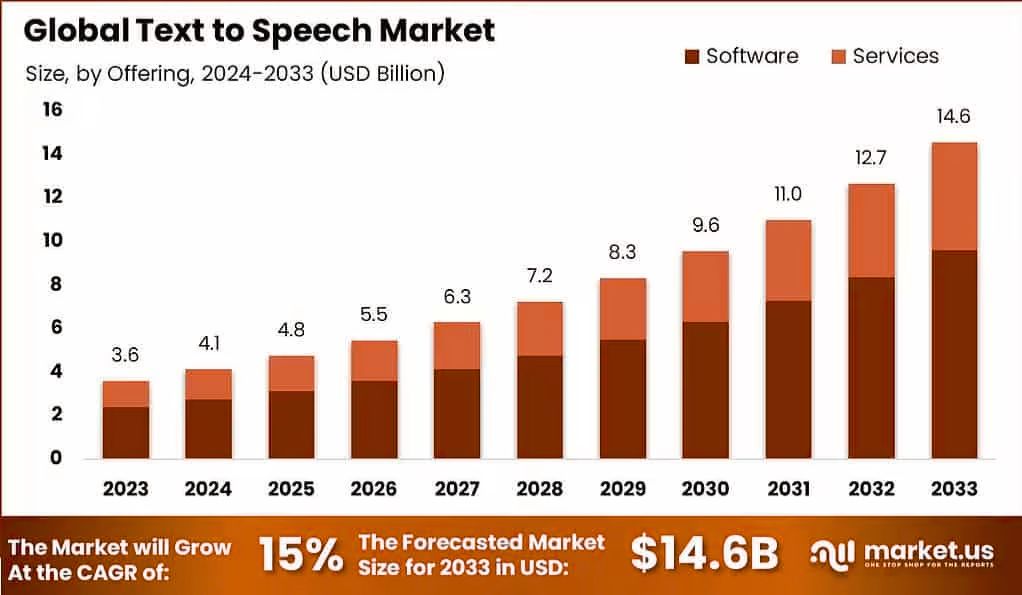
- By 2029, the text-to-speech industry will be worth $7.3 billion, with a compound annual growth rate (CAGR) of 30.20% during that time.
- North America is the biggest market for mobile apps and software that turn text into speech.
- According to studies, the cloud-based part of text-to-speech apps was the most popular and is predicted to increase quickly in the future.
How AI Is Enhancing Text to Speech App Capabilities
AI takes text-to-speech app creation to a whole new level, far beyond typical rule-based voice readers. Some of the new things that have come out are:
1. Deep Learning and GANs
Deep learning and Generative Adversarial Networks (GANs) have changed the way text-to-speech apps are made by making voices that sound like real people, with real emotions, realistic intonation, and small language clues. AI-based synthesis has changed the speech output so that it no longer sounds robotic. Instead, it has rich emotional features that make every interaction smooth and interesting for users in a variety of situations.
2. Advanced AI models
It looks at the context of the text, the structure of the sentences, and also the user’s individual preferences to change the voice output in real time. As a result, the tone, speed, and emphasis change automatically, which in turn makes the user experience unique and aware of the situation. Moreover, this level of sophistication ensures conversations flow smoothly in AI text-to-speech apps, therefore making them easier to use for e-learning, customer service, as well as entertainment.
3. Custom Voice Cloning
Thanks to AI, people and brands can now make one-of-a-kind voices from short audio clips. This feature lets businesses create brand voices that people can recognise, and it also lets them use regional dialects or accents to make their products more relevant to other areas. This means that the AI software for text to speech will be more flexible, open to everyone, and able to connect with users on a personal level.
4. Real-Time Capabilities
APIs that use AI can turn text into speech right away, which is important for virtual assistants, live captions, and accessibility solutions that need to stream in real time. Users don’t have to wait long, the speech output is smooth, and the conversations are interactive. This is especially useful for virtual meetings, contact centres, and smart device interfaces.
5. Next-Generation Models (Tacotron 2, WaveNet)
Tacotron 2 and WaveNet are two of the most advanced AI models that make voices sound incredibly natural and human-like. These models make speech that has small changes, emotional clues, and natural voice transitions, which makes listening much better. Making an AI program that turns text into speech now means making output that sounds almost like a human voice.
Using tools like Tacotron 2, WaveNet, and other next-generation models to create realistic speech synthesis is now part of making an AI app for text to speech.
Top Features of Modern Text to Speech Apps
To make a text-to-speech app that stands out, it should have:
1. Realistic Voice Synthesis
Neural network-based text to speech software today generates voices full of feelings, nuances, and natural flow. The technology guarantees that the spoken output will be warm and interesting, with changes in the tone and speed of the speech that are very close to human speech, thus the immersion is increased and the communication is more efficient.
2. Multilingual and Regional Language Support
The leading text to speech applications have the feature of supporting many languages and different local pronunciation going along with that they can accept corp of users from all around the planet. This wide-ranging inclusivity allows businesses and educators to reach wider audiences, thus ensuring accessibility and usefulness for non-native speakers and promoting better engagement in international markets.
3. AI-based Custom Voice
Sources of AI-driven processes are custom voice features which allow users to produce their own or to get licensing for the possession of the brand voice, thus strengthening the brand image or the personalization of the project.
Such a function is perfect for business, marketing, and accessibility because it gives the feature of an exclusive advantage—being able to create a personal or a corporate audio character in their AI text to speech app which is unique and recognizable.
4. Offline Functionality
Users can have access to the content at a convenient time and place without the hindrance of internet connection by making the app work offline. This comes as a plus to students, wanderers, and workers who operate in low-connectivity areas because it ensures they are not cut off from learning, accessibility, and productivity at any time they want to use these resources.
5. Voice Modulation and Emotional Tone
AI text to speech app development has now incorporated very powerful modulation controls allowing users not only to choose pitch but also speed and emotional tone. The voice outputs thus obtained can easily be fitted into different use cases ranging from pro presentations to vibrant story telling resulting in increased utility and expressiveness by many folds.
6. Text and SSML Support
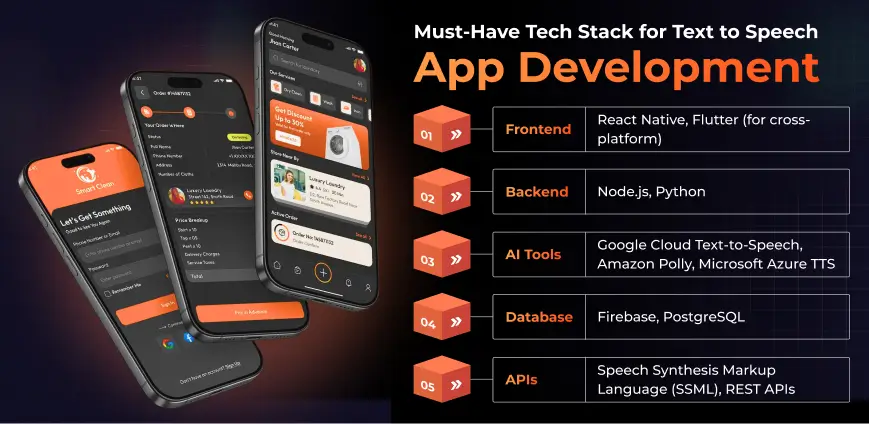
Speech Synthesis Markup Language (SSML) gives input over many fine details like pronunciation, short breaks, and stressing. This results in output that is not only more correct, but also more interesting and less tiring, thus making audio publications, announcements, or user guides more professional in enterprise deployments.
7. Import and Export Functionality
Nowadays, text to speech apps can read aloud from images, PDFs, online articles, and other sources and then create audio in multiple formats. This capability smoothes tasks performance for students, professionals, and creators by allowing better content portability and turning the written materials into the audio formats.
8. Highlight & Read-Along Functionality
The highlight and read-along function shows the words as they are being said. It helps reading comprehension, language learning, and is highly effective for children, visually impaired users, and anyone seeking a more immersive and interactive content experience.
9. Cloud-Based Syncing
Using cloud syncing of content, preferences, and notes across devices makes one never stop work easily and also experience picking up at the same place on each device. For example, if users start on a phone and continue on a tablet, cloud features unify experiences, thereby promoting convenience and productivity for both individuals and organizations.
10. Content Library Integration
The connection with digital libraries or article databases allows swift importing and converting of endless content sources into voice. It centralizes the access, thus, making it easy for users to listen to books, articles, or notes, which is an optimal way for knowledge consumption and information retention.
11. Batch Processing
Batch processing gives the users the opportunity to change several files into speech in one run thus, they can save their time and energy. This feature is indispensable to businesses, educators, and publishers, who need to audio-fy large text volumes efficiently, thereby increasing their productivity and operational efficiency.
12. API Integration
APIs open up possibilities for cross-app functionality, letting other apps, customer service tools, or bots leverage TTS features.
13. Cross-Platform Compatibility
A unified experience across iOS, Android, and the web maximizes reach, boosts engagement, and supports all user preferences and device habits.
Benefits of Developing a Text to Speech App
Creating text-to-speech apps has many benefits:
- Accessibility for people who can’t see: makes digital content available to millions of people across the world.
- Improved Learning and E-Learning Apps: Helps pupils with dyslexia and others who learn best through hearing.
- Businesses Save Time and Money: Reduce labour costs by automating voiceovers, support, and content development.
- Reach people for multiple languages: Easily reach a wide range of markets.
- Better Content Consumption: Users can read content while they’re on the go and without using their hands.
- Creating Engaging Content: Creators may easily make good audio for videos, podcasts, and other things.
- Automating Customer Service: Voice bots powered by AI make service faster and more satisfying for users.
Key Industries Benefiting from TTS App Development
Enterprise AI Development experts’ solutions are transforming various sectors:
| Industry | TTS App Benefits |
| Education & E-Learning | Read-along for students, language learning, special needs |
| Publishing & Media | Audiobooks, news narration, dynamic voiceovers |
| Healthcare & Pharma | Patient care, medication guidance, information accessibility |
| Customer Service | Automated voice support, reducing wait times |
| Automotive & Navigation | Hands-free driving aids, real-time directions |
| Banking & Financial | Voice assistants for transactions, customer engagement |
| Marketing & Advertising | Brand voice, personalized campaigns |
For insights on industry-leading voice solutions, check out Popular Voice Recognition Apps.
How Much Does It Cost to Build a Text to Speech App in 2025?
The cost of developing a text-to-speech app in 2025 will depend on how complicated the software is, what features it has, what platforms it runs on, and how skilled the team is:
Estimated Cost Ranges
| App Complexity | Cost Range | Key Features |
| Basic App | $30,000 – $60,000 | Simple TTS, basic UI, standard voices |
| Medium Complexity | $60,000 – $150,000 | Voice selection, multi-language, import/export, user profiles |
| Advanced AI Features | $150,000 – $300,000+ | Custom voices, emotional tone, real-time translation, cloud syncing |
- The time it takes to develop anything can be as little as one month (basic) or as long as nine months (advanced).
- Using high-end AI models or branded voices might make things more expensive.
- Hiring an AI development business or using AI consulting services can help you save money and lower your risk.
- Costs after launch include upgrades, cloud hosting, maintenance, and scaling.
These aspects can help you understand how you can build a text to speech App within your budgetary needs.
Best Text to Speech Apps in 2025
Some of the best TTS apps and platforms that will shape the market in 2025 are:
- Speechify is well-known for its realistic, customisable AI voices and strong cross-platform syncing.
- ElevenLabs has voices that sound almost real, lets you clone voices, and has an API that is easy for developers to use.
- Murf and WellSaid Labs are professional voiceover tools that are used for marketing, e-learning, and media.
- LOVO is known for having a lot of voice libraries and being able to work with video editors.
Future Trends in Text-to-Speech Technology
Make sure to keep below trends in mind when you build a text to speech app, check it out:
- Emotion-Based Voice Synthesis: Making narration sound real by copying small human emotions.
- Real-Time Translation & TTS: Translate and speak in many languages at the same time.
- IoT and Smart Device Integration: TTS built into wearables and home gadgets.
- Voice Cloning for Individuals: AI voices that are unique to each person and safe for creators and brands.
- Multimodal Interaction: Using voice, text, and pictures together to create rich, interactive experiences.
- AR/VR Integration: Interactions with a natural voice that are immersive in augmented or virtual reality situations.
Why Choose A3Logics for Text to Speech (TTS) App Development?
A3Logics is a prime AI Consulting solutions and text to speech app development provider with a team of skilled specialists in the speech recognition field. In turn, the Enterprise AI Development Company, A3Logics extends:
- The latest tech stack for end-to-end product development.
- Business goal-oriented AI customized solutions.
- A strategic plan for competitiveness and adherence to regulations.
- Continuity of service, updates, and innovation focus.
Final Thoughts
In 2025, constructing a text to speech application can be an unmatchable challenge in terms of impact and revenue generation. The triad of AI, excellent voice technology, and global markets spells a win-win for startups, enterprises, and institutions that can solve their TTS problems by leveraging a single robust solution. Whether your objective is to improve accessibility, automate content, or give power to worldwide users, investing in text to speech app development has to be done at this moment.
If you want to receive tailored solutions, have a consultant by your side for the most up-to-date innovations, and cooperate with an expert AI Development Company, then take advantage of the best AI Consulting Services in the industry.