
Traditional insurance platforms often struggle with high operational costs, slow claim processes, and limited flexibility. There are also transparency issues since customers rarely know how claims decisions are made. This is where peer-to-peer insurance offers a fresh alternative.It allows people with similar needs to pool their money together and lets members directly support each other during claims, creating a more transparent and fair system.
If you are planning to set up a custom peer-to-peer insurance software; this blog will walk you through everything. It covers what P2P Insurance is, its core principles, key features of P2P insurance software, and other important aspects you need to understand before getting started.
Statistics Highlighting The Importance of P2P Insurance Platforms
- The peer-to-peer insurance market is expected to grow from USD 9.36 billion in 2025 to USD 25 billion in 2035.
- North America currently leads the global peer-to-peer insurance market, accounting for 38% market share.
- Friendsurance’s P2P model cut claims frequency by about 50%
- Growth in the P2P insurance market reflects dissatisfaction with traditional insurers’ higher costs and opaque practices, leading more customers to choose digital, efficient alternatives.
What is P2P Insurance?
Peer-to-peer insurance; or P2P insurance, is a model where a group of people sharing similar interest; pool their money together to cover each other when a risk occurs; such as an accident or damage. The people may share similar needs or can be friends, family, or community members. Policyholders in peer-to-peer insurance; get more control over management decisions, such as claim approvals and fund usage, because the insurance is managed within the group. In many cases, unused premiums are returned to members or donated to a chosen charity.
How does Peer-to-Peer Insurance Work?
Unlike traditional insurance; where a big company is involved, peer-to-peer insurance allows people to directly pool their money in a shared fund and cover each other’s risks. One of the reasons for that is that payouts are comparatively lower. When a member initiates a claim, it gets covered from the pool. If there’s extra money left at the end, sometimes people get it back, or they can choose to roll over to the next period or donate money to a charity. The facilitator company that arranges for the P2P insurance platform often takes a fee for operations.
Now, talking of platforms, peer-to-peer insurance involves high-tech platforms and automation. As in the case of increased use of AI in claim management, claims can be verified fastert, leaving scope for no frauds as they can be detected early. Furthermore, payouts can be processed automatically with minimal manual effort, making the overall system more efficient and transparent.
The Core Principles Behind P2P Insurance Models
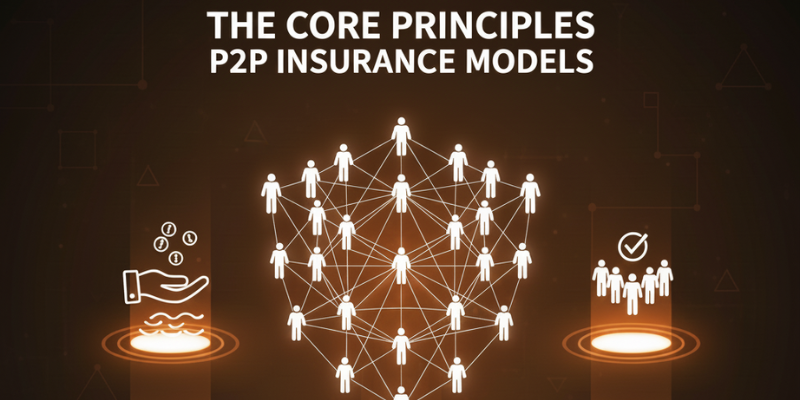
1. Community-driven Risk Sharing
In peer-to-peer Insurance, risk sharing happens when a group of people agree to combine their money to protect against losses instead of relying on a traditional insurer. This community-driven approach builds trust and cooperation because members have a shared interest in keeping losses low and helping each other.
2. Transparency in Premiums and Claims
With P2P Insurance, members can see how their premiums are used and how claims are handled through the platform. Unlike traditional insurance, where details are often unclear, this transparency builds confidence because everyone understands fund usage, claim payouts, and surplus management directly.
3. Reduced Administrative Overhead
Digital tools and custom P2P insurance software eliminate the need of middlemen and also reduce paperwork. This lowers operational; and administrative overhead. This means; that more of the pooled money goes towards actual claim payments instead of corporate costs.
4. Aligned Incentives Between Members
In P2P Insurance, members have aligned incentives because everyone’s money contributes to the shared fund. When people know that claims affect the entire group’s financial health, they are encouraged to avoid unnecessary claims and promote responsible behavior.
5. Technology-first Operations
Modern peer-to-peer insurance software rely on technologies such as AI, blockchain, and others to automate routine tasks such as managing claims, collecting premiums and others. This helps reduce manual work and speeds up various processes.

Key Features of P2P Insurance Software
1. Peer Group Creation & Management
The P2P Insurance software helps manage members; rules, and contributions. This way, every member knows who is part of the group and how the shared money is handled among the members.
2. Smart Policy Management
The smart policy management feature of peer-to-peer insurance helps users easily understand their insurance policies. Not just that, they can buy and manage their insurance policies. The software automatically updates aspects such as policy details, coverage periods, conditions, etc.
3. Risk Pooling & Fund Management
This feature of a P2P insurance software helps collect money from all group members in a common pool. The software safely manages this fund. Additionally, it tracks balances and ensures that the money is used only for valid claims.
4. Claims Management & Automation
In peer-to-peer insurance, claims management and automation make filing and processing claims simpler. Users can submit their claims online, whereas the software checks details, approves genuine cases, and releases payments without delays.
5. Smart Contracts & Blockchain Integration
A custom P2P insurance software comes with smart contracts and blockchain integration. Smart contracts; use blockchain to automatically follow insurance rules. When conditions are met; apt actions such as claim payouts happen on their own. These processes are transparent and can’t be manipulated.
6. AI-Powered Fraud Detection
The modern P2P insurance software uses AI to study claim patterns and user behavior. They use insurance fraud detection to quickly identify suspicious activities and fake claims. This helps protect the group’s shared money.
7. Premium & Contribution Calculation
The software calculates how much each member should pay based on – risk, group size, and coverage; making sure contributions stay balanced; and affordable while adjusting automatically – as group conditions change.
8. Wallet & Payment Integration
Wallet and payment integration in P2P insurance software lets users add money, pay premiums, and receive claims payouts digitally. The software connects with banks and payment apps for quick and safe transactions which are also easy to track.
9. Compliance & Regulatory Management
By leveraging the expertise of a seasoned insurance software development company, organizations can design a software that follows all legal requirements and government rules. The feature helps maintain records, update processes, and generate reports, so that the P2P insurance system stays secure and fully compliant.
10. Reinsurance & Risk Transfer Support
Reinsurance support helps protect the group; during large or unexpected losses. The software connects with external insurers to transfer excess risk; ensuring claims can still be paid even in extreme situations.

Types of Peer-to-Peer Insurance You Should Know
1. P2P Health Insurance
Peer-to-peer health insurance lets groups of people with similar interests pool money to cover each other’s health risks. Instead of relying fully on big insurers, the group shares risk, and lowers costs.
2. P2P Auto Insurance
In P2P auto insurance, people with similar driving profiles pool their money to cover each other’s car insurance claims. They bypass large traditional insurers for better control, lower costs, and greater transparency.
3. P2P Car Insurance
In this kind of insurance model; drivers with similar risk profiles pool their money to cover each other’s car insurance claims. This model reduces middlemen and encourages safer driving.
4. P2P Boat Rental Insurance
In boat rental insurance, boat owners and renters come together and put money into one shared pool. If any boat gets damaged during rental; the loss is paid from this pool, making insurance fair, cheap and transparent.
5. P2P Lending Insurance
It is a system where people who lend money on a P2P platform put a small amount into a shared pool. If a borrower fails to repay; the loss is covered from this pooled fund.
6. P2P Life Insurance
P2P life insurance works by people with similar insurance needs putting money into one shared fund. This fund is used when a claim arises, helping keep costs low and making the system fair and transparent.
7. Travel and Flight Delay Insurance
In this P2P model, various travelers pool small amounts of money. In an instance, when someone faces a delay, or has flight cancelled or has travel issues, they can claim compensation from the shared pool. This makes claims faster and costs lower.
8. Crop and Agricultural Insurance
Farmers contribute to a common fund under this insurance model. When weather events or other risks damage crops, the affected farmers receive support from the pooled money, reducing losses and reliance on traditional insurers.
9. Property and Home Insurance
Homeowners with similar property risks form a group; and share insurance costs. When a loss occurs, the shared fund pays the claims, thereby offering greater transparency, ensuring fair pricing, and ultimately providing refunds if any money remains unused.
10. Crypto and Digital Asset Insurance
In this kind of peer-to-peer insurance, crypto users pool funds to protect digital assets. If losses occur because of technical failures, compensation comes from the shared pool, providing community-driven protection.

Real-World Examples of P2P Insurance Companies
1. Lemonade (AI-driven P2P-inspired insurance)

Lemonade is a peer-to-peer insurance provider that offers low premiums for several insurance products such as renters insurance, homeowners insurance, pet insurance, car insurance, and term life insurance. It takes a flat fee from the customer’s premium to run the business. Being technology-driven, it uses AI in underwriting, implying that customers are able to get insured instantly.
2. Friendsurance (Germany-based peer groups)

Freindsurance uses a “cashback” model. Customers join small groups, and if no claims are filed by the group during the year, a portion of their premiums is returned to them. The company partners with established insurance carriers to underwrite the main policies, while Friendsurance itself manages the small claims and group dynamics to incentivize fewer claims.
3. Teambrella (fully decentralized P2P insurance)

It is building the first decentralized bitcoin-based insurance, where users can insure each other. Here, each member deposits funds into a special Bitcoin wallet. The funds in the wallet are co-controlled by the team and the members. In an event, a claim is raised, and the team votes to reimburse a teammate. Once agreed upon, all teammates pay their respective share from the bitcoin wallet.
Why Build a Custom P2P Insurance Platform?
Building a custom P2P insurance software has many benefits. A peer-to-peer insurance reduces administrative overhead; since there are no middlemen or paperwork involved. The software helps increase transparency; as members can gain visibility into how their funds are managed.
Another benefit of a custom P2P insurance platform; is that they can cater to specific communities. They offer highly customizable and tailored policies; that traditional insurers might find too complex to manage or less profitable.
And, most importantly, building a custom P2P platform allows for the integration of cutting-edge technologies such as AI that can automate a variety of tasks such as risk assessment and data analytics for personalized pricing, which also streamlines operations.
The Future of Peer-to-Peer Insurance Industry
With customers demanding transparency and speed doing the driving, peer-to-peer insurance looks strong. In that direction, advanced technologies such as AI and blockchain will automate claims, payments, and risk assessment, while giving more control to members over how their pooled funds are managed.
However, the future will not be without challenges. As peer-to-peer insurance sees higher adoption across domains like; auto, home, health, travel, and agriculture, platforms must handle fair premium management, strict adherence to regulatory compliance, and high scalability requirements.

Why Partner with A3Logics for P2P Insurance Software Development?
Partnering with A3Logics lets organizations build reliable and future-ready peer-to-peer insurance platforms. As a trusted AI development company, A3Logics brings capabilities in AI-driven automation, data analytics, secure cloud architecture, and system integrations. Its experience; in AI insurance claims processing supports insurers facing operational complexity by streamlining claims, improving accuracy, and enabling transparent workflows that scale smoothly as the platform grows.
Final Thought
Peer-to-peer insurance or P2P insurance helps remove manual insurance tasks and improves transparency across the insurance lifecycle. It simplifies how groups manage funds, handle claims, and share risks using digital platforms. This makes insurance more collaborative, efficient, and user-focused compared to traditional models.
That said, with challenges in scalability, regulatory compliance, and fair premium management, the need of the hour is to design software that can support growth without complexity. Such platforms benefit businesses and users alike who want efficient, compliant, and technology-driven insurance solutions.