
Decentralized exchanges (DEXs) are bringing about a major evolution in the world of cryptocurrency trading. Unlike standard centralized systems, decentralized exchange benefits let people keep full control over their assets, so there is no need for intermediaries. This change is more than technical, as it focuses on being transparent, independent, and inclusive.
As centralized exchanges are facing security breaches, legal rules and privacy issues, traders are shifting to DEXs for better, more inclusive trading. Anyone exploring the world of crypto and DeFi in 2025 and the future should know about the benefits of decentralized exchanges. To succeed in crypto and DeFi in 2025, you need to be aware of the decentralized exchange benefits and latest trends.

What Is a Decentralized Exchange (DEX)?
A Decentralized Exchange (DEX) allows people to trade cryptocurrencies directly with each other without the help of middlemen. Unlike CEXs, where users hand over their funds, DEXs make sure users keep control over their digital assets during the trading process. With smart contracts and blockchain, every transaction remains clear and secure.
Decentralized Exchange Benefits – Key Statistics
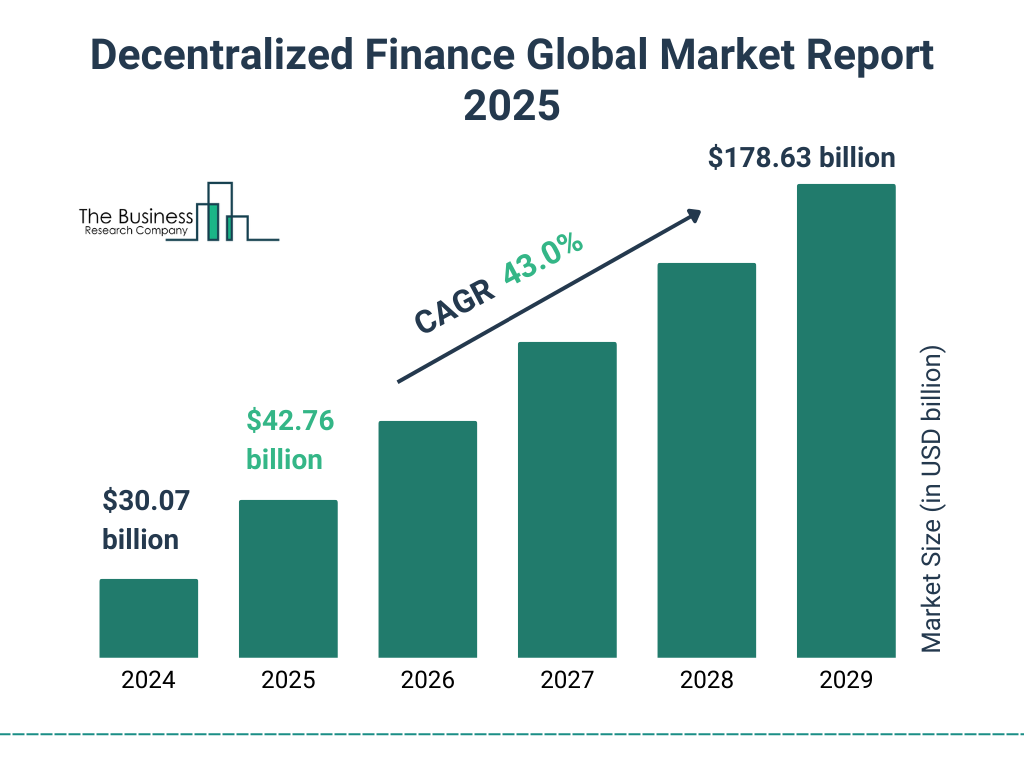
- The decentralized finance sector is estimated to increase from $30.07 billion in 2024 to $42.76 billion in 2025, at a CAGR of 42.2%, which reflects solid growth.
- During the first three months of 2025, the trading volume on decentralized exchanges (DEXs) rose to more than $1 trillion, which was twice as high as in the previous year.
- The combined trading volume of Solana-based decentralized exchanges topped $800 billion in 2025, proving that the platform is becoming more significant in DeFi.
- In 2024, the blockchain interoperability market was valued at $0.7 billion and it grew to $0.91 billion in 2025, showing a CAGR of 29.7%.
- On June 5, 2025, the daily volume on the BNB Chain’s decentralized exchange surpassed $14.23 billion, a sign of a huge increase in both capital and activity.
Key Decentralized Exchange Benefits
1. Enhanced Security
Improved security is among the most significant decentralized exchange benefits. Since DEXs are not controlled by any central entity, the user’s money is not held elsewhere. Instead, trades are done directly through individual wallets with the help of smart contracts. Due to its decentralized design, the platform is not at high risk of major hacks, which have repeatedly hit centralized platforms.
2. Greater Privacy
A major benefit of DEX platforms is the preservation of user privacy. With most decentralized exchanges, you can trade without having to provide your personal details. Each transaction is checked by the network, not by any third parties, which helps cut down on data tracking. For those who care about their privacy and live in places with strict government restrictions on money, DEXs provide a safer and more confidential way to trade.
3. Full Control Over Funds
Users have complete control over their cryptocurrencies with the help of DEXs. All of the funds are kept in the user’s wallet until a trade happens, meaning there is no need to deposit tokens into the exchange. That way, there is no risk that a third party could misuse or block the funds. Decentralized exchange relies on the self-custodial model, so that users are the sole decision-makers in accessing or moving their crypto assets.
4. Reduced Risk of Censorship
Being censorship-resistant is one of the core decentralized exchange benefits. DEXs are built using decentralized blockchain technology, which protects them from being shut down by the government or businesses. The platforms allow users to trade from any place without being concerned about account freezes or blacklists. Thanks to this decentralized model, people in regions with strict financial rules can still connect with the global market without worrying about interruptions.
5. Lower Trading Fees
Another benefit of DEX platforms is that using them is cost-efficient. With no middlemen or main intermediaries in the process, the cost of trading is much lower. In most cases, users just pay the gas fee to the blockchain and many DEXs have fees that are lower than those charged by centralized exchanges. For individuals and firms involved in high-frequency trading or trading with small amounts, this serves to boost their returns and enable them to trade more often without losing much to transaction costs.

6. Global Accessibility and Censorship Resistance
Anybody with access to the internet and a crypto wallet can take part in trading using DEXs, no matter where they are or what nationality they have. The fact that anyone can use these exchanges without a bank account or government barriers is one of the key decentralized exchange benefits. Being completely independent from any central authority, DEX users can always use the service and are not subject to local regulations or economic systems, making DEXs truly universal.
7. Transparency and Immutability
Transparency is a standout among the benefits of decentralized exchange. Every time a transaction happens, it is publicly recorded on the blockchain, keeping it open and unchangeable. Unlike exchanges that operate centrally, DEXs let everyone access order history and transaction records that cannot be altered. This means traders trust each other more, are held responsible and wash trading is less likely to occur.
8. Access to a Broader Range of Assets and DeFi Opportunities
DEXs usually offer a larger range of tokens, some of which are experimental and just starting out. This means users can access new DeFi projects and tools before anyone else, such as yield farming, liquidity mining and staking. Therefore, traders get a chance to explore new opportunities before the general public notices them. The wide range of options available on decentralized exchanges allows users to improve their crypto trading skills and tactics.
How Decentralized Exchange Benefits Are Reshaping the Future of Crypto Trading
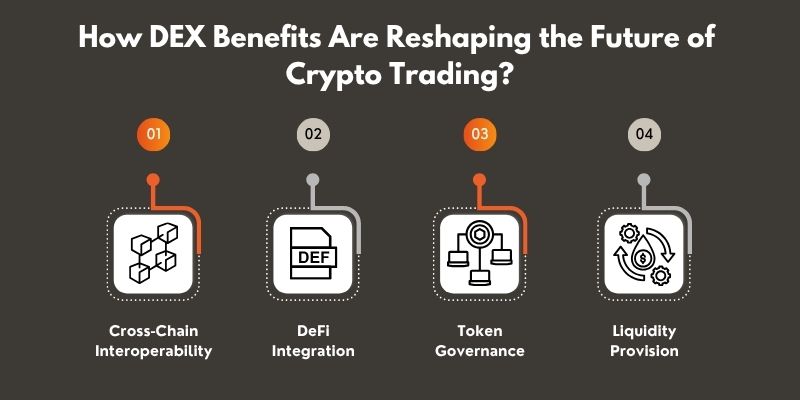
1. Cross-Chain Interoperability
The ability to connect different blockchain networks is reshaping crypto and it is one of the biggest decentralized exchange benefits. People can move their assets between blockchains easily, as they do not need to go through manual conversions or use other bridges. This increases the ease of trading, helps the markets become less divided and makes trading on crypto platforms smoother. With blockchain ecosystems joining forces, DEXs will help make asset transfers between chains easy and unrestricted.
2. Decentralized Finance (DeFi) Integration
The combination of DEXs with DeFi protocols is leading to changes in financial services through the provision of alternatives to banking with decentralized lending, borrowing and asset management. As a result, users can enjoy financial tools within their wallets, without the help of any intermediary. Here, the main benefits of decentralized exchange include greater freedom, better rewards through liquidity protocols and access to more markets for capital.
3. Token Governance through DAOs
In many DEXs, governance is done by DAOs, allowing users to take part in major decisions using governance tokens. This setup allows traders to become stakeholders, so that community goals and platform interests become the same. It highlights the most important features of DEX platforms—being decentralized, transparent, and user-focused. DAO governance helps bring about new ideas, community-led improvements, and greater accountability so that the DEX grows in line with its key users’ values.
4. Yield Farming and Liquidity Provision
DEXs encourage users to deposit their tokens into liquidity pools by promising to reward them for taking part in yield farming and liquidity mining. Through this system, users can enjoy both deep liquidity and the chance to earn income without active trading. Because of these decentralized exchange benefits, users are now choosing to supply liquidity instead of only trading on these exchanges. Thanks to AMMs, more people can now join decentralized finance and take part in transactions.
Top Use Cases of Decentralized Exchange
1. Core Cryptocurrency Trading (Spot Trading)
The basic purpose of DEXs is spot trading. People can trade cryptocurrencies instantly and directly with each other. Through peer-to-peer trading, the exchange of cryptocurrencies becomes prompt and free from any restrictions. In contrast to centralized exchanges, DEXs let traders keep their assets safe at every step during a transaction. As a result, DEXs are seen as secure and transparent and they attract traders because they support a wide range of tokens, including early-stage and niche coins.
2. Liquidity Provision and Earning Passive Income
People can deposit their tokens into liquidity pools and earn a portion of the fees from each trade which they can use as passive income. This is one of the major decentralized exchange benefits, as it lets people earn interest on their idle tokens. Liquidity providers assist in making the market more stable by helping others trade. Several DEXs provide extra incentives in the form of tokens, making it more appealing for people to take part in decentralized finance.
3. Yield Farming and Staking
In yield farming, you put your tokens into pools managed by smart contracts to earn rewards or more tokens. When you stake your assets, you help the network and get rewards in return. Yield farming and many other DeFi strategies are often supported by DEXs that help users find and handle different ways to earn interest. One of the main benefits of DEX platforms is that you can take part in these mechanisms straight from your wallet, which typically gives you much higher returns than traditional investments.
4. Decentralized Lending and Borrowing (Often Integrated)
A lot of DEXs offer users the ability to lend assets and earn interest or use them as collateral to borrow crypto. It gives people an option outside of banks or savings accounts, offering favourable rates and fewer rules. It also helps traders get the most out of their assets. Since the system is non-custodial, it gives users full control and high security which is an important benefit of decentralized exchange ecosystems.
5. Launchpads for New Tokens (Initial DEX Offerings – IDOs)
Launching tokens via Initial DEX Offerings (IDOs) has become very popular on DEXs. These launches allow anyone to join in, are swift and have no restrictions, differing from accredited investor-limited traditional funding rounds. This allows more people to invest in early-stage companies and brings more attention to blockchain projects. Taking part in IDOs allows users to get tokens before anyone else and perhaps at a lower price. A reliable dApp development company is necessary to build launchpad solutions that help projects fundraise and thrive in the world of DeFi.

6. Trading of Synthetic Assets and Derivatives
The latest DEXs allow users to exchange synthetic assets that imitate the value of real-world assets, including gold, stocks or currencies. Derivatives like futures and options are available to trade in a decentralized manner. These tools allow users to access trading strategies that were only available through traditional financial companies. On a decentralized exchange, investors can use markets and products from all over the world without going through brokers or financial institutions and they continue to manage their own assets.
7. Cross-Chain Swaps and Interoperability
With cross-chain swaps, users can change tokens from one blockchain to another without needing help from a third party. For example, traders are able to exchange Ethereum-based tokens for assets on other networks, like Binance Smart Chain or Avalanche, using interoperable DEX platforms. This helps to make assets more liquid, reduces the steps in processes and improves how assets can be used. One of the growing benefits of decentralized exchange infrastructure is allowing users to use multiple blockchain networks at the same time.
8. Decentralized Identity (DID) and Web3 Interactions
Some DEXs are working with Decentralized Identity (DID) technology, so users can manage their identities and still maintain privacy. These identities are compatible with different services across DeFi, NFT and Web3. The combination of DEX and DID builds confidence in the process and preserves privacy, so there is no need for traditional KYC when interacting securely. It not only helps with trading and is an important shift in managing identity and access control on the decentralized web.
9. Price Discovery and Arbitrage Opportunities
DEXs help set market prices because they are open, transparent and always active with trading. Prices are set by the balance between supply and demand in liquidity pools, so they show the immediate sentiment of the market. People can take advantage of the price gaps between different crypto exchanges by buying at low prices and selling at higher prices. By aligning market prices and improving efficiency, these activities highlight one of the most important benefits of DEX platforms that is often missed.
10. Governance and Community Participation
A number of DEXs are managed through decentralized governance which allows users to take part in decision-making with their tokens. With this system, the community can decide on fee adjustments, upgrades to the protocol or new features for the platform. It highlights the main idea of blockchain, which is to create decentralization and give users control. This type of model allows users to have direct input and makes them co-owners, making it one of the most impressive decentralized exchange benefits in Web3.
Challenges That DEXs Must Overcome to Shape the Future of Crypto Trading
1. User Experience Issues (Complicated Interfaces)
Most DEXs are still not user-friendly because their interfaces look complicated and include hard-to-understand terms. Navigation on these platforms may be a challenge for anyone who is new to cryptocurrencies or not tech-savvy. With difficult design, unclear steps for new users and no educational information, mass adoption will continue to be low. Making the interface better is vital for DEXs to outperform centralized exchanges and serve as the main exchange for most traders.
2. Lower Liquidity on Some Pairs
Although major tokens are usually easy to trade, new or less popular tokens on DEXs can be difficult to buy or sell. This means traders suffer from greater price swings and less attractive prices. Because of the limited liquidity, there are fewer chances for active trading and arbitrage. To solve this, DEXs should use better rewards, merge liquidity from various chains and form partnerships to draw more people and investors to untapped markets.
3. High Gas Fees on Congested Networks
Top decentralized crypto exchanges operating on congested blockchains like Ethereum can face high gas fees, especially during peak activity. Therefore, engaging in small trades is often not profitable for many people and this makes the service less accessible. Even though Layer 2 and alternative chains help decrease costs, it is still difficult to smoothly integrate them and get many people to use them. As long as this remains unresolved, high fees prevent DEX platforms from being widely used.
4. Smart Contract Vulnerabilities
Every DEX operation is powered by smart contracts, but they can still experience bugs or be exploited. It is possible for attackers to steal funds because of vulnerabilities, using flash loans or malicious scripts. Such issues make users less willing to trust the system and prevent them from using it. Standardizing auditing, bounty programs, and verification processes will help DEXs remain both innovative and secure.
5. Regulatory Uncertainty
As more countries begin to regulate decentralized technologies, DEXs are being watched more closely. A lack of understanding about the law, tax rules and compliance (for example, KYC/AML) leaves both developers and users vulnerable. Such uncertainty could make innovation harder or require DEXs to operate using rigid models. Developing rules that support users and preserving the decentralized exchange benefits of openness and autonomy will be key to their growth.
DEX Trends and Predictions: What to Expect in the Next Decade
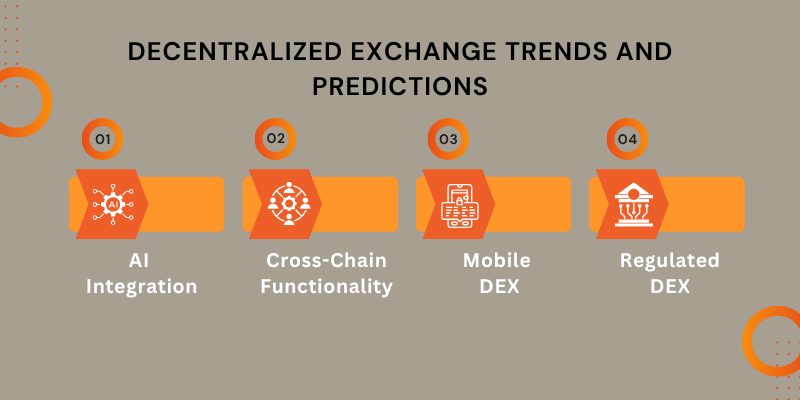
1. AI Integration
Artificial Intelligence will greatly improve what DEXs are capable of. Thanks to AI crypto trading bot systems, people will enjoy more intelligent trade execution, accurate predictions and better security against fraud. When used together, AI and blockchain make platforms more intelligent and able to learn on their own. With smarter AI tools, DEXs will enjoy higher efficiency, stronger security and an improved trading experience
2. Cross-Chain Functionality
DEXs will soon offer the ability to trade across multiple blockchains. This trend helps overcome one of the main issues with old DEXs—being stuck on only one chain. Future DEXs will let users use tokens and liquidity from different platforms with ease. Because of the changes, DEXs will become more flexible, connected and necessary for a crypto economy with many different chains.
3. Mobile Decentralized Exchange
In the future, mobile-first DEX platforms will make it simple for people to trade and use DeFi while on their phones. Since mobile is taking over the digital world, DEXs will develop applications that are convenient, secure and easy to use on these devices. They will focus on a good user experience, use biometric protection, and have wallet options, helping to make trading on decentralized exchanges much easier.
4. Regulated Decentralized Exchange
Decentralized exchanges that are regulated will become an intermediate solution between decentralization and compliance. Since governments are working to include crypto in regular finance, future DEXs could follow regulations such as KYC/AML while keeping their decentralized nature. Using hybrid models, users can agree to comply whenever required, which helps build trust among institutional traders. This change will make cryptocurrency more accepted by society and connect traditional finance to the benefits of decentralized exchange.
Why Choose A3Logics as Your Decentralized Exchange Development Company?
1. Expertise in Blockchain and DeFi
A3Logics brings deep technical expertise in blockchain, smart contracts, and DeFi ecosystems. Our blockchain development services help you build scalable, secure, and innovative DEX platforms tailored to market needs.
2. Custom DEX Solutions
We specialize in delivering fully customized decentralized exchange solutions, including AMM-based DEXs, cross-chain functionality, and yield farming features. Whether you’re launching a niche protocol or a full-scale trading platform, A3Logics tailors every component to your unique vision and business goals.
3. Security-First Development
Security is a core focus at A3Logics. From smart contract auditing to rigorous QA testing, we ensure every DEX solution is built with maximum protection against exploits, hacks, and vulnerabilities, thus safeguarding users and building long-term trust.
4. End-to-End Support
From ideation and UI/UX design to development, launch, and post-deployment maintenance, A3Logics offers complete support throughout your DEX journey. Our proactive approach ensures smooth delivery and quick adaptation to market trends or technical challenges.
5. Proven Track Record
As a leading DeFi development company, A3Logics has successfully launched numerous decentralized apps and crypto solutions across global markets. Our proven results and satisfied clientele make us a reliable partner for building your next-generation decentralized exchange.

Final Thought – Benefits of Decentralized Exchange
As the crypto landscape matures, the benefits of decentralized exchange platforms are becoming increasingly clear. DEXs offer a powerful alternative to traditional trading platforms by prioritizing user ownership, transparency, security, and financial freedom. They eliminate centralized risks, lower barriers to entry, and provide access to a wide range of assets and DeFi opportunities.
Whether you’re a casual trader or a serious investor, understanding and embracing the decentralized exchange benefits is crucial in navigating the future of crypto. As adoption grows, DEXs will continue reshaping the way we interact with global financial systems.