In 2025, smart home automation is not only redefining but also generating the way modern life should be. With Artificial Intelligence receiving major upgrades every day, smart home devices with AI automation know and understand their users just like a perfect life partner. As demand for such smart home devices increases, it is time to explore the scope of utilizing them for effortlessly comfortable living or as an investment option. So, let’s get into its depth with this thoroughly informative blog.
Market Trend of Smart Home Automation
- The global smart home automation market is expanding at a significant CAGR rate of 27.3% and is expected to continue growing until 2030.
- By 2032, this market is expected to reach a massive $237.07 billion, with North America dominating it with a 39.12% share.
- In the USA, the smart home automation market is projected to generate up to $ 43 billion in revenue by 2025.
- Around 77.6% of households will actively adopt smart home automation devices this year, and this is expected to increase to 92.5% by 2029.
AI Evolution in Smart Home Automation
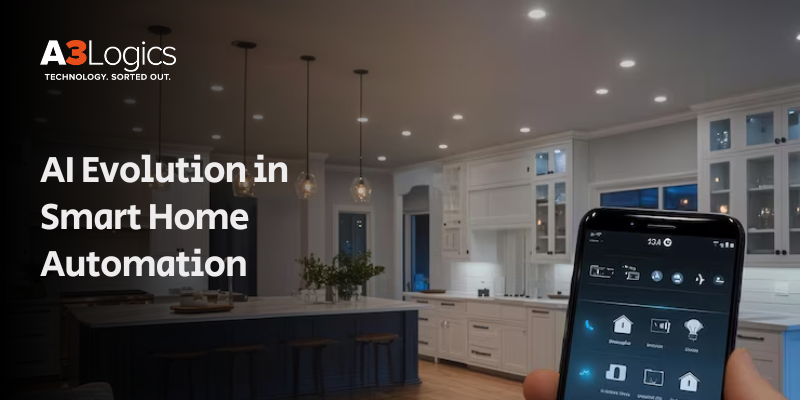
In 2025, smart home innovation seems impossible without integrating artificial intelligence into it. With compatible AI smart devices, your home can anticipate your needs, help you manage your tasks following a routine, and protect your space from intruders. Let’s explore AI’s growing role in next-generation home systems.
1. Role of AI and Analytics in Next-gen Home Systems
AI helps these home devices adapt to your daily habits, as well as assist you in maintaining a routine. For instance, bright lighting or a curtain system can increase your room’s brightness as soon as your smart alarm ticks 6 am. AI-powered predictive automation saves money with early warning for maintenance or defects. Smart mirrors can suggest skincare tips by noting changes in your skin, while a smart kitchen setup helps you find spices, instructs you on how to cook a meal, or even prepares it for you.
2. Growth of AI-powered Predictive Automation for Home Use
Companies are constantly modifying their devices, updating them with the latest AI updates. With machine learning and LLM integration, these AI smart devices now understand your voice commands and the sentiment behind them. It can smartly shift its actions according to your needs and water your plants as per the weather.
3. How AI Integration is Becoming Essential in Household Technologies
With life becoming rapid, people are considering using the best home automation apps for their smart devices. It allows them to control everything at home from their smartphone, even when they are not physically present. From managing a grocery list to turning the AC just before you reach home, AI inclusion is delivering a seamless household experience, making it unskippable.
Best Smart Home Automation Trends of 2025
The smart home automation industry is seeing a massive hit in 2025 as people are embracing it more to transform their daily lives. They are not mere gadgets but intelligent systems that ensure comfort, efficiency, and security in your home. Some of the most trendy sections among them are;
1. Smart Home Speakers
Smart speakers are literally the new home controllers with head-turning innovations that now allow for multi-user control, tone-sensitivity, and context-sensitivity. They can trigger multi-step routines like turning lights off, locking doors, and playing your favorite playlist—everything from a single voice command.
2. Smart Automated Home Lighting
Those days of flipping lights with the manual switch are over. Devices today use AI-powered predictive automation to switch on and off lights based on your schedule, sunlight exposure, and even mood. They also help save electricity bills by turning off automatically when not in use.
3. Smart Thermostats
Two thousand twenty-five models do more than temperature control as their occupancy sensors, AI, and analytics are used to learn your routine and modulate comfort with a minimum of energy consumption. Using them, you will not just achieve more savings, but the convenience that they will provide is unparalleled.
4. Smart Indoor and Outdoor Cameras
It has never been more secure as the cameras come equipped with real-time AI and analytics for object detection, threat detection, and facial detection. You get instant alerts if something is amiss, allowing you to remain at ease wherever you are.
Top Smart Home Automation Technology Companies in 2025
With smart living gaining momentum, smart home automation companies are leading the way to revolution with cutting-edge solutions. The war between technology giants and startup giants is fiercer than ever in 2025, leading to a smarter home revolution fueled by convenience, security, and energy efficiency. The companies are redefining the way we live, with anything from voice control and climatic control to intelligent surveillance systems and seamless AI inclusion.
No Matter whether you’re in the business of the best smart home devices, investing in smart home stocks, or simply adding on to your current infrastructure, these are the strongest players to keep an eye on in 2025.
1. A3Logics
One of the promising players in predictive AI-based automation now is A3Logics, the latest emerging force in custom IoT smart home development. With specialized experience in custom solutions for smart connected living, they offer everything from device control applications to full-fledged home security solutions. With the strength of AI and predictive analytics capabilities, they make data-driven decisions in real time. Thus, their systems are proactive, not reactive.
Notably, A3Logics is an IoT development company that integrates hardware with software development. Their solutions learn from user history, environmental inputs, and historical trends—perfect for those who want a fully automated, responsive home.
2. Google (Nest)
Google’s Nest brand remains the gold standard for smart home appliance automation needs in 2025. Google is already familiar with such products as Nest Thermostat and Nest Cam, and the system now features enhanced AI for power management, security notifications, and activity detection. With its deep AI integration, Nest becomes aware of your daily routine and controls the home functions accordingly.
Google Home app makes it easy to control lighting, temperature, and security and now offers solid third-party smart home tech support. Nest’s AI-powered predictive automation is innovative in its new adaptive climate control, which considers not just weather forecasts but also occupants’ behaviors. It is no surprise that Google remains one of the leading smart home device makers out there.
3. Amazon (Alexa Smart Home)

Amazon Alexa Smart Home system is still leading the industry with voice-first automation and robust device support. Alexa AI in 2025 is far more intuitive, having even more powerful multi-device routines and more contextual awareness. Alexa AI and predictive analytics monitor patterns of use and provide real-time automation.
Locking doors at night or turning off lights when a room is unoccupied are just some of Amazon’s seamless smart home automation capabilities. Their constant focus on AI places Alexa at the top of consumer favorites, as well as one of the most desirable tech stock investments for those who want to jump into smart home stocks. The network integrates hundreds of devices, meaning Amazon’s platform is one of the most versatile.
4. Samsung SmartThings
Samsung’s SmartThings platform is one of the leading companies to deliver a connected ecosystem. It facilitates the control of a staggering number of devices—lights, cameras, locks, and even appliances—using a single dashboard. In 2025, Samsung doubled down on AI-powered predictive automation by introducing machine learning into SmartThings for a more personalized experience.
With deep integration of AI, the system forecasts action by time, location, and user behavior. SmartThings also supports Matter, the universal smart home standard, for compatibility far beyond ever before. Samsung’s focus on end-to-end integration across devices—e.g., TVs, refrigerators, washing machines—makes it the consumers’ darling.
5. Apple (HomeKit)
Apple’s HomeKit platform focuses on deep hardware-software integration, simplicity, and privacy. Apple devices leverage encrypted data to control lighting, temperature, and security using a deep emphasis on secure AI integration. In 2025, Apple will include even more advanced smart home technology, such as mood and adaptive scenes via AI.
HomeKit works seamlessly on all Apple devices as well as is Matter-compatible, offering seamless compatibility with non-Apple devices. Apple’s intelligent design and respect for user privacy continue to be attractive to consumers concerned about security and automation. So, it is an excellent platform for very dedicated users of the Apple universe.
6. HDL Automation

HDL Automation carves out a niche for high-end and commercial smart home automation. They offer top-notch building control systems through wired and wireless solutions and bespoke designs specifically for energy efficiency, security, and comfort.
Commended for its scalable and bespoke methodology, HDL uses AI and analytics to accurately automate HVAC, lighting, and monitoring. Its solutions will be widely used in luxury residences and hotels in 2025 because of their reliability and wide range of compatibility with devices. HDL performs well in the global market, where its comprehensive product suite has good support for complex automation use cases for residential and commercial environments.
7. Vivint Smart Home
The Company operates in the segment of smart homes, focusing on integrated security systems and home automation technology. It offers one of the most comprehensive home security system plans on the market. Its competitive advantage lies in implementing physical security devices with AI-powered predictive automation systems. The Vivint system nowadays includes doorbell cameras, motion sensors, and smart locks. Theese all feed into a central AI unit, colloquially referred to as the brain.
Utilizing face identification and predictive behavior, the system makes tempered decisions. It anticipates the user’s arrival even before the user unchains the door. They represent a more friendly force in the smart home capital market capable of exciting concerns. This benefits not only from security-minded domicile proprietors but also from technology investors. Their blend of modern technology and round-the-clock supervision pulls most of the triggers that typically help it defeat competitors in the market.
8. Arenti

Established in 2025, the Company focuses on developing low-cost but rich-in-features smart home devices for surveillance and indoor monitoring. Customers will love the Company’s AI-empowered cameras with two-way talk, cloud recording, and nighttime surveillance. By integrating AI and analytics, Arenti enables automated movement detection, smart notifications, and face recognition.
The business is expanding quickly. They have new customers looking for smart homes who do not want to pay a lot for technology. smart home automation Arenti is a perfect fit for small families and households because it’s inexpensive but doesn’t compromise on quality or privacy.
9. SwitchBot
Automating smart home technology has never been as simple as SwitchBot. The company’s products claim to work alongside your existing setups, allowing you to enhance legacy electronics without replacing them.
SwitchBot hacks, such as flipping a switch and opening shades, can be streamlined through AI. There is no need to undergo significant renovations to utilize their innovative features. As one of the most affordable and flexible devices on the market, they have gained notoriety among hobbyist automation users.
Use Cases of AI Predictive Automation
The inclusion of AI predictive automation devices means your home has a life of its own, responding proactively rather than reactively. These capabilities are already being rolled out in 2025.
1. Anticipating User Behavior With AI
Modern AI is capable of self-learning, enabling it to predict and foretell changes in weather and energy usage and adjust the state of the devices. Lights could be set to dim while the user is drifting off to sleep, or laundry windows rolled down when there is a chance of storms.
2. AI Integration for Home Monitoring in Real-time
AI is progressing in the monitoring of homes by using cameras to keep an eye on strange movements and activities. It can, therefore, notify the owner instantly in case of any abnormalities.
3. Predictive Automation Initiatives in Modern Houses Case Studies
The installation of a smart home energy management system enables people to save up to 31% in energy costs and 35% in electricity expenses. Out of all other Smart home innovations, smart speakers are the most popular device, with over 400 million units sold in 2024.
The Future Smart Home Innovations
Sustainable smart homes are a growing accepted reality rather than a rare thought. The primary focus for these future innovations will be on interoperability, connectivity, sustainability, and wellness. 5G-powered Smart homes will offer automation without any delays. There will be significant breakthroughs in turning AR and VR concepts into reality. Upgrades will be witnessed in health and wellness technologies, including innovative fitness and disease monitoring devices.
Best Home Automation Apps & Tools
Choosing the best smart home devices and apps to manage them is a challenging task, given the numerous options available. Check out the below apps and tools below, as they can offer the most value to you.
1. Google Home
Using this app, you can connect all your Nest products and also leave space for third-party integration. You can personalize routines, opt for energy efficiency, and enhance your home’s comfort level with this one app.
2. Amazon Alexa

With more than 300 million Alexa-led smart devices, Amazon leads the market both in terms of affordability and innovative features. With Blink for smart security and Eero for a mesh Wi-Fi system, Alexa keeps on adapting to new environments each day.
3. Apple Home (HomeKit)
Apple Home focuses extensively on users’ privacy and data security. Using it, you can deploy Siri to manage your entire Apple ecosystem.
4. SmartThings by Samsung
It lets you connect with hundreds of smart home devices using Matter. Using a SmartThings Sensor and the SmartThings Hub, users can connect any smart appliance and automate their work with it.
5. Hubitat Elevation
It is yet another prominent name gaining popularity among privacy-conscious users seeking local control. With custom features, reliable automation, and remote access, Hubitat can be a great choice.
Why Choose A3Logics for Smart Home Automation Development?
While the top brands are already oversaturated, A3Logics offers unique solutions for smart home development utilizing AI. We give you the complete authority to customize your smart home automation as per your needs and, of course, the budget. Our system is open for scalability and dedicated to offering you long-term value. Trust and explore the process automation services of A3Logics to make your home smarter and safer.
Conclusion
The integration of AI and real-time predictions is increasing the desirability as well as experimentation with smart home innovations. Embracing these smart tech devices is not a distant choice but an increasing necessity to stay up-to-date amidst the global fervor. If you want to invest in AI-integrated smart home, partner with A3Logics and start your journey towards a brighter future.