
The insurance industry is experiencing a massive change that is mainly caused by increasing risk complexity, changing regulations, and the growth of data. Actuarial teams, which were heavily reliant on manual spreadsheets and conventional statistical tools, are now under a great pressure to provide insights that are not only faster and more accurate but also more predictive.
On the one hand, the exposure to global insurance risks has gone up significantly, causing natural catastrophes that accounted for $275 billion in economic losses in 2022, according to Swiss Re. On the other hand, fraud is contributing to $308 billion in losses annually across global insurers. The situation of escalating risks requires actuaries to build more sophisticated, automated, and data-driven models.
How AI Is Reshaping Modern Actuarial Science?
The AI in insurance is having a profound impact on the fundamentals of actuarial science. Cutting-edge insurers are embracing cloud computing, machine learning, big data, and automation not only to speed up their work but also to enhance their accuracy. According to Deloitte, 70% of insurance carriers have already started accelerating their automation efforts in the actuarial field. At the same time, Gartner anticipates that AI-powered analytics will cut the actuarial workload by half and hence lead to a 50% reduction in the workload by 2027.
Consequently, this transition has an extensive influence on the ways in which pricing, reserving, capital modeling, and risk management are approached.
Insurance actuarial software development now serves as a core strategic pillar for competitive insurers. Modern actuarial platforms deliver advanced capabilities such as real-time forecasting and automated operations. They also support predictive loss modeling, regulatory scenario simulations, and integrated portfolio management.
With faster and more precise insights, insurers treat actuarial software as more than a tool. Instead, it becomes the foundation for modern, data-driven risk intelligence.
What is Insurance Actuarial Software?
Insurance actuarial software is a comprehensive analytics and modeling platform that aims at helping actuaries in the areas of policy pricing, claims forecasting, reserve calculation, solvency assessment, and insurance profitability evaluation. The main goal of custom actuarial software development is to mechanize complex mathematical, statistical, and financial operations—thereby converting unprocessed insurance data into useful insights. At its core, actuarial software supports insurers to:
- Employ sophisticated statistical and machine learning models to price policies accurately
- Estimate the future volume of claims and loss distributions for the different product lines
- Handle reserves and compliance, for example, IFRS 17 and Solvency II
- Monitor profitability and capital sufficiency by means of real-time simulation models
- Evaluate risks at the portfolio level such as mortality, morbidity, lapse rates, and catastrophe exposure.
Simply put, insurance actuarial software development is the core of how the insurance sector can manage risks in the present times, offering insurers precision, speed, regulatory compliance, and intelligence to navigate the future in an ever-more-unpredictable environment.
Market Overview: The Rise of Actuarial Technology (InsurTech Evolution)
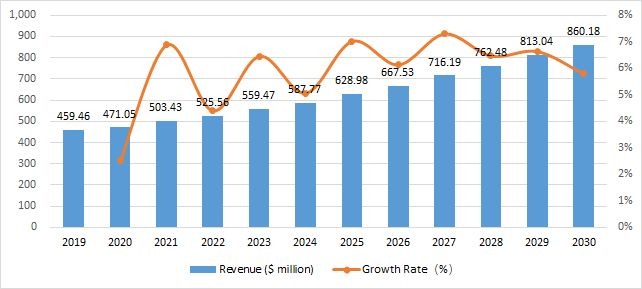
The amount of insurance data is growing exponentially and is forecasted to be 44 zettabytes in 2030. Hence the roles of automation, predictive analytics, and seamless integration are becoming more and more important. Old school spreadsheet programs are no longer sufficient for today’s computing needs. A study done by Milliman recently revealed that actuaries are engaged in manual data preparation for more than 40% of their time without the help of automation.
Present-day actuarial platforms have implemented a strategy that allows them to communicate with policy admin, claims, CRM, and other data sources (telematics, IoT, demographic datasets) without interruption, thus providing an integrated risk view.
Actuaries rely heavily on predictive analytics to become more efficient, which is why we see such systems as integral components of their reports. Top-tier insurers that engage in what-if machine learning models are more than 80% of the time. The brands of the tools in question, namely dynamic pricing, real-time risk scoring, automated assumption setting, and scenario testing, are able to do their respective functions at a previously unattainable scale.
Why Custom Actuarial Software Development Matters?
Traditional actuarial workflows often rely on spreadsheets and outdated legacy systems. These systems often fail to scale with today’s complex insurance data ecosystem. Such systems have notorious scaling issues, inadequate integration with modern insurance platforms, and high levels of manual intervention, thus creating operational bottlenecks, raising error probabilities, and slowing down decision-making.
Insurers are grappling with new types of risks, increasing regulatory pressures, and rapidly changing customer expectations. This is why they need smarter, faster, and more adaptable actuarial tools to support evolving business models.
Custom actuarial software development solves this by giving insurers full control over data and models. It also lets them manage workflows and user experiences with greater precision. Instead of accepting limitations in off-the-shelf tools, insurers design systems that fit their needs. These custom actuarial platforms align with life, health, property, casualty, or reinsurance operations.
These provide seamless integrations with underwriting, CRM, claims management, policy administration, and financial reporting systems that eliminate data silos and allow for true, end-to-end operational intelligence. Real-time model execution, automated workflow orchestration, and centralized governance, significantly smooth actuarial processes within custom-built solutions. Insurance actuarial software development scale effortlessly as insurers grow or diversify; supporting actuarial teams handling larger datasets, more complex models, and advanced analytics with ease.
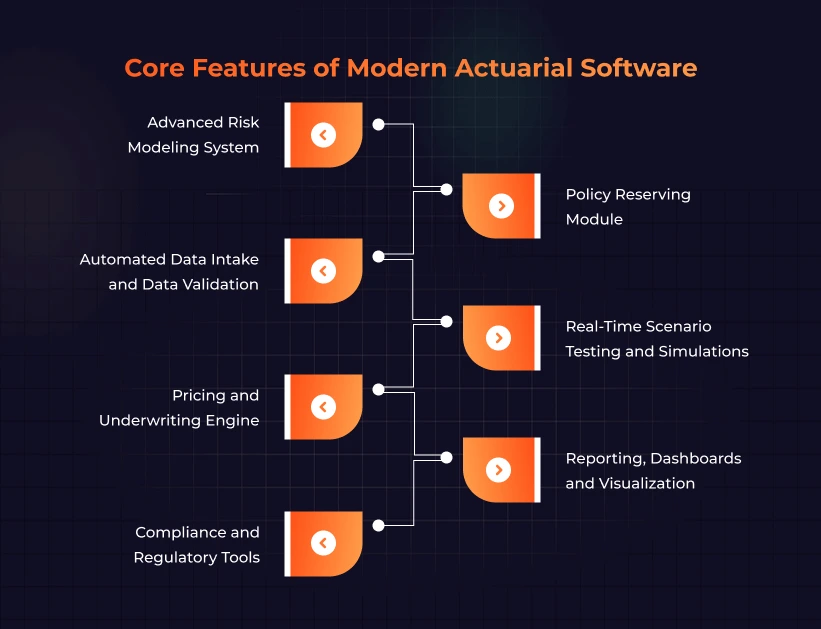
Key Features of the Modern Insurance Actuarial Software
1. Support for Multiple Actuarial Models
The modern actuarial software solutions accommodate models that cover different insurance segments, such as life and health, property, casualty, and reinsurance. These platforms allow the actuaries to create, compare, and update models all in one place. Because of this freedom, the standard of modeling practices is maintained not only within teams but also across business units.
2. Model Management & Governance
Actuarial governance includes features like version control, audit trails, scenario tracking, and controlled access. Modern software also provides structured environments that record every model change clearly. These systems ensure transparency, compliance, and accountability at every step.
3. Automated Data Intake & Validation
Top-tier insurance actuarial software development streamline the entire process of data import, cleansing, and validation from various internal and external sources. Automated pipelines eliminate the problem of manual errors, ensure data consistency, and stage high-quality datasets ready for modeling and reporting. For insurers handling large customer databases, integrating PostGrid Address Accuracy Software can further improve address validation, reduce data quality issues, and enhance the reliability of actuarial models.
4. Diagnostic Analytics & Model Monitoring
Inbuilt diagnostics provide support to actuaries in various tasks such as model performance evaluation, anomaly detection, drift detection, and assumption refinement. The continuous monitoring will guarantee the reliability, relevance, and alignment of models with the emerging trends in risks.
5. AI-Driven Risk Modeling & Sensitivity Analysis
The present day Actuarial Software Solutions integrate with the futuristic algorithms to forecast losses, gauge risk exposure, and examine the consequences of the different assumptions. Sensitivity analysis helps insurers to understand the impact of each variable on the outcome, and as a result, they can make better pricing or reserving decisions.
6. Loss Forecasting & Reserve Estimation
Among the most important tasks of actuaries is loss projection and reserve estimation. With the help of automated models, insurance firms can take more accurate financial planning steps by estimating their future financial liabilities thus also meeting regulatory requirements.
7. Dynamic Pricing & Optimization
Through the use of machine learning and behavioral data, insurers now can use dynamic premium models that reflect real-time risk factors thus moving beyond static pricing. The benefit is precise pricing to a greater extent, more excellent customer experience, and mainly portfolio profitability.
8. Visualization & Reporting
With the help of the dashboards, interactive charts, and tailor-made reports, the actuarial teams can see the changes in real-time for valuations, reserve impacts, risk trends, and pricing outcomes. Real-time insights enable quicker decision-making at all levels.
9. Security & Compliance Controls
Modern-day actuarial software solutions are equipped with strong data security and compliance measures for: Solvency II, IFRS 17, as well as other regulatory standards. Thereby providing secure, auditable, and regulator-approved actuarial operations.

The Role of Artificial Intelligence in Actuarial Software
1. AI in Predictive Risk Modeling
AI augments traditional actuarial practices by surfacing complicated patterns of risk and making more accurate predictions about what is likely to happen in the future. Machine learning models can analyze diverse datasets behavioral, environmental, medical, telematics, and historical, to provide deeper insights into loss trends and risk behaviors.
2. AI-Driven Pricing Algorithms
AI in Insurance Actuarial Software Development helps insurers migrate from broad rating categories to very granular, personalized pricing. With the ability to process thousands of risk attributes, AI-powered pricing engines can generate more accurate premium calculations that better reflect the behavior, lifestyle, and risk exposure of each customer.
3. Automation of Documentation using NLP
Natural Language Processing automates the creation of actuarial reports, regulatory documents, model summaries, and assumption documentation by reducing the manual burden on actuarial teams. Custom Actuarial Software development improves consistency in communication.
4. Generative AI for Reporting & Compliance
Generative AI tools can generate structured narratives on reserve reports, pricing memos, risk summaries, and compliance documentation. In that respect, it frees the actuarial teams from repetitive documentation tasks and accelerates regulatory reporting cycles.
5. AI-Based Fraud Detection
AI-powered systems support actuaries and claims teams in the detection of suspicious patterns in claims submissions, underwriting data, and customer behavior. This further improves fraud detection and reduces financial leakage.
6. Integration with AI Development Services
By integrating seamlessly with enterprise AI systems and analytics; the Custom Actuarial Software development turns into a trusted source for informed insurance decisions driven by data. The integration boosts predictive accuracy, operational efficiency, and underwriting performance.

Emerging Technologies Powering Modern Actuarial Software
1. Big Data Analytics
Modern actuarial software solutions make use of huge volumes of structured and unstructured data, ranging from claims and policy records to IoT, social, demographic, and environmental datasets. Big data technologies allow for faster simulations, richer insights, and higher accuracy in modeling.
2. Cloud Infrastructure
Cloud-native actuarial platforms deliver flexibility, faster compute power, remote collaboration, and cost efficiency. They enable actuaries to run large-scale models, conduct scenario analysis, and collaborate with distributed teams without hardware limitations.
3. Blockchain for Transparency
Blockchain makes the storage of: policy data, claims information, and histories of transactions secure and tamper-proof. This enhances: traceability, reducing disputes whilst applying to reinsurance and multi-party arrangements.
4. API Integration & Automation
APIs allow actuarial platforms to integrate with: underwriting, claims, CRM, ERP, and policy administration systems. Actuarial automation tools further facilitate the data flows, reporting, and model execution, reducing manual work and ensuring real-time consistent insights throughout the organization.
Benefits of Custom Actuarial Software Development
1. Increased Precision and Financial Gains via Precision Modeling
A custom-built actuarial tool empowers insurance companies to create ultra-detailed models that are in complete harmony with their: unique products, risk factors, and market conditions. Thus figuring out the prices more accurately, predicting risks more effectively, and achieving better financial results in the long run are the outcomes of such models.
2. Operational Efficiency Improved and Repetitive Work Fully Automated
Once data intake, calculations, scenario testing, and reporting are automated, the manual work that is significantly time-consuming and error-prone is totally eliminated. Hence, the turnaround times are shortened, and the actuarial teams’ time is unbound to be used for strategic decision-making.
3. Real-Time Decision-Making Strengthened by Predictive Insights
The fusion of AI and analytics results in the delivery of real-time risk projections, claim likelihood, and financial simulations. As a result, insurers are equipped with the power to react rapidly to the changes in the market and identify the new risk trends earlier.
4. Human Errors Diminished and Manual Work Reduced
With the introduction of automated workflows; the inconsistencies that result from spreadsheet-based processes are removed. Thus it is ensured that the calculations are accurate, the methodologies are standardized, and a reliable audit trail is maintained for all operations in the actuarial domain.
5. Greater Compliance, Transparency, and Audit-Readiness
Custom actuarial software development lead to compliance with regulations through the integration of preset regulatory frameworks (e.g., IFRS 17, Solvency II) and also by the automation of documentation, thus audits being effortless and regulatory requirements being met uniformly across different jurisdictions.
Development Process: How to Build Custom Actuarial Software?
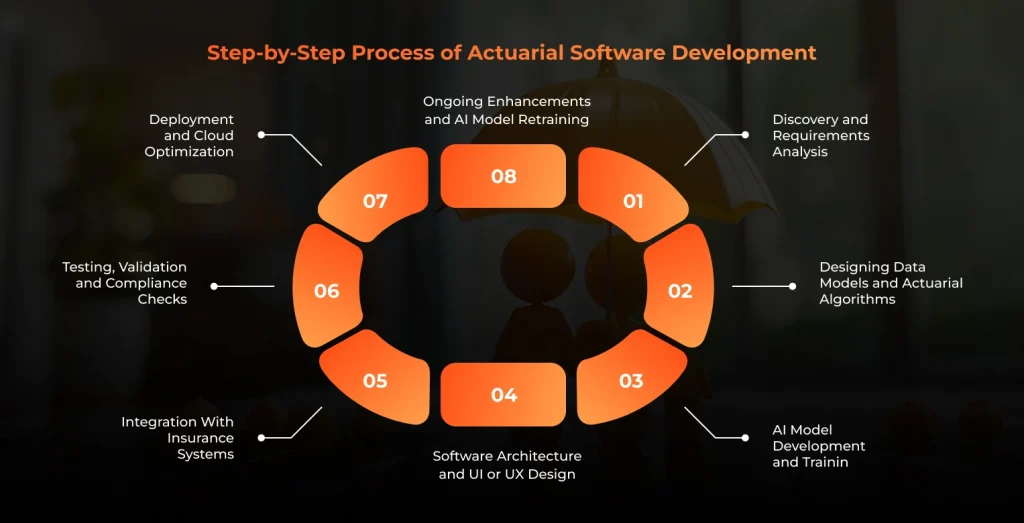
1. Requirement Analysis & Consultation
Consulting the affected people to understand the goals of the actuarial department, the sources of data, the types of products, the regulatory requirements, and the workflows. This step is the base for exact functionalities and model calibration.
2. System Architecture & Design
In this stage we develop a robust, expandable, and secure system framework that will be able to handle large datasets, fast calculations, and integration of the already existing insurance systems like ERP, CRM, and underwriting platforms.
3. Model and Algorithm Development
Here we are creating algorithms that are capable of performing pricing, reserving, forecasting, risk modeling, and capital adequacy operations. This is done by utilizing advanced statistical methods and machine learning where appropriate.
4. AI & Data Integration
In this stage of Insurance Actuarial Software Development we implement AI/ML engines, big data pipelines, and external data sources. This helps to facilitate: predictive accuracy, provide insight automation, and enhance the capabilities of the actuarial model.
5. Testing, Validation & Compliance Assurance
Here we perform extensive testing of the actuarial models by performing stress test, calculation consistency checking. While also confirming the compliance with regulatory frameworks and standards of the industry.
6. Deployment, Maintenance, and Post-Launch Support
The Insurance Actuarial Software Development is implemented over various stages, proper onboarding is ensured, and continuous monitoring, fine-tuning, and feature extension are available as enterprise and regulatory requirements change.
Use Cases Across Insurance Segments
1. Life & Annuity Insurance
Setting up correct mortality models, predicting data lapses, optimizing premiums, and forecasting reserves in the long run to come up with product pricing that is viable over time.
2. Property & Casualty Insurance
Disaster modeling, exposure analysis, and risk scoring with a primary goal of claims prediction, portfolio optimization, and the drafting of loss prevention plans.
3. Health Insurance
Using prediction, cost modeling, fraud detection, and risk adjustment analytics intended to price more accurately and to generate better benefit plans.
4. Pension & Investment Funds
Asset-liability modeling, longevity projection, contribution forecasting, and scenario simulations that support pension fund stability over a long period.
5. Reinsurance and Risk Transfer Modeling
High-level risk aggregation, treaty evaluation, capital modeling, and portfolio stress testing is aimed at helping reinsurance strategies and pricing.

Challenges and Best Practices
We can talk about challenges that you might face when you are implementing custom actuarial software development and also the best practices to get along with them.
1. Efficient handling large-scale and multi-source data sets
The systems must be able to handle data of both the types, that is, structured and unstructured data that are coming from different sources and they have to do it fast. To keep both speed and accuracy the following can be implemented: cloud-based pipelines, optimized ETL workflows, and high-performance computing.
2. Ensuring AI transparency and explainability in predictive models
As more and more AI-driven models are being used by insurers; clarity becomes more and more necessary. The good practices are employing explainable AI (XAI), model documentation, and providing easy-to-understand rationale for the assumptions and outputs.
3. Keeping up with compliance of ever-changing regulations all over the world
With standards like IFRS 17, Solvency II, and NAIC guidelines, continuously upgrading, insurers need to develop systems that are not only flexible but also capable of being updated quickly and equipped with automated compliance reporting.
4. Balancing automation with actuarial oversight and governance
Though automation helps to a great extent in making things more efficient; the role of a human expert is still very much there. The best systems have strong governance controls, audit trails, and human-in-the-loop validation workflows ensuring that the job is done correctly.
How Does A3Logics Help?
A3Logics, a leading AI development company provides the insurance industry with comprehensive end-to-end data analytics solutions; that address the challenges of the modern industry. We are a one-stop solution for advanced analytics, cloud computing, system modernization, and AI-powered insurance software development services – thus, the insurance companies keep their competitive advantage, customer focus, and compliance to the rules.
i. Manifest Experience in Tailored Insurance Software Creation
Leveraging decades of domain experience, A3Logics delivers scalable and secure insurance actuarial software development. Moreover, we support policy administration, claims automation, underwriting, and risk evaluation with precision. Additionally, we engineer platforms that remain fast, accurate, and fully compliant. Consequently, we ensure insurers receive reliable and future-ready actuarial solutions.
ii. Advanced AI-Driven Actuarial Modeling & Predictive Analytics
Employing machine learning, advanced statistical models, and predictive algorithms, our data scientists and actuaries improve pricing accuracy. Furthermore, they enhance risk forecasting while strengthening portfolio management. As a result, insurers reduce loss ratios and improve returns on equity. Additionally, they make faster decisions supported by reliable data.
iii. Complete Data Engineering & Cloud Integration Service
With A3Logics, you receive robust insurance actuarial software development services from data collection to transformation. Moreover, we build resilient cloud data pipelines that enhance accuracy and reliability. Additionally, we convert diverse insurance data sources—claims, policy, telematics, EHR, and CRM—into unified platforms. Consequently, these platforms strengthen decision-making and significantly increase operational scalability.
iv. Uninterrupted API Integration & System Modernization
We enhance API security by upgrading classic insurer systems and seamlessly connecting them with modern digital platforms through robust APIs. Moreover, this integration ensures the smooth flow of information across underwriting, claims, billing, CRM, and partner ecosystems. As a result, insurers improve customer experiences, accelerate processes, and achieve more streamlined and efficient operations.
Conclusion
Insurance companies are producing more data than ever before, and insurance data analytics now separates market winners. Moreover, it transforms raw data into meaningful insights that improve risk assessment. Additionally, it strengthens fraud detection and supports better customer experiences. Furthermore, it boosts operational efficiency across critical insurance functions.
Powered by advanced AI-driven analytics, complete data engineering capabilities, and A3Logics in-depth knowledge of the insurance domain, the company is able to help insurers to realize the true value of their data. A3Logics makes your company future-ready with their wide range of services that include: predictive modeling, real-time dashboards, and cloud-based solutions.
Simply put, A3Logics is a technology partner you can trust with the following: insurance actuarial software development, underwriting needs, claims accuracy potential, compliance workflows upgrading, insurance analytics ecosystem creation, and much more.