Build an App Like Deliveroo: In this digital age, food delivery online has become a global habit. People have begun to use meal delivery apps to receive food from their favorite restaurants delivered to their door in a few minutes, instead of the usual long and boring takeout options.
This is where app like Deliveroo come in. Deliveroo is one of the few super applications that has been able to break into the fast-changing European food delivery sector. This app, which is located in the UK, has become a big player in the meal delivery business. Meeting the changing needs and wants of customers.
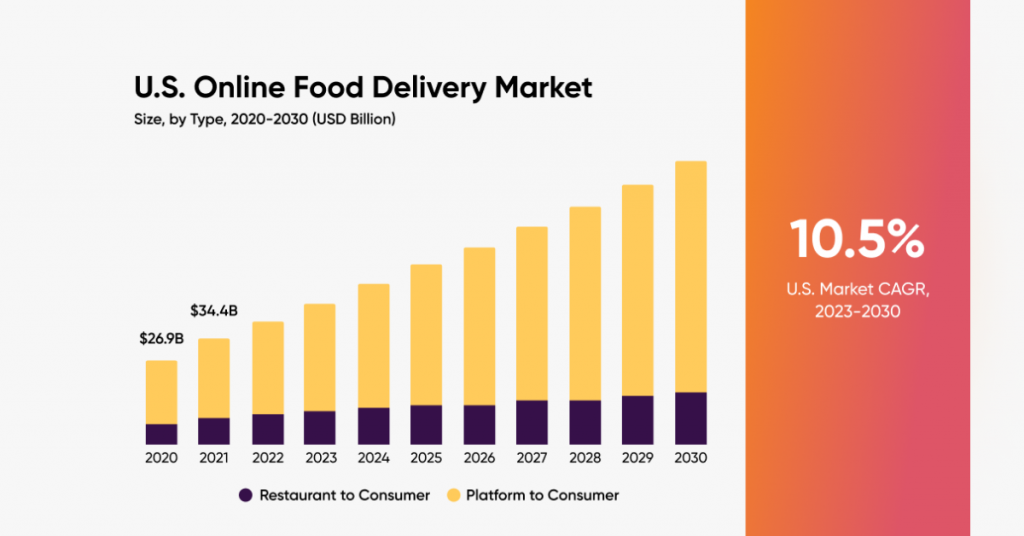
Experts say that the online meal delivery app business was worth $50.70 billion in 2021 and will grow even faster at a rate of 18.7% per year from 2022 to 2030. This information shows that app like Deliveroo have a bright future in the growing sector. If you own a restaurant or want to start your own restaurant app, or if you want to invest in and make an app like Deliveroo, we have one piece of advice for you: Now is the perfect time to do it! But to build app like Deliveroo is hard and takes a lot of work. But don’t worry; we’re here to help you.
The demand for food delivery services has surged, driven by convenience, technology, and changing consumer lifestyles. Deliveroo, founded in 2013, has been at the forefront of this revolution, offering fast and reliable food delivery from a wide range of restaurants. If you’re considering wanting to build app like Deliveroo, it’s crucial to understand the intricacies involved in creating a platform that meets the needs of customers, restaurants, and delivery agents alike.
Market Statistics on Food Delivery Apps
Let’s take a look at some of the must know market stats about food delivery apps like Deliveroo:
- More than nine million people around the world downloaded Deliveroo’s mobile app in 2023.
- Deliveroo, a British online meal delivery service, said that in 2023, 290 million orders were placed on its platform around the world. This was a little less than the 299 million orders placed the year before.
- In 2023, Deliveroo made more than two billion British pounds, which was more than the previous year’s total of 1.9 billion.
Deliveroo, a British meal delivery service, said that in the fourth quarter of 2023, there were almost four million active monthly users in the UK and Ireland. In the company’s international markets, on the other hand, this number was 3.3 million.
What is Deliveroo?
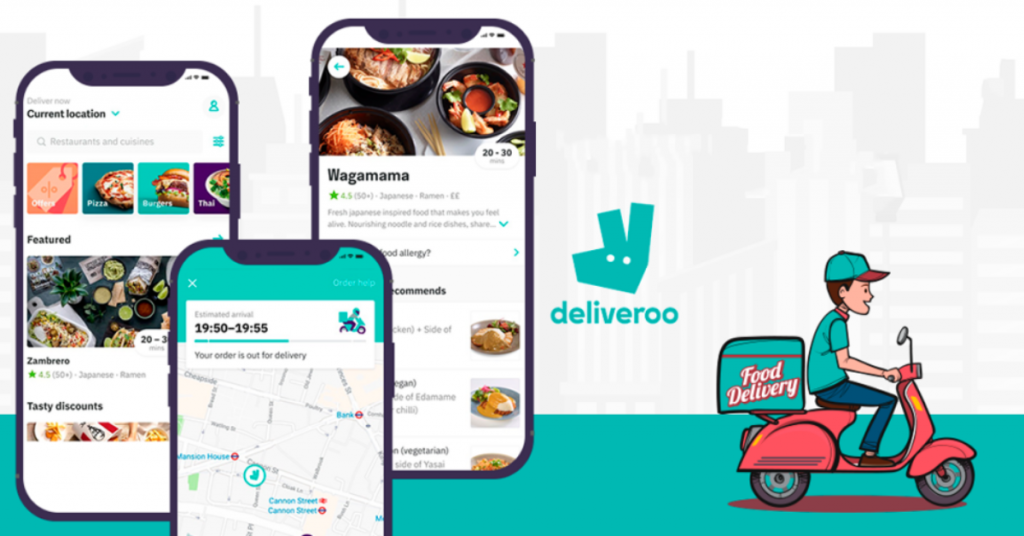
Deliveroo is a British multinational online food delivery company headquartered in London, United Kingdom. It operates in multiple countries, including the UK, France, Belgium, Ireland, Italy, Singapore, and the UAE. Founded by Will Shu and Greg Orlowski in 2013, Deliveroo has revolutionized the food delivery industry by partnering with a wide range of restaurants, from local eateries to large chains. The company employs a network of self-employed couriers to deliver food quickly and efficiently to customers’ doorsteps.
Deliveroo is one of the finest apps for food delivery because it lets people order from a lot of local eateries through its easy-to-use website and app. It gives eateries a chance to show off their recipes to customers who might not otherwise get to try them.
The technology works in many countries and connects clients and restaurants, making it possible for transactions to go smoothly without the need for kitchens at the restaurants. The nicest thing about Deliveroo is that it lets customers choose their food from their favorite restaurants and cafés and then pick it up.
The startup hires drivers and bicycles to deliver meals and lets customers track their orders so they always know where their food is. The app like Deliveroo makes it easy for people to order their favorite food.
Types of Food Delivery Apps
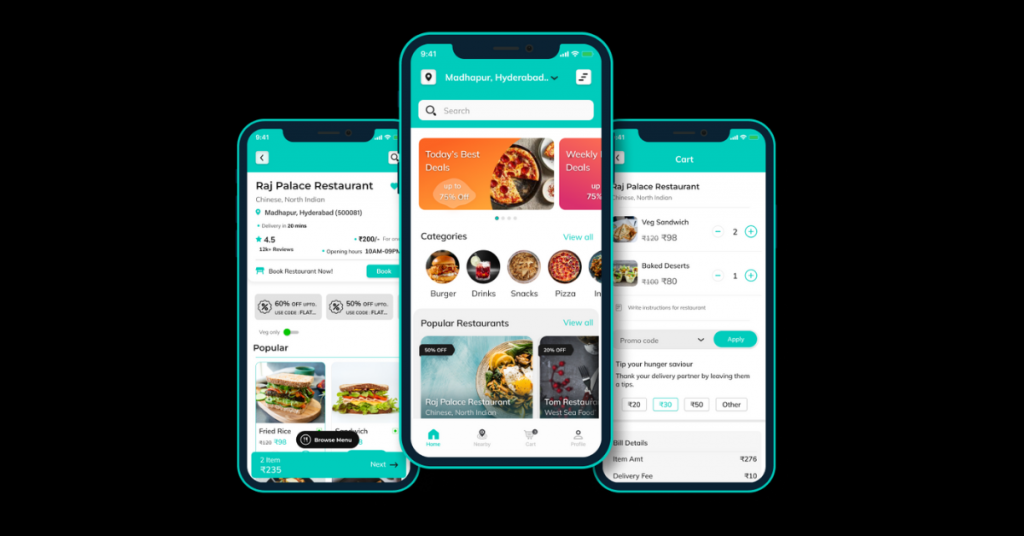
Understanding the different models in the food delivery ecosystem is crucial for determining the best approach for your app. Here are the primary types:
A. Restaurant-to-Customer Apps
One of the subcategories of app like Deliveroo is restaurant-to-consumer delivery. It involves the restaurants’ own handling of delivery and logistics. These apps connect customers and establishments in a digital way. It makes it easy to order food without having to rely on delivery services from other companies.
For example,
- Domino’s Pizza
- KFC
- McDonald’s
Features:
- Direct contact with customers
- Control over the quality of the meal and the time it takes to deliver it
- Special deals and loyalty schemes
B. Aggregator Apps
These app like Deliveroo group several restaurants belonging to various locations onto several platforms; however, they don’t arrange the delivery themselves. Rather, they serve as the connection between customers and restaurants which look after their deliveries. The best part about this model is that it is an extremely viable business model because the restaurant doesn’t have to maintain its fleet. Additionally, it also helps you capitalize on the customer base of your app.
Examples are:
- Ubereats
- Postmates
Features:
- Extensive restaurant listings
- User ratings and reviews
- Order tracking via the restaurant’s system
C. Logistics-Focused Apps
These apps are for consumers who like to cook at home rather than ordering cooked food by purchasing groceries or pre-measured meal kits with recipe guides. They provide an easy mode of shopping for ingredients or cooking meals without worrying about meal planning or store visits. Consumers can choose diet preferences, individual ingredients, or portion sizes to their liking and dietary needs.
Examples are:
- HelloFresh
- Instacart
Features:
- Recipe ideas with ingredients
- Scheduled deliveries
- Subscription models for regular deliveries
D. Cloud Kitchen Apps
loud kitchens, or ghost kitchens or dark kitchens, are delivery-only restaurants with no dine-in area. Restaurants that exist only online are supported by these apps, enabling them to handle multiple brands from one shared kitchen. They concentrate on online orders only, enhancing efficiency and minimizing overhead.
Example:
- CloudKitchens
- FreshMenu
Key Features:
- Multi-brand management from a single app
- Optimized for high-volume orders and fast delivery
- Data-driven menu customization
- Lower operating costs compared to conventional setups
E. Meal Kit Delivery Apps
Meal kit apps ship pre-measured ingredients as well as simple-to-make recipes straight to customers’ doorsteps. They serve customers who like to cook but do not want to go shopping for groceries or plan their meals.
Examples Include:
- HelloFresh
- Blue Apron
- Home Chef
Key features:
- Weekly or personalized meal planning
- Step-by-step recipe integration
- Dietary filters (vegan, gluten-free, low-carb)
- Flexible delivery timing and pause features
F. Subscription-Based Apps
These applications provide frequent, recurring meal delivery according to a subscriber’s plan. Customers can subscribe for weekly or monthly delivery depending on the diet or choice. Great for career-oriented people or fitness enthusiasts.
For Example:
- Freshly
- Tiffinly
- Factor
Features:
- Pre-determined meal plans or personalized choices
- Automatic renewal and convenient subscription management
- Tracking and personalization of nutrition
- Long-term commitment discounts
G. Grocery Delivery Apps
Grocery delivery apps enable the user to order daily supplies, fruits and vegetables, and home essentials online and have them delivered at the doorstep. Such apps became super popular after the COVID pandemic and are rapidly expanding.
Examples:
- Instacart
- Amazon Fresh
Features:
- Real-time inventory monitoring
- Multiple store and brand listings
- Scheduled or express delivery options
- In-app discounts, loyalty points, and coupons
Key Features to Include in a Food Delivery App
To compete with established players like Deliveroo, your app should offer a comprehensive set of features. Here’s a breakdown of features of Deliveroo app for each user panel:
Customer Panel
- User Registration & Login: Allow users to sign up and log in using email, phone number, or social media accounts.
- Search & Filter Options: Enable users to search for restaurants, cuisines, or specific dishes.
- Menu Browsing: Display restaurant menus with detailed descriptions and images.
- Order Tracking: Provide real-time tracking of orders.
- Multiple Payment Options: Support various payment methods, including credit/debit cards, digital wallets, and cash on delivery.
- Ratings & Reviews: Allow customers to rate and review restaurants and delivery services.
- Promo Codes & Discounts: Offer promotional codes and discounts to attract and retain customers.
- Reorder Functionality: Enable users to quickly reorder previous meals.
- Multi-Language Support: Cater to a diverse user base by supporting multiple languages.
- Scheduled Orders: Allow customers to schedule orders for a later time.
Delivery Agent Panel
- Easy Registration: Simplify the sign-up process for delivery agents.
- Order Notifications: Notify agents of new delivery requests.
- Optimized Route Navigation: Provide GPS integration for efficient route planning.
- Earnings Dashboard: Allow agents to track their earnings.
- Status Updates: Enable agents to update the status of deliveries.
- Availability Toggle: Let agents set their availability for deliveries.
- Support Chat: Offer in-app support for agents.
- Ratings and Feedback: Allow agents to rate customers and provide feedback.
Restaurant Panel
- Menu Management: Allow restaurants to update their menus.
- Order Management: Enable restaurants to manage incoming orders.
- Analytics Dashboard: Provide insights into sales, customer preferences, and more.
- Promotions & Discounts: Allow restaurants to create and manage promotions.
- Inventory Management: Help restaurants track stock levels.
- Customer Feedback Access: Provide access to customer reviews and ratings.
- Restaurant Profile Management: Allow restaurants to update their profiles.
Admin Panel
- User Management: Manage customer, restaurant, and delivery agent accounts.
- Order Management: Oversee all orders placed through the app.
- Analytics & Reports: Generate reports on sales, user activity, and more.
- Promotions & Campaigns: Manage promotional campaigns and offers.
- Dispute Resolution: Handle disputes between customers, restaurants, and delivery agents.
- Category Management: Organize restaurants and dishes into categories.
- Delivery Zone Management: Define and manage delivery zones.
Additional Features for All Panels
In order to design a highly user-focused and competitive app like Deliveroo, it’s important to extend beyond basic functionalities. Adding the following value-added features of Deliveroo app helps not only to better the user experience but also to boost engagement, satisfaction, and long-term retention among all categories of users—customers, restaurants, delivery partners, and admins.
1. Push Notifications
Provide timely and relevant feedback straight to users’ devices. Whether it’s keeping customers up-to-date on order status, reminding restaurants of new orders, or informing delivery agents of pickups assigned to them, push notifications assist in streamlining operations and enhancing responsiveness. Push notifications can also be leveraged for marketing—spreading promotion, seasonal offers, or loyalty point balance updates to drive sales and engagement.
2. In-App Chat Support
Facilitate real-time issue-solving within the app itself. Providing live chat support to all user roles assists in settling issues such as delivery delay, missing items, or app malfunction in real-time. This minimizes frustration, restores trust, and reduces the necessity of leaving the app or making external calls. For the restaurant and drivers, it provides instant clarification from the support team or users.
3. Referral Program
Make happy users your brand ambassadors. Incentivize users to refer friends or family using referral bonuses, cashback, or discounts. Delivery partners and restaurants can also be incentivized to onboard new users or collaborators. An optimized referral system can decidedly promote app downloads and user acquisition at a low cost.
4. Multi-Currency Support
Scale globally with effortless currency adaptability. If your food delivery app is going to be in or expand to overseas markets, having multi-currency support is essential. It enables users to see prices and pay in their home currency, enhancing accessibility and eliminating friction from checkout—especially valuable for tourists, expats, or cross-border delivery.
5. Dark Mode
Enhance accessibility and visual ease of use. Making a dark mode available enhances user experience in low-light settings, minimizes eye strain, and caters to individual design tastes. It also maximizes battery life in OLED displays. Making this capability available shows attention to detail and dedication to user comfort on all panels.
7. Steps to Build an App Like Deliveroo
Wondering how to create a app like Deliveroo? Developing a app involves several key steps:
1. Research and Planning
Start with thorough market research to know the user preferences, market trends, and strengths of your competitors. Determine your app’s objectives, business model, and target users. Determine your value proposition and create a list of features based on user requirements. A solid roadmap at this point guarantees seamless execution and a product that fully addresses market needs.
2. UI/UX Design
Create an intuitive and interactive user interface that facilitates smooth user interaction. Emphasize simplicity, rapid navigation, and unified branding across all displays. Employ wireframes and prototypes to sketch out user flows and obtain early feedback. Superb UI/UX engenders trust, enhances usability, and has a major influence on user satisfaction and retention within a saturated app environment.
3. App Development
Select the optimal technology stack with regard to scalability, performance, and security. Start frontend and backend development through agile methodology for flexibility and quickness. Implement essential features such as geolocation, payment gateways, order tracking, and notifications. Optimize APIs and databases. Developer-designer collaboration at this phase guarantees functional and visually identical outputs.
4. Testing and QA
Perform thorough testing to find bugs, security flaws, and usability problems. Utilize manual and automated testing tools to test functionality, performance, and cross-device compatibility. Focus on real-time scenarios, such as high-traffic load and payment failure. Quality assurance provides a smooth user experience, establishes credibility, and avoids customer churn because of unexpected errors.
5. Launch and Maintenance
Release the app on popular platforms such as iOS and Android with a well-designed marketing strategy. Watch early user activity and feedback intently. After launch, regularly update the app with new features, enhancements, and patch fixes. Regular maintenance guarantees security, performance, and user interest—converting first-time users into long-term, loyal patrons.
Core Technologies Required
Selecting the right technology stack build app like Deliveroo is crucial for the success of your app. Here’s a recommended stack for app like Deliveroo:
- Frontend Development: React Native, Flutter, Swift (iOS), Kotlin (Android)
- Backend Development: Node.js, Django, Ruby on Rails
- Database: PostgreSQL, MongoDB
- Cloud Hosting: AWS, Google Cloud, Microsoft Azure
- Payment Gateway: Stripe, PayPal, Razorpay
- Real-Time Updates: Firebase, Socket.IO
- Location Services: Google Maps API, Mapbox
- Push Notifications: Firebase Cloud Messaging (FCM), OneSignal
- Authentication: OAuth 2.0, Firebase Authentication
- Analytics Tools: Google Analytics, Mixpanel
- DevOps Tools: Docker, Kubernetes, Jenkins
Cost to Develop an App Like Deliveroo
The cost to develop app like Deliveroo can vary based on several factors:
- App Complexity: Basic apps range from $40,000 to $70,000, while complex apps can cost between $120,000 and $150,000.
- Development Team Location: Developers in North America or Western Europe typically charge higher rates than those in Asia.
- Features and Integrations: Advanced features like AI integration, loyalty programs, and custom UI/UX design can increase costs.
- Maintenance and Updates: Ongoing maintenance can cost 15% to 20% of the initial development cost annually.
Revenue Models for Food Delivery Apps
To monetize your app, consider the following revenue models to build app like Deliveroo:
1. Delivery Charges
A simple monetization strategy, this entails charging customers a delivery fee for each order. The fee can be dynamic—distance, time of day, or order size-based—or fixed. You can also provide tiered pricing where regular deliveries are free above a minimum amount while express deliveries cost extra.
2. Commission from Restaurants
Earn a commission from partner restaurants on each order that is placed through your platform. This is a popular model adopted by big players like Uber Eats and DoorDash. The rate of commission can also be dependent on the popularity of the restaurant or the nature of the partnership. Charging premium visibility to high-tariff restaurants can also increase your income.
3. Subscription Plans
Provide users with a monthly or yearly subscription (e.g., “Plus” or “Pro” membership) that includes benefits such as free shipping, priority customer service, special discounts, and early notification of special offers. This strategy creates a consistent revenue stream and enhances customer loyalty and lifetime value.
4. Advertising Revenue
Enable restaurants and food companies to place targeted ads within your app. These can include featured listings, banner ads, or sponsored search results. If you have the proper analytics, you can provide high-converting ad positions based on user behavior, location, and history of orders—making it appealing for advertisers.
5. In-App Purchases
Make money by selling add-ons and premium services within the app itself. This may be special meal bundles, tipping functionality, customizations (such as extra toppings), or event-specific services (such as party packs). These microtransactions increase average order value and provide extra streams of income without involving outside advertisers.
6. Data Monetization
With anonymized and user-permitted data, you can measure behavioral and demographic information and sell market intelligence to restaurants and food companies. This optimizes the menus, prices, and stock of partners. You can also provide targeted marketing based on user preferences, geographics, and order history.
How A3Logics Can Help in Build an App Like Deliveroo?
A3Logics is a leading app development firm known to build apps like Deliveroo. They are renowned for building extremely scalable, feature-packed, and user-friendly applications for various business models ranging from cloud kitchens, startups, to full-fledged food delivery businesses. Since more than a decade, A3Logics has provided end-to-end development services, which encompass:
- Strategic Consulting to identify your app’s distinctive value proposition
- UI/UX Design that boosts engagement and provides seamless user experiences
- Custom Development with the latest technologies such as AI, ML, AR/VR, and IoT
- Third-party Integrations (payment gateways, delivery APIs, CRM, ERP systems, etc.)
- Stringent Testing & QA for cross-platform compatibility and performance
- Post-Launch Support & Maintenance to ensure smooth functioning and feature updates
Whether you want to build an app like Deliveroo multi-vendor platform or a niche app for local deliveries, A3Logics offers full-cycle support—from ideation to deployment and beyond.
Learn more about their services here: Food Delivery App Development Company
Conclusion – Build an App Like Deliveroo
Building a app like Deliveroo in 2025 requires careful planning, the right technology stack, and a focus on user experience. By understanding the market, incorporating essential features, and selecting the appropriate revenue model, you can build apps like Deliveroo that meet the needs of modern consumers. The facts and descriptions above talk about how to make a app like Deliveroo.
The above elements, features, and processes might be quite helpful if you are a new player in the app business. You may make an app like Deliveroo that satisfies market needs and gives users a better experience by focusing on features that are good for customers, smooth operations for restaurant partners and delivery people, and a robust backend infrastructure.