
The role of AI is significantly evident in our lives – from voice assistants on our smartphones to self-driving cars. Needless to say, AI is changing the way we live and work. Statistically speaking, 70% of business leaders believe that generative AI will have a significant impact on their businesses. Until now, most of us were of the opinion that AI is all about making machines think and act like humans. However, as we delve deeper, we encounter concepts such as AGI vs. ASI. AGI refers to machines that think like humans, and ASI goes beyond human intelligence.
Sounds fascinating, right? In this post, we’ll explore these concepts, understand how AI has reached its current state, and consider where AI might be headed.
AGI and ASI – An Overview
AGI and ASI fall under the umbrella of Artificial Intelligence. Therefore, to understand the difference between AGI and ASI, let’s first get an overview of what Artificial Intelligence (AI) is.
To begin with, AI is a list of instructions for computers. It is a union of complex systems and machine learning languages that instruct computers to execute activities without explicit instructions every single time.
It is important to note that the Artificial Intelligence (AI) we see now has come a long way since its inception. The evolution has given rise to three distinct categories: Artificial General Intelligence (AGI), Artificial Narrow Intelligence (ANI), and Artificial Super Intelligence (ASI). Each of these subcategories exhibits different levels of capabilities.
Evolution of Artificial Intelligence from ANI to AGI to ASI
To further dive into what AGI Vs. ASI is, let’s go through a brief timeline –
AI research began in the 1950s, marked by the Dartmouth conference in 1956, where the term “Artificial Intelligence” was coined. Early AI systems focused on representing knowledge using rules and symbols, aiming to mimic human-like decision-making. Till 70’s, the progress remained slow because of limitations in computational resources.
The period between the 1980s and the 2000s saw a rise in machine learning and advancement in neural networks and deep learning techniques. In 1997, IBM’s Deep Blue became the first chess-playing computer to defeat a reigning world champion, Garry Kasparov.
The 2010s saw breakthroughs in the form of neural networks and deep learning, enabling systems to recognize images, understand natural language, and even surpass human performance in complex games.
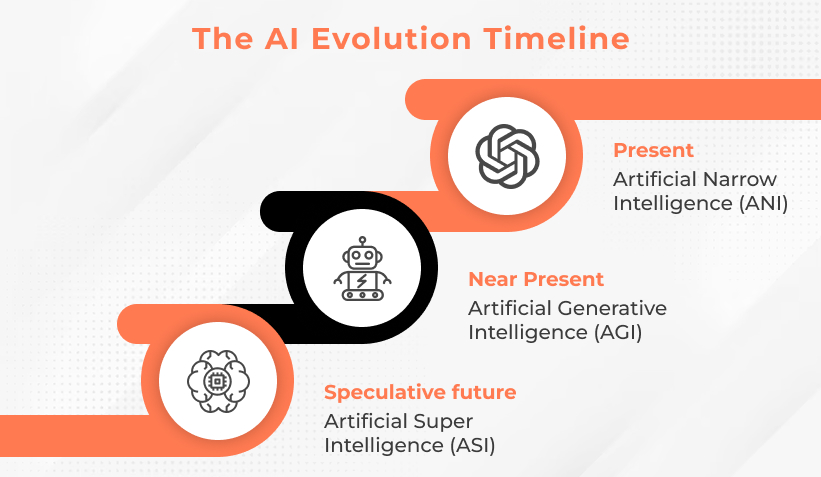
AI forms With Improved Learning Capabilities – ANI, AGI, and ASI –
1. Artificial Narrow Intelligence (ANI)
It is prevalent and is referred to as weak or narrow AI. ANI is mostly programmed to perform specific tasks such as speech recognition (e.g., Voice Assistants), facial recognition, etc. It simulated human behavior based on a limited set of constraints. Common examples of ANI include Siri on iPhones, Netflix’s recommendations, and Google’s RankBrain.
2. Artificial General Intelligence (AGI)
Known as strong AI, AGI aims to teach machines to truly understand human beliefs and emotions. It would go beyond just imitating humans and would exhibit human-level intelligence across domains by understanding context and nuance. It will be able to adapt to new situations and learn without specific programming.
3. Artificial Super Intelligence (ASI)
At this stage, models will outdo human intelligence across every possible domain. It will outperform the best human minds; not only will these models understand human experiences and sentiments, but they will also be able to evoke beliefs, emotions, and desires of their own.
Now that we have a fair idea of the three forms of AI, let’s get down to the actual comparison, i.e., Artificial General Intelligence (AGI) Vs. Artificial Super Intelligence (ASI), because that’s where the future lies – Where AGI matches human intelligence, ASI surpasses it, raising hope and concerns simultaneously.
What is Artificial General Intelligence? (AGI)
AGI or Artificial General Intelligence is also referred to as deep or strong AI, whose potential is yet to be discovered.
It is the ability of machines to think, comprehend, learn, and apply intelligence to solve complex problems quite like humans. It can adapt to a wide range of environments and tasks. AGI uses a theory of mind AI framework to recognize other intelligent systems’ beliefs, emotions, and thought processes, and is touted as the next phase of ANI.
The reason why it is considered the next stage of ANI is that AGI aims to teach machines to truly understand human beliefs, emotions, and thought processes instead of just mimicking them.
Although it hasn’t been realised yet, top tech companies have already started to invest in it. For instance, in 2019, Microsoft invested $1 billion in OpenAI, aiming to develop Artificial General Intelligence, and has made subsequent larger investments, becoming a significant force in AI.
According to most AI experts, AGI is inevitable. As for its attainability in the near future, a few years before the rapid advancements in large language models, scientists were predicting it around 2060, while some entrepreneurs predicted it around ~2030.

What AGI Tends To Achieve?
To give you a foresight of what we can expect out of AGI, here are things it aims to achieve –
- Resolve complex tasks that need human involvement, such as disease diagnosis and treatment.
- Achieve self-awareness and analyze ideas and behaviors similar to humans, something that current AI systems lack.
- Much better collaboration between humans and machines for a more fruitful and effective work environment.
What is Artificial Super Intelligence (ASI)
ASI, short for Artificial Super Intelligence, is a theoretical concept that surpasses AI’s capability beyond human intelligence and is possibly the next frontier after Artificial General Intelligence (AGI).
One significant difference between Artificial General Intelligence and Artificial Super Intelligence is that the latter will be tens or thousands of times smarter than humans. Some experts believe that ASI will emerge soon after AGI when AI becomes capable of improving itself.
It is also speculated that ASI will trigger rapid technological growth that surpasses human imagination and will be able to solve previously unsolvable challenges in medicine, science, and other domains.
AGI vs. ASI: Key Differences
Below is a quick tabular comparison of AGI vs. ASI across different aspects to help you understand their key differences. From intelligence levels to risks, this breakdown shows how they impact our future. It’s a simple way to grasp what sets AGI apart from ASI –
| Aspect | AGI | ASI |
| Stage | Present/in-progress | Future |
| Type | General/Human-level | Superhuman integrates various cognitive abilities. |
| Scope of understanding | Multi-domain understanding | Multi-domain understanding, self-improving, autonomous, and can evolve on its own. |
| Risk level | Moderate to potentially risks- Risks associated with AGI primarily concern control, fairness, and its impact on society, work, and decision-making. | High to extreme; could lead to existential risks – It might lead to decisions that are beyond human control. |
| Societal impact | Augments and automates tasks | It could redefine the structure and functioning of society. |
| Problem solving | General – specialized problem solving, parameters are defined. | Omniscient – Could solve problems beyond human comprehension. |
How Artificial General Intelligence (AGI) is Revolutionizing Sectors
AGI or Artificial General Intelligence is poised to revolutionize every aspect of human work and life. Although it is still in its theoretical stage, Artificial General Intelligence (AGI) will reshape industries by endowing machines with human-like intelligence, enabling them to perform tasks that extend far beyond fixed programming. Let’s study the probable impact of AGI across sectors –
1. Manufacturing
In manufacturing, AGI could handle diverse operations without the need for specialized programming for each function. In factories, AGI systems can reduce operational costs by managing entire production lines, making real-time decisions about maintenance, quality control, and supply chain logistics.
2. Healthcare
Another sector where AGI could exhibit a revolutionary role is healthcare. It can help recognize patterns across millions of patient records and identify optimal treatments. The systems will be able to create personalized treatment plans based on a patient’s lifestyle factors, genetic profile, and medical history.
3. Automotive
The automotive sector could soon see AGI-powered self-driving vehicles that can pick up passengers, navigate unfamiliar roads, and adapt to conversations in real-time. The vehicles may also be able to answer questions about local culture, geography, and other aspects, personalizing their responses based on the passenger’s interests.
AGI vs ASI from a Development Standpoint
From a development standpoint, the bigger goal is to focus on creating AI systems that can move from narrow task-based intelligence to those that can think more like humans. And, in the case of Artificial Super Intelligence, we need to step it up further and think of creating systems that can surpass human intelligence.
When heading towards AGI, we need to achieve certain milestones with current AI systems. For instance, the AI machines should be able to master games like chess and Go. Next, the machines should be able to transfer learning across unrelated fields. This implies that they are capable of demonstrating a deeper understanding, rather than just relying on patterns.
A true AGI would need to pass advanced version of certain tests like the Turing test and not just in one domain but in multiple domains. This would show that they can demonstrate human-level reasoning, creativity and human understanding.
Moving beyond AGI, the path to Artificial Super Intelligence is still theoretical but widely discussed in various researches. ASI might develop by scaling today’s AI models. It’ll utilize more computing power and much more advanced algorithms. Machine learning and deep learning will play a pivotal role in making AI systems learn from vast amounts of data and helping them make complex decisions on their own.
The Future of AI: How companies must invest in AGI to be future-ready for ASI
While we are still exploring the endless potential of Artificial General Intelligence, we are heading towards Artificial Super Intelligence, a form of AI that’ll surpass human intelligence. The question is – how can businesses prepare for this advancement and invest in AGI to be ready for ASI?
Here are some ways companies must invest in AGI to be future-ready for ASI –
1. Get A Grasp of AI Basics and Strengthen Research
It is first and foremost important to get a good grasp of AI basics. Companies would need to invest in the latest research and developments to understand the potential risks and opportunities.
2. Focus on Human Centric Skills
Another difference between AGI and ASI is the risk factor, i.e., the potential loss of human control. Experts speculate that ASI could surpass human intelligence and it might make unwanted decisions that humans might not be able to comprehend.
So, when investing in AGI to make it future-ready, companies should focus on skills like emotional intelligence, creativity, and critical thinking that can help bring back human control by balancing technological with strong human judgment.
3. Build A Robust Data Infrastructure
A robust infrastructure is crucial since AGI and ASI systems will require massive amounts of high-quality data. Even more importantly, they would need strong security measures to safeguard this data when storing it.
4. Phased Financial Planning
Allocate your investment in phases – short-term for AGI applications, mid-term for infrastructure, and long-term for ASI-readiness and research. It is also important to put aside flexible R&D fund for emerging AGI/ASI technologies.
5. Focus on Adaptable and Scalable AI Solutions
Choose AGI systems that can scale with your business needs, adapt across sectors, and evolve with advancing intelligence. Build strong human-AI collaboration frameworks and establish strict AI governance to ensure that future super intelligent systems work in harmony with human values, goals, and global ethical standards.
Partner With Experts To Navigate The AI Shift
Regardless of your stage of AI development, partnering with the right Artificial Intelligence development company, such as A3Logics, can be a strategic move towards a prosperous future, and here’s why –
- At A3Logics, we provide custom Generative AI development services to innovate, automate, and create customized solutions to address unique business challenges.
- Provide expert AI consulting services to help companies identify the opportunities where AI technologies can be implemented.
- Develop a Proof of Concept to validate AI use cases.
- We integrate AI into existing systems, helping businesses to enhance performance and functionality, ensuring smooth adoption across all platforms.
- Fine-tune LLMs to meet the futuristic demands of businesses.
Conclusion
To conclude, we are still in the nascent stages of AI, where we are mostly surrounded by weak or narrow AI systems designed for specific tasks. But, that doesn’t hide the fact that AGI is making its way where machines can think just like humans and make decisions without much human intervention.
This post on AGI Vs. ASI stresses on a larger paradigm shift – transition from AGI to ASI where AI systems will surpass human intelligence, make autonomous decisions, and possibly impact society in a way humans can’t comprehend.
As we transition from AGI to ASI, companies must adapt not only for profit, but also for responsibility. It’s not just about building more intelligent machines—it’s about creating systems that serve people. Businesses should focus on developing AI that solves real-world problems, improves lives, and is grounded in human values at its core.