
Large language models, such as Claude, GPT-4, and LLaMa, are revolutionary AI tools. These AI applications have taken over various industries, including healthcare, software development, customer service, and brand development—making LLM cost optimization crucial for sustainable deployment.

Each of these AI tools not only understands but also generates a human-like flow. It’s not wrong to say that these AI systems have become a crucial requirement in today’s digital ecosystem. The global AI market size is expected to reach USD1.01 trillion by 2032. With the increased adoption of AI, the operational costs are also growing in terms of energy consumption, computing, memory, and storage.
The Epoch AI report suggests that the cost of training AI models has grown by 2-3x annually in the past eight years. Some of these models require more than $100 million for training. It has an impact on the millions of users throughout the model’s lifecycle. Businesses must adopt proper cost optimization strategies for running large language models to ensure sustainability, achieving optimal performance without compromising the accuracy of their outputs.
Sector 1: Understanding LLM Development Costs for Effective Cost Optimization
There are two main types of LLMs: open-source LLMs and managed LLM. Each of them has their specific benefits to offer. However, while building the LLMs, it is crucial to thoroughly understand the different types of costs involved in the development process. This plays a pivotal role in LLM cost optimization.
The proper model selection for cost savings goes beyond the regular subscription fees. Some of the additional costs include operational expenses and indirect costs, such as integration, maintenance, and customization. It is crucial to understand each of these factors driving the price, for they help in making informed decisions.
Below are some of the different types of costs for the LLM development process:
Direct Costs: Pay-Per-Token and Infrastructure
The LLM providers usually charge depending on token usage for direct costs. In this case, inference is one of the most crucial factors to consider. For example, the GPT-4 model from OpenAI charges $0.03 for 1,000 inputs and $0.06 for 1,000 outputs. This is significantly higher than that of GPT 3.5.
The deployment models usually have a role in this. Choosing the right deployment model, in this case, contributes to scalability and better workload predictability. The top deployment models to opt for are as follows:
- API Access: The API access plays a crucial role in facilitating ease of use while driving scalability. However, the variability depends on the usage-based costs.
- In-house Deployment: The in-house deployment model, however, is expensive due to the investments in cloud computing resources and GPUs. The infrastructural costs are also involved. Moreover, in the long run, operational costs also increase, which can affect the cost-optimisation strategies for running large language models.
Indirect Costs: Fine-Tuning and Integration
The indirect costs for LLMs usually revolve around customisations. However, there are specific use cases for determining these customizations to understand the actual process for LLM cost optimization. The indirect costs involved in the LLM development process are as follows:
- Fine-tuning: Fine-tuning the LLM model typically requires substantial computing resources. Depending on the customisation requirements, there will be increased requirements for high-quality data assets. Furthermore, the development engineers may also need extra time to customise the models.
- Integration: As for integration, backend development, and API integration comes into play. Furthermore, additional security features may also be required for compliance. These integrations should align with the existing models to ensure efficiency.
The customization costs may increase with the complexity of deployment and frequency of updates. When establishing cost optimisation strategies for running large language models, it is crucial to understand the complexity requirements for businesses in LLM model development.
Operational Costs: Inference, Latency, and Scalability
Inference, latency, and scalability are key factors that contribute to operational costs. As user demands grow, operations costs will also have to be optimized for business needs. At the same time, it is advisable to look for key ways through which you can reduce LLM operational costs.
Large language models, over time, will require increased latency and more computing power, resulting in higher cloud costs. Some of the key aspects that can hamper the operations costs include the following:
- Auto-scaling: The auto-scaling ensures that peak loads can be handled. Dynamic scaling is a crucial factor to consider in this situation. It often caters to load balancing while keeping up with the infrastructural complexity.
- Real-time Constraints: Chatbot applications may have some real-time Constraints, mainly due to the need for low-latency responses, which often heighten computing demands.
Hidden Costs: Maintenance, Compliance, and Security
Now, while ensuring LLM cost optimization, many businesses overlook the hidden costs. These hidden costs are one of the most critical components, for it can determine the long-term expenses.
The hidden costs, along with other expenses, often impact the total cost of ownership of the LLM. Therefore, when establishing cost optimisation strategies for running large language models, it is also essential to consider these hidden costs.
Some of the key hidden costs for the businesses are as follows:
- Security Risks: Large language models are prone to a wide range of security risks. These models are vulnerable to data leaks, data misuse, and adversarial attacks. It is highly crucial to conduct regular security audits to prevent these risks in the long run.
- Regulatory compliance: The developed large language models must adhere to the regulatory compliance demands. For example, it must comply with data privacy laws such as the CCPA and GDPR. Adhering to these laws, however, can increase the overall operational and legal costs for businesses.
- Model drift: Selecting a model for cost savings in LLM is exceptionally crucial. Most of these models require regular fine-tuning to ensure they remain relevant. Data will keep evolving. Therefore, it is essential to consider the model drift to drive business cost savings.
Quality vs. Cost: Is Higher Spending Justified?
Balancing cost and quality in Large Language Models can often be difficult. Investing less may not always guarantee the best results, especially while providing complex inputs. Premium models promise superior performance. Therefore, businesses consider opting for that.
In some cases, however, the regular models tend to outperform the premium ones in terms of providing answers. While premium models offer superior outputs, they’re also quite expensive. It is highly crucial to compare the cost optimization of LLMs for different types of models.
Monitoring the ROI
Businesses must utilize LLM cost monitoring tools to determine the return on investment (ROI) that a particular language model (LM) is generating. High-performance models deliver greater accuracy and an enhanced user experience. However, the costs of investing and operations are significantly higher.
Businesses may consider using the Decision-Theoretic Model framework to determine which approach is most effective for their business. It helps to assess the ROI in the best manner while determining the success rate and also caters to proper financial impact. Through the use of this model, you can decide if the premium models are worth investing in. Furthermore, it also paves the way for the business to check out more cost-effective alternatives.
Are Premium Large Language Models Worth It?
Yes, premium large language models are worth it. However, it is essential to note that not everyone is effective. These premium models for large language models are effective for specific businesses under specific scenarios. Here are some of the key areas where premium large language models can be used at a massive scale:
- Healthcare and Legal areas must address serious and complex errors due to unforeseen circumstances.
- Creative industries with complex and open-ended tasks to easily solve them.
- Branding industry to deliver exceptional customer experience to keep up with the competitive markets.
Balancing cost and quality in the large language sector can be highly challenging. The proper cost optimisation strategies for running large language models often play a crucial role in maintaining this balance. It is essential to establish strategies that align with your business needs and also cater to the performance demands. However, if your business has budget constraints, it is advisable to optimize the strategy again after the testing phase.
Sector 2: Key Drivers of LLM Cost Optimization
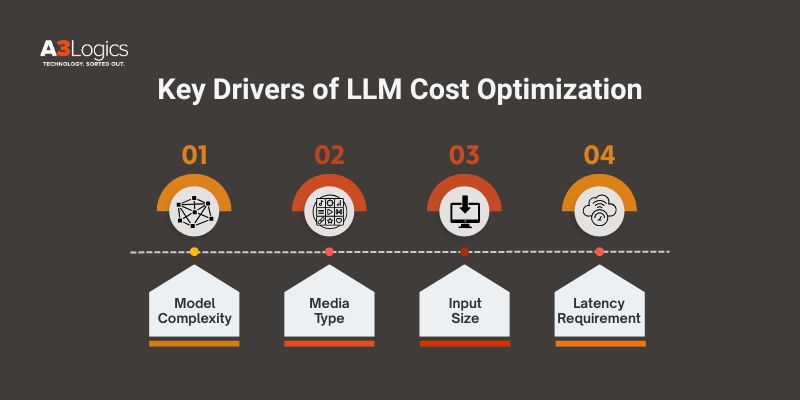
When developing large language models, a wide range of factors must be considered. These factors often play a significant role in increasing the cost. The cost optimisation strategies for running large language models often depend on various factors, such as the following:
1. Model Complexity
Model complexity is often determined by how sophisticated the model will be. While businesses focus on model selection for cost savings, complexity usually affects. Increasing model intelligence frequently leads to more complex architectures and larger models. These can be scaled from 7 billion to 3000 billion parameters, especially with the use of Mixture of Experts (MoE) models. If greater efforts are placed in driving computational demands and costs, the costs of large language models will be significantly higher.
2. Media Type
The type of media used for the LLM often affects the costs. Various media types, such as audio, video, and text, will impact the price. If the LLM is responsible for processing videos and audio at a larger scale, the costs will eventually be higher. This is primarily due to the involvement of large datasets and their inherent complexity.
3. Input Size
The input size of the tokens is also an essential factor to consider, mainly because it is impacted by time. Higher computational sources also affect the input size. When LLMs require significant inputs and outputs, the model development procedure eventually becomes expensive.
4. Latency Requirements
The LLM cost monitoring tools often consider latency requirements as well. How soon you want the tool to respond to the prompt also affects the overall cost. If the LLM has low latency requirements with higher computational resources and optimized infrastructure, the models will be more expensive to maintain. The LLM development company that you partner with can often help you in the process, especially with determining the latency requirements of your business.
Now that you’re aware of the various factors affecting the cost, it’s crucial to understand that there are other cost structures. When you’re establishing the cost optimisation strategies for running large language models, choosing the right model is exceptionally crucial. These often contribute to various deployment options as well. All the cost structures have different financial implications. Below are the top cost structure differences that businesses must understand:
1. Proprietary APIs
Example: Anthropic, Google, OpenAI
These proprietary APIs are often referred to as pay-as-you-go services, where users are charged depending on the number of API calls or token usage. This type of model requires minimal investment and helps with scalability and rapid deployment. However, during the scaling phase, the costs can be significantly higher. The infrastructure will have limited control with model fine-tuning facilities. However, the prices will fluctuate considerably depending on the pricing strategy offered by the vendor.
2. Open-source Models
Example: Mistral, Falcon, LLaMa
Open-source models play a crucial role in reducing long-term costs. However, running and hosting the models will require substantial computing resources, including memory, GPU, and storage. If you want to fine-tune the open-source models, the computing cost will add up to the entire procedure. The software may be free, but costs will be charged for security, optimization, and deployment.
3. Self-hosted Solutions
If your business opts for self-hosted solutions, you can enjoy better control and customization. This paves the way for optimization across various levels, from LLM model selection to inference pipelines. This can help reduce LLM operational costs. However, self-hosted solutions can be expensive, as a significant upfront investment is required for building and maintaining cloud infrastructure. While the business benefits from latency and privacy control, operational complexity can arise.
As part of the cost optimization strategies for running large language models, it is essential to understand the usage scale and data sensitivity. Furthermore, you also need to analyze whether there is enough in-house capability to handle the model while meeting the long-term business goals.
Sector 3: Core LLM Cost Optimization Strategies
Businesses must adopt core cost optimisation strategies for running large language models to determine success. It helps to maintain latency, drive accurate results, and cater to fast performance.
With large language models becoming an essential part of the AI ecosystem, it has become extremely crucial to manage its overall costs. These AI models are powerful, which is why they have high infrastructural and computational demands. These often add up to the extra expenses.
Some of the core LLM cost optimization strategies that businesses must adopt immediately are as follows:
1. Model Selection and Sizing
To save costs, it is essential to choose the right model. While premium and advanced models like Claude or GPT-4 offer accurate and high-quality results, they are quite costly due to their resource-intensive requirements and latency.
Here’s how to select the right model:
- Select smaller or quantized models: In the initial stages, it is advisable to select smaller, open-source models, such as Phi-2, Mistral, or LLaMa 2. These models are efficient in providing sufficient performance for affordable costs. However, it is advisable to try out these tools before actually implementing them.
- Optimization and Pruning: For optimization and pruning purposes, it is advisable to select libraries such as DeepSpeed, Hugging Face Optimum, or ONNX Runtime. These libraries can help deploy quantized models to reduce memory footprint while speeding up inference.
- Choose task-specific models: Fine-tuned models can be optimised for specific tasks. However, these task-specific models can also outperform specific LLMs across areas with low costs.
2. Prompt and Token Optimization
LLMs will charge based on the number of tokens. However, inefficient prompts eventually provide inaccurate responses, which can increase the overall costs due to higher token usage.
Here are key tips for prompt and token optimization:
- Prompt engineering: Opt for prompt engineering with concise and direct prompts. It is advisable to use the right tools for prompt engineering to track and manage version performance.
- Use embedding-based retrievals: Rather than feeding large contexts, it is advisable to store data as embeddings. These help drive relevant chunks with better and more accurate results.
- Token analysis tools: Various token analysis tools, such as LLM360 and OpenAI Usage Dashboard, can help monitor and optimize token usage performance.
3. Model Distillation and Fine-Tuning
Model distillation can compress large and powerful models into smaller ones that mimic their performance. On the other hand, fine-tuning helps adapt a base model for specific tasks while reducing reliance on large-scale inferences.
Some of the key tips for model distillation and fine-tuning are as follows:
- Task-specific fine-tuning: It is best to opt for task-specific fine-tuning using open models, such as QLoRA and LoRA, to train with low GPU requirements.
- Distillation frameworks: For distillation frameworks like Hugging Face Transformers, Trainer can help create smaller models that are trained to provide outputs for the larger ones.
4. Infrastructure and Deployment Tactics
The proper infrastructure and deployment tactics can be beneficial in the long run for driving stability. It helps to lower the computing costs.
The key practices for infrastructure and deployment tactics are as follows:
- Containerization: Models can be deployed with containers, such as Docker, which can be further orchestrated with Ray Serve, Kubernetes, and Modal Labs to drive cost-effective scaling.
- Autoscaling and Serverless options: To opt for auto-scaling and serverless options, you must choose pay-as-you-go deployment models. For this, you’ll have to select platforms like Google Cloud Run, Azure Functions, and AWS Lambda.
- Edge Deployment: Edge deployment is crucial for latency-sensitive takes. The small models can be deployed on edge devices with the help of TensoRT, ONNX, or TFLite.
5. Retrieval-Augmented Generation (RAG) and Hybrid Architectures
RAG plays a crucial role in enhancing business cost efficiency through model computation. On the other hand, it reduces the constant need for feeding huge context windows or re-training.
The key practices for RAG and hybrid architectures are as follows:
- Lower model load: The LLM can play a crucial role in offloading fact retrieval for external systems, enabling reasoning and generation. This plays a vital role in lower context size and text usage.
- Embedding search engines: RAG and hybrid architectures can be built with structures for driving relevant context. However, proper vector databases, such as Pinecone, Qdrant, or FAISS, must be used for this purpose.
6. Automation and Resource Management
Automation and resource management plays a crucial role in managing infrastructure and workflow. This helps ensure that there are no repeated or unmonitored expenses, which in turn facilitates better cost-optimization strategies for running large language models.
The key practices for these are as follows:
- Monitoring: Once automated, the complete process should be constantly monitored and observed for understanding token usage and model latency. Different tools, such as Datadog, Prometheus Grafana, and OpenTelemetry, can play a crucial role in this.
- Auto-shutdown and scheduling: Cloud-native tools can be efficient for auto-shutdown and scheduling. In case there are any unused instances, tools such as Google Scheduler, Terraform, and AWS CloudWatch Events can be of great help.

Sector 4: Case Studies and Practical Examples
Over the years, various businesses have implemented cost optimisation strategies for running large language models to cater to their business needs. This has helped them reduce the overall costs. Here are some of them:
1. Spot Instances
Spot Instances from AWS, Azure, and Google Cloud can cater to the on-demand pricing needs of businesses. It is effective for managing interruptible workloads such as AI model training and batch processing. Uber’s AI platform, Michelangelo, uses Spot Instances for training machine learning models while keeping the costs low. Anthropic also utilizes AWS Spot Instances for training machine learning models, which helps reduce costs, especially with the recent drop in GPU pricing.
2. Cloud FinOps
The Cloud FinOps infrastructure can help in managing AI spending. It provides a crucial framework that can be used for monitoring, allocation, and then helping with LLM cost optimization. It also enables real-time anomaly detection to identify spikes in AI model inference costs.
3. Model Distillation
Amazon Bedrock’s distilled agent models have been a great benefit for the business. AWS reported that the distilled models, such as LLaMa 3.2 3B, helped achieve 72% lower latency and delivered 140% faster outputs than other large models. At the same time, the tool contributed to maintaining a comparable quality of functioning.
For the model distillation method, Amazon Bedrock offers two primary methods for training the data: uploading JSONL files to Amazon S3 or using historical invocation logs. Irrespective of the model you choose, ensure proper formatting with tool specifications for successful distillation.
4. Snowflake’s SwiftKV with vLLM
Snowflake’s SwiftKV with vLLM is one of the top examples of inference and cache optimization. Using the self-distillation and KV cache reuse, SwiftKV from Snowflake AI Research was able to reduce the inference costs of Meta LLaMa LLM up to 75% on Cortex AI. During the entire process, there was only minimal accuracy loss, ensuring the balance between costs and quality.
5. SpotServe
SpotServe served generative large language models on preemptible instances. This procedure utilized spot VMs with dynamic graph parallelism to reduce costs by 54% while maintaining steady performance. Eventually, it helped minimize downtime.
6. AI-driven Hybrid-cloud Scaling
The AI-driven resource allocation framework is used in hybrid cloud platforms, primarily for microservices. The RL-based microservices allocator was able to reduce provisioning costs by approximately 30-40% while achieving proper resource utilization and cutting latency.
Sector 5: How to choose the right LLM Development company?
Choosing the right LLM development company is extremely crucial, especially to drive the growth of your business. These experts can help to reduce LLM operational costs and bring profits. Here are some of the key factors to consider when selecting the LLM company:
1. Comparing Leading Cloud Providers
It is advisable to compare the leading cloud providers before settling on a decision. The LLM company you choose should be working with any one of the top-tier cloud providers such as Google Cloud, Microsoft Azure, or AWS. These platforms offer the benefit of efficiently handling large-scale language models (LLMs).
The LLM companies that utilize these cloud providers often offer enhanced security features and improved uptime. Furthermore, they also provide seamless tool integration with all top services, catering to the demands of the business.
2. Pricing Models and Performance
Cost is one of the top factors to consider while dealing with LLM. Therefore, it is equally essential to understand the company’s pricing models as well. During the interview stage, you can ask the company about its different pricing models, such as pay-per-token, subscription-based, and usage-tiered.
Apart from pricing models, performance is equally important to consider. It is crucial to partner with a provider that can deliver a fast and accurate experience. This will ensure that the resources can be computed accordingly. Furthermore, the right company can also help with building cost optimisation strategies for running large language models.
3. Additional Features and Tools
While dealing with LLMs, additional features and tools must also be equally considered. The LLM company you partner with should also provide you with extra features and tools, such as real-time monitoring dashboards, prompt optimization, and token analytics. You should also check for LLM cost monitoring tools, as they can help you determine costs efficiently.
You can also look for additional features, such as model fine-tuning, multilingual capabilities, and hybrid deployments, with the LLM integrations. These features can speed up the LLM development process. Furthermore, it is advisable to check for other developer-friendly features, such as SDKs, APIs, and integration support, to drive exceptional advantages.
Sector 6: Challenges and Trade-Offs while deciding the cost of LLM
While building the cost optimisation strategies for running large language models, you are likely to encounter a wide range of challenges. It is crucial to address each of these challenges proactively to drive business demands. Some of the common challenges that businesses experience while deciding the cost of LLM include the following:
1. Balancing cost savings with model performance and accuracy
Balancing the cost between model performance and accuracy is often one of the biggest challenges for businesses, especially when deploying large language models (LLMs). Smaller models may reduce the expense, but they may not always provide accurate results or contextual depth due to a lack of understanding.
Large language models, on the other hand, are extensive and provide better results, but their costs are pretty high. API usage, storage, and computing typically result in higher costs for large language models (LLMs). As a result, it often becomes difficult for businesses to strike a balance between maintaining performance and accuracy while also meeting specific task demands.
2. Addressing operational complexity, monitoring, and governance in large-scale deployments
Operational complexity, monitoring, and governance in large-scale models must be addressed at all costs. Running LLMs means scaling it as the demand arises. Managing multiple endpoints, handling API rate limits, and tracking token usage can become challenging. Therefore, a skilled team is required who can work with the LLM cost monitoring tools.
Governance is also a crucial factor, especially in regulated industries. These models are essential for promoting data privacy and responsible AI usage, particularly in terms of ensuring compliance concerning cost and complexity. Businesses need to invest in robust infrastructure and frameworks that drive scalability and secure governance. At the same time, none of this must interfere with user performance or overall experience while using the model.

Conclusion: LLM Cost Optimization
Building cost optimization strategies for running large language models can often be challenging for businesses in the early stages. However, companies must understand that this isn’t only about reducing expenses but also maintaining optimal performance. Choosing the right models can play a crucial role in reducing operational costs. Moreover, experts can contribute to building a well-rounded approach that delivers accurate results without compromising value.