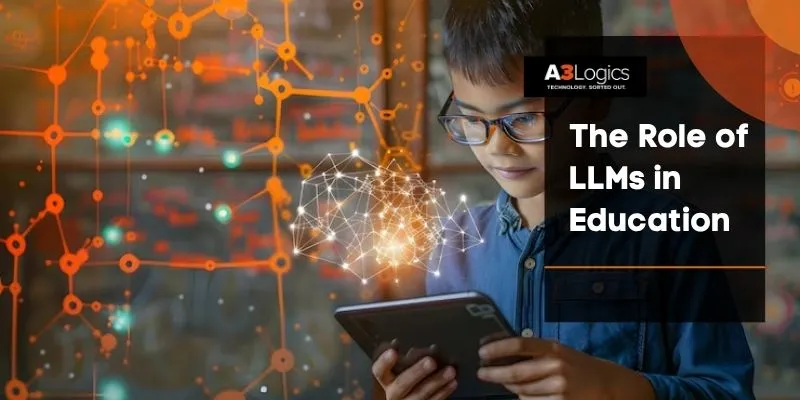
Large Language Models (LLMs) are a type of artificial intelligence that can understand and generate natural language like humans. They are trained on vast amounts of data and use deep learning techniques—such as transformer architecture—to learn relationships and patterns in language. The Role of LLMs in Education is growing as these models are increasingly applied to support personalized learning, automate content generation, and enhance academic research.
They are used for a wide range of tasks, including text generation, translation and other natural language processing (NLP) tasks.
Education is one sector where LLMs are driving meaningful transformation, and here’s how: While education has functioned traditionally, scaling personalized learning has remained unsolved and that’s where the role of LLMs in education is key. With transformer-based architectures like GPT and several other Types of LLMs, like various open-source LLMs, models have become capable of generating context-aware teaching resources, in addition to automated feedback and semantic search.
Secondly, with the data explosion in digital education, where there is an ocean of online courses, virtual classrooms, and e-learning platforms, NLP-driven automation has proved to be tremendously effective in content generation, grading, and enhancing student engagement.
Why Switch To Large Language Models (LLMs) In Education?
Switching over to large language models in education can help in delivering personalized education. They can revolutionize the learning experience by expanding knowledge coverage, providing personalized support, promoting critical thinking, and enhancing inclusivity and accessibility. Let’s dive into the reasons why switching over to LLMs can be a wise move –
1. Personalized learning
LLM-based adaptive learning tweaks its approach to fit an individual student’s needs; For example, a student facing problems in grammar could ask for personalized guidance from an LLM-powered tutor who would work on it with that student.
2. Better Efficiency in Administrative Tasks
LLMs can automate tasks like grading and scheduling. This way teachers and administrators can focus more on mentoring and teaching, and reduce workload.
3. Induce Critical Thinking and Independent Learning
LLMs can encourage students to explore topics independently. By simplifying text, LLMs can provide a strong foundation for understanding and analyzing information.
As the need for advanced, scalable, and intelligent large language models (LLMs) grows, partnering with experts becomes crucial.
Understanding LLMs in the Educational Context
How LLMs Differ from Traditional Educational Technologies
On several parameters, LLMs differ from conventional education technologies, implying that the role of LLMs in education is significant and that, they have an upper hand over traditional technologies –
1. Learning Style and Approach
Where traditional education relies on rote memorization, teacher-centric instructions, and standard tests, LLM-based adaptive learning offers adaptive assessments, personalized learning paths, and instant feedback. The latter caters to diverse learning styles and matches the pace of an individual’s learning capacity.
2. Feedback and Interaction
Prompt feedback given by LLMs is one of the reasons why there is an increasing use of LLMs for personalized learning as compared to traditional learning technologies.
3. Content Generation and Delivery
Conventional educational technologies rely heavily on predefined textbooks, classroom materials, and lectures. On the other hand, large language models in education don’t just generate learning material but even create personalized learning experiences and translate them into multiple languages.
4. Scalability and Cost
The role of LLMs in education can be ascertained by the fact that they are scalable and offer cost-effective solutions focused on personalized learning. Unlike conventional education technologies, they reduce the need for extensive teacher support.
Evolution of LLMs and their Capabilities Relevant to Education
Before we delve deeper into the significant role of LLMs in education, let’s examine their evolution – how they have evolved from basic language tools to advanced systems capable of deep reasoning.
| How LLMs Have Evolved? | |
| Time period | Event |
| 1960s | Eliza, an early chatbot, mimicked human conversations using pattern matching to respond to user inputs. Laid the groundwork for future NLP applications. |
| 1990s | LSTMs, or Long Short-Term Memory networks, were designed to remember information for extended periods. Paved the way for more coherent and context-aware text generation and to better process sequences of words. |
| 2010s | Word embedding models, such as GloVe and Word2Vec, were used. These enabled machines to grasp subtle language nuances and relationships. |
| 2018 | Google introduced BERT, which was capable of analyzing text bi-directionally. Exhibited supreme performance in tasks like language inference and question answering |
| 2020s | The advent of attention-based models (Transformer architecture) like Megatron-Turing NLG, GPT-3, LLaMA, and Jurassic-1.These models utilize self-attention mechanisms to comprehend the relationship between words within a sentence or even across a document. |
| Present day | LLMs like GPT-4 and others are pushing boundaries of AI with tools that can write, summarize, converse, translate, and even generate creative content with precision and sophistication, nearly replicating human intelligence. |
Now, let’s discuss the capabilities of large language models in education –
1. Personalized Learning
LLM-based adaptive learning can analyze students’ strengths and weaknesses and adjust learning materials and exercises accordingly. Furthermore, LLMs can create tailored paths based on career goals, individual learning styles, and preferences, including tutorials, online courses, and simulations.
2. Automated Tasks and Efficiency
The role of LLMs in education in automating tasks and increasing efficiency is unmatched. From providing basic feedback, grading quizzes, to answering student questions, LLMs can assist in creating various applications.
3. Enhanced Learning Experience
To enhance the learning experience of students, LLMs can simulate interactions with experts or historical figures. Interactive platforms can utilize large language models (LLMs) to create gamified learning modules, rewarding students for their progress.
4. Data-driven Insights
LLMs can help analyze student performance data to identify potential bottlenecks and enable early interventions. They can provide personalized learning paths and recommendations for resources.
Key Applications of LLMs in Education
LLMs are reshaping education by automating tasks, powering personalized learning, offering instant feedback, and creating immersive simulations, helping both students and teachers to engage with content more effectively. Let’s have a look at some of the key applications of LLMs in education –
1. Personalized Learning and Adaptive Systems
LLMs are used in personalized learning and adaptive systems. They tailor he learning experience to each student’s needs, style, and pace. To do that, they begin by first analyzing how students learn, what they struggle with, and accordingly adjust the content.
2. Content Generation and Curriculum Development
LLM-based platforms are able to generate complete, structured quizzes, course materials, and lesson plans within minutes. They can help automate curriculum development across multiple languages, subjects, and educational levels.
3. Tutoring and Student Support
LLMs can engage students in conversations, ask questions, and guide them through problem-solving, just as a human tutor would. While tutoring LLMs can automate tasks – such as generating quizzes, creating assignments, and freeing up educators so that they can concentrate on more critical tasks.
4. Administrative Automation
LLMs for administrative automation in schools are helpful as they automate routine school-related administrative tasks such as preparing circulars, drafting emails, creating lesson plans, and summarizing meeting notes. Furthermore, LLMs can assist in generating esports, managing student queries, scheduling events, and even help with grading templates, reducing manual work, and saving staff time.
5. Automated Grading
To grade student assignments or test papers, LLMs can use their natural processing capabilities to analyze and evaluate student answers, provide feedback, and assign scores. They can help assess the correctness, quality, and adherence to the grading criteria of answers.
6. Enhancing Accessibility and Inclusion
The significant role of LLMs in education is evident in their ability to enhance accessibility and inclusion. They break down learning, language, and communication barriers by simplifying complex text, translating content into various languages, and providing explanations in multiple formats. LLMs also help students with disabilities by generating audio versions of text or assisting those with learning difficulties.
Benefits of LLMs in Education
LLMs are a boon for educators; not only do they offer tailored support, but also make learning faster, smarter, and more accessible. Here are some of the key benefits of LLMs in education –
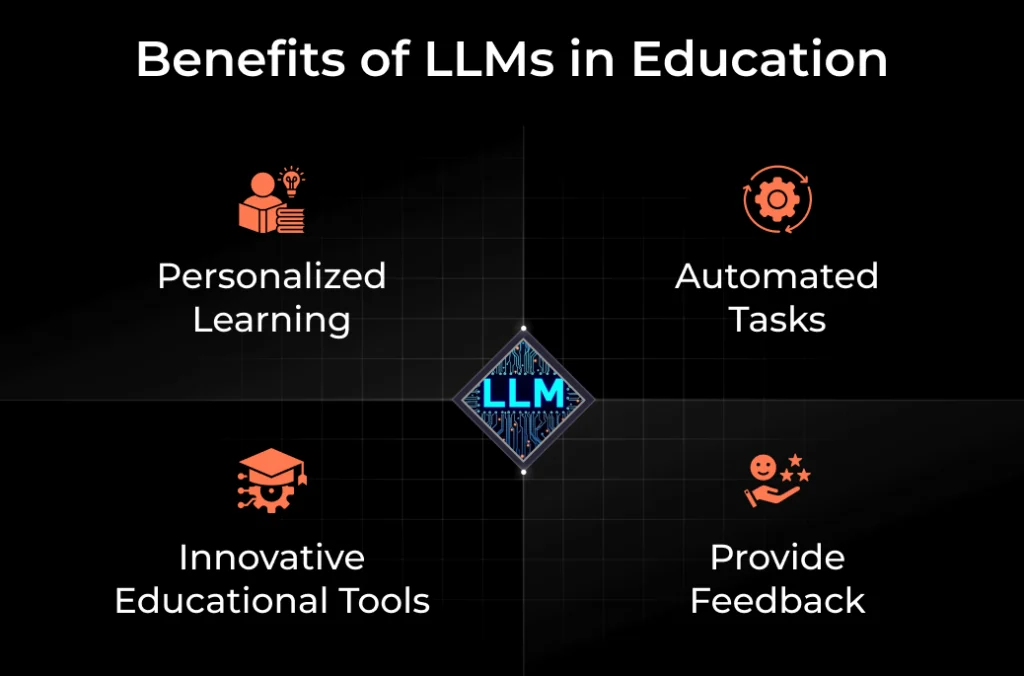
1. Personalized Learning
Large Language Models in education provide customized learning experiences for each student, offering individualized feedback, lesson plan customization, and real-time progress monitoring.
2. Automated Tasks
LLMs can be leveraged to automate processes like lesson planning and grading. By automating tasks, educators can have more time to focus on more critical tasks, such as connecting with students or planning teaching strategies.
3. Innovative Educational Tools
Using LLMs, innovative and cutting-edge learning resources and technologies can be developed. The models can be used to create real-time doubt solvers, simulations, automated feedback tools, personalized quiz generators, content summarizers, and more.
4. Provide Feedback
When analyzing students’ answers, LLMs can provide real-time feedback. This means as soon as the student submits an answer, the LLM model will be able to grade it comprehensively, letting the student know why specific answers are wrong, on which aspects the student can improve, and provide insights on many such aspects.
How LLM can be Used for Transforming Education with Advanced Learning Strategies?
The Role of LLMs in education is pivotal in making traditional education more dynamic and relevant. Let’s discuss how large language models have a revolutionary impact on education –
1. Advanced Personalized Learning Pathway
LLMs can adapt to individual learning styles, student needs, and progress, offering real-time feedback and customized content. They can act as virtual tutors, providing on-demand guidance and support.
2. AI-Enhanced Learning Analytics
The use of LLMs in learning analytics may provide educators with more detailed information on students’ performance and help them make appropriate recommendations.
3. Advanced Interactive Simulations for Learning
LLMs can power advanced interactive simulations by generating scenario-based, dynamic learning environments. For example, in an entrepreneurship class, an LLM can simulate the process of launching a startup. Here, students will be able to pick a product idea, define the target market, and set prices.
In return, AI will act as investors, customers, and competitors, behaving in the same way as these parties would. This simulation will sharpen pitching skills, decision-making, and business strategy.
Challenges and Considerations
1. Potential risks
One of the potential risks of LLMs for personalized learning is that they may disseminate incorrect or false information. In addition to generating incorrect information, LLMs are also vulnerable to generating biased responses that favor a specific viewpoint, belief, or opinion. Apart from these two risks, LLMs may also pose privacy risks as they leverage datasets encompassing data sourced from users, sometimes without their consent.
2. Ethical Concerns
While the role of LLMs in education can’t be denied, ethical issues pose a significant challenge. These encompass issues like privacy, bias, academic integrity, and misinformation. When implementing LLMs for education, it is crucial to address these ethical concerns and take proactive measures to mitigate them.
3. Lack of Understanding
LLMs may struggle to grasp the nuances of human communication and context. This may lead to inappropriate responses or misinterpretations. They may not fully understand the material they produce, and as such, may yield confusing or irrelevant answers, provide feedback that doesn’t align with the task, or misinterpret student queries.
4. Incorrect or Misleading Information
LLMs are trained on vast volumes of data. Although every effort is made to train LLMs on current data, some datasets may still contain outdated, inaccurate, or even biased information. Students and other learners may struggle to differentiate between fabricated and factual information.
The Future of LLMs in Education
LLMs in the future are going to shift from just being tools to intelligent partners helping reshape learning and enhancing education.
1. Enhanced Personalization
The role of LLMs in education is evident in their ability to adapt to individual students’ learning styles and needs, resulting in enhanced engagement, improved academic outcomes, and increased retention. They can provide real-time feedback, generate customized content, and offer tailored learning pathways.
2. Increased Accessibility
LLMs are designed in a manner that allows them to be customized according to diverse learning needs. Even students with learning disabilities or learners from different cultural backgrounds can enjoy education. All in all, increased accessibility translates into a more equitable and inclusive learning environment. Another aspect of accessibility is that LLMs can deliver a personalized learning experience to a wider range of students.
3. Deeper Integration
LLMs are poised to integrate deeper into existing school systems. For instance, there is widespread use of LLMs for administrative automation in schools, where LLMs are embedded into their systems. This enables them to automate tasks such as handling parent communication, generating reports, managing timetables, and drafting official documents.
4. Advanced Analytical Capabilities
LLMs can analyze student performance, preferences, and learning behaviors to curate customized learning paths. Furthermore, they can analyze large datasets of student data to identify trends and patterns in learning. This way, they can aid educators in creating personalized assessments based on these patterns and trends.
5. Broader Applications
Large Language Models in education will unlock a diverse range of real-world simulations and hands-on learning experiences. By simulating real-life scenarios such as scientific experiments, business negotiations, and social interactions, they’ll train students to apply theoretical knowledge in practical settings.
6. Ethical and Responsible AI Use
Future LLMs will play a key role in promoting responsible and ethical AI use. Students are being taught about AI’s limits, risks, and strengths. Furthermore, in the future, LLMs will be designed to explain why certain outputs are generated, enabling learners to identify inaccuracies and biases. Institutions will integrate LLMs with clear guidelines on transparency, fairness, and privacy.
How Advancement & Research Have Been Happening in LLM Technology for Education?
1. Innovative Features & Technological Advancements
LLMs are transforming education by enabling adaptive learning, personalised tutoring, automated grading, and intelligent assessment. They are helping learners through interactive tools such as chatbots, simulations ,and other accessible formats.
2. Ongoing Research in LLM Applications
As we look to the future, ongoing research and development will be key to realizing the full potential of LLMs in education, creating a more personalized, adaptive, and accessible learning experience for all students.
3. Research and Development Focus
Research and development in LLMs for education focuses on utilizing these models to enhance teaching and learning processes, including personalized learning, intelligent tutoring, and assessment. Specifically, current research is exploring LLMs for providing real-time feedback, reducing educational barriers, and automating tasks like grading.

Why Choose A3Logics for LLM Development in Education?
Looking for a large language model development company that can help you with tailored solutions?
At A3Logics, we design tailored solutions for educational platforms – ranging from automated content generation to adaptive learning tools and admin automation. What makes us stand out is the fact that we have a deep understanding of both real-world education systems and AI technology. As an expert LLM development company, we connect our large language models with existing education systems such as ERPs, learning management systems, student information systems, EdTech apps, etc.
So, if you are looking for reliable, future-ready Generative AI Development, we are just a call away.
Conclusion
To conclude, large language models have started to revolutionize education by enhancing the learning experience of students as well as easing administrative tasks for institutions. It goes without saying that there are challenges, but with the right intent, effort, and partnership with a seasoned company like A3Logics, LLMs can be implemented in education, regardless of the platform or business size.