Customer data is one of the most important things a firm can have in today’s world. But it might be hard to get useful information from that data if you don’t have the necessary tools to look at it and use it. Role of Data analytics in CRM (Customer Relationship Management) systems, has a key role to play along with other technologies like AI. You can find out more about how AI is changing CRM solutions here.
Companies want to get ahead of their competitors in their fields, therefore data analytics is becoming more and more crucial in CRM. The Global CRM Analytics Market was worth $12.93 billion in 2023. It is expected to rise from $14.59 billion in 2024 to $38.23 billion by 2032, with a compound annual growth rate (CAGR) of 12.8% during the forecast period (2025–2032). Businesses can learn a lot about their customers’ behavior, interests, and needs by looking at sales, marketing, and customer data. You may then use these insights to make better business choices and make your customers happier. This is where the role of data analytics in CRM.
In this article, we will discuss the basic classifications of data evaluation in customer relationship management (CRM), which include the role of data analytics in CRM, as well as the ways in which implementing data analytics in CRM might improve Customer relationship management in order to facilitate a more comprehensive perspective of your customers.
Understanding Data Analytics in CRM
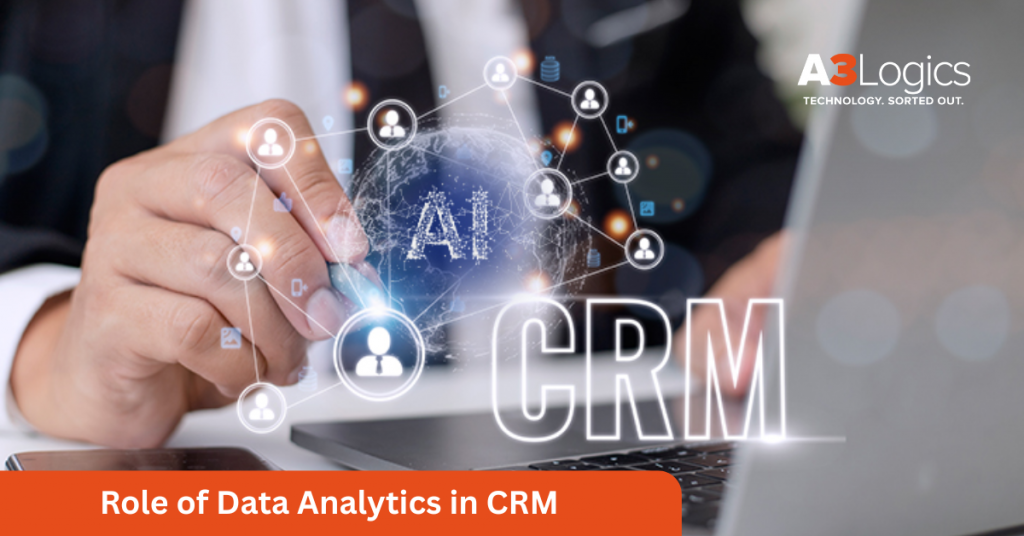
Data Analytics in CRM (Customer Relationship Management) is the process of gathering, processing, and analyzing customer-related information to enhance relationships, comprehend behaviors, and maximize sales and support strategies. It means applying tools and technologies to transform raw customer information—such as purchase history, feedback, browsing activities, and service interactions—into actionable insights that can inform improved business decisions.
With data analytics, companies can segment customers, forecast future actions, tailor communications, and see how well their sales and marketing efforts are working. Whether it’s customer high-value identification or minimizing churn, analytics enhances every aspect of the CRM system.
Why Data Analytics is Critical for CRM?
Data analytics is critical to CRM because it turns a CRM system from a passive store of contacts and interaction history into a decision-making powerhouse. Without analytics, CRM platforms are nothing more than contact storage and interaction histories. With analytics, they are systems that can forecast customer requirements, detect revenue opportunities, and deliver personalized experiences that build loyalty.
The top reasons why data analytics in CRM matters are:
- Customer Insights: Know customer preferences, buying behavior, and pain points in real-time.
- Personalized Engagement: Facilitate customized marketing, sales, and service interactions that connect with individual customers.
- Customer Retention: Anticipate churn risk early and actively engage at-risk customers.
- Revenue Optimization: Identify upselling/cross-selling opportunities and determine your highest-value customer segments.
- Performance Tracking: Measure campaign performance and sales pipeline metrics to inform strategies.
How Data Analytics Drives Successful CRM?
Data analytics drives successful CRM by refining customer knowledge and informing data-driven decisions throughout departments. It enables companies to leverage prior behavior and real-time interactions to predict future results and adjust strategies in response.
A few concrete ways it drives CRM are:
- Customer Segmentation: Segment your customer base by behavior, demographics, or purchase history to provide tailored messaging.
- Predictive Modeling: Employ machine learning and AI to predict customer behavior, i.e., probability of buying or churn probability.
- Sales Forecasting: Determine which leads will convert and which products will be successful in various markets.
- Sentiment Analysis: Use customer feedback or social media feedback to gauge customer emotions to modify service tone and complaints handling more sympathetically.
- Lifecycle Tracking: Track an individual’s entire path from lead to repeat customer to enhance interaction at each point.
How Data Analytics Improves CRM Performance?
Data analytics can significantly help with improving CRM performance. Here is the role of data analytics in CRM to improve its performance.
> Enhances customer segmentation
Data analytics in CRM enables organizations to segment their consumer base based on behavior, demographics, and interactions. This facilitates the development of targeted marketing efforts that appeal to various audience segments.
> Tracks and Measures Engagement.
CRM systems can analyze data from many touchpoints to determine how customers interact with your brand. This allows you to track engagement levels and identify areas for improvement in outreach and communication efforts.
> Provides predictive insights.
Data analytics in CRM provides predictive modeling, which allows organizations to forecast future customer actions based on historical behavior. This aids in the optimization of marketing tactics, improving sales predictions, and anticipating client wants.
Key Benefits of a Data-Driven CRM Approach
A CRM system augmented with data analytics can give substantial advantages, the key benefits of implementing data analytics in CRM which include :
- Personalized Customer Experiences: Analyzing data allows you to provide more relevant information, goods, and services to specific customers.
- Improved Decision-Making: Predictive analytics enables your team to make wiser, data-driven decisions that result in improved outcomes.
- Optimized Sales and Marketing efforts: Data insights can help you fine-tune your efforts and ensure that your marketing dollars are well spent.
- Increased Customer Loyalty: Better data equals better service. Understanding consumer behaviors and preferences allows you to develop stronger relationships and enhance retention.
What are the Types of CRM Analytics?
There are four different kinds of data analytics in CRM software. There are many types of software for different types of businesses, from small business CRMs to enterprise-level software.
Here is the breakdown of the various types of CRM analytics.
1. Operational CRM
Operational CRMs automate and streamline a company’s customer relationship management activities. These CRMs, especially sales CRMs, also help to optimize sales, marketing, and customer care by offering tools for teams to visualize and manage the whole buyer’s experience.
By optimising and automating these activities, sales teams may spend more time engaging with customers rather than managing manual duties. Furthermore, operational CRMs make it easier for developing firms to maintain providing high-quality service at scale by:
- Sales automation solutions help to streamline sales tasks such as lead scoring, opportunity management, and quote generation.
- Contact management saves and manages all client data, including contact information, interaction history, and preferences.
- Ticketing systems, live chat functionality, and knowledge base software are examples of tools used in service management to track and handle client complaints.
CRM automation and other features also free up staff time for tasks that demand creativity and human interaction. These operational capabilities are particularly effective for hubspot b2b lead generation, where automation and personalization work together to nurture prospects efficiently.
In the manufacturing sector, operational CRMs play a key role in managing complex customer relationships, coordinating sales pipelines, and improving communication between sales, production, and service teams. A dedicated manufacturing CRM helps businesses track customer requirements, monitor orders, and maintain accurate records throughout the production lifecycle. Solutions such as Method CRM provide manufacturers with greater visibility into customer interactions while automating routine processes, enabling teams to deliver more responsive service and build stronger long-term client relationships.
2. Analytical CRM
Analytical CRMs gather and analyze customer data, providing data-driven insights. Digital CRM analytics tools and platforms simplify data collection and streamline analysis, ensuring firms really use the information they collect via:
- Data mining uses client data to forecast trends and behavior.
- Data warehousing is the process of storing, organizing, and managing huge amounts of data in a CRM database to acquire a comprehensive view of customer interactions.
By implementing data analytics in CRM businesses can have a better understanding of what processes lead to successful sales, how to boost customer retention, and what the most typical consumer requirements and challenges are.
3. Collaborative CRM
To improve collaboration between sales and service teams, you need a mechanism to transmit information in real time across a company. Collaborative CRMs boost departmental communication, ensuring that everyone understands management and strategy expectations.
- Collaborative CRM views each encounter as part of a bigger, integrated dialog between the brand and the customer, as follows:
- Interaction management monitors interactions across many channels, ensuring that each consumer receives consistent brand communication and tailored offers based on the buyer’s journey stage.
- Channel management optimizes sales tactics and marketing campaigns using communication channels such as email, phone, and social media.
- Document management consolidates where organizations store critical client papers in order to improve data access.
Omnichannel integration and departmental collaboration save buyers from having to repeat information every time they speak with a new contact and allow any team member to access current, relevant client information at any time.
4. Strategic CRM
Strategic CRMs assist firms in identifying high-value clients and developing individualized CRM strategies to maximize engagement. This sort of CRM software offers a complete solution for managing client connections and enhancing corporate processes by:
- Customer segmentation separates customers into groups based on certain characteristics such as behaviors, needs, demographics, or geography.
- Customer engagement creates long-term strategies for keeping customers engaged with a business, resulting in increased retention and revenue growth.
- Customer data management involves collecting, storing, and managing a database of customer information in an ethical and secure manner.
Businesses that use a strategic CRM can devote more resources to upselling and cross-selling, as well as other sales-boosting methods.
How to Implement Data Analytics in CRM Successfully?
Various businesses are looking to integrate data analytics into their CRM systems. Here is how a data analytics service company can help them integrate data analytics for CRM effectively.
1. Define Clear CRM Objectives
Prior to getting into data analysis, take the time to define exactly what you hope to accomplish through your CRM—whether customer retention, sales conversion, or service delivery. Having measurable goals in place keeps your analytic efforts targeted and aligned with larger business strategies so that valuable data can be collected and actionable insights developed.
2. Gather and Analyze Relevant Customer Data
Gather data from various touchpoints such as website interactions, purchase history, social media, support tickets, and email campaigns. Clean and structure this data so it is consistent and of quality. Analyzing it enables you to determine patterns, behavior, and pain points, which are vital to creating bespoke marketing and customer engagement tactics.
3. Apply Insights to Refine CRM Strategy
Use data insights to modify your CRM strategy. For instance, divide customers on the basis of purchase behavior, customize messages, or automate processes. It ensures improved customer satisfaction, higher rates of retention, and better overall ROI by making informed data-driven decisions instead of making guesses.
4. Choose the Right Analytics Tools
Choose analytics solutions that easily integrate with your current CRM and provide functionality such as real-time dashboards, AI-powered insights, and predictive modeling. Solutions such as Power BI, Tableau, or analytics native to the CRM can automate operations and enable visualization of customer trends and patterns in ways that make data interpretation easy for both technical and non-technical staff.
5. Train Teams for Data-Driven Culture
Make sure your sales, marketing, and customer service teams learn how to use and read CRM analytics. Provide workshops and develop SOPs for reading reports and using insights. A culture that emphasizes data fuels informed decision-making across all levels and promotes accountability, teamwork, and ongoing improvement.
6. Continuously Monitor and Optimize
CRM data analytics is not a static activity. Monitor performance metrics, customer feedback, and campaign effectiveness on a regular basis to see what works and what doesn’t. Utilize this feedback loop to iterate strategies, pilot new initiatives, and remain nimble in adapting to changing customer requirements and market dynamics.
Common Challenges in Applying Data Analytics to CRM
Data analytics can help CRM operations in many ways, but firms may also run into some problems. CRM Challenges with Data Analytics are:
> Data Quality and Inconsistency
One of the hardest things about using data analytics in CRM is making sure that the data being looked at is correct and trustworthy. If the data is missing or wrong, it can give you wrong information and make you make bad choices.
> Lack of In-House Expertise
Not knowing enough about data analytics in CRM is another problem. Companies might not have the required tools and technology, or they might not have the expertise or understanding to collect and analyze data well.
> Integration with Existing Systems
It might also be hard to add data analytics capabilities to CRM systems that are already in place. Companies would have to buy new equipment or work with vendors to make sure that their data analytics solutions can function with their CRM systems.
> Balancing Data Privacy and Personalization
Another problem is finding a balance between protecting people’s privacy and wanting individualized marketing and customer experiences. Companies must make sure that they are gathering and using client information in a moral and responsible way.
Data analytics in CRM has a number of problems. Businesses can get around these problems, though, by buying the correct technology, training their employees, and putting data quality and privacy first. They can get useful information that can help them make the client experience better, work more efficiently, and expand by doing this.
Why Choose A3Logics for CRM and Data Analytics Solutions?
At A3Logics, we combine our extensive knowledge of CRM with powerful data analytics to help organizations gain valuable information about their customers and expand strategically. Our CRM and data analytics tools are made just for your business needs, whether you want to keep more customers, make your marketing efforts more personal, or make your sales pipelines more efficient.
We have a team of qualified IT experts, CRM strategists, and experienced data scientists that make sure that our solutions work well with your current systems. Our data-driven solutions improve customer engagement and operational efficiency.
We don’t just do regular installations; we also assist you create a culture in your company that is based on data. We help with anything from gathering and cleansing customer data to using AI and machine learning for predictive analytics. Our systems meet international data privacy standards, which means that data is handled safely while yet allowing for individualized client experiences.
Our CRM analytics frameworks are also great for both mid-sized and large businesses because they can expand with your organization.
When you work with A3Logics, you get more than simply a service provider. You get a long-term partner who wants to turn your CRM into a strong tool for growth, loyalty, and intelligence. We can help you make important decisions based on facts.
Conclusion – Role of Data Analytics in CRM
Businesses who want to improve their CRM operations might use data analytics to do so. Businesses may learn a lot about their customers by collecting and analyzing their data. This information can help them improve their marketing, sales, and customer service. But it can be hard to use data analytics in CRM. To be successful, businesses need to get the necessary tools, technology, and training.
If businesses don’t use data analytics in their CRM systems, they could slip behind. Businesses who don’t make full use of consumer data miss out on the chance to streamline their processes, make better decisions, and give customers a more personalized experience.