Blog Summary
The introduction of AI Agents in pharmaceuticals has indeed brought a radical change to each part of the value chain in pharma, which covers the spectrum from drug creation to clinical trials, right to supply chain management and even pharmacovigilance.
Agentic AI in Pharma is transforming operations by boosting speed, accuracy, compliance, and enabling data-driven decisions with minimal human input. This blog highlights its real-world use cases, key benefits, implementation challenges, and future trends shaping the pharmaceutical industry.
Introduction
The pharmaceutical sector is advancing technologically at a breakneck speed. The primary driver of this growth is the adaptation of different technologies like the cloud, big data, and AI/ML. Pharmaceutical software is changing the way drug companies automate the supply chain from developing drugs to post-market surveillance. Pharma software has changed the whole sector, with AI Agents in pharmaceuticals being the most effective among them.
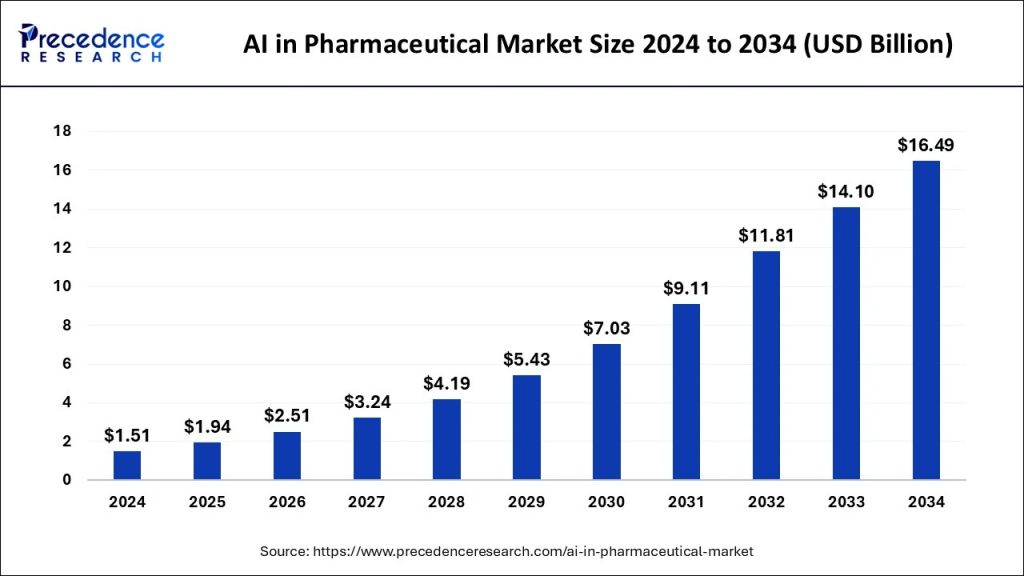
Source: precedenceresearch.com
AI has shown significant growth during the COVID-19 pandemic. In the past, it pushed the life sciences sector to digital automation in R&D and manufacturing environments. AI agents today are in a phase of expansion in which they contribute to the automation of tasks in clinical studies. According to forecasts made by Precedence Research, the market will fly from USD 1.94 billion in 2025 to USD 16.49 billion by 2034, which translates into a yearly growth of 27%.
This blog focuses on the emergence of AI Agents in Pharma, on the contrast with standard AI applications, and how these systems manage to bring real benefits to the pharmaceutical life cycle.
What Are AI Agents and Agentic AI?
1. What Are AI Agents?
An AI agent is an intelligent system that perceives its environment, makes decisions, and acts with minimal human input. Unlike traditional AI, which waits for instructions, AI agents reason, plan, and use memory to solve problems independently. According to Google Cloud, they choose tools, APIs, or data autonomously to complete tasks.
2. What is Agentic AI?
Agentic AI, as the name implies, has added special features that are autonomous, iterative, and flexible. AI that learns based on decisions made about the previous setting is a prime example of agentic.
Agentic AI mirrors actions and environments while understanding their functional relationships. It combines large language models, machine learning, and automation to handle complex, multi-step tasks without constant human input or repeated triggers.
In pharmaceutical research, agentic AI autonomously improves lead compound synthesis by analyzing chemical data, simulating molecular structures, and refining outcomes using lab feedback and feasibility checks.
3. Key Characteristics of AI Agent and Agentic AI
- Autonomy: They are at liberty to act once certain conditions are met; that is, they will perform actions that they see as correct on their own accord.
- Goal-Oriented Planning: They break down goals into performable subtasks using decision trees.
- Context Awareness: They use data gained from different sources (EHRs, chemical libraries, market signals) to get a clear picture and thus make adequate decisions.
- Memory and Learning: They keep track of previous events, and with that knowledge, they either alter actions or improve processes over time.
- Tool Invocation: They choose dynamically which APIs or modules are necessary to perform the subtasks, which for example can involve querying genomic databases or document drafting.
Differentiating AI Agents from Traditional AI in Pharmaceutical
Static vs. Dynamic Intelligence
Conventional pharma AI systems such as an image recognition tool or a dosage calculator that make decisions based on fixed inputs and deterministic models. They are efficient only for clearly defined, repetitive tasks and cannot be adapted to new scenarios.
Agentic AI mirrors human actions while understanding the relationships between environments, tools, and goals.
It combines large language models, automation, and memory to handle tasks with little to no human input.
Unlike static systems, it reasons, plans, and adapts in real time based on data and context.
Static AI alerts you to abnormal lab results, while dynamic AI goes further by linking those results with patient history. It then suggests diagnostics and autonomously schedules follow-ups, executing the entire workflow without additional human input.
Reactive vs. Proactive Behavior
Traditional AI is reactive as it waits for inquiries to proceed. If no requests are made or the data format changes, the system just stops. Nevertheless, AI agents present a different approach through their proactivity. Upon receiving a directive, they find the relevant information, create hypotheses, conduct experiments, and based on the results of these experiments, they modify their actions if needed.
With the deployment of outcomes as the main driving force, agentic AI in Pharma shifts processes from trigger-based to outcome-driven workflows.
Examples of AI Agents in Pharmaceutical
- Regulatory Automation: The use of AI agent tools to create, read, and revise based on new medications or safety studies regulatory documentation that takes care of most of the human errors while being much faster.
- Digital Lab Assistants: Lab experiments to analyze data autonomously, tweak the experiment, interface with electronic lab books, and autonomously run agents.
- Pharmacy Inventory Management: Agents that analyze trends, automate inventory reorders, and plan logistics without needing human involvement.
- Virtual Research Coordinators: A multi-agent system that is capable of running any study by analyzing the site performance data, patient data, and modifying the research protocols accordingly, in real time.
These use cases are indicators showing that Agentic AI in Pharmaceutical Industry is evolving into systems that both support human decision-makers and act as independent contributors to multiple workflows.

Real-World Use Cases of AI Agents in Pharmaceuticals
1. Drug Discovery & Development
The most positive and constructive use of AI Agents in pharmaceutical workflows is in drug discovery. The usual time for development is 10 – 15 years, having high costs and failure rates. AI agents take over the majority of this process by processing genomic, proteomic, and chemical data to find viable drug candidates.
In 2023, there were 24 AI-discovered candidates that had reached the Phase I trials, and 21 of them were successful resulting in a win-rate of 90% against the historical 40 – 65%. These agents are responsible for target identification, lead optimization, and ADMET profiling, which are all improving the compounds based on laboratory feedback.
With the help of generative models, for instance, AI agents have been embedding REINVENT 4 in their designs which results in the autonomous and optimal designing of novel compounds.
2. Clinical Trial Management
Clinical trials face delays and cost overruns as nearly 80% fail to meet enrollment targets on time. AI agents help by managing recruitment, site selection, risk monitoring, and compliance from the start. This proactive approach cuts down the time required for trial setup and reduces operational bottlenecks.
AI agents can design protocols, consent forms, and case report templates using past submissions and current regulations. This reduces administrative burden and increases regulatory readiness at the same time, improving overall trial efficiency and compliance.
3. Personalized & Precision Medicine
One of the significant utilities of AI Agents in the pharmaceutical area is personalized medication. Traditional medical approaches often depend on population-level data, which can be the reason for the inconsistent results. AI agents modify this by prescribing drugs, whereas the medications that are associated with the patient’s genetic data, lab tests, wearable sensors, and comorbidities are used.
For instance, an agent can evaluate a tumor sequencing, check the clinical libraries, and suggest a tailored therapy. Additionally, it can recommend a precise dose based on the expected metabolic modeling and pharmacokinetics.
4. Supply Chain & Inventory Optimization
The pharmaceutical supply chain is a web of complexities with disruptions, including delays, stockouts, and compliance risks that constantly plague operations. AI Agents in Pharma on the other hand, are able to tackle these problems through real-time tracking, predictive analytics, and self-decisions.
They collect data from prescription trends, weather, and logistics APIs to manage drug availability in a proactive way. For instance, they can change the dispatch route or resize the production without human interaction at all.
At the hospitals, they predict the demand frequency and are programmed to automatically reorder which ultimately leads to preventing the wastage of products and the avoidable crisis of shortage. This shows the broader benefits of AI Agent in pharma, from operational resilience to seamless ERP and SCM integration.
5. Pharmacovigilance & Safety Monitoring
Drug safety is of paramount importance in the pharmaceutical sector, while pharmacovigilance, a traditional approach, relies on delayed, manual reporting. AI Agents in pharmaceutical environments completely change this process by conducting continuous, autonomous monitoring across literature, clinical reports, social media, and wearable data.
When incidents of adverse events happen like an increase in certain symptoms, agents send alerts to the safety team with pre-drafted documents instantly. These systems not only detect adverse drug reactions but also automate the surveillance and reporting, thus saving hundreds of hours in the process.
Agents that focus on continuous monitoring and automatic reporting are examples of the Agentic AI in Pharmaceutical Industry as a core model. These instruments will both improve safety signal detection and as a result ensure faster, more thorough responses.

Key Benefits of AI Agents in Pharmaceuticals
1. Speed & Efficiency
Drug development is heavily reliant on time, and the AI Agents in pharmaceutical workflows make it optimal and shorten it by completing the tasks that were manual and will take several weeks. Generative agents are able to write trial protocols and analyze genomic data in a few hours, rather than spending days performing lengthy manual processes.
According to the World Economic Forum, these AI tools are capable of shortening timelines and saving hundreds of millions of dollars for each product.
This automation increases speed, reduces R&D expenses, and, most importantly, helps pharmaceutical companies remain agile and compliant while maintaining data integrity.
2. Improved Accuracy & Precision
Mistakes caused by humans are a regular risk in pharmaceuticals from wrongful documentation and data errors to poor trial site selection. AI Agents reduce these risks by employing ML models that are made easier by trained and validated datasets, based on which they make high-accuracy, data-driven decisions.
For example, agents in clinical trials can set the inclusion criteria by using both structured and unstructured data sources. While in pharmacovigilance, they decode safety signals through correlating data from different sources, which is simply out of the reach for static tools.
This precision is of utmost importance in rare disease studies where the slightest mistakes can have dramatic consequences.
3. Data-Driven Decision Making
Decision-making in Pharma has gone through a massive transformation, now primarily driven by available data, and AI Agents in pharmaceutical setups have been the key drivers of this change. Instead of just generating dashboards, agents deliver actionable insights and when needed, take appropriate action.
In a trial, an agent might note the enrollment delays occurring and recommend reallocating resources. In a chain supply, it can foresee demand by using the EHR data and speak of the early reorder.
Through the embedding of intelligence into the workflow, AI agents achieve the turn of insight into the relevant outcome.
4. Regulatory Compliance
Pharma companies have a hard time staying compliant with global regulations, as such are resource-intensive. AI Agents take care of this by making use of automation in documentation, validation, and compliance monitoring.
By pulling from the validated data and updating the processes with the evolution of guidelines, agents can automatically generate the IND or NDA documents. Also, A3Logics ensures that its AI solutions are HIPAA, GDPR, and ISO 27001 ready and brings in features like audit trails and encryption.
Challenges in Adopting AI Agents in Pharmaceuticals
1. Data Privacy & Security
Sensitive data is the primary concern in AI Agents used in a pharmaceutical context, especially those dealing with health-related data, such as patient records or proprietary and confidential knowledge and research. With such data, there are threats related to privacy regulations, such as HIPAA and GDPR.
Even data that is anonymized can be re-identified through advanced ML formulas, and hence adding robust security is an absolute must. This includes encryption, access controls, and federated learning to protect data during processing.
To build trust, organizations should validate their entire AI architecture against the ever-evolving privacy standards – in the absence of that, adoption will definitely wind down.
2. System Integration
Pharma companies are generally relying on legacy systems, such as on-prem ERP, siloed databases, and manual workflows, which are the cause of the integration issues.
AI agents require real-time and unified data access. The need for APIs, middleware, and in some cases major infrastructure upgrades is needed to bridge the gap. Organizations should be taking the digital maturity assessment to make considerations on scaling the agentic AI solutions.
3. Bias & Transparency
AI Agents can exhibit attentional bias wherever they have training data issues or design flaws, which must not be the case in life-impacting decisions. As an example, an agent that is trained on Western datasets might constrain the representation of some groups in clinical trials.
Transparency is critical. Regulators and teams must fully understand the algorithms and their formative research. Organizations have to put in place rules that define explainable AI, validation processes, and routine bias audits as part of their governance framework.
4. Human Resistance & Workforce Adaptation
Making adjustments to the team environment during the adoption of Agentic AI in pharma can influence how employees work. Workers might feel threatened with their jobs or worry that they are not ready to work with AI agents.
Overcoming this problem requires solid change management. Leaders should promote agents as support rather than replacement and should also invest in reskills, early demos, and cross-functional teams to make it easier for new hires to adopt the system and build their confidence.
Future Trends in AI Agents in Pharmaceuticals
Here are some futuristic agentic AI trends in pharma industry:
1. Federated Learning & Edge AI
The increase in the demand for privacy and the distribution of health data has led to the utilization of federated learning and edge AI in Agentic AI in the pharma sector.
Federated learning provides the opportunity for agents to train at different institutions without data sharing, which improves privacy and model performance at the same time. Edge AI allows for real-time decision-making on local devices, such as wearables or hospital servers which is more efficient by cutting latency.
These technologies together boost the use of AI agents in pharmaceuticals that require secure, fast, and decentralized computing.
2. AI Agents in Drug Design
Drug design is evolving beyond human-driven exploration. Using generative models and reinforcement learning (e.g., REINVENT 4), AI Agents can autonomously design, evaluate and refine new compounds.
These agents run closed-loop cycles, proposing molecules, predicting outcomes, and adjusting based on lab feedback. The result: faster discovery and higher-quality candidates.
3. Digital Twins for Clinical Trials
Digital twins are virtual models of patients or trials, which enable AI agents to simulate outcomes and refine protocols using real-world data.
They reduce trial costs, durations, and ethical burdens by generating synthetic cohorts and minimizing placebo reliance. Agents forecast risks like dropout rates and optimize dosage plans in advance.
4. AI Governance Frameworks
As AI adoption rises, so does the need for governance. The FDA and EMA are two regulators that require AI agents to be transparent, traceable, and managed across their life cycle.
Enterprises are setting up governance frameworks that incorporate fairness testing, audit trails, and human-in-the-loop controls. The governance-as-a-service model has gained traction along with the standardization of validation tools.
Governing the use of AI is not an option but a prerequisite for responsible deployment in the case of any AI Development Company in life sciences.

Why Choose A3Logics for AI in Pharmaceuticals?
A3Logics is a great choice for AI in Pharmaceuticals because we have been delivering secure, scalable platforms for over 21 years to industries like healthcare, manufacturing, and education. We have a strong track record of building high-performance AI solutions that meet the requirements of the pharmaceutical sector.
As more companies transition from pilot projects to AI Agents in Pharma at the enterprise level, it has become crucial to have the right technology partner more than ever.
Our Certifications & Accreditations
- ISO 27001 – Information Security Management: Ensures strict protocols for protecting sensitive health and business data.
- ISO 9001:2015 – Quality Management Systems: Validates consistent quality in AI solution design and deployment.
- HIPAA Compliance Expertise: Helps to manage protected health information, which is critical for the U.S. based pharmaceutical application.
- Microsoft Gold Partner: Demonstrates advanced capabilities in cloud-based AI deployments, including Azure AI and ML platforms.
- AWS Certified Consulting Partner: Provides deep expertise in scalable, cloud-native AI infrastructure.
- CMMI Level 3 Certified: Reflects institutionalized processes for software development maturity, including validation and compliance.
- NASSCOM Member: Ensures alignment with global IT and healthcare innovation standards.
With these credentials, we at A3Logics not only accelerates deployment but also de-risks the process, delivering AI Agent Development Services that are auditable, scalable, and future-proof.
Conclusion
AI Agents in pharmaceutical environments are no longer an experimental piece. They are becoming necessities in R&D, clinical trials, safety, and supply chain. These systems set the new path for the pharmaceutical industry in terms of how to innovate and scale.
However, the adoption of technology needs more than tools. It involves a strong data foundation, governance, and partners who are technology experts. By embracing Agentic AI in Pharma, companies can achieve intelligent automation that is flexible across functions and regions.
A3Logics is the one that brings this ability.
Partnering with a trusted AI Development Company is the next strategic step for pharma leaders who are looking to implement AI efficiently at scale.