
Fraud has increasingly become a smart, agile, and very organized cyber threat. Automation-driven fraud, Synthetic IDs, Social Engineering, & Networks are propelling fraud attacks on financials, insurance, e-commerce, healthcare, & businesses today. The fraud vectors span: channels, geography, & transactions, exploiting the seams between systems & functions.
Traditional methods of fraud detection were designed for a less complicated world. AI algorithms can achieve up to 96% accuracy in distinguishing fraudulent from legitimate transactions. Rule-based engines or siloed monitoring tools can’t match today’s speed and intricacy. Static thresholds create false positives, swamping the investigation teams with noise while missing high-risk activity. Fraud often isn’t identified in advance, only afterward.
It is this asymmetry that’s growing wider between fraudsters and organizations that’s forcing a fundamental shift. AI agents for fraud detection are fast emerging as a strategic priority among risk leaders because they go well beyond prediction: They observe, reason, learn, and act autonomously across fraud workflows. Instead of isolated models scoring transactions; organizations can now deploy coordinated intelligence systems capable of real-time decisioning, adaptive learning, and proactive fraud prevention.
What are AI agents in fraud detection & risk management?
AI agents for fraud detection are autonomous and goal-driven systems; that continuously sense data, analyse risks, make decisions, and execute actions across fraud management workflows. Unlike the traditional, typical machine learning fraud detection models that operate as isolated scoring engines, the agentic AI for fraud detection functions as an orchestrated network of intelligent components.
These AI agents for fraud detection aggregate several models, business rules, contextual reasoning layers, and feedback mechanisms. They can watch live transaction streams, investigate suspicious behavior, ask for additional verification, escalate a case, retrain themselves – based on outcomes, and coordinate with human analysts.
Core Architecture of AI Agents for Fraud Detection
1. Data Intelligence Layer: Laying the Bedrock for Precise Fraud Detection
Effective fraud detection using AI agents starts with a strong data intelligence layer. It will ingest and unify diverse data streams such as transactional data, behavioral interactions, device fingerprints, network activity, historical claims, and third-party risk feeds. The goal is to create an ever-evolving and high-resolution view of users, devices, accounts, and entities.
Feature engineering: Raw inputs are transformed into fraud-relevant signals. Temporal features capture the velocity and deviation of behaviors over time. Behavioral features model user habits, navigation patterns, and transaction flows. Graph-based features expose hidden relationships that exist among: accounts, devices, merchants, and identities, revealing coordinated fraud rings that rule engines can’t detect.
The training and detection processes use supervised learning for the detection of known fraud methods, unsupervised learning for the identification of new fraud patterns, as well as a combination of the two. This allows the AI-powered fraud detection systems to identify new fraud methods as well as already existing ones.
It creates dynamic risk profiles for – users, devices, merchants, and organizations through its strong capabilities in profiling and knowledge management. These risk profiles keep evolving to support cross-channel intelligence and long-term fraud pattern recognition.
2. Decision Intelligence Layer: Converting Insights to Real-time Actions
The decision intelligence layer converts detection into action. Fraud detection using AI agents calculate real-time risk scores by synthesizing behavioral, transactional, contextual, and network intelligences. Rather than static thresholds, risk evaluation is dynamic and situational.
The decision and alerting engine orchestrates fraud responses based on confidence levels, regulatory obligations, and business tolerance by determining whether transactions should be approved, challenged, delayed, or blocked. It can escalate high-risk events to investigators while autonomously resolving low-risk cases.
Orchestration of actions runs outcomes across operational systems. AI agents can invoke step-up authentication, account freezes, divert claims to manual review, initiate KYC revalidation, or update fraud watchlists. Real-time orchestration like this allows fraud risk management solutions to operate at a transaction speed.
3. Learning Intelligence Layer: Ensuring Continuous Improvement and Compliance
Fraud ecosystems change every day. AI-powered fraud detection systems have embedded continuous learning loops so that their effectiveness is sustained. Confirmed fraud cases, customer feedback, analyst decisions, and dispute outcomes are inputted right back into the models to rebalance the detection logic for greater precision.
Compliance and audit alignment is key to enterprise adoption. Learning layers incorporate explainability frameworks; allowing an insight into why decisions were taken. Any fraud action will be traceable, justifiable, and auditable – to support regulatory requirements in banking, fintech, insurance, and healthcare environments.
Human-in-the-loop workflows assure oversight and ethical governance. Analysts validate edge cases, override decisions tune models, and provide domain expertise that strengthens system intelligence. Such collaboration makes certain that the AI agents evolve responsibly and in consonance with organizational risk policies.
4. Adaptive Intelligence Layer: Keeps Detection Resilient Against Emerging Threats
The adaptive intelligence layer extends fraud detection beyond numeric signals. Natural language processing enables AI agents to – analyze documents, claims narratives, emails, and support tickets. Language intelligence supports document forgery detection, claims anomaly analysis, and policy compliance interpretation.
Continuous adaptation mechanisms monitor data drift, behavioral shifts, and fraud pattern emergence. Models are retrained, features updated, and risk strategies refined without system disruption. It keeps AI fraud prevention solutions resilient against new attack vectors, synthetic identities, and organized fraud networks.
Types of Frauds Detected by AI Agents
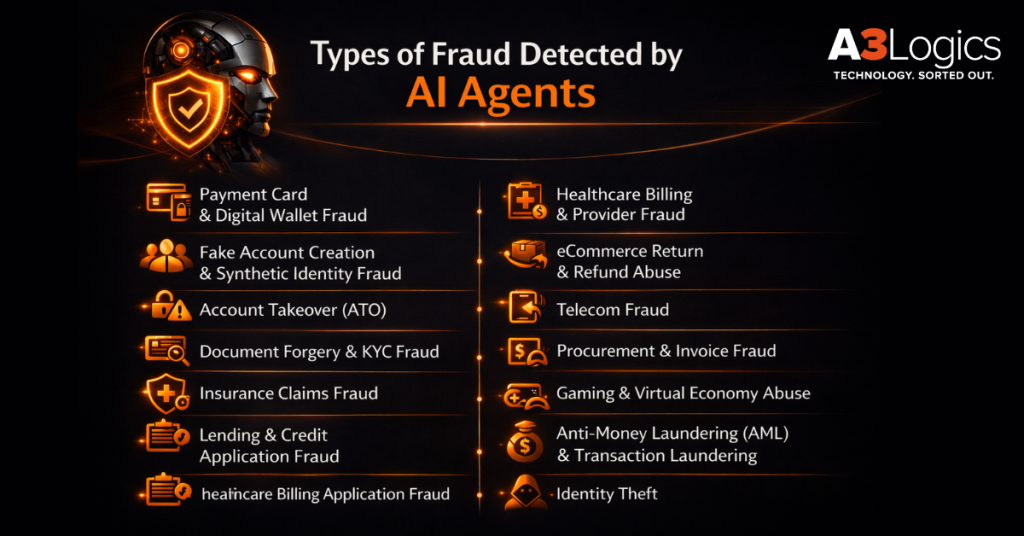
1. Payment Card and Digital Wallet Fraud
The AI-powered fraud detection systems track transaction behaviors on cards, UPI, and wallets for anomaly detection, which may indicate unusual geographical locations, suspicious velocity, or different devices. The systems dynamically evaluate the factors in real-time, preventing card not-present fraud, token, and wallet misuse before actual financial losses are incurred.
2. Fake Account Creation & Synthetic Identity Fraud
AI models evaluate identity information, device fingerprints, BBI, and consistency in order to identify created or composite identities. AI models identify created identities that aim at abusing sign-up bonuses, mule accounts, or future credit card fraud—with considerable anticipation before being detected through traditional methods.
3. Account Takeover – ATO
The AI models can detect slight behavioral modifications in login activity, browser flow, typing patterns, and transaction intent. By constantly authenticating users beyond password or OTP access, they can locate compromised accounts in real-time and halt any attempts at credentials stuffing, hijacking, or cross-account fund transfers.
4. Document Forging & KYC Fraud
Neural networks-based vision intelligence verifies ID documents, bank statements, and proof of address papers. Agents identify any signs of tampering, deepfakes, metadata discrepancies, and content discrepancies. They also cross-verify documents using authoritative sources, improving onboard processes, as well as readiness to pass regulatory audits.
5. Insurance Claims Fraud
AI for Insurance Claims Fraud Detection analyzes the data in the claims, past trends, images, medical reports, and estimates related to repairs in order to detect over-inflated, staged, and/or repetitive claims. The models uncover the underlying connections between the individuals filed in a claim, the provider, and any past events, allowing the insurer to focus more on the high-risk claims and expedite the processing of true ones.
6. Lending and Credit Application Fraud
These AI models identify income misrepresentation, employment fraud, misuse of identity, and fraudulent loan rings engaged in collusion. By integrating public data, alternative data, and behavior risk patterns, the models differentiate actual consumers from high-risk applicants, which helps in default reduction and portfolio protection.
7. Healthcare Billing & Provider Fraud
The software agents receive real-time input about billing codes, treatment patterns, and provider networks in order to identify upcoding, phantom services, unnecessary care, and referral payment schemes. Continuous learning models can reveal hidden anomalies within large-scale health care sets, assisting health care payers in minimizing leakages while retaining payments to legitimate care providers.
8. eCommerce Return & Refund Abuse
Consumer behavior, device history, buying cycles, and returns are the areas AI agents monitor to identify the instances of the aforementioned forms of fraud. AI agents score customers and transactions dynamically to allow the retail sector to prevent the scenarios while preventing constant interruptions to loyal customers.
9. Telecom Fraud
The AI models detect SIM swapping, subscription fraud, international revenue share fraud (IRSF), and call pumping frauds. They are able to prevent the unauthorized usage of services, loss of revenues, and financial frauds, as they correlate call detail information and device changes in real-time.
10. Procurement & Invoice Fraud
The AI algorithms examine: relationships with vendors, the structure of invoices, payments, and approval patterns. They look for duplicate invoices, shell companies, high pricing, and insider trading. Continuous analysis helps protect financial operations and alert the user to irregularities.
11. Gaming and Virtual Economy Abuse
AI assistants analyze the play activity, transaction speed, transfer of assets, and social interactions of users in the game to look for bot farming activities, collusion rings, virtual currencies being laundered, and marketplace manipulations. They help protect the economies of the game.
12. Anti-Money Laundering (AML) & Transaction
These AI systems trace the complex networks of financial transactions to reveal the existence of structuring, muling, layering, or abuse by the hidden merchants. These systems are more advanced than the fixed thresholds since they are able to learn the new ways used by the launderers.
13. Identity Theft
In The identity misuse can be detected by the use of cross-channel behavior, device, and lifecycle by the artificial agents. The agents are able to determine whether orchestrated identities that have been stolen are used to create other accounts, gain access, as well as move funds.

AI Agents versus Traditional Fraud Detection Methods
| Traditional Fraud Detection | AI Agents for Fraud Detection |
| Rules-based engines and isolated ML models. | Autonomous, agentic systems coordinating multiple AI models. |
| Static thresholds based on historical patterns. | Dynamic risk scoring that adapts in real time. |
| Reactive alert generation. | Proactive, prevention-focused intervention. |
| Single transactions analyzed in isolation. | Full behavioral, transactional, and network-level intelligence. |
| Manual updates and periodic tuning. | Continuous self-learning through feedback loops. |
| Flags suspicious events. | Orchestrates detection, decisioning, and response. |
| Siloed by product or system. | Unified cross-channel and cross-entity view. |
| Alerts routed to human investigators. | Autonomous actions with human-in-the-loop governance. |
| Limited adaptability; vulnerable to novel tactics. | High adaptability to emerging fraud patterns. |
| High false positives and operational load. | Reduced false positives, faster decisions, better CX. |
Why AI Agents Outshine Traditional Fraud Monitoring
1. Context-aware, multi-signal decision-making
As it happens, AI agents prosper because they work contextually and not transactionally. They correlate signals across devices, sessions, geographies, accounts, and networks. The multiple-signal reasoning enabled by this allows the detection of coordinated and low-signal fraud much earlier.
2. Cross-channel and cross-entity intelligence
Fraud detection using AI agents adapt in real time. New fraud behaviors are incorporated through feedback loops without full system redesign. An AI system used in fraudulent activity detection helps in preventive measure implementation in advance, anticipating paths of risks and taking preventive measures much earlier than fraud occurs.
3. Real-time adaptability to new fraud tactics
Because of their ability to integrate cross-channel intelligence and respond; it makes them much more efficient than some piecemeal, or disjointed, monitoring tools.

Key advantages when using AI agents for fraud detection
Real-Time Decision Making: AI agents bring real-time decision making that allows organizations to detect fraud and stop it in real-time.
Adaptive Machine Learning: Their adaptive machine learning continuously evolves detection logic to counter emerging threats.
Significant Reduction in False Positives: AI-powered systems can reduce false positive rates by up to 90% because they assess a wider range of behavioral and contextual signals; thereby reducing operational costs and customer friction.
Advanced Pattern, Network & Graph Detection: advanced pattern recognition and graph detection uncovers dark fraud rings.
Behavioral Biometrics & Intelligent Authentication: Behavioral biometrics make the authentication experience smoother without affecting the usability of the service.
Multi-Channel & Omnichannel Integration: AI agents integrate seamlessly throughout omnichannel channels, providing continuity of fraud management processes in digital as well as physical channels, as well as from third-party channels.
Proactive Fraud Prevention: They enable proactive fraud prevention rather than post-loss recovery.
High Scalability & Cost Efficiency: High scalability makes it possible to handle large amounts of transactions with minimal latency. Operational efficiency improves while investigation backlogs shrink.
Improved Customer Experience: Improvement in customer experience due to fewer false declines and faster resolution.
Regulatory Compliance & Audit Readiness: Explainable AI capabilities strengthen – regulatory compliance, audit readiness, and internal governance.
Industry-Wise Use Cases of AI Agents for Fraud Detection
1. Banking & Fintech
AI agents enable banking fraud detection on AI-driven transaction monitoring, AML surveillance, account takeover prevention, abuses in payments detection, and credit fraud mitigation by orchestrating the risk signals across digital banking, cards, wallets, and lending platforms.
2. E-commerce & Marketplaces
They identify refund abuse, fake sellers, bot-driven attacks, and loyalty manipulation, all while finding a balance between fraud prevention and optimizing conversions.
3. Insurance
The insurance fraud detection system enables automated claims scoring, document anomaly detection, identity verification, and risk orchestration across underwriting and claims operations.
4. Healthcare & Payers
AI agents track billing abuse, duplicate claims, phantom providers, and coordinated fraud rings right through to healthcare ecosystems.
5. Logistics and Transportation
AI-powered fraud detection systems track theft of cargo, invoice manipulation, route tampering, and supplier fraud.
6. Retail & Omnichannel
AI agents for fraud detection defend loyalty programs, POS environments, and return processes against organized abuse.
Best Practices in the Implementation of Agentic AI for Fraud Detection
> Evaluate existing fraud processes and determine what constitutes fraud process success
Start by analyzing your current fraud processes, tools, and points of decisions. Then determine areas of fraud processes that create bottlenecks, false positives, and human dependencies. Set success metrics like fraud accuracy, fraud loss, time to complete investigations, customer frustration, and reporting success.
> High Quality Data Preparation, Normalization, and Integration
AI Agent Development services require unified, trustworthy data. Integrate your transactional, behavioral, device, and third-party data. Clean, normalize, and resolve identities within systems. Build real-time and batch pipelines so agents can reason about complete, timely, and consistent fraud signals.
> Design a scalable agency AI architecture
Create a modular framework that allows specialized agents for detection, analysis, orchestration, and learning activities. The modular framework should enable event-driven pipelines, APIs, and cloud-native services that promote decision support on events happening in real-time, horizontal scaling capabilities, visibility of events that span cross-channel lines, and easy integration of new fraud scenarios.
> Create and train Multi-model AI systems
Integrate machine learning, deep learning, graph analysis, NLP, and rules to build coordinated agent systems.Train models using labeled fraud data and simulation scenarios that closely resemble real life. Deliver systems that allow agents to work together and validate findings, across different connections, while adapting to changed fraud behavior and business risks over time. Pilot with high-risk, high-impact use cases
The starting point should be where losses, risk, or friction with customers are greatest, perhaps in payments, ATO, or onboarding fraud. Pilots under control provide a proof point for performance, help uncover operational blind spots, and instill confidence in creating business value.
> Autonomy Levels
Clearly establish where the agents should be able to decide independently, versus where they need to seek approval. Set up decision rights tiered systems, hand-offs, and escalation processes. This will allow for fast decision-making for non-risky things; yet maintain accountability for the complex ones.
> Embed Explainability, Monitoring, and Governance
Embed Explainable AI to help trace the reasoning behind the decision-making. Ongoing monitoring for: model drift, bias, and performance. Model approval processes, audit trails, compliance, and regulatory submission should be set up for establishing continued model confidence, transparency, and control over future model utilization.
> Business unit & fraud type scalability
Once success is achieved, scale the agents out to products, geos, and fraud types. Leverage shared data foundations and simple agents – scale and adapt to threats in the domain. This is the secret to scaling automation success and achieving maximum fraud impact.
> Implement security, regulatory and compliance controls
Lock down agent pipelines with enterprise-class access controls, encryption, and logging. Inform agent deployment with data protection regulations, financial regulations, and best practices from the particular vertical market or industry that an agent serves. Design the agents to enable the creation of evidence and regulatory reports right from the start.
> Optimize through continuous feedback loops
Results of the feed investigation, customer reactions, and labeled fraudulent activities should be fed back into the agents. This helps the agents learn and overcome obstacles related to emerging attack behavior and fraud techniques through continuous learning loops.
> Invest in Training and Change Management
Ready fraud analysts and fraud leaders to work with agentic systems. Train them on how to interpret results from AI-powered fraud detection systems, escalations, and how to train an agentic system. There are systems in place that help in the management of change.
> Ensure production-level quality and performance
Design for low latency, high availability, and fail tolerance. Leverage load tests, failover tactics, and real-time monitoring. This level of production-quality reliability means – that agentive AI can be used for fraud prevention without any issues for customers.
How A3Logics Helps Implement AI Agents for Fraud Detection?
A3Logics, a leading AI development company initiates engagements through the alignment of fraud intelligence initiatives with business priorities and risk strategy.
- Real-time, high-integrity data pipelines are fired up in order to support advanced modeling.
- AI agents are architected to integrate seamlessly within the home of existing banking, fintech, insurance, and enterprise systems,
- Adaptive machine learning fraud detection models are trained to evolve with evolving fraud behaviors.
- A3Logics pilots solutions in controlled environments before scaling across operations.
- Agents are directly embedded into workflows that constitute decisions, ensuring prevention in real time rather than detection after the event.
- Explainable AI frameworks ensure auditability and regulatory confidence.
- MLOps and monitoring disciplines support production stability.
- Continuous improvement cycles maximize detection accuracy and ROI.
With deep experience as an Insurance Software Development Services, A3Logics offers enterprise-grade Fintech software development services in the fields of financial services, insurance, healthcare, and digital commerce.
Case Study: ClaimPro Corp – Leap into AI-Driven Insurance Fraud Detection
ClaimPro Corp sought to reduce fraud losses by increasing the speed of claim turnaround. Overloaded investigators with high volumes of false positives; along with fragmented fraud signals across claims systems, made it really tough for the organization.
A3Logics used AI agents for automated claim risk scoring, document intelligence, and fraud orchestration. AI agents continuously analyzed behavioral patterns, historical claims, and network relationships to understand whether a file presented fraud.
Human-in-the-loop workflows allowed investigators to validate cases, refine the models, and govern the decisioning. Continuous learning pipelines for adaptation to new tactics.
These included faster approvals, reduced fraud leakage, lower investigation burdens, and improved customer experience. Read more about the case study here.

Conclusion: From Fraud Detection to Intelligent Risk Management
AI agents represent a shift from isolated fraud tools to intelligent risk ecosystems. They unify – data, decisions, learning, and action into adaptive systems capable of outrunning fraud operations in the modern world.
Organizations that deploy AI agents move from reactive loss mitigation to proactive fraud prevention, scaling up to become resilient with strategic visibility of risk.
As fraud becomes increasingly automated, the intelligent management of fraud risk will turn to agentic AI systems designed not just to detect fraud, but to continuously outthink it.