
Are you looking to invest in the field of product development? Are you thinking about how to proceed and get complete clarity about the same? This is why we are here to help you understand how you can make the most out of it with the use of AI.
When companies use artificial intelligence in product development, they can use predictive analytics to find out about market trends, improve design processes, and make quality assurance checks better.

Using it can help you with accurate and efficient results that suit your needs and requirements. So, if you are thinking about how to proceed ahead with AI in product development, then below we discuss all the aspects related to it that includes benefits, use cases, and even challenges. It will help you understand all the aspects and proceed ahead with complete clarity. Read on.
Key Numbers That Defines AI in Product Development
The use of AI in product development is growing quickly in many different fields. Here are some important numbers that show how important it is becoming:
- Companies that use AI solutions can cut their operating costs by 20% to 50%, depending on the industry and the specific apps they use.
- Businesses that use AI technologies have seen their time-to-market cut by up to 50%, which lets them quickly adapt to changes in market demand. source
- AI-powered quality assurance systems may find more than 90% of defects, which makes customers happier.
- Companies who use AI to learn more about their customers say they understand their behavior and preferences 70% better. source
- In 2025, over 30% of all product development processes would use some type of AI automation, which will change the way new ideas are developed. source
Key Use Cases of AI in Product Development

Artificial Intelligence (AI) is changing how products are made by offering new ways to make decisions and speed up procedures. AI may be used in many ways in product creation, from designing and prototyping to analyzing the market and getting customers involved. Companies may learn more about how customers act, make better designs, and increase the quality of their products overall by using artificial intelligence in product development.
AI technology helps businesses look at huge amounts of data rapidly, spot patterns, and make smart choices. This capacity helps businesses keep ahead of the competition in a market that is changing quickly. Here are some important examples of how AI may be used in product development to show how it can affect different parts of the process.
1. AI in Product Design and Prototyping
AI is very important for designing and prototyping products because it automates some chores and makes people more creative. Machine learning algorithms can look at user comments, market trends, and past data to come up with design solutions that fit what customers want. This feature lets designers quickly try out different versions, which cuts down on the time they spend making changes by hand.
2. Predictive Analytics for Market Trends
AI-powered predictive analytics is changing how organizations learn about consumer behavior and market trends. AI models can predict how the market will change in the future with amazing accuracy by looking at past data and finding trends. This capacity lets companies make judgments on how to build products based on data.
3. Automated Quality Assurance
Quality assurance (QA) is an important part of making sure that items fulfill certain criteria before they are sold to customers. Automated quality assurance solutions powered by AI make this process easier by utilizing machine learning algorithms to look at data from production lines and find errors in real time.
During manufacturing, these devices may keep an eye on things like size, weight, and material qualities. The technology lets operators know right away when something goes wrong, like when something goes outside of the set tolerances.
4. Personalized Product Development
AI helps make products that are tailored to each customer by looking at their data to learn about their likes and dislikes. Businesses can use this information to make items that are perfect for certain groups of customers. This level of customisation makes customers happier and more loyal, which leads to more sales.
5. AI-Powered Testing and Simulation
AI-powered testing and simulation tools improve the product development process by letting teams test how well a product works in different situations before making real prototypes. These tools utilize complex algorithms to mimic real-life situations and see how things would act in different settings. Companies can prevent expensive recalls or redesigns later on by finding any problems early on through virtual testing environments.
6. Dynamic Pricing Models for Product Launches
AI-powered dynamic pricing models let businesses change their prices in real time based on how the market is doing, how much demand there is, and how much their competitors are charging. AI algorithms help businesses find the best pricing strategies by looking at past data and current patterns.
This helps them make the most money while staying competitive. For example, airlines use these models to look at how people book flights and change prices to keep the best occupancy rates.
7. Optimized Supply Chain Integration
AI changes how supply chains work by using real-time data and predictive analytics to improve logistics, inventory, and purchasing. Machine learning algorithms predict demand, find bottlenecks, and automate paperwork, which lets people make decisions ahead of time and keeps things running smoothly. AI-powered solutions make things more open, lower costs, and make things run more smoothly by making workflows and resource allocation more efficient. Companies can see everything from start to finish when they include IoT data. This helps them make sure that deliveries are on time and that they follow ethical and environmental standards. In the end, this makes their supply chain more flexible and strong.
8. Collaborative AI for Team Ideation
AI helps teams come up with new ideas by coming up with more ideas, looking at market trends, and suggesting new ones. AI-powered brainstorming tools can use a lot of data from the industry, client feedback, and past experiences to organize, finish, and come up with new ideas. These systems make it easy to give feedback in real time, let teams iterate quickly, and encourage creative collaboration no matter where people are. AI helps teams come up with more creative and useful product strategies by supporting different points of view and giving them useful information. This speeds up the cycles of innovation.
9. AI Systems for Sentiment Analysis
AI-powered sentiment analysis gives product teams the tools they need to turn customer input from reviews, social media, and support channels into useful information. AI helps prioritize features and allocate resources micro by finding trends in positive and negative sentiment. It does this by highlighting features that users like and problems that repeat. This ongoing feedback loop makes sure that product development meets the needs of real users, which makes them happier and makes them more loyal to the company. Companies can also compare themselves to their competitors, see how the market sees them, and change their plans in real time for the best results.
10. Sustainability in Product Design
AI is a catalyst for making products that last longer by helping to optimize materials, cut down on waste, and save energy. Machine learning looks at thousands of permutations of materials to find alternatives that are good for the environment and cost-effective. Generative AI looks at several design options that use fewer resources without lowering quality. Digital twins and lifecycle assessment tools show how designs will affect the environment before they are made, making sure they satisfy sustainability goals. These skills help businesses save money, follow the rules, and stand out in the market by making items that are more environmentally friendly and new.
11. AI in Competitive Benchmarking
AI automates competitive benchmarking by constantly gathering and evaluating data about competitors from websites, social media, prices, and customer reviews. Companies may watch market changes, guess what will happen next, and find chances or threats faster with this real-time information than with manual techniques. AI-driven benchmarking lowers research costs, makes results more accurate, and gives useful information for making strategic decisions. Businesses may improve their positioning, marketing, and competitive edge in fast-changing marketplaces by learning what their competitors are saying and how customers are responding.
12. AI-Enabled Material Discovery
AI speeds up the discovery of novel materials by looking at large volumes of data from tests and the literature to find trends and guess what new properties they might have. Machine learning models can go through millions of compositions, which cuts down on the requirement for trial and error that takes a lot of time. This process finds new materials with the right traits, including being eco-friendly, long-lasting, or having unique mechanical properties, faster than older methods. AI-powered discovery is opening up new possibilities in fields like aerospace, electronics, and manufacturing, leading to improvements in product performance and environmental impact.
13. Augmented Reality (AR) Integration with AI
Combining AI with AR makes product experiences that are interactive and immersive. Artificial intelligence (AI) lets augmented reality (AR) apps customize material, understand natural language, and make smart suggestions in real time. For instance, AI-powered AR can change experiences based on what the user likes, translate language, and add 3D objects on top of other things. This integration improves training, design visualization, and customer interaction by providing easy-to-use interfaces and real-time feedback. Companies use the combination of AI and AR to make their work easier, spark new ideas, and create digital experiences that are interesting and relevant to the user.
14. Product Lifecycle Management with AI
AI changes product lifecycle management by automating everyday operations, making better use of resources, and giving you predictive insights. Machine learning models predict demand, keep an eye on how well products work, and suggest ways to make them better over time. AI-powered analytics help organizations find problems early, cut down on downtime, and make sure that inventories and supply chain management are done well. AI helps businesses improve all the time, save money, and get new products to market faster by combining information from design, production, and customer feedback.
15. Transform Product Development through AI-powered Chatbot
AI chatbots make product development easier by handling customer service, gathering feedback, and making it easier for teams to talk to each other. These chatbots employ natural language processing to talk to people, answer questions, and get useful information about product features and problems. Internally, chatbots help teams by giving them immediate access to documents, keeping track of project progress, and organizing activities. This cuts down on the amount of work that needs to be done by administrators, speeds up the process of making decisions, and makes sure that product development keeps in line with user wants and market demands.

Benefits of AI in Product Development
AI has changed the game in product creation by providing many benefits that improve productivity, creativity, and consumer pleasure. Companies may make their goods better, cut costs, and speed up procedures by using AI in product development. The use cases of AI in product development can vary, from automating simple chores to giving insights that help people make important decisions.
Also, organizations can use complex algorithms and machine learning approaches that are personalized to their needs when they use Artificial Intelligence development services. Companies that use AI technology in their product development processes should expect big gains in operational efficiency and market competitiveness.
1. Enhanced Efficiency
AI significantly enhances efficiency throughout the product development lifecycle. By automating repetitive tasks such as data entry, testing, and reporting, organizations can reduce the time spent on manual processes.
For example, AI algorithms can automatically generate test cases based on user scenarios, execute them across various conditions, and identify defects more accurately than traditional methods.
2. Improved Decision-Making
AI provides valuable insights derived from data analysis that support informed decision-making. By analyzing historical data and market trends, AI models can predict customer preferences and behaviors. This predictive capability allows product teams to prioritize features that resonate with target audiences, ultimately leading to more successful products.
3. Cost Reduction
Implementing AI in product development can lead to significant cost savings. By streamlining processes and reducing the need for extensive manual labor, organizations can allocate resources more effectively. For instance, predictive maintenance powered by AI can help companies avoid costly downtime by identifying potential equipment failures before they occur.
4. Enhanced Quality Control
AI-driven anomaly detection systems enhance quality control by monitoring production processes in real-time. These systems can identify deviations from established norms and alert teams to potential issues before they escalate into significant problems. This proactive approach ensures higher quality products while minimizing waste.
5. Faster Time-to-Market
With AI automating various stages of product development—from ideation to prototyping—companies can bring products to market faster than ever before. This speed is crucial in today’s competitive landscape where consumer preferences shift rapidly.
6. Better Customer Experience
By leveraging AI to analyze customer feedback and behavior patterns, organizations can develop products that better meet user needs. This focus on customer-centric design leads to improved satisfaction and loyalty.
7. Continuous Improvement
Post-launch analytics powered by AI allow companies to monitor product performance continuously. Sustaining that improvement requires the kind of structured approach to AI product development that treats model retraining, drift monitoring, and UX iteration as ongoing engineering work rather than one-time fixes. By gathering data on user interactions and feedback, businesses can iterate on their products quickly and efficiently—ensuring they remain relevant in a dynamic market.
AI Tools & Technologies for Product Development
By utilizing Artificial Intelligence Development Services, organizations can access advanced tools that automate routine tasks, provide predictive analytics, and enhance decision-making processes. Below are some key tools and technologies that are shaping the future of product development through AI.
1. Machine Learning Algorithms
Machine learning algorithms are at the core of many AI applications used in product development. These algorithms analyze historical data to identify patterns that inform design decisions or predict future trends. For instance, clustering algorithms can segment customers based on purchasing behaviors, allowing teams to tailor products accordingly.
2. Natural Language Processing (NLP)
Natural language processing enables machines to understand human language. In product development, NLP is used to analyze customer feedback from reviews or social media comments. This analysis helps teams gauge public sentiment about a product or feature, guiding improvements based on real user input.
3. Predictive Analytics Tools
Predictive analytics tools leverage historical data combined with machine learning techniques to forecast future outcomes. In product development, these tools help teams anticipate market demands or identify potential challenges before they arise—allowing for proactive adjustments to strategies.
4. Generative Design Software
Generative design software uses algorithms to explore multiple design options based on specified parameters such as materials or manufacturing constraints. This technology accelerates the prototyping phase by allowing designers to visualize numerous possibilities quickly—leading to innovative solutions that might not have been considered otherwise.
5. Robotics Process Automation (RPA)
RPA involves using software robots or “bots” to automate repetitive tasks within business processes. In product development, RPA can streamline workflows such as data entry or document management—freeing up human resources for more strategic activities that require creativity and critical thinking.
6. Collaboration Platforms with AI Integration
Collaboration platforms equipped with AI capabilities facilitate communication among cross-functional teams during product development projects. These platforms often include features like real-time document sharing, task management tools powered by machine learning algorithms that prioritize workflows based on urgency or importance.
7. Cloud-Based Solutions
Cloud-based solutions are changing the way products are made by giving developers a way to store all the data they collect during the process on a scalable infrastructure. Think of it as a digital storehouse with no limits that can grow as needed, so you’ll never run out of room for your designs, simulations, and test results.
Steps to Implement AI in Product Development
When companies want to use AI in their product creation, they need follow these important steps:
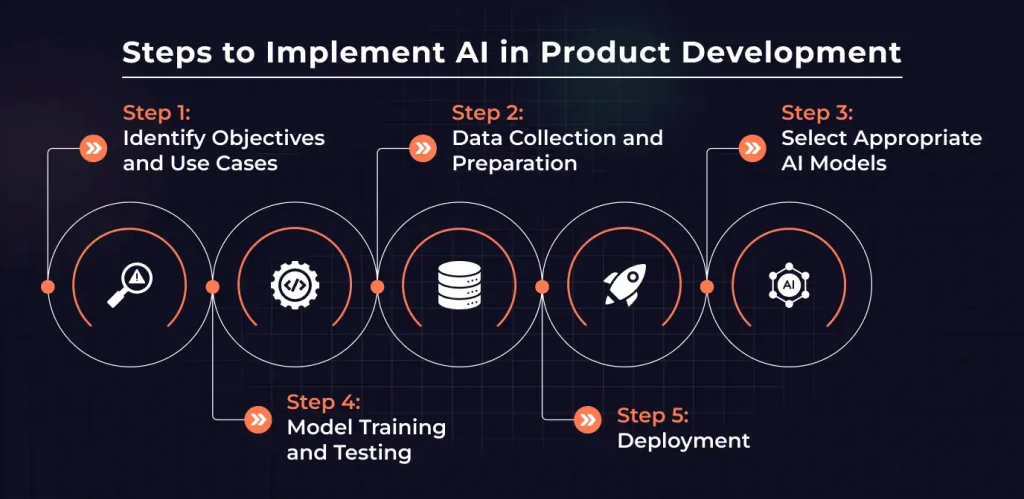
Step 1: Identify Objectives and Use Cases
Before you start using AI, you need to be clear about what you want to get out of it and where it can help you the most with product development. This involves getting everyone on the same page about the aims and expectations for AI integration by meeting with teams from engineering, marketing, and sales.
For instance, if you want to improve customer experiences by making personalized recommendations, think about how AI can look at how users behave and make ideas that are unique to them to make them happier.
Step 2: Data Collection and Preparation
The next important step is to get the data you need to train your AI models well once you’ve set your goals. This means finding the right data sources, such CRM systems, social media sites, and market research reports, to make sure you have a complete dataset that includes all the parts of your use cases. But gathering data is only the first step. Cleaning and arranging the datasets to make sure they are accurate and consistent is just as critical as preparing the data.
Step 3: Select Appropriate AI Models
It is very important to choose the correct AI models for a successful implementation. This means looking at different machine learning methods, such supervised and unsupervised learning, depending on whether there are labeled datasets available. For instance, if you want to use past sales data to guess what will happen in the future, supervised learning methods like regression analysis might work.
Step 4: Model Training and Testing
The training step starts when the right AI models have been chosen. During this phase, the algorithms learn how to find patterns and connections in the prepared datasets. Teams track performance metrics closely during this stage to ensure the model achieves expected results. They conduct regular checks to identify issues or improvement areas during training. After training, they rigorously test the model using new validation datasets to confirm its effectiveness.
Step 5: Deployment
The deployment phase starts after the trained models have been successfully validated. This means adding the chosen AI solutions to the workflows and systems you already have in place in different departments. To make sure that everything works together well, this stage may need working with IT teams. This will reduce disruptions during the transition and increase efficiency.
Challenges of AI in Product Development
There are many benefits to using AI in product development, but there are also a number of problems that businesses need to solve in order to get the most out of it. AI solutions can be hard to put into place, which might slow down progress and make things less efficient. Businesses who want to use AI for anomaly detection need to know about these problems.
Some of them are:
1. Getting high-quality data is one of the biggest problems with using AI to make new products. To work well, AI models need data that is both accurate and useful. If the data is missing, skewed, or not well-organized, it can cause forecasts and insights to be wrong. To make sure they have credible datasets for training their AI models, organizations need to spend money on systems for collecting, cleaning, and managing data.
2. It can be hard to add AI technologies to established product development processes. A lot of companies still use old systems that might not work with new AI technologies. This problem with integration needs careful planning and can mean big adjustments to how things are done now and how things are set up.
3. Using AI in product creation typically involves talents that the company may not have on hand. To develop and keep AI models that work well, you need data scientists, machine learning engineers, and AI experts. To fill in these skill shortages, businesses may need to pay for training or hire outside workers.
4. The first expenditure needed to use AI technologies can be rather large. Costs for software, hardware, training, and continuous maintenance may pile up quickly. Before putting money into AI projects, companies need to carefully look at the return on investment (ROI).
5. Employees may not want to use new technologies because they are afraid of losing their jobs or don’t comprehend how AI may help them accomplish their jobs better. To deal with these issues and create a culture that supports new ideas, change management tactics are necessary.
Future of AI for Product Development
The future of AI in product development is promising because technology keeps getting better, which makes AI systems more powerful. As more and more data is created in all fields, it is more important than ever to be able to find anomalies quickly. As more and more organizations use blockchain technology in their marketing, they will also profit from what artificial intelligence can teach them.
- As companies see how useful AI can be for making new products, more and more of them will start using it. This will happen in many areas, such as manufacturing, healthcare, finance, and retail.
- Future AI models will focus on giving enterprises real-time analytics for finding abnormalities so they can act quickly to fix them and reduce the damage or losses they can cause.
- As more and more IoT devices are used, there will be a greater need for AI-powered anomaly detection tools that can look at data from several sources at once. This will improve monitoring across a wide range of applications.
- As product teams use AI systems more in development, they will increasingly prioritize explainability to show how decisions are made based on detected anomalies and to build consumer confidence.
How Does A3Logics AI Development Services Transform Product Development Operations?
A3Logics looks at market trends, consumer behavior, and operational data using the most recent AI models to assist them decide what goods to build and how to make them better. A3Logics is an Enterprise AI Development Company that helps organizations cope with the problems that come up when they try to use AI so they can stay ahead of the competition.
- A3Logics helps companies identify problems that can come up during the product development lifecycle by using AI-powered predictive analytics. This foresight lets teams deal with problems before they get worse, which makes the project go more smoothly.
- A3Logics uses AI-powered quality assurance techniques that keep an eye on how well a product works as it is being developed. Companies may make sure that their final products satisfy high-quality standards by finding problems or faults early on.
- As an Enterprise AI Chatbot Development Company, A3Logics offers solutions that may grow with your organization and meet its evolving needs. Companies can count on A3Logics for flexible AI solutions that help them grow, whether they are introducing new products or moving into new markets.

Final Thoughts
Hopefully, you have got complete clarity in how AI into product development can make a huge impact. Businesses can completely transform the way their operations go about creating products and stand out in the respective field. All you need to do is to connect with the experts to help you with artificial intelligence development services. The experts are going to understand the market trends and accordingly help you with AI in product development services.
If you are looking for experts to assist you with Enterprise AI development services, then do not hesitate and connect with A3Logics. We help businesses stay ahead of market trends and make products that customers love by focusing on important areas including data analysis, automation, predictive analytics, and customer-centered design.
As businesses continue to deal with the challenges of developing new products in today’s environment, working with a reliable partner like A3Logics will be very important for their long-term success.