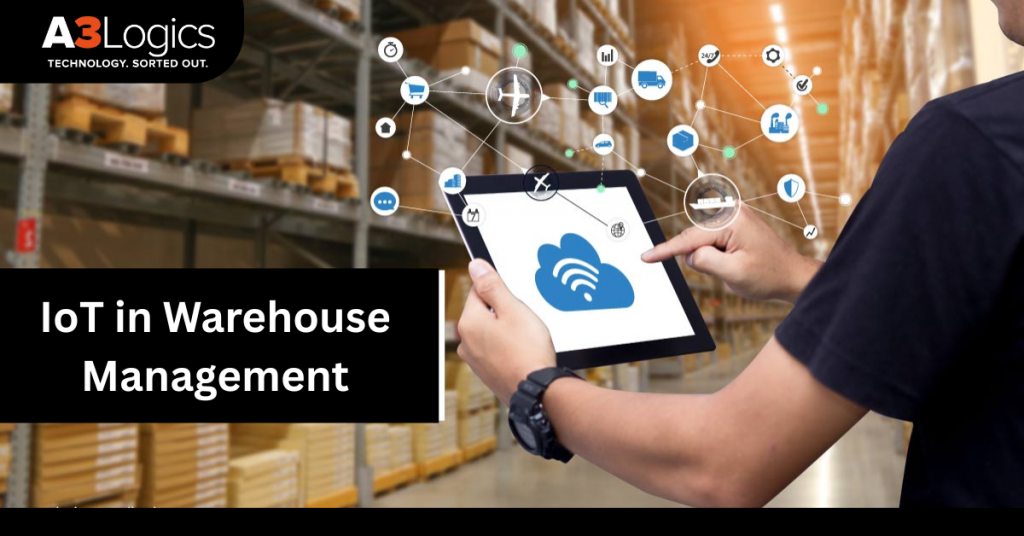
IoT in Warehouse Management: In the last decades, warehouses have undergone great changes. In the past, they were places where workers exerted their energy and handled stock manually, whereas nowadays they are becoming smart logistics centers because of the latest technologies. Businesses must render their warehouse operations more nimble, accurate, and effective because e-commerce, global supply chains, and mounting customers’ expectations are all rushing forward.
The Internet of Things (IoT) is the center of this digital revolution. IoT facilitates the capturing, communication, and analysis of real-time data to make Warehouse Automation with IoT easier through the connection of physical devices and sensors to a digital network. IoT transforms the storage, tracking, and transportation of goods in warehouses. For example, intelligent shelves notify managers when the stock level is low, while robot-moving machines ease picking of products.
Here we shall be talking about how IoT is changing the way warehouse operations are done, the main benefits that it provides, through which ways IoT in Warehouse Management can be implemented in practical life, the challenges that come while implementing it, and how an enterprise partner like A3Logics can help in making a warehouse smart.
How IoT Is Revolutionizing Warehouse Management?
Through the utilization of IoT, your warehouse inventory is more efficient and allows you to react more quickly towards the fluctuations in consumer demand. It provides high efficiency, accuracy, and visibility. Currently, new IoT in Warehouse Management systems allow you to monitor and manage your warehouse remotely, which minimizes the level of human labor required and lowers operational costs.
One of the most important areas in which IoT solutions really shine is in preventing supply chain mistakes that involve a lot of money. With this new technology integration, warehouses can now see inventory control in real time, and that gives them real-time and up-to-date information. This enables facility managers to make sound decisions right away and avoid costly delays and downtime.
Security takes a top priority in warehouses, and IoT devices are appropriate means of securing goods, machines, and property. They provide enhanced security from theft – especially for those that do not have complete warehouse management systems.
IoT is a highly significant warehouse management tool because it changes how we track significant environmental parameters – like temperature, pressure, and humidity. IoT technologies help to keep storage conditions in their best shape by sending out alarms and reports in real-time. This not only protects the quality of stored products, but also makes them last longer -which gives companies an evident edge in preventing losses and keeping their products top quality.
In short, IoT in warehouse management not only assures the quality of products at the optimum level, but also protects against possible financial losses. This cutting-edge technology converts run-of-the-mill warehouses into smart hubs that are efficient, accurate, and adaptable.
Main Features of IoT in Warehouses
Sensors: Track temperature, humidity, vibration, weight, and others to ensure best storage conditions and equipment performance.
RFID (Radio Frequency Identification): Tags and readers track product movement and automatically manage inventory.
GPS and Geofencing: Monitor goods travel between locations – define warehouse zones for specific activities.
Edge Devices & Gateways: Handle data near the source to enable real-time action.
Cloud Platforms & Analytics Engines: Store, analyze, and present actionable insights for making decisions.
The Smart Warehouse Ecosystem
Smart warehouse is an entirely interconnected facility wherein IoT technologies work alongside warehouse management systems (WMS). Enterprise resource planning (ERP), robotics, and AI to deliver.
- Smart inventory control
- Predictive maintenance
- Autonomous operation of equipment
- Enhanced worker safety
- Seamless supply chain communication.
IoT technology reduces dependency on manual intervention and enables warehousing operations to be predictive rather than reactive enhancing productivity and decision accuracy.
Important Benefits of IoT in Warehouse Management
1. Better Inventory Management
By removing the need for human validation and approximation, IoT facilitates end-to-end, real-time data analysis of inventory quantity, locations, and status.
Accurate asset tracking optimizes warehouse space by minimizing product location time.
Effective resource allocation and replenishment decisions are made through keen insights into inventory movement.
2. Real-Time Monitoring and Tracking
Constant Bluetooth communication via beacon technology facilitates real-time tracking and monitoring. New battery-free Bluetooth tag tracking offers increased reliability at a lower cost to tag inventory.
Intelligent insights and real-time data analysis make processes more efficient and lower the labor cost.
Avoiding overstock and spoilage, real-time control over inventory location, condition, and quantity saves money and minimizes waste.
3. Enhanced Operational Efficiency
Time and money are saved through automation via IoT devices, which increases operational efficiency.
IoT in Warehouse Management increases productivity and decreases errors through automated processes like picking, packaging, and shipping.
Autonomous guided vehicles (AGVs) and telematics minimize intervention, speeding up and increasing the precision of logistics operations.
4. Decreased Waste and Spending
Predictive maintenance solutions help prevent equipment failures. IoT in Warehouse Management minimizes risks and downtime while enabling preventive repair and minimizing equipment failure.
Energy consumption is minimized by IoT-driven smart lighting and temperature management systems.
5. Better Safety and Asset Security
Environmental conditions, asset movement, and warehouse access are tracked by IoT sensors, preventing theft and accidents and maintaining product integrity.
The sensors collect data and provide real-time notifications, facilitating prompt response to security breaches or safety concerns and maintaining a safe environment.
IoT in Warehouse Management will also reduce the risk of unforeseen events and give a safe environment for aggressive worker safety. This helps the company by giving employees that are engaged in every stage of the process a safe and secure environment.
6. Efficient Order Processing and Customer Satisfaction
Simplified order processing and shipping are facilitated with efficient workflows and real-time inventory visibility through sensors and RFID tags.
Error minimization fosters loyalty and trust by providing clients with the correct products at the right time.

IoT Applications in Modern Warehousing
As there are smarter warehouses now, businesses are leveraging a wide range of IoT applications to streamline processes, boost efficiency, and improve bottom-line results. Some of the most noteworthy IoT Applications in Warehousing are as follows:
> Smart Inventory Management Systems
Inventory systems based on the internet of things (IoT) use sensors, RFID, and barcodes to automatically track items and monitor stock levels and movement. These systems offer real-time visibility into what is in stock, what is low, and where items are—all eliminating human error associated with tracking and improving inventory accuracy by up to 99% today.
> Automated Item Tracking (RFID, Barcodes, Sensors)
Using RFID tags or IoT barcodes on pallets and case goods, warehouse managers are able to trace goods from receipt to shipping. Real-time tracking offers transparency and enables quicker tracking of goods for order fulfillment or auditing.
> Asset Management & Predictive Maintenance
IoT sensors attached to the critical warehouse equipment (forklifts, conveyor systems, sorting systems) monitor usage and condition information. This enables predictive maintenance planning—preventing costly breakdowns, reducing downtime, and extending the life of the equipment.
> Robotic Systems and Smart Storage Solutions
IoT-enabled Automated Guided Vehicles (AGVs) and Autonomous Mobile Robots (AMRs) streamline picking and replenishment processes. Smart shelves automatically update stock levels when items are added or removed. Together, these systems improve speed and reduce labor.
> Wearables for Warehouse Workers
Smart wearables like wristbands that are IoT enabled, smart helmets, and smart glasses that provide augmented reality make workers productive and safer. Smart wearables can remind workers of potential risks, monitor fatigue levels, and even give visual instructions for picking and packing operations.
> IoT in Transportation & Logistics Coordination
IoT sensors on delivery vehicles offer real-time tracking of moving goods, monitor driving habits, and predict delays. Such intimate coordination among warehouse and logistics operations reduces delays and enhances the accuracy of ETAs.
> AI + IoT for Predictive Analytics & Forecasting
When combined with AI, IoT information is even more powerful. Machine learning programs can cross-analyze past and present data to predict peaks in demand, recommend redistributing inventory, and anticipate operating bottlenecks—enabling intelligent decision-making.
Implementation Obstacles for IoT in Warehouse Operations
Despite the groundbreaking benefits of IoT in Warehouse, IoT implementation in warehouse operations also has its obstacles. Organizations must overcome technology, cost, and operational hurdles:
1. Data Integration and Real-Time Processing
IoT generates massive amounts of data. Integrating this into existing warehouse management systems (WMS), ERP applications, and analytics systems can be complex. Edge computing and scalable, high-performance infrastructure are required for processing data in real time.
2. Legacy System Compatibility
The majority of Warehouse Automation with IoT utilize legacy systems that were not designed to interface with newer IoT devices or applications. Upgrading or replacing these systems is expensive and time-consuming, likely to require phased implementation approaches.
3. Device Interoperability of IoT
Different IoT devices from various companies are likely to utilize non-compatible protocols. Without a standard method of communicating, achieving hassle-free interoperability and centralized management is difficult.
4. IoT Infrastructure Scalability
As a company grows, so must their IoT infrastructure. Whether it’s device provisioning or network bandwidth, organizations must project ahead for the requirements to avoid performance bottlenecks.
5. Cost and ROI Concerns for Deployment
Initial costs of Warehouse Automation with IoT—hardware, software, integration—can be substantial. Even though ROI is realized in the long term, financially conservative companies will hold back if there isn’t a business case and well-defined strategy.
6. Security and Data Privacy Threats
IoT expands the digital attack vector. Devices, if unsecured, can be exploited as entry points for cyber attacks. Encryption, device authentication, and secure communication protocols (e.g., TLS, VPNs) are crucial to data privacy.
7. Choosing the Correct IoT Platform and Partners
With so many IoT platforms available, the choice of the right platform that is flexible, secure, and industry-aligned becomes challenging. An inappropriate partner can cause lock-in or incompatibility issues.
8. Employee Training and Change Management
Application of IoT in Warehouse requires a culture shift in operations. Employees must be properly trained on new technology, and resistance to change is managed through communication, involvement, and phased rollout.

How A3Logics Helps You Implement an IoT-Powered Warehouse Management System?
We at A3Logics offer end-to-end IoT development services that are tailored to address the unique needs of modern-day warehouses. Being a trusted IoT Development Company, we help customers transform outdated warehousing into adaptive, intelligent environments that build business impact.
> Custom IoT Solutions for Warehousing
We create tailor-made IoT platforms that integrate sensors, RFID, cloud infrastructure, and mobile interfaces to extend real-time visibility and control. Our solutions are modular, allowing phased adoption in sync with your business objectives and budget.
> Smooth Integration with WMS, ERP, and Analytics Platforms
Our integration experts make your IoT systems integrate with your warehouse management software, ERP, CRM, and analytics engines. This allows for central dashboards and harmonized, synchronized data flow across operations.
> Scalable and Secure Architectures
A3Logics implements highly scalable cloud-native IoT architectures with encryption built-in, device authentication, and secure APIs. From a single warehouse to a worldwide network, our platforms scale confidently with your scale.
> Ongoing Support and Optimization
From pilot initiatives to global deployments, we offer sustained support, monitoring, and analytics-based optimization. Our experts help you fine-tune, optimize, and scale your IoT operations in the long run for achieving maximum ROI.
> Inventory Management Excellence
Inventory management needed? Our expert IoT in Inventory Management solutions combine sensor data, machine learning algorithms, and forecasting software to help warehouses prevent stockouts, reduce wastage, and optimize ordering cycles.
Conclusion
The rapid digitalization of supply chains has made the role of warehouses from storage centers to active, data-enabled command centers. IoT is behind this transformation and enables warehouses to operate at levels of visibility, efficiency, and responsiveness previously unknown.
From smart inventory management and real-time tracking of assets to predictive maintenance and AI-based forecasting, the benefits of IoT in warehouse management are endless and tangible. Firms embracing IoT in Warehouse Management have a greater opportunity to reduce expenses, eliminate human inefficiencies, enhance laborers’ safety, and maintain pace with increasingly high consumer demands for speed and accuracy.
But effective IoT deployment has its own set of challenges—integration of data, interoperability, security, and cost considerations require meticulous planning. That is where skilled partners such as A3Logics step in. With better domain expertise, robust development strength, and focus on end-to-end scalability, we help enterprises deploy future-proof IoT-enabled warehousing solutions that provide long-term competitive advantage.
As warehouses become smarter, businesses that invest in IoT today will define industry standards tomorrow.