The industry is always changing – which leads to new value creation and makes it possible to digitize content and communication services. The arrival of IoT in industrial automation in 2025 will speed up digital transformation. This will be possible by making important tools, skilled workers, and cutting-edge technology more accessible. IoT is a network of electronic devices that can be uniquely identified and communicate with each other over the Internet.
It uses IP, cloud computing, and online services to change the way industrial automation works. Encourages the use of mobile devices, virtualized systems, and cloud-based data storage. It also opens the door for new ideas by combining IoT with cyber-physical systems in Industry 4.0.
Even if the number of IoT devices and users in industrial automation is growing, companies still need to deal with ongoing issues with security and interoperability. Around 70% of firms have adopted digital transformation plans, which shows how important they are in the IT world. According to IDC – In 2025, there will be 55.7 billion IoT devices, generating about 80 ZB of data.
Businesses will increasingly integrate their internal processes on digital platforms. Industries will also prioritize expanding their ecosystems to meet market demands and enhance adaptability.
It’s no longer an option to integrate IoT into industrial operations; it’s a strategic necessity because of the increased need for flexibility, responsiveness, and predictive capabilities. This article talks about how IoT in Industrial Automation is changing the way factories work, what it can do, its benefits, the problems that come up when trying to use it, and why companies who want to be ready for the future are working with specialists like A3Logics to speed up their IoT journey.
How IoT is Revolutionizing Industrial Automation?
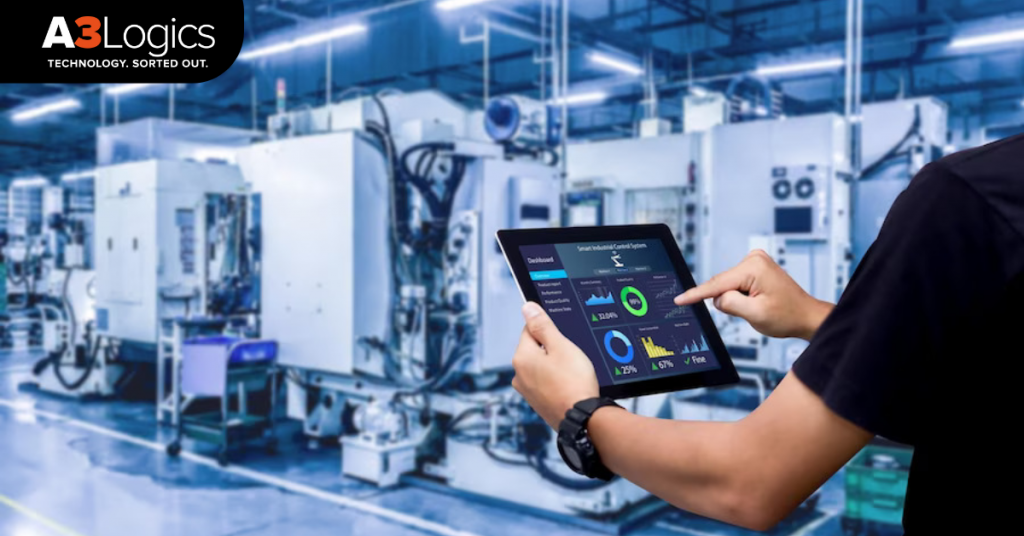
With the connection of devices, sensors, and systems, IoT facilitates improving the productivity and efficiency of most industrial operations. Industrial automation systems based on IoT enable you to view, monitor, and gather real-time data. Combining IoT enables you to closely monitor and trace the processes of products.
It ensures that the products’ quality is high by acting as soon as any issue or deviation is discovered. This also reduces the number of defects. IoT-based automation factory technologies allow you to observe, monitor, gather, and analyze in real time. These capabilities provide manufacturers with data on how well their equipment is functioning, enabling them to identify issues ahead of time and maximize overall efficiency.
> Connecting Physical Assets to Digital Intelligence
Smart sensors, RFID tags, and networked controllers are examples of IoT devices that are built into machines and systems all across the manufacturing floor. These gadgets are always collecting data, like temperature, vibration, pressure, speed, and more. They provide you a digital view of what’s going on in the real world.
> Real-Time Data Capture and Actionable Insights
Old-fashioned automation systems depended on collecting data on a regular basis. IoT, on the other hand, lets you keep an eye on things all the time. This lets manufacturers find problems right away, make operations better on the go, and get rid of downtime risks with predictive alerts.
> The Shift from Reactive to Proactive Operations
One of the best things about IoT in industrial automation is that it makes predictive maintenance possible. Industrial IoT solutions let management know when a machine is showing early symptoms of stress, which stops losses and extends the life of the equipment.
Key Benefits of IoT-Based Industrial Automation
Understanding the benefits of IoT in industrial automation can drive the development of IoT based solutions. Here is a look at some of the key benefits of IoT in industrial automation.
1. Enhanced Operational Efficiency
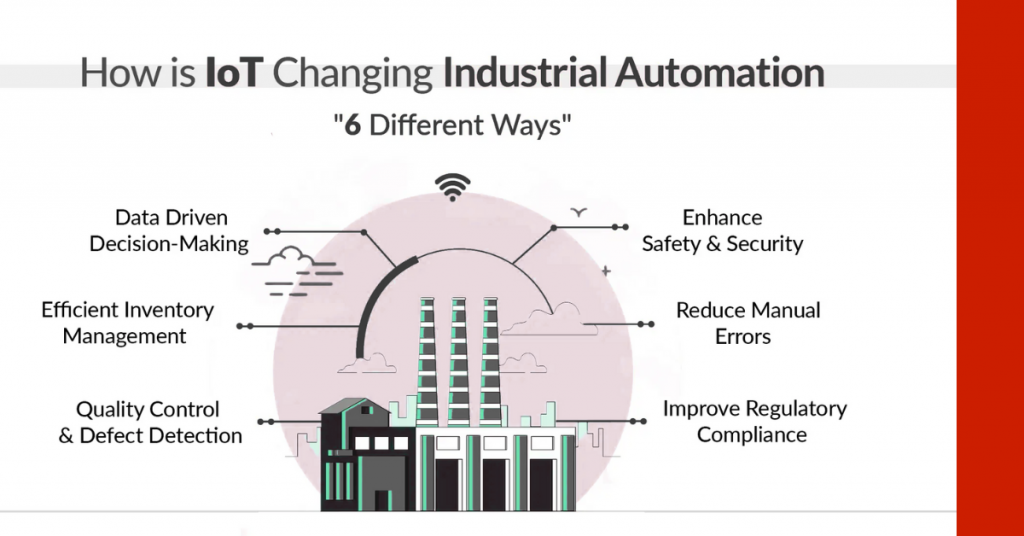
IoT streamlines processes by eliminating manual interventions, enabling machines to communicate seamlessly, and automating decision-making in real time. This results in faster production cycles, reduced wastage, and increased throughput with fewer resources.
2. Maximized Uptime and Safety
IoT sensors continuously monitor equipment health and working conditions, helping detect abnormalities like overheating, misalignment, or leakage. This early detection reduces unplanned downtimes and prevents safety hazards—ultimately saving both time and human lives.
3. Collaborative Productivity Boost
Smart automation enables machines and humans to work in harmony. Collaborative robots (cobots) equipped with IoT sensors adapt to human movement, making operations more flexible and safe, and improving productivity without compromising workforce wellbeing.
4. Real-Time Data-Driven Decision Making
IoT enables the capture and analysis of large volumes of data in real time. This empowers production managers to make faster, more accurate decisions—whether it’s rerouting production during machine downtime or adjusting supply levels during demand spikes.
5. Predictive Maintenance
Instead of reactive or scheduled maintenance, IoT facilitates predictive models that forecast equipment failure before it happens. This saves costs on repairs, extends machinery lifespan, and enhances asset utilization across the production lifecycle.
6. Improved Quality Control and Consistency
IoT-based quality monitoring systems can detect deviations from standard specifications instantly. This allows for immediate corrections in-process, reducing defect rates, improving product quality, and minimizing the need for manual inspections.

Core Applications of IoT in Industrial Automation
1. Asset Tracking and Management
IoT sensors and RFID systems help manufacturers track asset locations, utilization rates, maintenance history, and performance in real time. This ensures better inventory control and higher ROI on capital equipment.
2. Remote Monitoring and Control
Supervisors can remotely monitor production lines, control equipment settings, and respond to alerts from any location using IoT-powered dashboards and mobile apps. This boosts operational agility and is especially beneficial for multi-site or remote facilities.
3. Predictive Maintenance & Analytics
With condition-monitoring sensors feeding into predictive algorithms, companies can identify mechanical issues before they lead to costly breakdowns. Predictive analytics helps optimize maintenance schedules based on actual equipment conditions.
4. Optimized Maintenance Scheduling
Rather than relying on time-based maintenance, IoT enables need-based service scheduling. This ensures machines are serviced only when required, reducing unnecessary service costs and increasing equipment availability.
5. Worker and Plant Safety Enhancements
Wearables and environmental sensors monitor conditions like gas leaks, air quality, worker fatigue, and hazardous zones. IoT alerts managers and workers about potential dangers in real time, enabling proactive safety measures.
6. Inventory and Warehouse Monitoring
Smart shelves and IoT-based warehouse systems track product movement, temperature, and storage conditions. This minimizes stock-outs, overstocking, and product spoilage—especially for perishable or high-value items.
7. Connected and Intelligent Supply Chain Management
IoT improves visibility across the supply chain—from raw material sourcing to final delivery. Real-time data from transport vehicles, warehouse sensors, and vendor systems helps optimize logistics, minimize delays, and reduce costs.
Real-World Use Cases and Success Stories
IoT in industrial automation has left its mark by simplifying processes and cutting down significant downtime. In order to understand how industrial IoT solutions work in various industries we need to take a look at the various real-world applications of IoT in industrial automation.
> FANUC – Intelligent Robotics & Preemptive Maintenance
FANUC, a robotics world leader, employs IoT to track thousands of industrial robots using its FIELD system. The robots communicate with the cloud where AI algorithms read their performance and forecast maintenance. This saves 25% of downtime and enhances production efficiency, particularly in automotive and electronics industries.
> John Deere – Farm Automation
John Deere uses IoT in its farm equipment to improve agriculture practices. Its harvesters and tractors receive real-time soil, weather, and crop information, empowering farmers to make the best decisions. The outcome: higher yields, more efficient resource use, and less environmental footprint.
> Siemens Insights Hub – Scalable Industrial IoT Platform
Siemens created the MindSphere platform (today Siemens Insights Hub), an open IoT operating system that links industrial devices to the cloud. It helps companies analyze the performance of equipment, save energy, and carry out predictive maintenance, delivering 10–20% cost savings and improved energy efficiency.
> Bosch Rexroth – Condition Monitoring
Bosch Rexroth deployed IoT sensors throughout its hydraulic systems to support condition-based monitoring. This lowered unscheduled downtime by 40%, lengthened the lifespan of components, and delivered more detailed knowledge of system health to factory floor managers.
Challenges in IoT Implementation & How to Overcome Them
With the industries rapidly looking to invest in IoT in industrial automation for an improved workflow we are seeing a quick rise in the demand for industrial IoT solutions, however with the various benefits of IoT in industrial automation that we have covered earlier it can come with its own challenges.
In this section, we have taken a look at the various challenges faced in the implementation of industrial IoT solutions and what are the best ways to overcome them.
1. Security and Data Privacy
Challenge: IoT systems often communicate over public networks, increasing vulnerability to cyberattacks.
Solution: Implement end-to-end encryption, multi-factor authentication, and regular security audits. Choose IoT platforms that are compliant with industrial security standards like ISO/IEC 27001, NIST, and IEC 62443.
2. Interoperability and System Integration
Challenge: Integrating IoT devices with legacy systems and different protocols is complex.
Solution: Adopt open standards, use APIs, and select scalable IoT platforms that offer backward compatibility with older PLCs and MES/SCADA systems.
3. Big Data Management and Analytics
Challenge: IoT generates massive volumes of data, which can overwhelm storage and analytics systems.
Solution: Leverage cloud-based analytics platforms with AI/ML capabilities. Use edge computing to filter and preprocess data before sending it to central systems.
4. Workforce Skill Gaps and Training Needs
Challenge: The shift to IoT automation requires new skills in AI, data science, cybersecurity, and IoT systems management.
Solution: Invest in ongoing workforce development, partner with training providers, and upskill existing staff through certifications and workshops tailored to Industry 4.0 technologies.
5. Scalability and System Flexibility
Challenge: Businesses often struggle to scale their IoT deployments due to inflexible infrastructure.
Solution: Use modular IoT architectures and cloud-native platforms that can scale resources based on demand. Prioritize pilot testing before full-scale deployment.
Future Trends and Opportunities in IoT-Driven Automation
The future of Industrial IoT solutions is bright. And with the advent of so many technologies and gadgets there are many ways to inculcate them into the everyday work process. In this section, we are going to look at what the future holds for IoT in industrial automation.
AI/ML Integration for Smart Decision-Making
The future of industrial automation lies in combining IoT with artificial intelligence and machine learning. AI models can analyze IoT sensor data in real time to detect patterns, anomalies, and optimization opportunities. Predictive analytics will allow companies to forecast machine failures, automate inventory planning, and dynamically adjust operations to meet demand, reducing waste and improving agility.
Digital Twin Technology
Digital twins—virtual replicas of physical systems—are gaining traction in manufacturing. By linking IoT data to 3D models of machinery, companies can simulate real-world scenarios, test product designs, and anticipate maintenance needs before deploying solutions physically. This minimizes prototyping costs, accelerates innovation cycles, and helps ensure operational accuracy across complex industrial processes.
5G-Enabled Real-Time Connectivity
The rollout of 5G networks is set to revolutionize industrial IoT. With ultra-low latency and high bandwidth, 5G will enable real-time communication between IoT devices, robots, and edge systems. This facilitates faster data transfer, remote machine control, and more accurate robotics—critical for industries like automotive, healthcare, and aerospace.
Edge Computing for Instant Processing
Edge computing brings data processing closer to the source—on machines, robots, and gateways—rather than relying solely on cloud infrastructure. This reduces latency, improves response time, and enables rapid decision-making in time-sensitive operations like assembly lines and autonomous vehicles. Future factories will adopt hybrid architectures that combine edge and cloud for optimal performance.
Enhanced Cybersecurity Frameworks
As industrial systems become more connected, cybersecurity becomes a top priority. Future trends include the use of AI-driven threat detection, zero-trust architecture, blockchain for device authentication, and secure firmware updates over-the-air. Compliance with international standards such as IEC 62443, NIST, and GDPR will be critical for global operations.
Why Partner with A3Logics for Industrial IoT Solutions?
A3Logics is a trusted IoT Development Company delivering innovative, scalable, and secure Industrial IoT (IIoT) solutions tailored to manufacturing and industrial clients. With 21+ years of experience and a dedicated IoT and automation Center of Excellence (CoE), we help businesses transition seamlessly into the Industry 4.0 era.
Our services cover everything from smart factory consulting and IoT platform development to sensor integration, data analytics, and predictive maintenance systems. We specialize in creating interoperable, cloud-native, and edge-enabled solutions that can handle massive data volumes and deliver real-time insights.
Key Reasons to choose A3Logics:
- End-to-End IIoT Solutions: From ideation to deployment, we cover every aspect of industrial automation.
- Domain Expertise: Proven success in automotive, logistics, energy, and manufacturing sectors.
- AI & ML Integration: We embed intelligence into your machines and processes for smarter decision-making.
- Legacy Modernization: We help you integrate modern IoT platforms with existing SCADA, ERP, and MES systems.
- Security First: We implement robust cybersecurity frameworks aligned with NIST, ISO 27001, and IEC standards.
- Scalability & Flexibility: Cloud-native platforms that grow with your operations—no downtime, no disruptions.
With A3Logics as your partner, your business can unlock new levels of efficiency, safety, and agility, turning your factory into a smart, data-driven enterprise ready for the future of industrial automation.
Conclusion
The integration of IoT in industrial automation is no longer just a competitive advantage—it’s a necessity. As global supply chains demand faster, smarter, and more agile manufacturing operations, Industrial IoT (IIoT) enables companies to bridge the gap between physical systems and digital intelligence. From predictive maintenance and real-time monitoring to enhanced safety and intelligent supply chains, IoT is revolutionizing how industries operate.
However, the path to full IoT-driven automation requires overcoming challenges like data integration, cybersecurity, system scalability, and workforce readiness. Companies must adopt a strategic approach that involves strong partnerships, scalable infrastructure, and future-ready technology.
A3Logics empowers industries with cutting-edge Industrial IoT development services that are secure, scalable, and deeply aligned with business objectives. Whether you’re starting your smart factory journey or scaling existing IoT operations, our expertise ensures that your digital transformation leads to tangible ROI and sustained operational excellence.