Employee benefits administration is the job of figuring out and overseeing the benefits that a firm gives to its workers. Usually, the HR department or benefits administrators within an HR department are in charge of carrying out the process.
Good benefits management can help you get an edge over your competitors when it comes to hiring, keeping, and attracting top staff, as well as lowering operational expenses. When a company looks at what its employees need and picks perks that suit those requirements, employees feel heard and valued, which can make them more engaged at work.
As part of the benefits administration process, firms can also save money by getting rid of programs that aren’t being used and getting the best plans and pricing possible.
The Benefits Administration Process must now be done without any problems. This is necessary for the success of the firm and the happiness of the employees. As technology changes the way HR works, smart companies need to simplify their Benefits Administration Process Flow to cut down on mistakes, keep costs down, and keep up with the needs of today’s workers.
Here we are going to look at the best technologies, tactics, and trends that HR professionals can use to improve benefits administration in 2025 and beyond.
Importance of Efficient Benefits Administration
Managing benefits well goes beyond just filling out forms. It is very important for getting employees involved, keeping expenses down, and making sure the company follows the rules.
When the Benefits Administration Process is well-managed, employees are happier and more likely to stay with their current company. Employees get benefits in addition to their normal pay or income. To be eligible, workers may need to put in a certain number of hours.
For a lot of workers, benefits are just as important as or even more important than their base wage. According to our research, 37% of workers would rather have paid time off than pay hikes.
Some common benefits for employees are:
- Insurance for disabilities and long-term care
- Benefits for commuters
- Insurance for health, teeth, and eyes
- Reimbursement for tuition
- Leave for parents
- Mental health care
- Time off with pay
- 401k contributions and retirement accounts
- Hours of paid volunteer work
- Money for childcare
Key Statistics in Benefits Administration
- Seven out of ten firms have made their benefits enrollment digital.
- Most employers utilize 2 or 3 different providers to run their benefit plans.
- Benefits administration software is said to cut down on manual errors and save operational costs.
- 45% of businesses say that benefits administration technology has made them more efficient.
- Well-managed and well articulated benefit schemes make employees happier.
- Data analytics helps make benefits plans better and keeps costs down.
- HR may focus on strategic goals when the benefits administration process flows are efficient.
It’s clear that putting money into the correct Benefits Administration Process has a direct effect on how productive, engaged, and successful a firm is.
Top Tips to Streamline the Employee Benefits Administration Process
Improving the benefits administration process includes changing the way things are done, using new technology, improving communication, putting compliance first, and using data-driven insights. This is a detailed look at the finest plans for 2025.
1. Embrace Technology and Automation
HR directors today know that technology is the key to making the Benefits Administration Process Flow work better. Not only does digitization reduce time, it also makes sure that things are correct, safe, and may grow.
i. Benefits Administration Software (BAS)
Comprehensive BAS platforms take care of enrollment, checking eligibility, updating plans, and reporting. They cut down on paperwork, remove mistakes made by hand, and keep all benefit information in one place. Intuitive interfaces make the Benefits Administration Process easier to use and more clear for both HR and employees.
ii. Human Capital Management (HCM)
By adding benefits management to a larger HCM package, payroll, time tracking, and talent management all work together, getting rid of data silos. Real-time updates make sure that every Benefits Administration Process Flow is compliant and that employees always have access to accurate, up-to-date information.
iii. Self-Service Portals
Giving employees the ability to enroll, update beneficiaries, and handle claims greatly cuts down on the amount of work that needs to be done by administrators. Self-service solutions that are available 24/7 make the Benefits Administration Process easier and give people more control.
iv. Automate Repetitive Tasks
Automation technologies take care of everyday tasks like sending reminders, making documents, and checking eligibility, so HR can focus on strategy instead of paperwork.
v. Integrate Systems
The Benefits Administration Process Flow is streamlined by seamless connection between benefits platforms, payroll, HRIS, and insurance provider systems. This removes the need for double entry. Application Programming Interfaces (APIs) keep data in sync in real time, which can cut administrative costs by up to 85%.
vi. AI and Chatbots
AI-powered chatbots answer basic questions about benefits, help employees sign up, and fix problems right away. Predictive analytics show what causes costs, predict usage, and provide ways to improve the Benefits Administration Process.
2. Improve Communication and Education
For a smooth Benefits Administration Process Flow, it’s important to communicate clearly. When there is misinformation or a lack of information, mistakes happen, perks go unused, and employees are unhappy.
i. Clear and Concise Information
Make sure that plan details, eligibility requirements, enrollment instructions, and policy changes are all available in formats that are easy to comprehend. Use infographics and FAQs to help people understand better.
ii. Multi-Channel Communication
Use email, the intranet, webinars, in-person meetings, and mobile apps to talk to each other. Getting to employees where they are at every step of the Benefits Administration Process keeps them interested.
iii. Year-Round Education
Go beyond open enrollment. Throughout the year, send out updates, reminders, and instructive information to keep benefits on employees’ minds and help them get the most out of what they offer.
iv. Total Rewards Statements
Use detailed total rewards statements to show the complete worth of compensation, which includes salary and benefits. This makes people feel valued and enhances their morale.
v. Manager Training
Teach managers how to answer simple questions about benefits and point employees to resources. Informed managers help everyone in the organization communicate better and keep the Benefits Administration Process Flow going in a favorable direction.
3. Ensure Compliance and Data Accuracy
In today’s world of rules and regulations, not following them can lead to big fines and damage to your reputation. In the Benefits Administration Process, accuracy, attention to detail, and keeping up with the latest procedures are very important.
i. Stay Informed with Federal, State, and Local Regulations
Keep an eye on legislative requirements that affect benefits, like the ACA, ERISA, FMLA, and state-specific rules. Make sure that all plan documentation and policies are up to date.
ii. Centralized Data Management
A single platform brings together all of the records of benefits, eligibility, and employee documents. Real-time syncing cuts down on errors and makes audit trails easier to follow in the Benefits Administration Process Flow.
iii. Regular Audits
Check benefits data and processes on a regular basis to find mistakes, find compliance gaps, and make sure that everyone is eligible. Modern audit technologies find problems fast and offer fixes.
iv. Vendor Management
Work with benefit vendors and carriers whose processes also help with data security and compliance. To maintain the Benefits Administration Process safe and effective, keep good records and review them often.

4. Outsource to a Benefits Administrator
For a lot of firms, especially small and medium-sized ones, outsourcing the Benefits Administration Process can make a big difference.
i. Consider a Professional Employer Organization (PEO)
PEOs handle all the difficult parts of payroll processing, employee benefits, and following the rules all in one place. This makes the Benefits Administration Process Flow easier to follow and gives you access to superior benefits at reduced group prices.
ii. Evaluate Cost vs. Efficiency
Think about the pros and cons of managing your own business versus hiring someone else to do it. Outsourcing can save money by up to 70% and allow HR leaders more time to work on big projects. Employee Benefits Administration Services frequently come with the greatest technology, committed assistance, and knowledge of the law.
iii. Managed Benefits
Managed Benefits take care of everything from enrollment to compliance, which saves internal HR teams time and effort and makes sure that the Benefits Administration Process Flow goes smoothly.
5. Leverage Data Analytics for Better Decision-Making
Data is very important for making the Benefits Administration Process better. Strong analytics can:
- Keep an eye on enrollment rates, claims use, and employee happiness.
- Find out which perks are popular and which ones aren’t used much to improve your services.
- Help with planning and negotiating with vendors.
- Give early warnings about possible compliance problems.
- Help with keeping costs down and figuring out the return on investment for every part of the Benefits Administration Process Flow.
Why Automation is Key in Simplifying Employee Benefits Processes
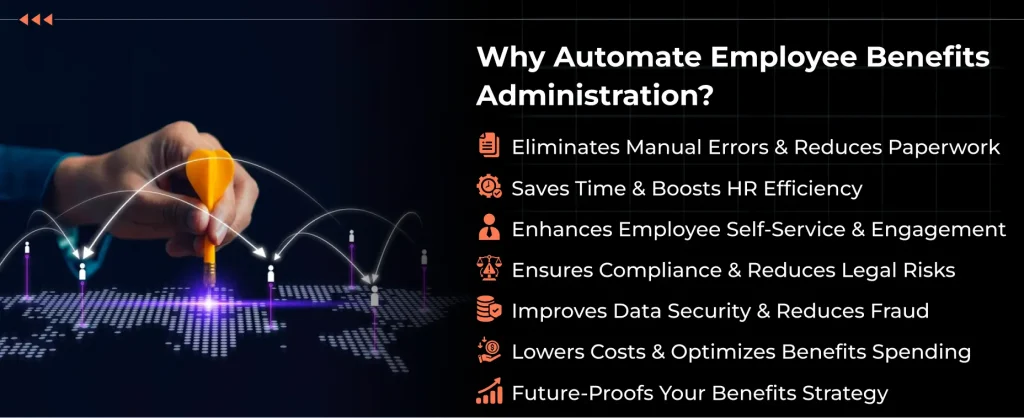
Embracing automation completely changes the Benefits Administration Process, making it more efficient, accurate, and engaging for employees on a large scale.
1. Eliminates Manual Errors & Reduces Paperwork
Automated workflows lower the chance of human errors, data entry mistakes, and lost files, making sure that the Benefits Administration Process Flow has clean, auditable records all the time.
2. Saves Time & Boosts HR Efficiency
HR workers may put their focus into strategic projects instead of doing the same chores over and over again, which will make them more productive and happy at work.
3. Enhances Employee Self-Service & Engagement
Automation gives employees the power to make adjustments, file claims, or look up plan data whenever they want, which makes them feel like they own the Benefits Administration Process.
4. Ensures Compliance & Reduces Legal Risks
Automated rule-based validation makes sure that all benefit transactions follow state and federal laws, which greatly lowers the chance of having to pay expensive fines for not following the rules.
5. Improves Data Security & Reduces Fraud
Automated systems keep track of every transaction, regulate who may access certain areas, and make it easier to keep an eye on questionable activities, all of which protect sensitive data.
6. Lowers Costs & Optimizes Benefits Spending
Automated systems lower administrative costs, combine repetitive work, and give you data-driven insights to help you spend your benefits plan money more wisely.
7. Future-Proofs Your Benefits Strategy
Automation adapts fast to new rules and employee expectations, which means that your Benefits Administration Process can change smoothly over time.
Common Mistakes to Avoid in Employee Benefits Administration
When improving the Benefits Administration Process, be careful of some typical mistakes that might make things less efficient and compliant:
- Using old systems and manual processes
- Not talking to employees well
- Not paying attention to updates on compliance and regulations
- Not Giving Personalized or Competitive Benefits
- Not connecting benefits with payroll and HR systems
- Ignoring Risks to Data Security and Privacy
- Not keeping track of how benefits are used and the return on investment
- Putting off getting ready for open enrollment
- Not teaching HR and managers about benefits
- Not getting ready for audits or disagreements
Taking care of these problems makes sure that the Benefits Administration Process Flow is strong and helps the business stay healthy in the long term.
Best Practices for Managing Open Enrollment Efficiently
Open enrollment is an important part of the Benefits Administration Process. Good management means getting things ready early so you don’t have to hustle at the last minute.
- Using online manuals and self-service portals to teach and sign up workers.
- Testing systems before they go live to make sure they work well.
- Sending out reminders and clear instructions for signing up across a number of channels.
- Offering webinars or Q&A sessions to answer employees’ questions.
- Checking and updating registration materials on a regular basis to make sure they are clear and up to date.
- Using analytics to look at participation rates and plan future changes.
A well-planned open enrollment season lowers stress and makes the Benefits Administration Process Flow better for everyone.
How A3Logics Empowers Seamless Employee Benefits Administration
A3Logics is an expert in optimizing the entire Benefits Administration Process. They offer customized solutions that automate activities, make sure compliance, and give employees an easy-to-use experience. These range from cutting-edge Benefits Administration Software to integrated HCM platforms. With Managed Benefits Services, A3Logics works with companies to set up the best technologies, real-time data, and strong vendor connections.
This makes the Benefits Administration Process Flow smooth from onboarding to claim resolution. Their consultative approach makes sure that benefits management keeps up with your business and the rules, which leads to demonstrable savings and happier employees.

Final Thought
Modern businesses that care about efficiency, following the rules, and employee health need to make the benefits administration process easier. HR directors can make their Benefits Administration Process Flows more flexible and responsive by using technology, encouraging communication, making sure data is correct, thinking about outsourcing, and using analytics.
This will help their businesses stay ahead of the curve. No matter if you use internal teams, Employee Benefits Administration experts, or outside partners like Managed Benefits experts, the road to better benefits management requires constant development, a clear strategic vision, and a dedication to both operational excellence and employee care.