
We all know how important it is to ensure the security of our smart devices. These devices contain our personal information and with increasing digitization the threat of this information being misused is rapidly rising. This is where one key security feature comes into play – AI Face Recognition. This feature provides an additional layer of security making it nearly impossible to crack, especially in mobile applications.
Cherry on top? AI facial recognition. This software uses deep learning algorithms to examine and compare facial traits in order to reliably identify persons. With the market size of facial recognition expected to show an annual growth rate (CAGR 2025-2031) of 16.79%, resulting in a market volume of US$14.55bn by 2031. To keep with this growth it is important that facial recognition software solutions are secure for the future. Various businesses are combining emerging technologies like blockchain, AI, AR, and VR.
For a deeper understanding of AI facial recognition technology in this comprehensive guide we are going to breakdown the various AI face recognition features and the cost to develop an AI face recognition app.
What is AI-Based Facial Recognition?
AI-based facial recognition is a system that employs artificial intelligence algorithms to recognize and verify people based on their visual characteristics. It operates by evaluating distinct patterns in a person’s facial traits, such as the distance between the eyes, the shape of the nose, and the curves of the jawline.
AI algorithms are trained on massive data of facial photos to learn and recognize patterns. This enables the system to reliably match faces to recorded IDs, or detect and classify faces in real time.
Enter deep learning – it is a branch of artificial intelligence in which neural networks are trained with enormous quantities of data to execute specific tasks, is an important component of AI-based facial recognition.
Deep learning algorithms seems like the perfect solutions for facial recognition. Do you know why? It is because they can automatically extract key elements from photos and make accurate predictions based on them.
Facial Detection – Identifies and authenticates human faces in photos or video streams, allowing security, attendance, and personalization use cases.
Emotion Detection – Examines facial expressions to recognize feelings like happiness, anger, or fear, beneficial for customer analysis, security, and mental health tracking.
Mask Detection – Identifies whether an individual is wearing a face mask. This will help in assisting health adherence in public areas and workplaces.
Privacy and Encryption – Stores and transmits all facial information securely using encryption, safeguarding user privacy while complying with regulations.
Market Analysis of AI Face Recognition Applications
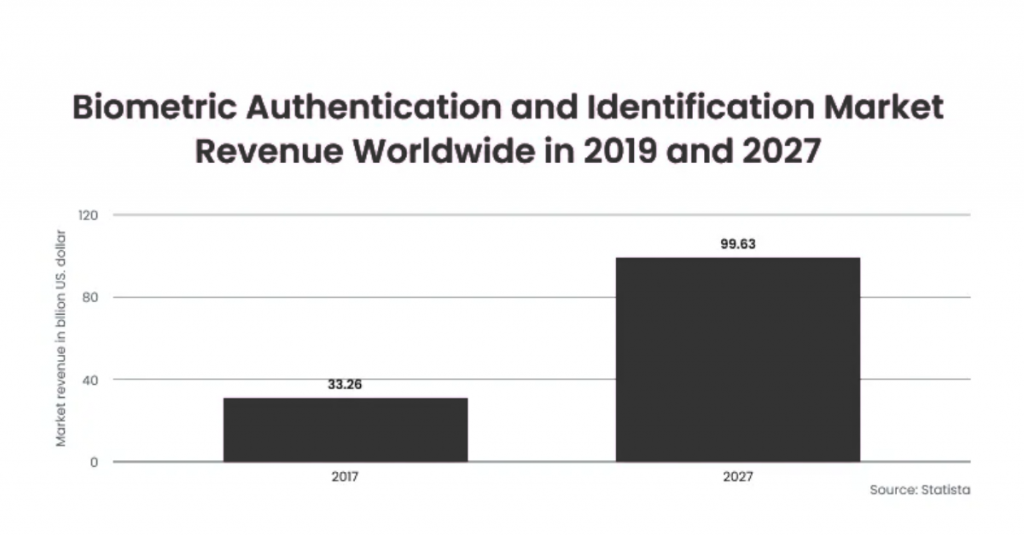
There is hardly anyone who has not heard about AI facial recognition and its uses. Statista estimated the 2019 biometrics verification and identification market at 33.26 billion USD. With this trend continuing, researchers expect this market to reach 99.63 billion USD by 2027. Within a decade, the specialty may triple! Global biometric authentication and identification market revenue 2019–2027 which is almost three times market growth is expected in ten years.
To understand the reach of this technology let’s take a deeper dive into how the technology came about! A few years ago, NIST produced FRVT, the Facial Recognition Vendor Test. It evaluates facial recognition techniques using academic and commercial algorithms.
Recent research demonstrated that facial recognition technology can attain 99.97% accuracy in ideal situations. High accuracy and dependability drive the fast-growing face recognition business.
Consider how much this technology could benefit your business. And as a leading provider of AI development services we can help you build and adjust facial recognition for your needs as a leading computer vision development business.
How Facial Recognition Works?
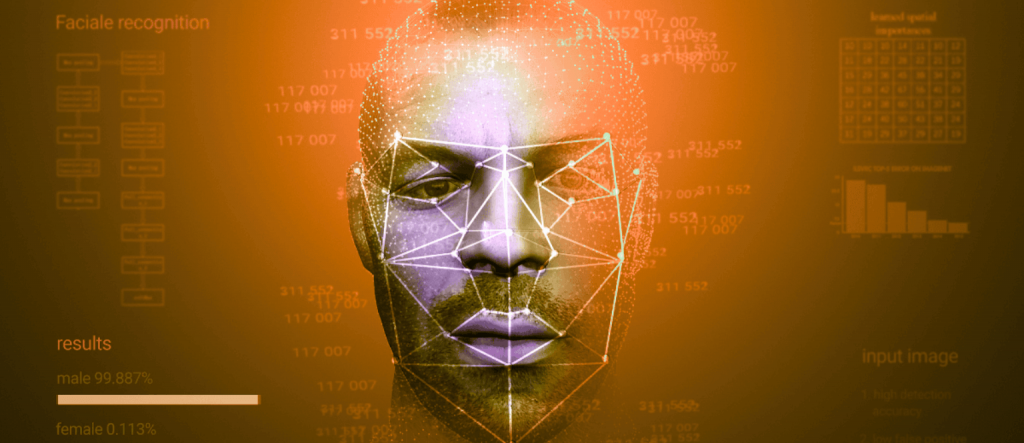
With the increasing need for security AI facial recognition, the ins and outs of how facial recognition works is important. In the general case here is how most facial recognition software works.
1. Capture
The face recognition system starts by capturing an image of the face; which is the main input for analysis. Using different devices like cameras on smartphones or stored images; the system retrieves visual data required for identification.
2. Extraction
After the capture phase; the system then pulls out relevant facial features and patterns from the captured image. This is done through algorithms that dissect the collected data and determine distinctive characteristics and properties unique to the face of the individual. With advanced image processing techniques, useful information is segregated and ready to be compared.
3. Comparison
After facial features have been extracted – the system then goes on to match these patterns with data that already exists in its database. This entails a detailed process where the system compares the features extracted against face profiles that were previously recorded. Based on analysis of similarity and difference, the system identifies possible matches or differences.
4. Matching
In the last step; the system completes the process of recognition by determining a match from the database, that is if available. When it finds an appropriate match, the system presents the related information to the user who made the request. This final step is the ending of the facial recognition process, providing users with meaningful information based on the found match.
Business Benefits of Utilizing AI Face Recognition
One thing people frequently ask is what are the advantages of integrating AI-based facial recognition into any software. In this section, we have explored how this innovation can optimize processes and elevate customer experiences, driving growth and efficiency.
> Contactless Identification
Facial recognition technology for identification has the benefit of contactless engagement. Facial recognition is significantly quicker compared to – conventional fingerprint scanners, making it especially beneficial in high-density situations or offices that have a huge workforce.
> Recognition Speed Enhancement
Facial recognition technology has come a long way over the years; leading to quicker and more streamlined processes of recognition. With little time taken for identification – particularly when people’s biometric information is saved in the system, companies can gain from quick and smooth functions.
> Stronger Security Measures
Facial recognition technology supports security systems in different contexts – such as public places like stadiums, hospitals, and shopping malls. By effectively distinguishing between permitted people and unauthorized parties; facial recognition systems help ensure safe environments and protect precious assets.
> Automation of Verification Processes
By automating verification procedures using facial recognition technology; companies can maximize resource allocation and minimize the necessity for extra staff. Since the system runs around the clock – organizations can shift manpower to other critical functions – maximizing overall efficiency.
> High Accuracy Rates
Facial recognition technology uses complex facial anatomy to provide high accuracy in identification. The ever-changing nature of the technology and advancements in camera technology increase accuracy levels, and it becomes difficult to manipulate or mislead the system in many ways. Therefore, companies can use accurate identification results for different purposes.
Technologies Used in AI Face Recognition App Development
Implementing the latest technologies can make your software future proof. Which is pretty important in our opinion. Because to stay relevant in the coming years, technology like deep learning, transfer learning and AI is important.
Here are some of the technologies used in AI face recognition app development :-
1. Deep Learning Models
Deep learning – especially Convolutional Neural Networks are the foundation of modern face recognition systems. They learn automatically hierarchical patterns from raw image data, from simple textures and edges to intricate facial features. Given training on massive datasets, they generalize well to lighting, pose, and background changes, delivering accurate identification under real-world conditions.
2. Generative Adversarial Networks
GANs consist of two neural networks a discriminator and a generator that work against each other to generate very realistic fake data. In face recognition, GANs can generate varied – high-quality faces to augment datasets. This allows models to generalize well when training data are limited. They can be used for:- face aging, de-aging, or reconstructing partially occluded faces.
3. Face Recognition
Face recognition technology involves the comparison of a detected face with face data stored to verify identity also known as 1:1 matching or identify an individual from a database (1:N matching). Facial embeddings—numerical representations of the face—are utilized in the process and remain unchanged even with varied expressions, lighting, or accessories.
4. Face Detection and Alignment
Before recognition – the system must first identify a face within a still image or video stream. Detection algorithms find the bounding box surrounding the face, and alignment places facial features (eyes, nose, mouth) in a canonical position. Proper alignment greatly improves the performance of recognition by reducing variation caused by head tilt or rotation.
5. Facial Landmark Detection
Facial landmark detection detects specific key points on a face:- such as the eye corners, the tip of the nose, and the lip contours. These landmarks play a significant role in: emotion detection, facial animation, and AR effects. Facial landmarks are also used for normalizing and cropping faces for recognition.
6. Feature Extraction
After a face is identified and enrolled, the system calculates a small number of numerical features (embeddings) to represent unique facial characteristics. This prohibits storing raw images and allows for quick – precise matching in recognition tasks.
7. Attention Mechanisms
Attention layers within neural networks enable the model to focus more attention on the most beneficial facial regions (e.g., the eyes and mouth) and ignore unbeneficial parts of the image. This increases robustness against various kinds of occlusions, background noise, and low-quality images.
8. Transfer Learning and Fine-Tuning
Instead of training a model from the ground up – practitioners will often use pre-trained face recognition models. They will then fine-tune them on their dataset. This operation—transfer learning—is faster, less computationally intensive, and more effective, especially for use in a specific domain.
9. Privacy-Preserving Techniques
Since facial data is private – privacy-preserving methods like:- encryption, secure multi-party computation, differential privacy, and federated learning are used. These will enable facial recognition models to be trained and utilized without leaking raw personal data, solving regulatory compliance with GDPR and CCPA.
Popular Examples of Face Recognition Applications
Now you won’t go for a job interview before doing some preparations now will you? Similarly, before creating an Android or iOS facial recognition app, it is important to understand how the popular ones are doing it. Here are some of them.
1. FaceLock
Android facial recognition app FaceLock prioritizes security. FaceLock, a pioneer in facial recognition technology, lets users lock certain apps and files with a personalized facial lock. The program has an easy-to-customize UI. FaceLock also has a free and premium version with greater features.
2. MojiPop
Eureka Studios’ free MojiPop software works on Android and iOS. It stands itself by delivering a variety of animated stickers that respond to facial recognition technologies. The software has simple navigation and an interactive keyboard to engage users.
3. Applock
The Applock, a top Android facial recognition app, is known for its security. Applock provides full protection by restricting unauthorized access to personal data and apps. This app protects data and provides simple mobile device access via voice and facial recognition.
4. FindFace
The FindFace, an Android facial recognition app, lets users upload images of strangers and find them on social media. FindFace, designed for amusement, has a 95% success rate and can analyze 250 million faces in under a second. The developers also added a cross-platform API for mobile and web apps.
5. Face Analysis Pro
Facial Metrics Analysis Pro is another exciting entertainment application of facial recognition technology. This Android software uses face analytics to identify celebrity resemblances, making it fun and participatory.
6. FaceFirst
The FaceFirst is a popular remote identification tool used by law enforcement and transportation hubs. FaceFirst simplifies facial recognition and monitoring with a large database and real-time notifications.
7. LuxandFace Recognition
LuxandFace Recognition, an Apple-exclusive facial recognition tool, lets users name faces to identify people. Though simple, this software is reliable for identifying and managing recognized individuals.

Must-Have Features in an AI Face Recognition App
You know what is the bare minimum required for facial recognition software? It is to identify individuals based on their traits like unique identification and different identity.
Other things you can expect from a basic face recognition software offers fingerprint, eye, hand geometry, voice, card, and signature identification.
1. Multiple Verification
The AI Face Recognition App supports multiple verification techniques to accommodate user preferences. The program is adaptable and user-friendly because it offers – fingerprint, eye, hand geometry, voice, card, and signature recognition choices to meet user demands.
2. Live Facial Recognition
Live Facial Recognition uses numerous video feeds to scan and compare faces to a predefined database of IDs using cutting-edge technology. Real-time alerts to administrators when a matched face is spotted improve security; making it useful for surveillance, access control, and event monitoring.
3. Multiface Readability
Multiple Face Readability can read up to 10,000 faces at once! This is a significant number when meeting the needs of increasing enterprises. This capacity helps major organizations and institutions manage faces with a prominent LCD display. It streamlines identification and tracking in high-traffic areas.
4. Multiple Facial Recognition Methods
The software allows face, card, or a mix of facial verification methods and this improves security. This multi-mode method lets customers customize verification to their security needs. It adds another authentication layer which is pretty handy to strengthen the system against fraudulent access.
5. Upgrade Remotely
Remote Upgrade addresses the changing needs of small businesses and startups. This connection with the app’s interface lets users upgrade the program pretty easily. This remote upgrade allows enterprises to update to the latest features plus get security enhancements without the need for physical interaction, saving time and resources.
6. Cloud-DB Method
Some facial recognition software use Cloud-DB for scalability. This allows the system to accommodate an ever-growing database of faces plus boosting the limits to 20,000 or more! Cloud technology lets the software easily handle the ever-rising datasets – and grow with the organization’s demands.
How to Develop an AI Face Recognition App?
Face recognition software development takes careful planning and attention to detail to maintain consistency and reliability. And nobody wants to pay spend than the assigned budget now, that also is why there has to be proper structure and here’s how you can decide yours!
1. Define Goals, Scope, and Use Cases
Before developing a face recognition app, understand its objective, scope, and use cases. Without a goal, app scope and functionality are hard to determine. Finding relevant conditions helps tailor the app to the target audience.
2. Ensure training data accuracy
Training data and accuracy are crucial to facial recognition app development. Facial recognition technology is complex; thus a large dataset of images from: varied populations, lighting, postures, and expressions is needed. Validating training data ensures it represents target users and removes biases that may impede recognition.
3. Face Recognition Algorithm
Choosing the right facial recognition algorithm comes next. Fishfaces, Local Binary Patterns, Eigenfaces, and Deep Learning-based CNNs offer varying strengths and capabilities. Compare:- performance measures, scalability, computational efficiency, and compatibility with datasets. This will assist you in selecting the best algorithm for the application.
4. Preprocessing
Needing accurate facial recognition? Now that calls for preprocessing. Then the data is fed for identification algorithms, face detection, alignment, noise reduction, illumination correction, and feature extraction. This is key to increase the data quality. Use use case and dataset-specific preparation strategies if you want to improve recognition performance.
5. Adjust Recognition Model
Iteratively training and fine-tuning – the recognition model helps in improving performance. Labelled datasets train the model to recognize facial features. After that; rigorous testing and validation evaluate its performance in various scenarios. Based on testing results – model parameters are refined to better app identification.
6. Consider Ethics, Privacy, and Security
Face recognition app development requires – privacy, security, and ethics. In order to protect user data it is important to follow the GDPR and CCPA compliance. Face image dataset security is improved with the helps of data encryption, secure storage, and access limits. Addressing dataset and algorithm biases promotes:- ethical technology, transparency, and trust.
Cost-Affecting Factors for AI Face Recognition App Development
When you are outsourcing your dream project to a Computer Vision Development Services provider it is obvious that you want to know what are the things that are affecting the cost of your AI facial recognition system. Mainly the facts that affect the cost to develop AI face recognition app include:-
Type of Facial Recognition Software – You can choose from 1:1 verification, 1:N identification, or real-time surveillance. And that also pretty much affects price and how complex your software is.
Integrated Features – Features such as emotion recognition, mask recognition, or multi-factor authentication contribute to development scope.
Needed Tech Stack – Sophisticated AI frameworks, cloud hosting, and security software can affect overall costs.
Where the Software Development Company is – Development prices differ extensively geographically. For example prices in North America vary drastically when compared to Asia.
Team Expertise – Want the best for your business? The top-notch AI engineers and computer vision experts can be quite expensive.
Project Duration – Long complicated project? Ever-increasing demand – more time translates to higher labor expenses and resource utilization.
Add-On Features – Another key factor the affect the price is features. Which can include advance features such as – offline mode, AR overlays, or sophisticated analytics add to the cost.
Recommended Tech Stack for AI Face Recognition App Development
Here are the tech stacks that the experts at A3Logics recommend for creating AI face recognition.
| Category | Tools / Tech | Purpose |
| Programming Languages | Python, JavaScript | Core coding for AI logic (Python) and UI (JavaScript). |
| ML Frameworks | TensorFlow, PyTorch | Train and deploy face recognition models. |
| Computer Vision | OpenCV, Dlib | Detect, track, and extract facial features. |
| Models | CNNs, Siamese Networks | Perform face classification or similarity checks. |
| Databases | PostgreSQL, MySQL, MongoDB | Store user data, images, and face embeddings. |
| Cloud & Deployment | AWS, Azure, GCP, Docker | Host, scale, and manage ML services. |
| Frontend | React, Angular, Vue.js | Build interactive user interfaces. |
| Backend & APIs | Flask, Django | Handle API requests and model integration. |
| Utilities | NumPy, Pandas, JWT | Data handling and authentication. |
Conclusion
The rise of facial recognition technology has made many tasks easier. From unlocking cellphones to improving security; its uses are varied and significant.
However, developing this technology can be pretty challenging. Just because you are creating a facial recognition program does not mean that it is going to be a success. After study, AI-powered software must be trained to correctly distinguish faces in vast databases.
Facial recognition demands a reliable tech partner. In addition to software development, this partner should be proficient in facial recognition algorithm training.
How A3Logics assists in Developing an AI Face Recognition App?
A3Logics utilizes its technological expertise in AI, computer vision, and data protection to develop scalable and high-precision face recognition solutions. From selecting appropriate deep learning models to integrating strong privacy measures, our team facilitates smooth deployment, high-speed processing, and global regulatory compliance. We deliver tailored features such as real-time recognition, emotion identification, and multi-platform support to suit industry requirements.