The field of medical imaging is undergoing a groundbreaking change with Artificial Intelligence (AI) for Fracture Diagnosis. Medical facilities around the world, in increasing numbers, are investing in AI Bone Fracture Detection Software Development solutions in order to improve diagnostic accuracy and efficiency in clinical workflows. This guide will cover the development, services, and implementation of AI for Fracture Detection in Radiology.
Statistics – AI in Medical Imaging, AI in Healthcare, AI in Orthopaedics
The effectiveness of Artificial intelligence for fracture diagnosis in orthopedic X-rays has been extraordinary. Research has shown that AI-assisted clinicians have a sensitivity of 92.5% for detecting fractures, specificity of 94.1%, and can provide the same level of detection as Orthopaedic and Radiology experts.
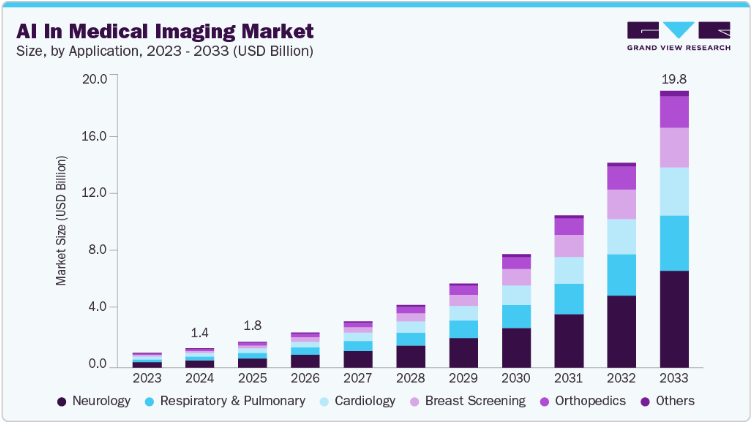
source:grandviewresearch
The global AI in medical imaging market size was at USD 1.36 billion in 2024 and is expected to reach USD 19.78 billion by 2033, growing at a CAGR of 34.67% from 2025 to 2033.
This demonstrates an incredible improvement in accuracy and liability that fracture detection potential from AI vision models for the Fracture Detection sector is achieving.
The NHS in England has adopted the use of this technology by introducing NICE-approved technologies such as TechCare Alert, Rayvolve, BoneView, and RBfracture, all of which are AI platforms, to detect potential fractures from X-rays. The use of AI technology aims to reduce missed fractures and improve the overall efficiency of emergency care. This is the first mainstream demonstration of the potential value of a Deep Learning Model for Bone Fracture Analysis within a healthcare system. The Guardian
The Fracture Liaison Service (FLS) also derives benefit from AI technologies in the use of HealthOST (derived from the ADOPT study) that collects information on potential fractures and assesses bone health. The evaluation of HealthOST resulted in reduced fracture rates, savings of over £50,000 per organisation, while demonstrating significant clinical value. The potential clinical and financial value of a Deep Learning–based Computer Vision Model for Bone Fracture Detection technologies is apparent.
How Does AI-Powered Bone Fracture Detection Software Work?
AI-powered detection software uses various sophisticated deep learning algorithms that are trained with large collections of medical images. The Deep Learning–based Computer Vision Model for Bone Fracture Detection process begins once medical images, regardless of whether they were taken via X-ray, CT image, or MRI, are entered into the system.
AI vision models for Fracture Detection utilise computer vision techniques to inspect medical images, identifying patterns and abnormalities that indicate possible candidates for fracture interpretation. The methodology is based on convolutional neural networks (CNNs) trained on various datasets to assist analysis of even subtle visual distinctions associated with bone fracturing, which are generally not detected by human visual interpretation.
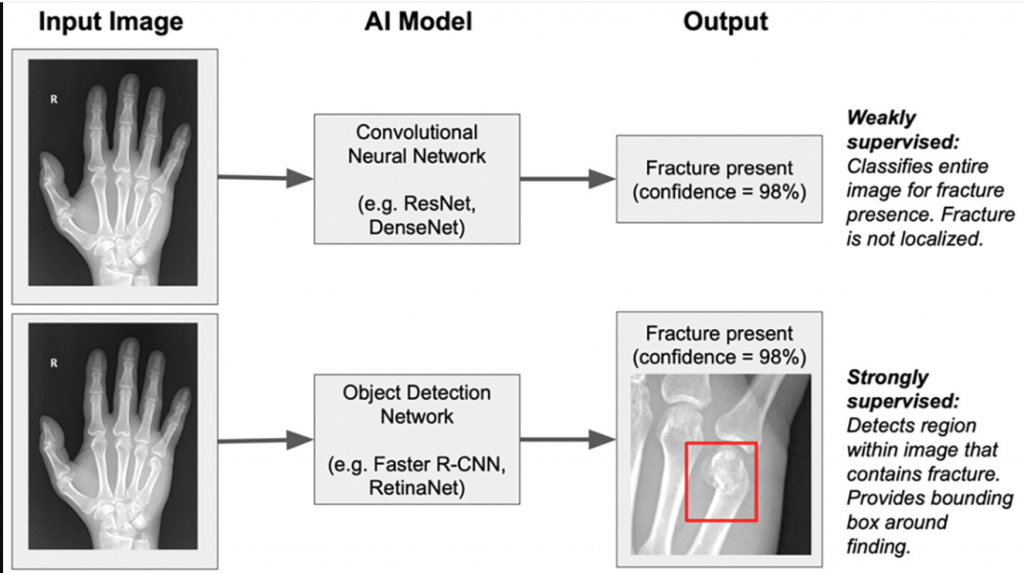
source: ajronline.org
These Deep Learning Model for Bone Fracture Analysis systems can identify thousands of image features at the same time, including such things as bone density changes, discontinuity in structural features, and other criteria of which the human visual system cannot detect, and likely would not pay attention due to environmental factors (like visual fatigue), or time-based limitations.
Artificial intelligence for the analysis of medical images of orthopedic X-ray images displays similar consistency in analysis, irrespective of environmental factors.
How Does AI-Based Bone Fracture Detection Software Benefit Medical Practitioners?
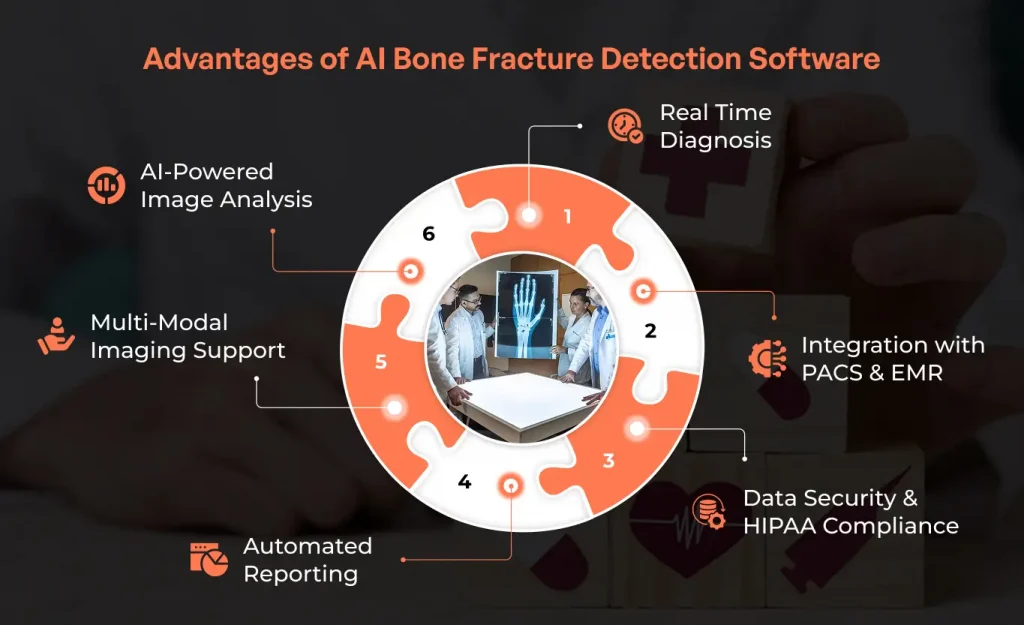
The bone fracture detection software provides real value for medical practitioners with commercially viable, evidence-based options. There are already a number of well-established solutions offered by AI consulting services on the market, which show tremendous tracking metrics as listed below:
Faster & More Accurate Diagnosis – AI analyzes medical images in seconds, reducing errors and helping detect even subtle or complex fractures.
Early Detection & Better Patient Outcomes – Identifies hidden or micro-fractures early, ensuring timely treatment and faster recovery.
Reduced Workload for Radiologists – Automates routine image analysis, allowing specialists to focus on complex cases and decision-making.
Cost-Effective Healthcare – Minimizes repeat tests, shortens hospital stays, and lowers overall treatment costs.
Seamless Integration with Hospital Systems – Works with existing PACS and EHRs, enabling easy adoption without disrupting workflows.
Scalability & Accessibility – Handles large imaging volumes and supports telemedicine, making advanced diagnostics available even in underserved areas.
Popular AI-Driven Bone Facture detection software available in market
| Product Name | Company (Vendor) | Clearance | Modality & Region | Key Features & Performance |
| OsteoDetect | Imagen Technologies | FDA cleared (2018) | X-ray – wrist (distal radius) | AUC ~0.97, sensitivity ~92%, specificity ~90% (PMC, American Journal of Roentgenology) |
| Fracture Detect | Imagen Technologies | FDA- cleared (2020) | X-ray – multiple bones | AUC ~0.98, sensitivity ~95%, specificity ~89% (PMC, American Journal of Roentgenology) |
| uAI EasyTriage-Rib | Shanghai United Imaging Intelligence | FDA- cleared (2021) | CT – ribs (≥3 fractures) | AUC ~0.94, sensitivity ~93%, specificity ~85% (PMC, American Journal of Roentgenology) |
| BriefCase (RibFx) | Aidoc Medical | FDA- cleared (2021) | CT – ribs (≥3 fractures) | AUC ~0.98, sensitivity ~97%, specificity ~90% (PMC, American Journal of Roentgenology) |
| BoneView | Gleamer | FDA & CE-cleared (2022) | X-ray – extensive regions | AUC ~0.93, sensitivity ~93%, specificity ~93% (PMC, American Journal of Roentgenology, ODT) |
| Rayvolve | AZmed | FDA & CE-cleared (2022) | X-ray – full body coverage | AUC ~0.99, sensitivity ~99%, specificity ~89% (PMC, American Journal of Roentgenology, Azmed) |
| TechCare Alert | (Generic NHS solution) | NICE- Recommended (2024) | X-ray – Basic fracture detection | ~90% sensitivity, simple, effective screening tool (The Guardian) |
| Milvue Smarturgences | Milvue | CE-marked | X-ray – pediatric focus | ~90% pediatric detection sensitivity (aitoolmag.com) |
| Nanox.AI Bone Solution | Nanox.AI | (Study-based) | CT – vertebral/spine | Improved spine fracture detection in the ADOPT study context (Nanox) |
Read Also: Use Case of AI in Healthcare
Who Are the Key Users of AI Bone Fracture Detection Software
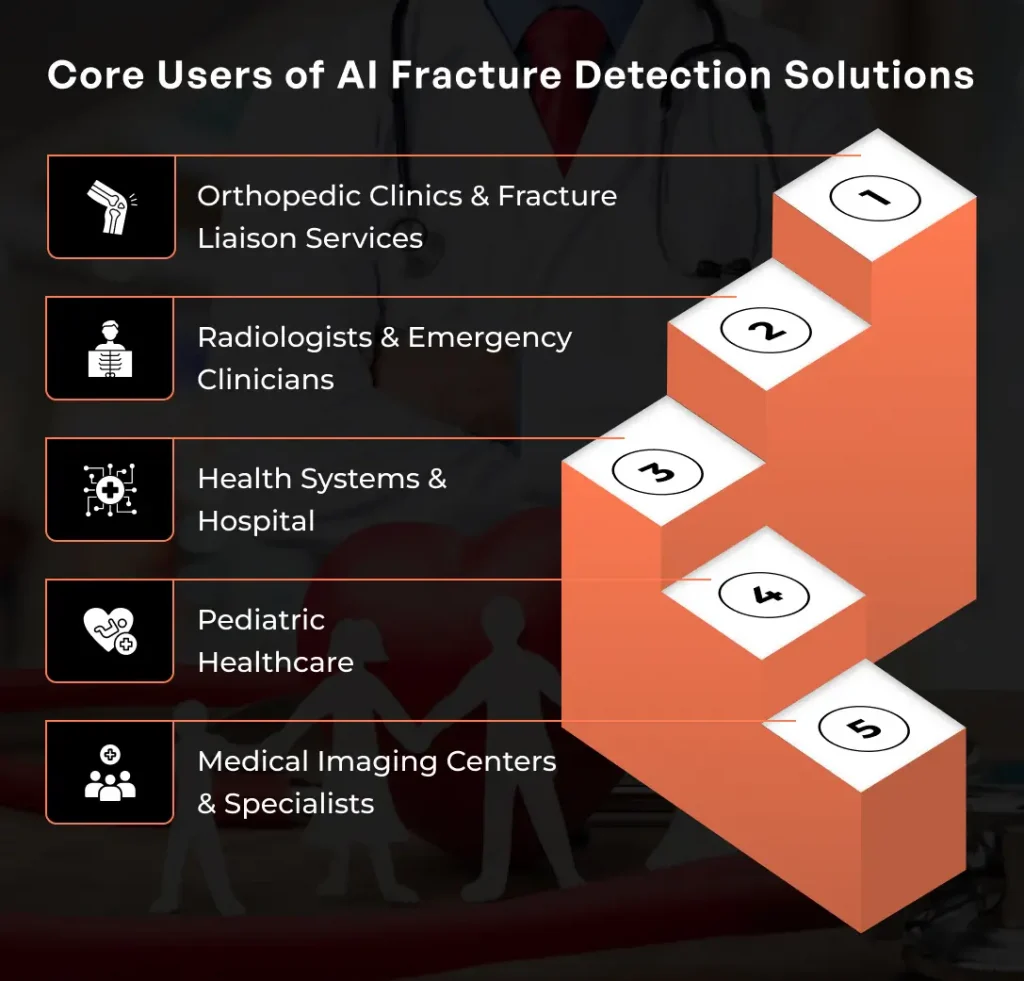
1. Radiologists & Emergency Clinicians
AI tools act as diagnostic assistive devices, enabling radiologists and Emergency care doctors to detect fractures more rapidly and accurately. AI Bone Fracture Detection Software Development detects fractures specifically in high-pressure environments, where rapid and accurate diagnosis is key.
2. Health Systems & Hospitals
Health Systems and Hospitals use AI-powered bone fracture detection software to limit diagnostic delays. The systems work in concert with existing workflows, evidence-based R&D frameworks, and provide immediate analysis that increases patient throughput and improves allocation of resources.
3. Orthopedic Clinics & Fracture Liaison Services
AI tools such as HealthOST (developed under the ADOPT study) provide Fracture Liaison Services with technology that assesses bone health and detects fractures. This Deep Learning Model for Bone Fracture Analysis system is the supportive technology in the acute diagnosis, as well as preventative measures.
4. Pediatric Healthcare
With the use of AI-enabled models, studies have shown the ability to detect fractures in children, including elbow and skull fractures, with high sensitivity and greater accuracy. It is important to understand that Artificial intelligence for fracture diagnosis in orthopedic X-rays requires specific training to assess and address paediatric cases due to the developing bones.
5. Medical Imaging Centres & Specialists
There are solutions such as Aidoc and OsteoDetect that hospitals and imaging locations are utilising to enhance early fracture diagnoses. That reflects actual use of AI vision models for Fracture Detection in multiple clinical locations.
Key Features to Include for AI-Powered Bone Fracture Detection Software Development
1. Automated Analysis
AI bone fracture detection software removes the need for manual pre-screening to identify fractures in X-ray, CT, or MRI images by detecting fractures in the images automatically. Computer Vision Model reduces overwrought human error and variation in analysis for consistent reads in every imaging project.
2. Multi-Bone Coverage
The deeptech model is capable of detecting multiple fractures in multiple areas, including wrist, ankle, hip, and rib fractures. The comprehensive AI vision models for Fracture Detection allow clinical practitioners to be assured that there are no fractures missed on complete skeleton coverage when performing an image-based assessment to identify fractures.
3. Real-Time Detection
The AI model produces results for diagnosis with suspected fractures found within seconds of scan upload. The processing capabilities of Artificial intelligence for fracture diagnosis in orthopedic X-rays eliminate lengthy wait times for patients in Emergency Departments.
4. High Sensitivity & Specificity
The design is to reduce false negatives and false positives so that the system can be trusted clinically. The Deep Learning Model uses algorithms that provide diagnosis with expert-level accuracy.
5. Image Annotation
The Artificial Intelligence (AI) for Fracture Diagnosis also highlights the suspected fracture areas on the electronic medical image for an accurate diagnosis. In radiology, the AI-based visual annotation improves AI for Fracture Detection and delivers good results.
6. PACS/RIS Integration
The software can integrate with hospital imaging systems without imposing any additional burden on actual clinical workflows. This connectivity preserves the ability for Artificial Intelligence (AI) for Fracture Diagnosis solutions to provide services in an existing healthcare infrastructure without creating barriers and workflow interruptions.
7. DICOM Compatibility
This computer vision AI model follows standard DICOM formats that are expected in radiology imaging. Therefore, in addition to being clinically effective, our AI Bone Fracture Detection Software Development has compatibility with non-proprietary data formats of imaging equipment and vendor systems.
8. Radiologist Assist Mode
The AI model will detect suspicious areas for radiologist review and support the doctors’ decision-making process. This allows the healthcare professional to remain the key component of this relationship while improving AI vision models of Fracture Detection.
9. Assessment of Bone Density
The deep learning model will assess osteoporosis risks with fracture diagnosis. This dual-purpose functionality of the Deep Learning–based Computer Vision Model for Bone Fracture Detection not only expands its utility from an acute diagnosis to assessment of preventable care.
10. Multi-View Comparison
This software compares multiple angles of a scan, improving the accuracy and probability of detecting a fracture. By cross-referencing images from different perspectives, Artificial Intelligence (AI) for fracture diagnosis relies on a broader basis.
11. Adjustable Sensitivity
The AI model allows customization according to patient demographics and scan type. This helped the Deep Learning Model to adapt to a clinical tool involving a wide range of scenarios in fractures and the population.
12. Regulatory Compliance
The software complies with FDA and CE conformity standards from a safety and accuracy standpoint. Comprehensive regulatory approval will ensure that the AI for Fracture Detection in Radiology solutions are always designed to maintain the highest standards.
13. Cloud and On-Premise Deployment
This AI model can be deployed in whichever way best suits a healthcare facility. It has the advantage of having a scalable Artificial Intelligence (AI) for Fracture Diagnosis implementation, depending upon the type of healthcare organisation.
14. Auto-Reporting
The AI Bone Fracture Detection Software Development can produce reports ready for fill-in, integrated into the EMR systems. Auto reporting supplies a documentation component and consistent standards for reporting.
15. Self-Learning Capabilities
The AI model will undergo continuous improvement in accuracy with further training from contemporary medical data sets. This training in an adaptive learning way will always keep models updated.
How Much Does It Cost to Develop an AI-Driven Fracture Detection Software Like BoneView?
Understanding the investment required for AI Bone Fracture Detection Software Development involves analysing multiple cost components:
| Component | Description | Estimated Cost Range (USD) |
| Data Acquisition & Annotation | Gathering X-ray, CT, and MRI datasets & having radiologists label fractures. | $50,000 – $300,000 |
| AI Model Development | Building, training, and fine-tuning a computer vision deep learning model. | $70,000 – $250,000 |
| Cloud Infrastructure | GPU servers for training, storage, and hosting. | $20,000 – $80,000/year |
| Software Development | Front-end & back-end for a web/app interface, PACS/RIS integration. | $60,000 – $200,000 |
| Regulatory Compliance | FDA, CE marking, HIPAA/GDPR compliance documentation & testing. | $100,000 – $500,000+ |
| Testing & Validation | Clinical trials, accuracy test, model validation. | $50,000 – $150,000 |
| Maintenance & Updates | Model retraining, bug fixes, and new features. | $30,000 – $100,000/year |

Total Development Cost Estimates
Costs of AI bone fracture detection software development vary based on the intended application and desired feature complexity:
- Basic Rapid Prototype (non-clinical) – $150,000 – $300,000
First comes the basic prototype of bone fracture detection software that doesn’t clearly focus on the clinical clearance and regulatory compliance. The core goal of this type of solution is to conduct the research and perform internal testing.
- MVP for Pilot Testing – $300,000 – $600,000
MVP refers to a minimum viable product that comprises fewer functionalities as compared to a full-fledged solution, but can be deployed to be used for the target audience. It has the capability to integrate with legacy systems and perform certain tasks.
- Full Clinical Grade Solution – $600,000 – $1.5M+
This is the full-grade clinical solutions that are ready to use for the healthcare professional. This type of solution complies with all the relevant rules and regulations, with next-generation features along with the highest precision level. It can be easily integrated with PACS/RIS, etc.
| Tier | Cost Range (USD) | Target Use Case | Key Features |
| Tier 1 – Prototype/ Research Model | $150,000 – $300,000 | Academic research, internal R&D, proof-of-concept | ● AI-based bone fracture detection model with a simple deep learning architecture ● Models are trained on a very limited publicly available dataset ● Single bone detection (wrist or leg, etc.) ● Simple web-based demo interface ● No regulatory compliance ● Limited accuracy (~80-85%) |
| Tier 2 – MVP for Pilot Testing | $300,000 – $600,000 | Hospital pilots, early-stage clinical evaluation | ● AI bone fracture identification software trained on medium-sized licensed datasets ● Multi-bone coverage (arm, wrist, leg) ● Minimal integration with PACS/RIS ● Typical accuracy ~88-92% ● Initial HIPAA-compliant data management ● Early user management & reporting site ● Cloud deployment for testing |
| Tier 3 – Clinical-Grade Solution | $600,000 – $1.5M+ | Full-scale hospital deployment, commercial rollout | ● AI deep learning model with remarkable accuracy (93-97%) ● Multi-bone & multi-modality support (X-ray, CT, MRI) ● Real-time fracture analysis & severity grading ● FDA/CE compliant with all necessary documentation ● Full HIPAA/GDPR compliance ● Integrated with PACS/RIS & EMR systems ● Role-based access & audit history ● Continuous model retraining & updates ● On-premise & cloud options |
How A3logics Can Help You Develop an Artificial Intelligence-Powered Vision Model to Detect Bone Fractures
A3logics offers AI Bone Fracture Detection Software Development Services ranging from development, service, and implementation in healthcare organisations. We develop solutions for the entire continuum of applications.
As a leading AI development company we provide development services which cover:
Custom AI Vision Models: We create AI vision models for Fracture Detection for your clinical needs and patients.
End-to-End Development: We build the complete Deep Learning Model from inception. Every step until it is ready to be sent for regulatory approval.
Regulation: With our company, you can feel confident that your software meets all regulatory bodies, the FDA, and the CE & Medical Device Regulation.
Integration: We connect your existing PACS/RIS and EMR into a seamless Clinical Workflow.
Support: We offer maintenance and upgrade servicing to ensure your Deep Learning based Computer Vision Model for Bone Fracture Detection is performing optimally.
Conclusion
Each missed fracture creates prolonged suffering for the patient, longer healing times, and potential complications in the future.
AI for Fracture Detection in Radiology is not just improving statistics; it’s allowing radiology to potentially identify what human eyes may not see at a busy ER with a fracture patient being processed at 3 AM. It’s preventing a child from suffering for weeks with an undiagnosed fracture or preventing an elderly patient from suffering future concerns.
Healthcare professionals dedicate their lives to healing the sick; however, the struggles of unreasonable caseload and making split-second decisions can hinder their ability to heal. The model for Bone Fracture Detection is meant to be a highly capable and deeply trusted ally in the sacred mission to heal bodies and devote lives to patient-centric care.