
AI is now the most important transformational force in modern-day health care. It is influencing diagnostics, treatment plans, and preventing healthcare fraud. The AI in Healthcare global market size was $26.5 billion in 2024 and is expected to grow at a 38% compound annual growth rate (CAGR) by the year 2030. This growth is driven by developments in the areas of machine learning, availability of health data, and the growth and scalability of digital health solutions. The demand for accurate, scalable, and accessible health care models has never been greater!
Hospitals, insurers, and direct-to-consumer healthcare platforms have integrated AI-powered tools to enhance triage and diminish misdiagnosis. The AI Symptom Checker exemplifies one of the more direct impacts of this technology: a tool clinicians use to check symptoms, render possible conditions, and provide triage recommendations almost instantaneously.
Importance of Symptom Checker Apps in 2025
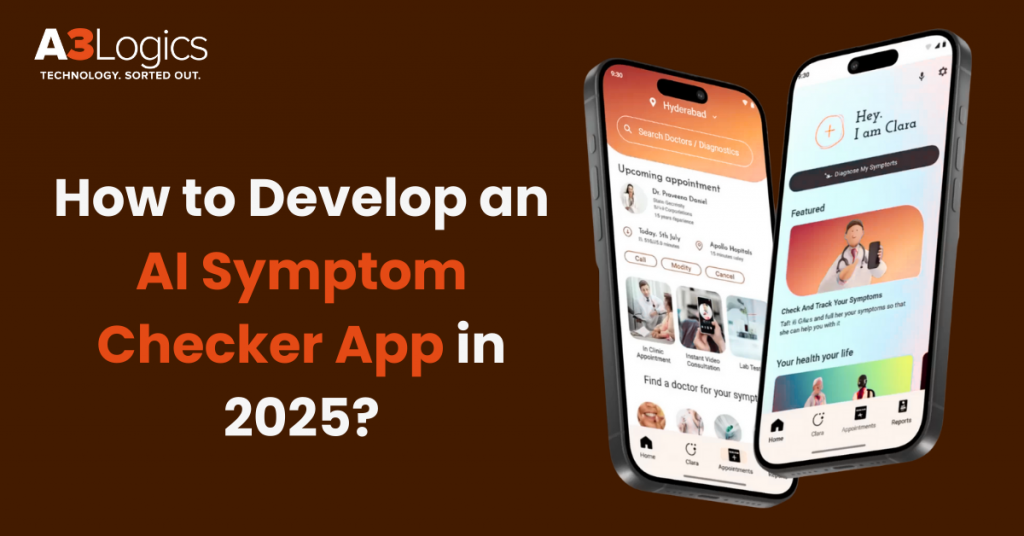
In 2025, AI Symptom Checker Apps (also referred to as AI Symptom Checkers) are now viewed as essential tools by consumers, while providers think of them as necessary tools for triaging patients. The expectations of consumers have also changed to think of credible, instant health insight 24/7 as an expectation. Applications such as Ada Health, Buoy Health and Babylon Health have issued millions of assessments across the world with accuracies comparable to nurse-led triage decisions for many of the common conditions.
They are also cost-effective applications to not only improve early detection, but to avoid unnecessary ER visits. In integrated care systems, they are effectively the first point of contact for an individual who has gathered symptom information and assessment data to determine the urgency of their symptoms, and possibly direct them to a telehealth consultation or in-person visit. As a whole, the AI-based Symptom Tracker represents a critical step in digital health ecosystems.
Market Overview
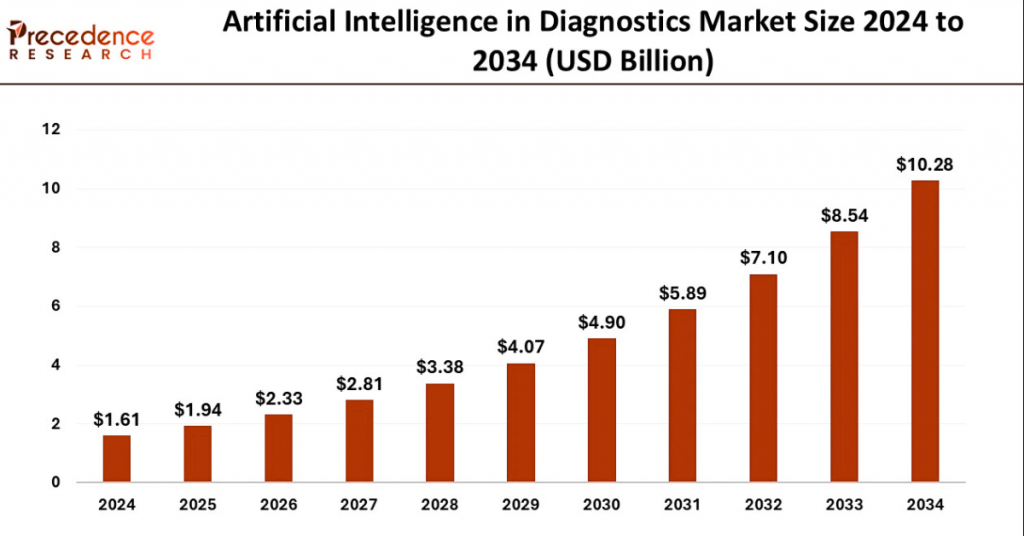
1. Key Market Statistics and Trends (2025 Data)
The market of AI Symptom Checker solutions is rapidly evolving.
- The Global symptom checker (chatbot) market is on pace to exceed $3.55 billion by 2029, growing at a CAGR of 25%.
- Adoption is occurring globally, with penetration rates of digital health assistants of 47% in North America, 39% in Europe, and 52% in various regions of Asia.
- Notably, engagement rates are strong with average completion rates for symptom assessment at 91% in 2025 compared to early market average rates of 74%.
There is strong venture investment; Ada Health spent over $120 M to scale its AI engine and K Health raised $439 million. This reinforces the confidence that AI Health App Development can scale and be profitable.
2. Growth Drivers and User Adoption
There are several growth drivers that are catalyzing adoption:
- Chronic Disease Burden: The high prevalence of diabetes, hypertension and respiratory diseases drive the need for frequent and inexpensive symptom assessments.
- Convenience: AI Symptom Checkers give answers when and how consumers want to access them – quickly and in an understandable way.
- Telehealth Integration: As virtual care becomes mainstream, symptom checkers are appearing on the front doors of digital triage for telemedicine platforms.
- Regulatory Support: Certified AI triage tools are now also eligible for reimbursement or can be formally integrated as part of a health system’s workflow.
- Technological Advances: High accuracy in NLP and multi-language systems is improving the usability and accuracy of any AI Symptom Checker.
What Is an AI Symptom Checker App?
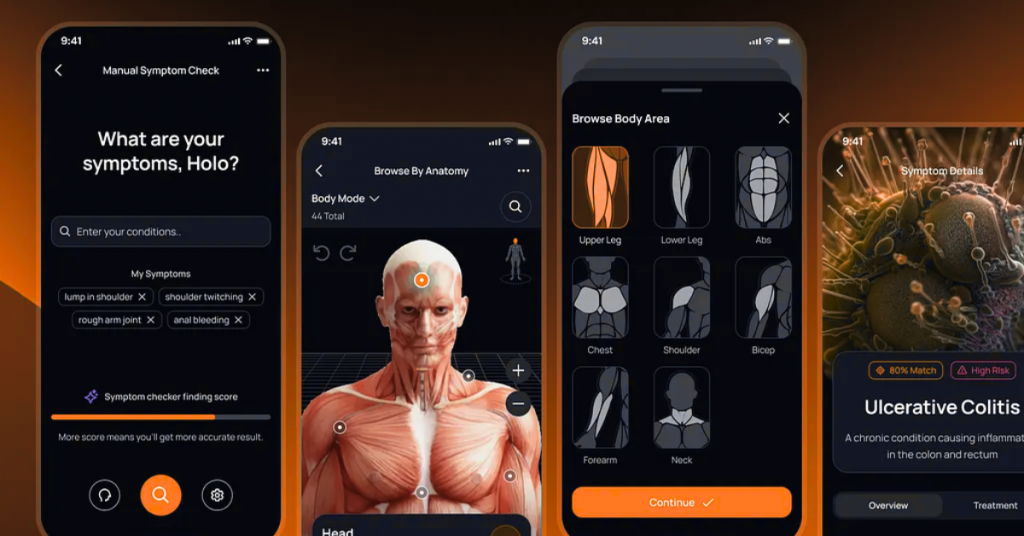
An AI Symptom Checker App is an engaging digital experience that uses a user’s symptoms and medical history against one or more AI algorithms, or natural language patterns, to assess the user’s symptoms. The AI tool cross-references the user’s symptoms against large medical databases to create a list of possible conditions to explore further while providing suggested triage advice.
The choice of suggested health actions is dependent on relevant clinical knowledge, which is regularly updated, so the decisions made by the symptom checker are relevant.
The workflow is constructed to simulate the early steps of a medical appointment:
- Symptom Input: Users communicate symptoms in their own words or choose from structured lists.
- Interpretation: NLP interprets and turns normal language into medical terminology.
- Analysis: AI models compare symptoms against extensive datasets of conditions and clinical guidelines.
- Output: The app returns a ranked list of conditions and recommends next steps (self-care, telehealth, or urgent care).
While these apps do not provide the expertise of licensed clinicians, they bring value in AI in Medical Diagnosis by providing users with a quick, data informed starting point for their decision making. It helps users better understand what they may be facing and rapidly take steps toward appropriate care.
How Do AI Symptom Checker Apps Work?
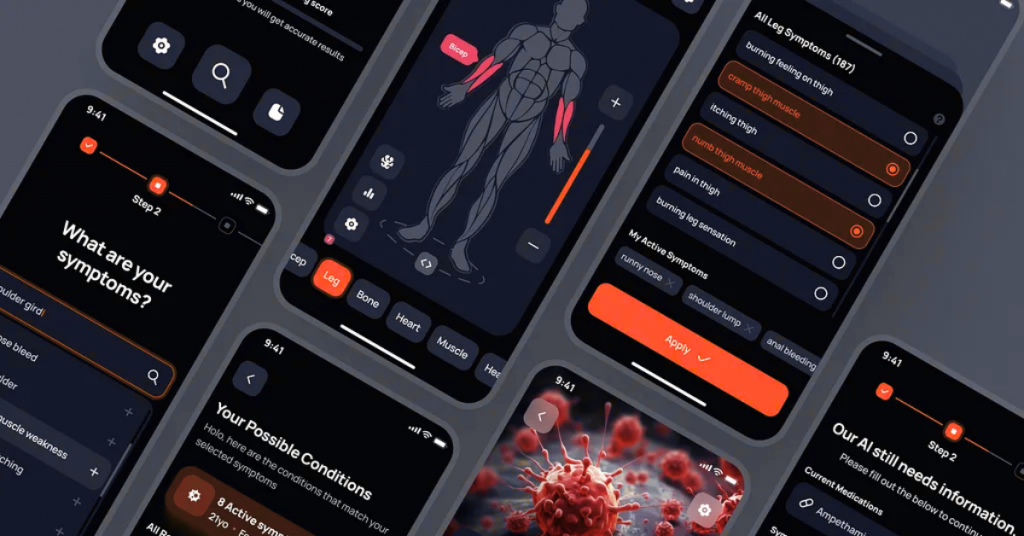
The creation of a reliable AI Symptom Checker involves many technical layers and clinical logic steps.
1. User Inputs: Symptoms & History
The diagnostic process starts by gathering structured or unstructured health-related input from the user to inform the reasoning process. This includes:
Symptoms: Free-text (e.g. “my throat is sore”); structured through checklists, or as selections from a body-map.
Demographics – Age, gender, and ethnicity are also used to adjust probabilities for conditions.
Medical History – Prior illnesses, treatments, allergies, or chronic conditions.
Lifestyle & Social History – Context about smoking, alcohol use, job, exercise routines.
Wearable Data – Over 30% of U.S. adults report sharing their wearable metrics (e.g. heart rate variability, SpO₂, sleep patterns, activity levels) again, to support presenting real-time physiological context.
2. NLP for interpreting inputs
Once the symptoms are submitted, the Natural Language Processing (NLP) engine interprets the input into rigorously established medical language:
- Colloquial Interpretation: “feeling dizzy” → “vertigo”; “stuffy nose” → “rhinorrhea”
- Context Recognition: understanding negated statements (“no fever”) and time context ( ” started yesterday”)
- Language Support: Global-ready systems like Ada Health interpret 15+ languages with 90% accuracy of symptom words.
- Model Base – Most of the leading platforms derive from biomedical LLMs, such as BioBERT, ClinicalBERT, and Google’s MedPaLM 2, to deliver meaningful accuracy in symptom extraction and intent classification.
3. Data Mapping to Medical Databases
The next stage after NLP, once the words and nomenclature have been standardized, and knowledge bases:
- ICD-10 and SNOMED CT for a formal coding of diagnoses.
- UMLS (Unified Medical Language System), which will map out non-standard or variations of medical terminologies.
- Own proprietary domain-specific ontologies that adhere to the most up-to-date research and epidemiology evidence
This mapping step adds even broader interoperability with Electronic Health Records (EHRs) and intersects with compliance with healthcare information standards such as HL7 FHIR.
4. Risk Scoring Using AI Algorithms
This risk-scoring layer is the true “inner-brain” of AI Symptom Checkers. AI employs ensemble learning classifiers and probabilistic reasoning models to predict the relative likelihood of a number of possible conditions.
- Bayesian Networks assessing level of dependency of symptoms, demographic, and risk factors.
- Gradient boosting (Classifier Models, like XGBoost and LightGBM) produces fast ranked diagnoses.
- Neural networks trained on anonymized patient datasets leverage many more correlation measures across multiple symptoms.
- Severity Prioritization: Cases like acute chest pain with diaphoresis might prompt instant triage workflows.
5. Output: Possible Conditions & Recommendations
The user would receive an output that presents:
- A Ranked list of Possible Conditions (shown with perhaps percentages or confidence scores)
- Triage Recommendations such as ” self-care”, “book GP appointment in next 48 hours” or “Go to ER NOW!”
- Suggested options for next steps, e.g. connect to telehealth, order diagnostics, see in-network clinics.
For example, the AI Symptom Checker might conclude there is a high probability of Appendicitis and will recommend an urgent evaluation at the hospital. It also provides a link to a map to local ER facilities by using APIs, such as Google Maps and Healthgrades.
6. Feedback Loop for Continuous Improvement
High-quality AI Symptom Checkers are not static and are constantly adapting through an iterative closed-loop learning cycle:
- Data on Outcomes: Each time users come back later with their actual diagnosis, the ground truth data is pulled back into the model.
- Federated Learning: Updates only occur at the model level, leaving no sensitive raw data behind. It ensures HIPAA and GDPR compliance.
- Human-in-the-Loop Review: Medical experts can review ambiguous cases to sharpen algorithms.
Outcome: This continuous looping refinement shows improvements of 3-5% per year in diagnostic accuracy.
Popular AI Symptom Checker Apps in 2025
The top AI symptom checker apps from early 2025 show the variety of capabilities and business models that exist in this market category.
| App | Key Features & Strengths |
| Ada Health | Hybrid AI method; combines probabilistic ML with rule based logic; 13+ million users; >90% accuracy for common conditions; 15 language support. |
| Buoy Health | Conversational Q&A style; utilizes adaptive questioning; partnered with health systems; developed in partnership with Harvard Medical School. |
| Healthily (Your.MD) | AI symptom assessment with self-care library; partnered with pharmacies and providers. |
| Symptomate | Over 800+ conditions; certified EU Class I medical device; 10 languages; frequently seen in B2B integrations. |
| Babylon Health | Symptom checker embedded within telehealth ecosystem; partnered with NHS; integrated with chronic care monitoring. |
| MDLIVE | AI triage chatbot (“Sophie”) used for pre-visit assessments; telehealth-first workflow. |
| Doctor on Demand | Utilizes AI intake to steer patients to correct specialists; integrated with virtual visits. |
| Teladoc Health | AI-driven intake for millions of consultations each year; scalable enterprise-grade deployment. |
| HealthTap | AI symptom checker (“Dr. A.I.”) combined with live doctor Q&A; hybrid human-AI model. |
| Amwell | Automated triage integrated with telehealth scheduling; HIPAA compliant enterprise deployment. |
These examples illustrate the key differentiators for any product competition in this field.
Must-Have Features in an AI Symptom Checker App
Building a competitive product means building in some of the following features of AI symptom checker app design and development.
1. Symptom Input Interface
Any AI Symptom Checker output is only as good as the input. Ideally, a modern interface for the user to enter their symptoms should utilize a conversational AI chatbot or an adaptive questionnaire that adjusts based on user answers.
Importantly, this will allow for the capture of clinical details (duration, severity, triggers, and associated things) in a way that does not overwhelm the user.
2. Real-Time AI Symptom Analysis
Speed is a key differentiator that drives user satisfaction. An AI Symptom Checker must, therefore, assess and consider multiple inputs within seconds, using medical databases and AI models that are continually trained on millions of clinical cases over time.
Real time assessments and feedback are critically important when conditions are serious. For instance, assessing for a potential myocardial infarction, with swift suggestions at all relevant periods, could lead to life-saving actions.
3. NLP Engine
The NLP component enables the link between layman symptom descriptions and medical evidence and crafts dialogue back into the system for outputs. The NLP in a top-capability app should:
- Interpret many languages and dialects.
- Interpret slang or idioms (“feeling woozy” → “dizziness”).
- Treat almost anything as a defined detail.
4. Personalized Health Profiles
Part of every assessment should be grounded in the specific health profile of the user. Some profile factors are: age, sex, medical history, substance and medication use, allergies, and lifestyle habits. A good AI symptom checker will use health profile information to:
- Make adjustments to probability scores (e.g., someone who has chest pain and is a 55-year-old smoker will tend to generate a higher risk score in relation to the heart).
- Avoid suggesting contraindicated behaviours or actions.
- Add accuracy to triage urgency.
5. Symptom History Logs
Chronic and repetitive symptoms require longitudinal tracking. Symptom history logs: allow users and their care providers to:
- Identify patterns (e.g., migraine patterns at certain times of the year).
- Compare previous and current assessments
- Share structured timelines of their health in relation to presenting problems with physicians.
Even incorporating simple analytics, such as frequency graphs or severity trends, could improve this feature.
6. Telehealth/Doctor Consult Integration
The best AI Symptom Checker features close the loop from self-assessment to professional care. By fully integrating with telehealth software, users can:
- Schedule same-day video calls.
- Share AI-generated pre-visit summaries with their clinician to cut down on time in an appointment.
- Find in-network providers or urgent care based on insurance and location.
7. Multilingual Support
A go-to-market AI Symptom Checker should:
- Provide fully localizable interfaces in target regions.
- Adapt culturally meaningful medical sample scenarios for better understanding.
- Maintain an equal level of accuracy across languages.
8. Data Security & HIPAA/GDPR Compliance
Healthcare applications deal with significantly sensitive data, and compliance should be a key aspect. A compliant solution consists of:
- End to end data encryption (AES-256 or equivalent).
- Proven secure authentication (which should include multi-factor).
- Use of data based on consent and clear privacy policies.
- Regularly scheduled audits from independent third-party security firms.
9. AI Learning & Feedback System
Ongoing improvement is what delineates a static tool from a true intelligent platform. An AI Symptom Checker should:
- Provide a feedback prompt (“Was this helpful?” / “What was your doctor’s diagnosis?”) to collect outcome data.
- Leverage federated learning mechanisms to update AI models to adapt without exposing raw user data.
- Include a human-in-the-loop review process for lower-confidence cases.
10. Integration with Wearables/Devices
By integrating device data into the app, we can improve accuracy and set up alerts to proactively notify people. Some examples of integrations can include:
- Synchronizing heart rate, SpO₂, and temperature data to assess it in real-time.
- Activating symptom checks when data starts to drift away from established baselines.
- Improving chronic disease management. For example, data from a glucose monitor can be integrated to evaluate symptoms related to diabetes.

Case Study: How Ada Uses AI for Symptom Checking
In this case study, we will show how a well-designed AI Symptom Checker App uses state-of-the-art AI and strict medical validation.
1. User Input Collection
Ada opens with an intake process, as you might find in a clinical setting. The user gives their demographics, known medical conditions, medications, and primary symptoms. Ada will then ask follow-up questions, which are customized according to the primary symptom.
For example, if ‘headache’ was populated for the primary symptom, Ada would ask the Details (severity, duration, accompanied, etc.). If accompanied, Ada would ask whether it was nausea or strange vision. You could observe that the conversational nature of the symptom checker continually asks more detailed, clinically based questions without losing its flow as a symptom checker.
2. AI Engine Interpretation
Ada’s AI engine functions behind the scenes. The AI engine is hybrid, combining probabilistic machine learning with curated coding. Ada’s NLP programming translates user free-text input into predefined medical language, so that all entries are uniformly mapped to a large clinical information set. The clinical information set contains more than 20,000 symptoms and 2,800 conditions. Ada’s AI can analyze multiple symptoms and account for comorbidities, which increases the overall accuracy of the diagnosis.
3. Triage Logic and Condition Matching
There is also triage logic built in. A clinical example might be chest pain and shortness of breath. Even though the chest pain ‘probability’ is fairly low %, the poly-symptom result might ‘justify’ or recommend a ‘seek emergency care’ response.
4. Results and Actionable Suggestions
The next stage of results is a ranked list of possible conditions with plain language and concrete action recommendations. The recommendations could be self-care or booking a telehealth consult. The recommendations are dependent on your profiles. For example, the recommendation for a diabetic person with foot pain will differ from that for a healthy adolescent with foot pain.
Ada’s results are consistently compared against clinical benchmarks. It reports 90% accuracy for common conditions and triage decisions that are comparable to human clinicians.
This case exemplifies how an AI Symptom Checker can be both safe and scalable.
Future Trends in AI Symptom Checker Apps
The competitive landscape of AI Symptom Checker Apps is advancing rapidly. Rapid advancements in AI, the adoption of digital health, and shifting consumer expectations are all impacting this space. There are a few major trends defining the next generation of development:
1. Conversational AI and Advanced NLP
Advances in transformer-based NLP will allow for more natural, human-like interactions. Future designs will interpret and respond to rich, complex narratives that appropriately incorporate elements of expression with speech (e.g., slang, mixed languages, colloquialisms, implied meaning). As a result, user trust and engagement will be improved.
2. Predictive Health Analytics
AI Symptom checkers and predictive modeling will be more than just a remark that triggers symptoms, including many in the form of reactive assessment. Rather, they will draw upon longitudinal health data based on user profiles and wearable devices.
3. Integration with Virtual Health Assistants
Symptom checkers will be directly integrated and merged into health ecosystems. It will work directly with virtual health roles via voice enabled assistants, collecting and recording symptoms and syncing with EHR systems. Likewise, Symptom checkers can initiate care steps robustly, from booking telehealth appointments to lab testing, all occurring in one singular interaction.
4. Mental Health Symptom Detection
Capabilities will also be extended to screen for anxiety, depression and other mental health conditions. These systems will pick up on more subtle cues in terms of verbal cues – such as communication style or behavioral markers.
5. Real-Time Wearable Data Syncing
Integrating data with devices like smart watches, glucose supply monitors, and connected stethoscopes, we will gather more robust data streams. AI models will be able to dynamically adjust risk scores and recommendations based on updates to biometric data. This will allow an organization to respond early to rapid changes in physiologic status. This real-time adaptability will be a game-changer for managing chronic conditions and avoiding emergencies.
These trends demonstrate why now is an excellent time to build AI Symptom Checker solutions. The underlying technology is mature and user experience expectations are in alignment with advanced, integrated, data-driven experiences.
How We Develop AI Symptom Checker Apps at A3Logics
A3Logics is an AI Development Company with deep expertise in Health Tech. We bring a methodical, compliance-focused approach to AI Health App Development. Our operations deliver a consistent build that will meet clinical, technical and regulatory expectations.
1. Requirement Gathering
We conduct thorough stakeholder workshops to determine consumer demographics, scope of conditions (your symptom checker can be general or specialized), platform priorities (iOS, android, web-based), and integration needs (e.g. EHR, telehealth).
We also map clinical workflows so that we are meeting the expected patterns of how physicians triage patients. This minimizes the potential for misalignment between solutions recommended by the app and what occurs in the real world.
2. Market and Competitor Research
We will take a look at how the Top AI symptom tracker apps perform and identify where they do well, where they fell short, and where our solution can differentiate itself. We will also look at the current regulatory guidance to make sure we are in compliance from day 1.
As part of our competitor research, we will conduct sentiment analysis related to user reviews to identify unmet needs that may help to prioritize features.
3. AI Architecture Blueprint
We produce the system architecture that defines any NLP pipeline, the inference engine, and integration with the medical database. The blueprint establishes a process that will reiterate and secure all user data throughout the AI-based model used to triage the data and/or elicit results.
4. UI/UX Prototyping
We create prototypes to test different conversation flows, symptom entry (where we try to eliminate symptoms that slow, aggravate, or irritate the user), and the ways we present the results. In addition to the accessibility process, multilingual options, and HIPAA/GDPR compliance, this work will also incorporate these elements.
We also conduct usability tests with a group of various users, in various groups, depending on their cultural, context, and environmental background.
5. Model Training & Development
The results we want to evaluate medically are the result of machine learning (ML) through targeted medical datasets. Just as, our ML engineers will be using NLP (Natural Language Processing) to build models that will assess and interpret symptoms, and develop predictive algorithms that will map a condition. The outputs produced from the models will be validated through synthetic and real-world test cases.
6. Feature Integration
In all, from syncing wearables and telehealth appointment scheduling to all elements of an AI Symptom Checker, we will deliver a complete, working solution and ensure interoperability from the end-user back to their care team, ensuring a safe end-to-end experience.
All of our integrations, conducted through sandbox testing, will ensure that data exchange formats (HL7-FHIR) are exchanged with no loss of meaningful data occurring at that point.
7. Regulatory Compliance Setup
Sampling security protocols, ensuring encryption, and implementing consent management to comply with HIPAA in the U.S. and GDPR in the EU. We can also help with CE marking or FDA software-as-a-medical-device pathways as needed.
8. QA & Beta Testing
Our rigorous QA services include functional, load testing and clinical validation using gold-standard diagnostic pathways.
We conduct beta testing with a select group of healthcare professionals and patient volunteers to gather qualitative feedback, followed by objective performance metrics.
9. Launch
We deploy via app stores or enterprise mechanisms with rollout strategies that may include regional launches for the phased, scaled release of the software.
The staged rollout reduces the risk of downtime and allows us to observe early adoption metrics before a global roll out of the software.
10. Post-Launch Support & ML Optimization
We continually monitor the performance of the software, retrain the AI models with anonymized end-user feedback if indicated, and incorporate product feature updates to ensure competitive relevance and accuracy. A dedicated support and monitoring team maintains awareness of valuable clinical data, regulatory updates, and tech stack renewals.
This full-lifecycle approach ensures that clients who build AI Symptom Checker with A3Logics receive a highly usable, technically rich and clinically sound product.
Why Choose A3Logics for Symptom Checker App Development?
Selecting the right partner for AI Health App Development is as critical as the technology itself.
With 20 years of experience and over 500 successful projects completed, A3Logics leverages deep healthcare domain knowledge and excellent personnel in AI Engineering. We have expertise in compliance and regulation to ensure your AI Symptom Checker App is a fit for today’s needs, and with room to scale into the future.
1. Expertise in Healthcare AI
A3Logics has a team of AI Engineers, data scientists and clinical consultants that develop AI in Healthcare solutions in the domain area of diagnosis support tools, telehealth enterprise platforms and telehealth app management. This ensures that the logical constructs of your application are medically relevant, technically solid, and clinically user-oriented.
2. End-to-End AI Development Services
The delivery lifecycle includes concept development, competitor analysis, quality assurance through to launch and post-launch analytics and optimization. Whether you are building a standalone AI-based Symptom Tracker or integrating with a hospital’s existing patient web portal, we are able to tailor a strategy appropriate for your operational model.
Our multidisciplinary teams reduce the potential risks of integration, improve time to market, and deliver features of the AI Symptom Checker application that are significantly better than the best performing options on the market.
Conclusion
To create an AI Symptom Checker App that can effectively compete in the marketplace, companies must train AI models rigorously, receive medical validation, and build a secure, compliant system. The most successful apps will weave together conversational AI, predictive analytics, wearables, and telehealth handoffs with a meaningful user experience.
For companies eager to create new AI Symptom Checker products, the opportunity is clear: users are willing to adopt products, the market is growing rapidly, and the capabilities of technology are stronger than ever. If you can find the right development partner for your product, it could be rated one of the “Top AI symptom tracker apps” and create lasting meaning in the category of AI for medical diagnosis.
A3Logics has the technical expertise, regulatory knowledge and healthcare regulatory knowledge to build high-quality, trusted AI-based Symptom Tracker applications.
Reach out to us today to discuss how we can turn your vision into reality.