Machine learning in embedded systems is changing how gadgets connect to the outside world. This includes anything from smart home assistants and health monitoring that you wear to self-driving cars and industrial robots. As the need for smart, real-time, and energy-efficient solutions develops, using machine learning in embedded systems is becoming a key part of innovation in many fields.
In the past several years, machine learning has become very popular as a way to solve a number of tough problems in many fields. Embedded devices are a new field where machine learning is used to do tasks like data analysis, prediction, and decision-making quickly in real-time applications.
To successfully integrate machine learning models into embedded systems, we need to deal with problems like the need for fast and effective algorithms and the limited resources available in embedded systems to meet the needs for storage and computing. This study attempts to provide an overview of the use of machine learning in embedded systems, including past and current solutions, and to show the issues that need to be addressed. The future of machine learning in embedded systems is also spoken about.
Here in this post we are going to look at the industry, the pros and cons of using ML in embedded systems, and some useful tips for doing so. It is a complete reference for businesses and engineers.
Machine Learning in Embedded Systems: Market Overview
After learning about the possible financial benefits, a lot of decision-makers integrate machine learning and embedded systems. People usually save money because the processing happens right on the device, so they don’t have to send the data to the cloud.
They can also apply machine learning in embedded systems with fewer computational resources, which lowers the cost of transferring data. That could imply they can start looking for prospects without having to spend a lot of money first.
You should also remember that using machine learning and embedded systems together doesn’t always save money. People are more likely to save money when they think about which aspects of their present process cost the most and how they use the cloud right now.
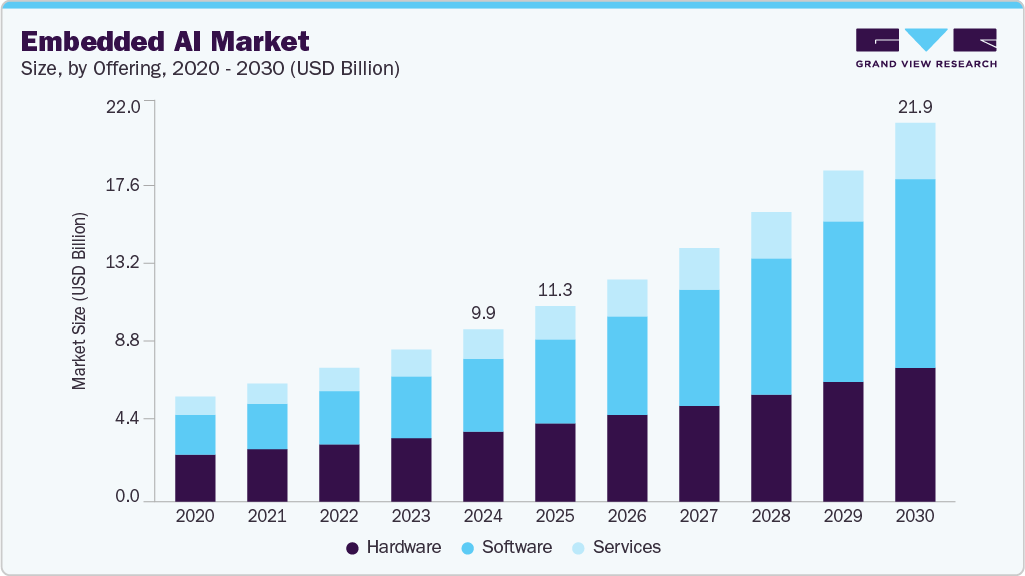
The market for machine learning in embedded systems is experiencing unprecedented growth. According to current industry reports, the global embedded systems market is anticipated to reach over $308 billion by 2032, propelled by the proliferation of IoT devices, smart electronics, and the increased requirement for real-time data processing. From 2025 to 2030, the embedded AI market, which is a part of this domain, is predicted to develop at a CAGR of 14.1%, reaching $21.9 billion by 2030.
Key Drivers Include:
- More IoT ecosystems: Billions of connected devices need to be able to work on their own at the edge.
- Demand for real-time analytics: Industries such as healthcare, automotive, and manufacturing rely on fast data processing for safety and efficiency.
- Processors that use less energy: New chip designs are making it possible for strong machine learning applications to run on embedded devices that use very little power.
- Personalization: People want their devices to learn their habits and preferences, which is why ML is becoming more common in embedded systems.
As businesses look to put intelligence directly into devices more and more ML consulting services become more important for making solutions that can grow and work well.
What Are Embedded Systems and Why Is Machine Learning Important for Them?
Embedded systems are specialized computing units that are built to do specific functions within bigger systems. These devices are optimized for efficiency, reliability, and often function with little resources. Microcontrollers in smart appliances, sensors in industrial automation, and control units in cars are all examples.
Using machine learning on an embedded system usually doesn’t let you get rid of the costs of cloud computing. But it can help businesses depend less on the cloud because the device itself does the processing instead of the cloud.
Professionals who wish to apply machine learning for embedded systems to save money should figure out where they’re paying too much and what kind of savings they would find useful. They should also keep in mind that the benefits of conserving money may not be clear right away. Finding the best ways to add machine learning to a system might take a lot of time, but people who are patient and dedicated usually find that their work pays off.
Why is it so Necessary for Embedded Systems to Use Machine Learning?
- Pre-programmed logic is what most embedded systems use, which makes them less flexible.
- ML in embedded systems lets devices to learn from data, recognize patterns, and make intelligent decisions without explicit programming.
- Application of machine learning in embedded systems allows for smarter, more autonomous devices that can adapt to changing environments and user needs.
This change in thinking is necessary to fully realize the possibilities of IoT, smart cities, healthcare devices, and more.
Benefits of Machine Learning in Embedded Systems
The combination of machine learning apps with embedded systems has many benefits that lead to new ideas and better operations.
1. Real-Time Decision Making
Embedded systems that use machine learning let devices process sensor data and make decisions right away, without needing to connect to the internet. This is really important for things like self-driving cars, industrial robots, and medical monitors, where every millisecond counts.
2. Edge Intelligence
By integrating ML models directly into devices, systems may evaluate data locally, lowering latency and bandwidth utilization. Edge intelligence is very important for privacy, security, and smooth operation, especially in places where there isn’t much bandwidth or where people are far away.
3. Reduced Bandwidth and Power Usage
Embedded systems that use machine learning don’t have to send as much raw data to the cloud. Instead, only useful warnings or insights are broadcast, which saves bandwidth and battery life, which is important for wearables, sensors, and mobile devices.
4. Personalization
When machine learning is used in embedded systems, gadgets can change to fit the needs and habits of each user. Personalization makes users happier and more engaged. For example, smart thermostats learn your schedule and fitness trackers give you tailored recommendations.
5. Automation and Efficiency
ML in embedded systems automates everyday chores, finds problems, and makes operations run more smoothly. This makes businesses more productive, requires less human interaction, and makes processes more reliable.
6. Offline Functionality
Machine learning applications in embedded systems can work even when there is no internet access all the time. This is important for mission-critical equipment in healthcare, defense, or remote areas since it makes sure that service and data privacy are not interrupted.
Applications of Machine Learning in Embedded Systems
Machine learning is used in embedded systems in many different fields and for many different purposes. Each one benefits from smart, real-time analytics and automation.
1. Smart Home Devices
Machine learning (ML) in embedded systems makes smart speakers, thermostats, and lighting systems that learn how people use them, understand voice commands, and use energy more efficiently. Amazon Echo and Google Nest are two examples of devices that use on-device machine learning to be more responsive and keep your information private.
2. Healthcare Monitoring
Machine learning applications in embedded systems are used by wearable health monitors and medical equipment to keep track of vital signs, find problems, and give early warnings for disorders like sleep apnea or arrhythmias. Local processing keeps patient data safe and usable in real time.
3. Automotive Industry
Modern cars use machine learning in embedded systems for advanced driving assistance systems (ADAS), predictive maintenance, and personalization inside the car. Analyzing sensor data in real time makes things safer, more comfortable, and more efficient.
4. Industrial Automation (IIoT)
Using machine learning in embedded systems lets industries do predictive maintenance, quality control, and process optimization. Smart sensors and controls can find broken equipment, make better use of energy, and automate complicated processes.
5. Agricultural Technology (AgriTech)
Embedded systems with machine learning are used by drones, sensors, and automated machinery to keep an eye on crop health, improve irrigation, and guess yields. These innovations make farming more productive and environmentally friendly.
6. Consumer Electronics
Embedded systems that employ machine learning to recognize images, interpret voice, and verify users are useful for smartphones, cameras, and wearables. ML makes devices work better while keeping battery life.
7. Security and Surveillance
Embedded ML lets security cameras and access control systems do real-time video analytics, recognize faces, and find strange things. Local processing makes sure that responses are quick and that data is kept private.
8. Robotics and Drones
ML in embedded systems is what autonomous robots and drones use to find their way, avoid obstacles, and do tasks automatically. These machines may change to fit their surroundings because they can learn in real time.
9. Smart Cities
Using machine learning in embedded systems helps regulate traffic, keep an eye on the environment, and keep people safe in cities. Smart sensors and controls make better use of resources and make life better.
10. Building Management Systems
Embedded systems in commercial buildings employ machine learning apps to improve energy use, find problems, and make people more comfortable with HVAC, lighting, and security systems.
Implementation Strategies for Embedded Machine Learning
To use machine learning successfully in embedded systems, you need to take a methodical strategy that balances the performance of the model with the limits of the hardware.
Step 1. Model Selection and Design
Pick lightweight models (TinyML) that work well with embedded hardware. Put architectures that offer great accuracy with low memory and processing needs at the top of your list.
Step 2. Data Collection and Preparation for Edge Devices
Get accurate, useful data from sensors and other devices. Prepare and label data so that it accurately represents real-world operating situations and edge cases.
Step 3. Model Training and Optimization
Use representative datasets to train models on powerful computers or in the cloud. Use methods like pruning, quantization, and knowledge distillation to make the model smaller and less complicated for deployment.
Step 4. Model Conversion and Deployment
Change trained models into formats that work with embedded platforms, such ONNX and TensorFlow Lite. Put models on the devices you want them to work on, making sure they work with both hardware accelerators and operating systems.
Step 5. Hardware-Software Co-Design
Work together with hardware and software teams to make ML work better in embedded devices. Choose CPUs, memory, and peripherals that give the best performance while using the least amount of power.
Step 6. Testing, Evaluation, and Maintenance
Always test and evaluate how well the model works in real-world situations. Use tools for remote updates, monitoring, and retraining to keep accuracy and reliability high.
Top Tools and Frameworks for ML in Embedded Systems
It’s easier to create and use machine learning apps in embedded systems when you have a good set of tools and frameworks.
- TensorFlow Lite (TFLite) / Google AI Edge (LiteRT): A simple way to use machine learning on mobile and embedded devices.
- PyTorch Mobile / TorchScript: You can easily deploy PyTorch models on edge devices.
- ONNX Runtime: Make predictions on models that were trained in more than one framework on any platform.
- Edge Impulse: It is a complete platform for creating, training, and using machine learning in embedded devices.
- TinyML: It is a community and set of tools for ultra-low-power machine learning for microcontrollers.
- MicroTVM: It is a TVM stack that lets you run ML models on microcontrollers and edge devices.
- The NVIDIA Jetson, Arduino Portenta, and Raspberry Pi: These are all popular hardware platforms for building and running embedded ML.
- uTensor: A little inference engine for microcontrollers.
These tools let developers use machine learning in embedded systems on a lot of different devices and programs.
Challenges of Machine Learning in Embedded Systems
Even though it holds a lot of potential, adding machine learning apps to embedded systems is not easy.
1. Limited Computational Resources
It’s hard to run complex ML models on embedded devices because they usually don’t have a lot of CPU, memory, or storage. It’s important to have good model design and hardware acceleration.
2. Model Optimization
Advanced optimization approaches are needed to get great accuracy while using as few resources as possible. Quantization, pruning, and knowledge distillation assist make models smaller without hurting their performance.
3. Power Constraints
A lot of embedded devices run on batteries, which means they need to use very little power. ML in embedded devices has to find a balance between processing power and battery life.
4. Data Availability and Labeling
It might be hard to gather and classify high-quality data for training and validation, especially in fields that are specialized or important for safety.
5. Deployment and Updates
To roll out and keep machine learning apps in embedded systems across a lot of devices, you need strong update systems and the ability to monitor them from afar.
6. Security and Privacy
Processing sensitive data on the device itself creates worries about the security of the device and the privacy of the user. Access controls, encryption, and secure boot are all important for keeping embedded ML systems safe.
What’s the Future of Embedded ML?
The future of machine learning in embedded systems looks good because of improvements in hardware, algorithms, and programming tools. Some important trends are:
- The growth of TinyML: Very little models will make even the smallest gadgets smart.
- Edge AI and Federated Learning: Distributed learning and inference will let devices work together to make smart decisions while keeping their privacy.
- Hardware Acceleration: Embedded systems will be able to do real-time machine learning with very little power thanks to special chips like TPUs and NPUs.
- Self-learning Devices: Embedded systems will learn and improve on their own more and more, which will mean less work for people.
- Seamless Cloud-Edge Integration: Hybrid architectures will combine local processing with cloud-based analytics to provide the best performance and scalability.
As the industry changes, organizations will need to work with a machine learning development company, use AI development services, and get advice from ML consulting experts to stay ahead of the game.
How Can A3Logics Assist Businesses in Implementing ML in Their Embedded Systems?
A3Logics is a top provider of embedded systems solutions that use machine learning to assist businesses use AI at the edge. Some of the things they do are:
- Custom Model Development: Making and improving machine learning models for certain embedded platforms and uses.
- Integration of hardware and software: making sure that everything works well on different devices and in different settings.
- End-to-End Deployment: Taking care of the whole process, from collecting data and training models to deploying them and keeping them up to date.
- Security and Compliance: Putting in place strong security measures to keep data safe and follow the rules.
- Continuous Support: Keeping an eye on, updating, and optimizing machine learning applications in embedded systems to get the most out of them.
Businesses can speed up innovation, cut down on the time it takes to get products to market, and get more value from their embedded devices by working with A3Logics.
Final Thoughts
Embedded machine learning is making our devices smarter and more responsive. There are certain problems to solve, but the benefits are evident. We’re making technology smarter, more efficient, and more personalized by using machine learning in embedded systems. This is true for smart homes, healthcare, cars, and industrial automation.
Companies can successfully deal with the complexity of integrated ML and stay at the forefront of technological innovation with the help of AI development services.