The Internet of Medical Things (IoMT) is growing at a rapid rate of 24.4% by 2026. It is helping the healthcare sector to improve patient care while also reducing per-patient costs. The digitalization and IoT through IoMT in healthcare have helped to bring a significant difference with a more personalized and proactive approach.
The benefits of IoMT in healthcare are unmatched, ranging from transformed patient care to streamlined facility operations. This helps the businesses with real-time monitoring and using AI-driven diagnostics. Therefore, medical data collected, analyzed, and applied through IoMT can shape healthcare changes significantly.
What is IoMT (Internet of Medical Things)?
Internet of Medical Things or IoMT refers to a network of medical devices, sensors, and applications connected via the internet. This is further used for transmitting, collecting, and exchanging all essential information. The data collected through IoMT helps in the medical field as a subset of the IoT concept. This is extremely crucial in the healthcare industry.
IoMT helps with flexible medical data analysis and also brings a wide range of benefits. Several businesses are opting for IoMT in healthcare to keep up with the demand for intelligent healthcare solutions. The data-rich ecosystem, therefore, helps in the rapid growth of adopting smart healthcare systems.
Why IoMT is Transforming Healthcare?
IoMT is bringing a huge change in the healthcare sector. Therefore, a lot of businesses are considering investing in IoMT in healthcare development, not only to boost the company but also to help with the operational work.
Some of the key reasons why IoMT is revolutionizing the healthcare sector include the following:
- After the pandemic, most people prefer staying connected to health. Most of these individuals adopted healthy practices to monitor their health conditions. Therefore, many of them started using IoMT devices, especially wearables, to keep track of their health.
- While Internet of Medical Things wearable devices have become popular, there has also been an increased demand for real-time monitoring and personalized care. This provides the benefit of improved patient outcomes with accurate diagnosis. As a result, not only can the individuals cater to treatment plans, but they can also bring about a significant shift to personalized care.
- There’s a huge demand for digital-first healthcare workflows, especially for enhanced patient satisfaction. This brings personalized care and fewer clinic costs. The patients can engage with their health better, which eventually brings better results.
Market Stats and Future Outlook
Considering the huge potential of IoMT in healthcare, the demand has grown rapidly in the past few years. Here are some of the stats and future outlook that you must be mindful of because of IoMT in healthcare:
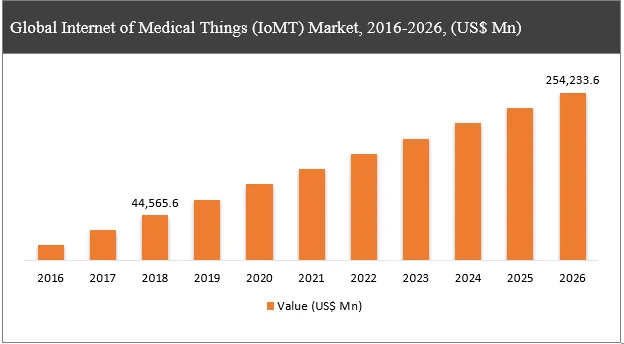
Source:- alltheresearch
- The global IoMT market will potentially reach $814.28 billion by 2032, growing at a CAGR of 38.5%.
- Around 85% of healthcare businesses use IoMT devices for boosting patient monitoring and engagement.
- It is anticipated that there are around 20-30 billion IoMT devices in use today.
- 60% of healthcare companies and medical businesses have already integrated IoMT in their business model to foster cost savings.
- Approximately of 64% patients use one IoMT device for their daily lives, like health monitoring devices, smartwatches, and fitness trackers.
- Around 30% of US adults used wearable healthcare devices for monitoring their health conditions in 2020.
Core Components of IoMT Architecture
IoMT in healthcare uses a lot of components, especially because of its complex architecture. Most of the core components involve the use of AI and ML for medical decision-making, connected medical devices, and more.
Some of the core components of IoMT device architectures include the following:
1. Connected Medical Devices
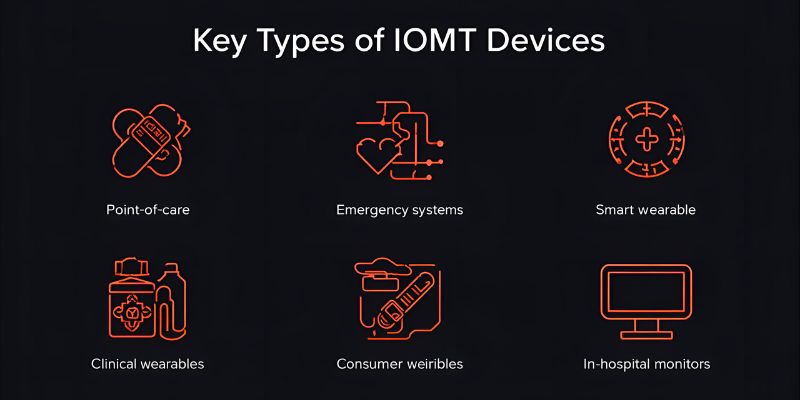
The connected medical devices refer to the physical or wearable devices. These devices are integrated with sensors and include components like smartwatches and fitness trackers. The devices with sensors, therefore, help with vital signs monitoring, activity levels, and more. The connected medical devices are identified as imaging equipment, implantable devices, and diagnostic tools.
2. Data Communication Infrastructure (5G, Wi-Fi, Bluetooth)
As for data communication infrastructure, you’ll have to check what the accepted networks are. The healthcare systems and devices must be connected through 5G, WiFi, or Bluetooth. This ensures seamless data transfer across multiple channels.
3. Cloud and Edge Computing
Always ensure to have strong cloud and edge computing for IoMT in healthcare to overcome latency, especially when a huge amount of data is being generated. This plays an important role in boosting real-time decision-making.
4. AI, ML and Big Data in Medical Decision-making
Another component that can be helpful with better medical decision-making is AI, big data, and ML. All these technologies will identify the existing anomalies and predict any potential health issues. As a result, you can obtain the results sooner.
5. Cybersecurity and Compliance Standards (HIPAA, GDPR)
Adhering to healthcare compliance standards like GDPR and HIPAA is crucial for IoMT in healthcare. It ensures the security and privacy of any private patient information. Furthermore, the integration of a strong cybersecurity network prevents the risk of any unauthorized data access or breaches.
Key Use Cases of IoMT in Healthcare
The healthcare sector has a lot of IoMT use cases every day. Therefore, keeping track of all the information will be slightly difficult. Some of the use cases of IoMT in healthcare:
1. Remote Patient Monitoring (RPM)
IoMT is helpful for remote patient monitoring. It can help to track respiratory rate, heart rate, blood pressure, temperature, and other vitals in real time. Apart from physiological indicators, the medical practitioners can also help with psychological parameters for patients suffering from conditions with paranoia and depression.
2. Smart Diagnostics and Imaging
IoMT systems can work similarly to virtual assistants by predicting health issues. Therefore, through smart diagnostics and imaging, it can help with chronic disease management, such as special sensor devices and implanting sensors within the skin.
3. Automated Medication Dispensers
IoMT devices also come with automated medication dispensers that can monitor the condition of the patients. It can educate patients about diet and lifestyle. This can alert medical staff to emergencies. These automated medication dispensers can help monitor the glucose levels and other crucial information.
4. Asset and Inventory Tracking
IoMT in healthcare integration can be helpful in asset and inventory tracking. This can help healthcare businesses to help you analyse what assets and medicines are available in the industry and which ones are required to be fulfilled.
5. Emergency Alert Systems
IoMT devices come with emergency alert systems with supportive mechanisms across communication modules and sensors. The users can therefore stay alerted if required. This can play an important role in early diagnosis, especially by providing self-care and remote monitoring systems.
6. Elderly and Chronic Patient Care Solutions
IoMT in healthcare is useful for the elderly and chronic patients. The stronger security measures and technology help to analyze any condition that the elderly may be suffering from. Furthermore, the healthcare professionals are constantly updated about their medical journey and the progress that they make.
Real-Life Case Studies
Below are some of the real-life case studies for IoMT in healthcare:
1. Mayo Clinic
Remote Patient Monitoring: Mayo Clinic implemented IoMT devices for remote patient monitoring. They monitored the patient’s vitals, reducing readmissions and fostering timely interventions.
2. Cleveland Clinic
Chronic Care IoMT Programs: Cleveland Clinic uses connected devices for monitoring chronic conditions such as hypertension and diabetes. This allows patients to help with proactive care.
3. Stanford Health
Cardiac Monitoring via Wearables: Stanford Health monitored cardiac health conditions with the help of wearable sensors. This is used for monitoring potential cardiac risks and the detection of arrhythmia.
4. Mount Sinai
Smart Sensor Integration: Mount Sinai had smart sensor integration for hospital systems to improve patient safety. It also helped in improving workflow efficiency while boosting precision care.
Types of IoMT Software for Remote Monitoring
Internet of Medical Things (IoMT) has a wide range of remote monitoring software solutions assisting the growth of businesses. The software integrated in different tools helps with data analysis, collection, and improved communication between patients and healthcare providers.
Some of the prominent types of IoMT software used by medical businesses for remote monitoring include the following:
1. Patient Monitoring Dashboards
The patient monitoring dashboards are one of the key software components in IoMT devices. It allows healthcare professionals to get a centralized view of patient data collected from different devices. It can help with activity levels and monitoring vital signs. Furthermore, the medical professionals, as per their needs, can also customize the dashboard to set specific alerts.
2. Mobile Health Apps for Patients and Caregivers
There’s a huge demand for mobile health apps. The patients and caregivers can use the advantage of IoMT in healthcare for tracking data, managing medicines, and communicating their care requirements. The caregivers can constantly stay updated about their loved ones’ health. These mobile apps are also integrated with wearable devices and have IoMT sensors that can offer comprehensive insights into a patient’s health.
3. Cloud-based Health Data Analytics Platforms
The cloud-based health data analytics platforms can easily handle large volumes of data, even if they’re taken from different resources. This data is further used for predicting trends and determining whether any health condition can occur. This plays an important role in providing proper insights for patient care, especially fostering data transfer between healthcare providers and organizations.
4. Device Integration Middleware
The device integration software bridges the gap between healthcare systems and IoMT devices. It fosters proper data exchange for different devices while catering to the communication protocols and manufacturers. It can be integrated with the newer devices for the existing healthcare infrastructure, thereby helping with proper monitoring.
5. Wearable Health Data Processing Systems
The wearable health data processing software has wearable sensors like smartwatches and fitness trackers. The software can be useful for tracking sleep patterns, heart rates, and activity levels. Furthermore, it can also help to achieve personalized feedback and help patients make informed decisions.
6. AI-powered Symptom Analysis Tools
The AI-powered symptom analysis tools are one of the top requirements for individuals. These tools mostly depend on AI for symptom analysis and predicting any potential health conditions. It can help to diagnose the disease and also offer proper treatment plans based on AI recommendations.
7. Teleconsultation and Video Diagnostics Interfaces
Remote consultations have become the norm, thanks to IoMT in healthcare. Patients and healthcare providers can easily connect with remote consultations via video conferencing. The patients can receive medical advice and care right from the comfort of their homes. With remote consultations being possible, the patients can even connect with doctors abroad if required for a second opinion.
How to Implement IoMT in the Healthcare Sector?
The implementation of IoMT in the healthcare sector can bring a huge difference for businesses. Some of the prominent things to follow to implement IoMT in healthcare are as follows:
Step 1: Define Clinical Goals and Use Cases
Start by identifying what you want to achieve with IoMT device integration in your business. You need to consider various factors like cost savings, improved efficiency, and patient engagement.
As a business, you need to identify the different sectors where IoMT in healthcare can bring the maximum benefits. Therefore, regarding achievements, you’ll have to consider hospital equipment tracking, chronic disease management, remote patient monitoring, or any other things.
Step 2: Choose Compliant IoT Hardware and Sensors
As a business, it is extremely important to choose the right IoMT devices to be integrated into your business. The devices and wearables that you integrate should align with what your business needs and objectives are.
Regarding compliance and sensors, you’ll have to check security, integration ease, and compatibility with the existing software in your system. Making the right decision at the right stage is crucial to bring in the difference.
Step 3: Build or Integrate IoMT Software Platforms
In order to avail the benefits of IoMT in healthcare, the software must be integrated with the existing system. Therefore, during the trial phase, it is advisable to integrate the devices with the hospital’s existing Electronic Health Record (EHR) system and other software.
By integration, you’ll get a brief idea of how smoothly it is functioning and what the outcomes are. You can partner with an IoMT development company to help you with the integration. Their expertise ensures that they can take the burden of integration while helping you avoid any failure risks during the process.
Step 4: Ensure Security and Data Governance
The next step is to ensure security and data governance. It is crucial to build a comprehensive data infrastructure while keeping up with security and governance. This ensures that the data can be collected, stored, and processed from different sources.
After the integration, you must also include strong security measures for safeguarding patient data. This can also determine compliance with various healthcare regulations and data governance surrounding HIPAA. As you build a strong data ecosystem, you get to gather valuable information. This can indeed play an important role in helping you make data-driven decisions.
Step 5: Train Staff and Run Pilot Programs
As a part of the IoMT in healthcare integrations, it is important to train the staff and patients. Running pilot programs can help you analyse whether the integration is running successfully or not. Moreover, you must verify how the data is being verified.
Proper training is extremely crucial in today’s times, especially for healthcare professionals. The patients can maximize all the benefits, especially with the data obtained. Through accurate data prediction, outcomes can be favoured, determining growth in the long run.
Step 6: Monitor, Scale and Optimize the System
Once the IoMT devices are implemented into the software, it is crucial to monitor and evaluate the results as well. Monitoring will help you identify how effective the software is and what the respective areas of improvement are.
As a healthcare business, it is of utmost importance to closely monitor all the IoMT solutions in the business. Furthermore, you must also collect feedback from the respective teams, the patients, and healthcare professionals alike. After that, you can optimize the channels and make the necessary adjustments for patient care based on the data you have collected.
Benefits of IoMT in Healthcare
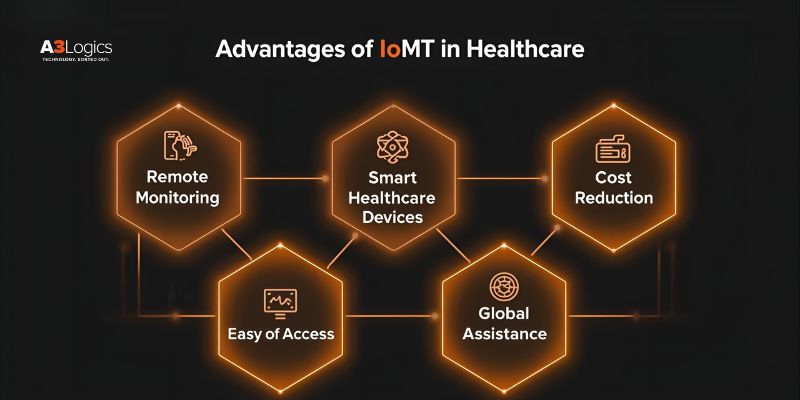
The Internet of Medical Things (IoMT) in healthcare can improve patient care while reducing unwanted costs. This helps in streamlining overall business operations. Some of the key benefits of IoMT in healthcare include the following;
1. Real-time Data for Faster Medical Decisions
IoMT devices help in gaining real-time data. This is one of the key ways of making faster medical decisions. The healthcare professionals can analyze the condition in real-time through the continuous data gathered and offer a solution accordingly.
2. Reduced Hospital Visits and Admissions
With IoMT devices available, there are fewer requirements for hospital visits or admissions. A lot of patients prefer receiving medical care from their home. IoMT, therefore, provides the benefit of video consultation, enabling patients to receive remote care.
3. Increased Efficiency in Patient Tracking
The wearable IoMT devices help in remote patient tracking. Once the patients wear these smartwatches or other medical devices, their condition will be tracked in real time. From their vitals to blood sugar levels, the device would provide information about it all. This can help to align better treatment chances.
4. Better Patient Engagement and Experience
Patients need to be informed about their condition, too. Through IoMT devices, the patients can also monitor how they’re performing. They can actively participate in their care journey. They constantly learn about what their updates are and how they are performing.
5. Proactive Chronic Disease Management
Regular patient monitoring is crucial, especially if they’re suffering from any chronic diseases. Regular monitoring can help to overcome any challenges with long-term or chronic health conditions management. It helps to find a solution and overcome the issues faster.
6. Enhanced Operational Visibility for Hospitals
IoMT devices help with data-driven insights. This can be helpful for resource allocation and hospital management. Therefore, operational efficiency around the hospitals can improve, thereby driving maximum visibility and helping to enhance working.
IoMT Business and Integration Models
As a healthcare business, you can integrate various models to drive maximum growth and streamline operations. Some of the key IoMT businesses and integration models are as follows:
1. Device-as-a-Service (DaaS) for Healthcare Providers
The healthcare providers also provide medical DaaS (device-as-a-service). Consumers access electronic devices and associated software with monthly subscriptions that vendors offer. It is an effective alternative regarding device rental programs and Software-as-a-Service.
2. Pay-as-you-go IoMT Platforms
Pay-as-you-go IoMT platforms have advanced solutions. It helps in accelerating and managing industrial IoT deployments. It will help you access the necessary tools and resources for creating and managing IoT solutions across all the web portals.
3. Subscription-based Remote Care Models
Subscription-based remote care models can offer patients virtual healthcare services. This can be monthly or annually, to offer patients convenience and cost-effectiveness. This can provide timely care, especially across remote areas and mobility limitations.
4. Integrated Care Systems using Cloud Services
The integrated care systems (ICS) use cloud services to improve patient care and boost operations. It comes with cost-effective solutions like AI-driven analytics, telemedicine, and data storage. Furthermore, ICS with cloud services can also help with remote patient monitoring.
How to Choose the Right IoMT Partner?
While integrating IoMT in healthcare for your business, it is extremely crucial to choose the right partner. Since this is the healthcare sector, you can’t compromise on anything. Therefore, accuracy is one of the top things to consider when selecting IoT healthcare solutions.
Some of the key things to consider when choosing the right IoMT partner for your business are as follows:
1. Technical Capability and Healthcare Expertise
Always assess the technical capability and understanding of the healthcare sector of the IoMT development company you’re about to hire. They must carefully analyze the clinical workflows and regulations. It is best to choose a partner who is updated with the evolving technologies.
Choosing experts with updated information ensures that you’ll get scalable and future-proof solutions. At the same time, you’ll have to analyze what their project management solutions are carefully. Therefore, this can be beneficial for your healthcare business while helping you overcome numerous problems.
2. Compliance Knowledge (HIPAA, HL7, FHIR)
The software development company you partner with should be familiar with healthcare compliance. Therefore, they must know about different healthcare compliances like HL7, FHIR, and HIPAA.
As for security, you’ll have to understand how they integrate security and how the data is protected. In the healthcare sector, patient data is extremely crucial and sensitive. Therefore, it is vital to choose experts who understand healthcare compliance and can seamlessly integrate it into your business.
3. Portfolio of IoT and Medical Tech Integrations
Has the software development company worked with any medical tech or IoT companies earlier? Before finalizing your decision to hire the company, you have to check their past projects and understand what their experience has been. Furthermore, you must also analyze how they integrated the IoMT devices.
While analyzing their expertise, for medical tech integration, you’ll have to check their experience in various sectors like remote patient monitoring, data analytics, and telehealth. Furthermore, it is crucial to check how they can integrate the new IoMT devices with the existing healthcare software, preferably any Electronic Health Records (EHR).
4. Scalability, Support and Customization Services
Is the IoMT software development company going to offer you support for the system updates? The company must be available at all times to assist you with ongoing maintenance for the software.
Do you need any customisation in the software? If yes, you must communicate the same to the company. Then, you must check if they can integrate the features into your specific needs to keep up with future requirements. At the same time, you must carefully consider whether they can help you manage a huge flow of data and user demands.
Why Choose A3Logics for Your IoMT Project?
If you want to launch an Internet of Medical Things project, it is extremely crucial to choose a software development company that adheres to those rules. That’s where A3Logics steps into the picture for growth.
Some of the key benefits of partnering with A3Logics for IoMT in healthcare development include:
- Compliance-ready Development: As the leading software development company, A3Logics adheres to all healthcare solutions. Therefore, while developing the app, they make sure to opt for solutions like HIPAA, FDA, and GDPR.
- End-to-end IoMT Implementation: A3Logics can assist you with a complete end-to-end IoMT implementation. Therefore, the experts will help your business across all areas like device connectivity, secure data pipeline, and dashboard building.
- Expertise in Healthcare Integrations: The professional IoT development company, A3Logics, helps with device connectivity. It is supported for various healthcare integrations like FHIR, DICOM, HL7, and EHR system APIs.
- Enterprise-grade Security: A3Logics follows a zero-trust architecture. This helps with encryption and caters to role-based access. Therefore, it allows businesses to integrate all the healthcare development solutions.
Conclusion
IoMT in healthcare has brought a huge revolution, especially with real-time and remote patient monitoring. In the long term, it helps to monitor patient outcomes and also helps with care models. IoMT app development in today’s time can surely prove to be a huge benefit for your business. A3Logics helps with digital transformation services, allowing companies in the healthcare sector to grow. The digital solutions can therefore bring a significant change in your business and boost your revenue.